Friday, July 12, 2013

52. Review of CHOIR BOY (July 11, 2013)

52. CHOIR BOY


When the Manhattan Theatre Club’s production of Tarell Alvin McCraney’s CHOIR BOY, at the City Center Stage II, opens, Pharus Jonathan Young (Jeremy Pope), a vocally gifted but markedly effeminate student at the Charles R. Drew Prep School for Boys, is singing the school song, “Trust and Obey.” Suddenly, a student in the auditorium hisses a homophobic slur (something like "faggot-ass-sissy"). Pharus, taken by surprise, takes a four-second pause before he continues. Soon he is being questioned by Headmaster Marrow (Chuck Cooper), very disturbed about his performance, but Pharus, citing the school’s code of not snitching on his classmates, refuses to name names. Pretty soon, however, he exacts vengeance on his tormenter, Bobby Marrow (Wallace Smith), the headmaster’s nephew, by kicking him out of the school choir. The tensions created by Bobby’s virulent reaction to Pharus’s sexuality (possibly because of his jealousy of Pharus’s talent) and Pharus’s response create the play’s thematic through line.

Outside City Center's entrance to Stage II.

Drew is a school for African-American boys, and the only five boys seen are the members of the school choir, which concentrates on gospel music. The boys all dress neatly in traditional prep school uniforms, with blazers and yellow ties, and wear close-cropped, regulation haircuts. (They also undress to take showers, allowing for a bit of full frontal nudity.) In addition to Pharus and Bobby, there are AJ (Grantham Coleman), the star athlete, who is Pharus’s mature and understanding roommate; Junior (Nicholas L. Ashe), a baby-faced baritone who follows Bobby around like a puppy; and David (Kyle Beltran), a thin, eternally serious, bible-carrying divinity student. The only adults are Headmaster Marrow, relatively new to his job and somewhat insecure in it, and Mr. Pendleton (Austin Pendleton), an older white man who marched during the Civil Rights movement, and who has been hired to teach a required course in Creative Thinking; even though he has no musical ability, the headmaster puts him in charge of the choir, hoping he can somehow heal the fractious relationships among the boys. One of his first lines after making his entry caused a burst of laughter:  "It's not just black people who are late."

Pharus offers a strong fulcrum around which the drama revolves, although he does bring to mind Chris Colfer's Kurt on TV’s GLEE. He’s extremely bright and well read, extraordinarily talented, aggressively defensive, and creatively resentful. (Is he, perhaps, autobiographical?) Jeremy Pope plays him on multiple levels, showing his deep insecurities as well as his overt self-confidence. He’s able to mine the character’s limp-wristed effeminacy for both comedy and pathos. In one of the play’s most powerful moments, taking place in Mr. Pendleton’s class, he engages in a provocative debate about the meaning of spirituals, arguing against some historians’ belief that they are coded messages to slaves about flight,  advocating for them instead as still relevant tools for achieving spiritual healing.

McRaney’s intermissionless, hour and forty minutes play, which premiered in a hit production last year at London’s Royal Court Theatre, engages with sexual and racial issues in a number of ways, not least the habit some young black men have of tossing around the word “nigger,” a proclivity that detonates an explosive response from Mr. Pendleton, who categorically rejects such thoughtlessness. These subjects are always interesting and well conveyed by McRaney’s dialogue, although its crafting sometimes seems too carefully designed for dramatic effect and not what boys of this age would normally say. Smart as he is, for example, Pharus's speech about spirituals sounds more like an academic paper than an impromptu outpouring during a class discussion. Also, plays and movies that dramatize a gay boy’s victimization and consequent coming of age are becoming overly common, even when handled as creatively as in CHOIR BOY.  

What many spectators will take away from CHOIR BOY, however, are its musical interpolations, sung acapella in exquisite harmonies and solos as memorably arranged by Jason Michael Webb. Each boy has a terrific solo, but when the choir sings as a group, especially “Sometimes I Feel like a Motherless Child,” it’s almost as if you never heard the songs before. Despite the enormous ability of the young actors, the number that stood out for me was Chuck Cooper’s giving voice to “Been in a Storm So Long.”    

Trip Cullman does a fine job of staging CHOIR BOY, giving it a definite rhythm and precision; everything is well timed and fluid. On the other hand, there is a theatrical overlay that makes me feel that the boys, in particular, are not so much being as performing; the effect was to have me watching and listening with deep interest but not engaging on a deeper emotional level. For pure acting honesty, the palm goes to the marvelous Chuck Cooper. Austin Pendleton is the Austin Pendleton we have seen so often before, with his rumpled clothing, uncombed hair, and irregular speech rhythms, but when he blows the roof off with his attack on the n-word, he reveals a facet of his talent very rarely on display.

David Zinn’s set (he also did the costumes), surrounded by the audience on three sides, consists of a red floor and a red brick wall on which hangs a large blackboard. The wall is built so that its lower half can come down, revealing the interior of AJ and Pharus’s bedroom. This is clever and effective, as are the nicely choreographed scene changes using the actors and eschewing the need for visible stagehands.

CHOIR BOY has a great deal to offer, and I wouldn’t be surprised to see it given an extended run, or even to be moved to another venue. It didn’t work for me on every level, but it did on enough for me to recommend it. Given all its laudatory reviews, of course, that may simply be preaching to the choir.


Sunday, July 7, 2013

51. Review of THE SILVER CORD (July 6, 2013)

51. THE SILVER CORD


In light of the current revival of Sidney Howard’s THE SILVER CORD at the Theatre at St. Clements, I am appending here an adapted and abbreviated version of the play’s entry in my ENCYCLOPEDIA OF THE NEW YORK STAGE, 1920-1930. That production opened on Broadway on December 20, 1926,  in a Theatre Guild production directed by John Cromwell. Mrs. Phelps was played by Laura Hope Crews, David by Elliot Cabot, Robert by Earle Larimore, Hester by Margalo Gilmore, and Christina by Elizabeth Risdon. All were major Broadway players of the 1920s.  (The 1933 movie version starred Laura Hope Crews in her original role, with Irene Dunne as Christina, Joel McCrea as David, Eric Linden as Robert, and Frances Dee as Hester.)  


A Best Play of the Year, and one of the better remembered plays of the decade, THE SILVER CORD was a fierce indictment of the emotional and psychological havoc that possessive maternal affection could wreak. . . . As a study of a woman’s selfish obsession, it was compared to plays such as George Kelly’s CRAIG’S WIFE and August Strindberg’s THE FATHER. Many noted the Freudian implications of its Oedipal theme.

              Mrs. Phelps keeps her two grown sons, David and Robert, clinging to the symbolic umbilical cord to the extent that when Robert becomes engaged to Hester she manages to sever the relationship; the older and slightly more independent David nearly finds his marriage to Christina coming apart, but Christina’s [I mistakenly wrote Hester, who, however, also stands up to Mrs. Phelps] forthrightness (Brooks Atkinson called it “Shavian”) in confronting her soon-to-be mother-in-law makes him see the light. David frees himself from Mrs. Phelps’s clutches; not so the weakling Robert.
Some thought Mrs. Phelps was too exaggerated a monster for complete believability, and the last act’s resolution (Richard Dana Skinner called it “almost a lecture on the previous acts”) seemed tagged on; criticism also focused on the play’s lack of action and verbosity. But it was a vivid play for actors, and the Guild’s notable cast made the most of their chances. Atkinson found it “enormously exhilarating” theatre and approved loudly of its “flavorsome dialogue that depicts character and holds the interest at the same time.


Some of the original reactions to the play still hold water. By and large, however, the Peccadillo Theater Company’s mostly undistinguished production, directed by Dan Wackerman, only exacerbates the play’s weaknesses, THE SILVER CORD seems quite dated, with its overly elaborated and self-conscious dialogue. Lines that probably were shocking in 1926 now merit titters. Worst of all are the male characters, whose worship of their mother (Robert keeps calling her his “blessed, blessed mother”) and blindness to her blatant wickedness seems so pathological that it is impossible to find any sympathy for them. Instead you so want to scream at them that when Hester, and then Christina, tell her off, you realize how mismatched these strong women are with such world-class wimps.


Theatre at St. Clements, on W. 46th Street.

             Making things even worse is the misguided decision to cast a male actor, Dale Carman, as Mrs. Phelps. While Carman, who is clearly at home in drag, gives the most intelligent performance in the production (he played it for the same company 18 years ago), he is unable to escape either his gender or his unique facial attributes; despite his playing the role “straight,” ahem, his presence is a constant distraction and robs the play of any persistent impact it might have if a woman were playing this aggressively controlling mother. (Charles Busch, by the way, played Mrs. Phelps in a reading earlier in the year.) Is the production suggesting that such a woman can only be accepted if she has a strong masculine streak in her? Is there a gay agenda at work that seeks to explain the boys’ unyielding affection for their mother by having her played by a man? The production certainly seems inclined in this direction by its inclusion of a scene in which Dave is shown with his bare ass facing the audience as he changes into his pajamas (something that would have padlocked the theatre in 1926), or scenes in which one or the other of the young men hold their mother in intimate embraces, with Dave even kissing her at length as they lounge together in bed. Methinks the director hath been watching too many reruns of Olivier’s HAMLET.  

The action all takes place on a wintry February day in 1926 at Mrs. Phelps’s home in an Eastern American city. Set and lighting designer Harry Feiner creates a sense of outdoors and indoors by placing his interiors downstage where they are backed by a silvery painted backdrop showing frosty pine trees. The wall-less living room set has a fireplace at stage right and windowed areas upstage and stage right. Detailed period furniture and chintz effectively establish a conventionally old-fashioned living room. However, those nefarious destroyers of theatrical reality known as stagehands enter in dim light to change the set to David’s bedroom and back again to the living room, once more making it clear how damaging to theatrical illusion for plays like this is the absence of a curtain. And despite the alterations, the place doesn't look much different from the living room. Moreover, Mr. Feiner places a cramped and tiny bed at center, almost as if Mrs. Phelps arranged it so David wouldn’t have sex with his wife on it.
          Gail Cooper-Hecht’s costumes for the women seem appropriately authentic, but when David dons evening wear, its poor fit makes actor Thomas Matthew Kelley, who is rather tall, resemble Lurch in THE ADAMS FAMILY. At the end, as he, Hester, and Christina prepare to leave, he dons a heavy overcoat, but the ladies depart coatless, each carrying a piece of luggage that seems to weigh half a pound. These visual bloopers show a careless disregard for artistic integrity. 
           Despite its overwrought dramatics, its cluttered dialogue, its old-fashioned locutions, and its stagy theatrics, THE SILVER CORD does, in fact, come to life when each of the women stands up to the old harpy, and when Christina, a biologist who represents the “new woman” of the times, lays it on the line to her namby pamby husband in act two (of three). But the performances of Caroline Kaplan as Hester, Thomas Matthew Kelley, Victoria Mack as Christina, and Wilson Bridges as Robert fail to embody their characters with any depth; Bridges, in particular, seems at sea in this milieu.

            For those interested in a peek at what 1926 audiences viewed as daring drama, the play offers an interesting history lesson. But as quality theatre, 87 years after it was created, THE SILVER CORD has become hopelessly tarnished.

Saturday, July 6, 2013

50. Review of UNLOCK'D (July 5, 2013)

50. UNLOCK’D


In 1712 Alexander Pope wrote a mock-heroic narrative poem, “The Rape of the Lock,” published in expanded form in 1717, in which he satirically commented on a true event. This was a dispute that arose between the families of one Lord Petre and the woman he loved, Arabella Fermor, when, without asking, he snipped a lock of her hair. Pope’s poem was written in the hope it would “comically merge the two” families by noting how silly the whole thing was, although he also underlined contemporary attitudes on women’s place as decorative accessories in a patriarchal society. Arabella, renamed Belinda, is surrounded by virginal “sylphs,” parodized versions of the gods of goddesses of epic poetry, whose mission is to protect Belinda (especially her hair) from inappropriate advances. Pope’s poem is the chief inspiration for UNLOCK’ED, the new musical at the Duke, directed and choreographed by Marlo Hunter, and presented by the Prospect Theatre Company.
            The plot circles around the romantic aspirations of dashing Roderick Shearing, the Baron of Windsorloch (Sydney James Harcourt); his attractively nerdy, book-obsessed brother, Edwin (A.J. Shively); Belinda (Jillian Gottlieb), an early 18th-century version of the dumb blonde; and her more practically-minded, redheaded stepsister, Clarissa (Jennifer Blood), who often narrates the action in rhymed verse. There is a lot of maneuvering by the brothers with scissors to clip a lock of Belinda’s hair. She would sooner die than trim her locks, being so besotted with her luxurious tresses that she has personified them with names (Lotty, Letty, and Beatrice, for example) and even sings with them. When she discovers that one of them has been snatched, she ends act one by screaming, “Beatrice!”
 Through it all wander three actors and three actresses in double roles: the men (Chris Gunn, Adam Daveline, Hansel Tan) play both ragamuffin gnomes and gentlemen of the court. The former speak in syntax reminiscent of a cross between cockney and the Golem in THE HOBBIT, while the latter, with names like Sir Flittybud, Lord Inconstantine, and Lord Littlewit, wearing outlandish wigs (with plumes) and silken finery, are effeminate British fops. The women (Catherine LeFrere, Maria Couch, and Chandler Reeves) play both attractive sylphs and maidens of the court, their vivid gowns and wigs in the latter roles paralleling those of the three gentlemen.
The show, which won a Richard Rodgers Award in 2004 and was originally seen at the 2007 New York Musical Festival, does not slavishly follow Pope, and introduces elements from other sources as well, including Shakespeare, but, for all its occasional charm and musical pleasures, it never quite comes together in a more than mildly amusing way. It’s reminiscent of other fairy tale musicals (from ONCE UPON A MATTRESS to RODGERS + HAMMERSTEIN’S CINDERELLA) in its whimsical, self-mocking attitudes, where the actors more or less wink at the audience as if we’re all in this droll romantic charade together (ain’t we got fun?). You get a whiff of this from the program note on the setting: “Back Then-ish. Across the Pond-ish.” Characterizations are skin deep; everyone is handsome, pretty, or cute; the costumes (by Amy Clark) are lavish, clever, and colorful; the scenery (by Wilson Chin and David L. Arsenault), chiefly a bulls-eye patterned floor and three benches within a three-quarters round arrangement, is brightly imaginative and agreeable; the lighting (by Cory Pattak) is cheery and fanciful; the choreography, more like staged movement than dance, is energetic, with one memorable number involving giant playing cards during a game of War; and there is a pervasive sense of playfulness from start to finish.
What can get lost in this world of tongue-in-cheek make-believe, however, is honesty and truth, with performances so lacquered over with directorial choices designed to create a stylized fantasy world that they become cartoonish and ultimately unaffecting. It’s the kind of show that, however clever it may be, makes you wonder, “Why should I care?” It takes a remarkable talent to overcome this kind of stylistic imposition; apart from Jennifer Blood and Jillian Gottlieb, who come closest, the company by and large fails to manage this, although most of them do fine work not only in establishing their stock personas but in singing the quite listenable score (lyrics by Sam Carner; music by Derek Gregor). Unlike the too frequently cerebral style of John Michael Lachiusa and his followers, several of Gregor's tunes have the kind of tuneful appeal that is gradually vanishing from the musical theatre. Standout numbers included Belinda’s “The Hair Song,” Belinda and Edwin’s “Off to the East,” and the Baron and Edwin’s “A Delicate Thing.”  Regardless of its distinguished sources, or maybe because of them, however, Sam Carner’s book remains clunky, too talkative, and more smile than laughter inducing.
UNLOCK’D is around two hours and 20 minutes long, far longer than such slight material requires. Where were those scissors when they were really needed?


Thursday, July 4, 2013

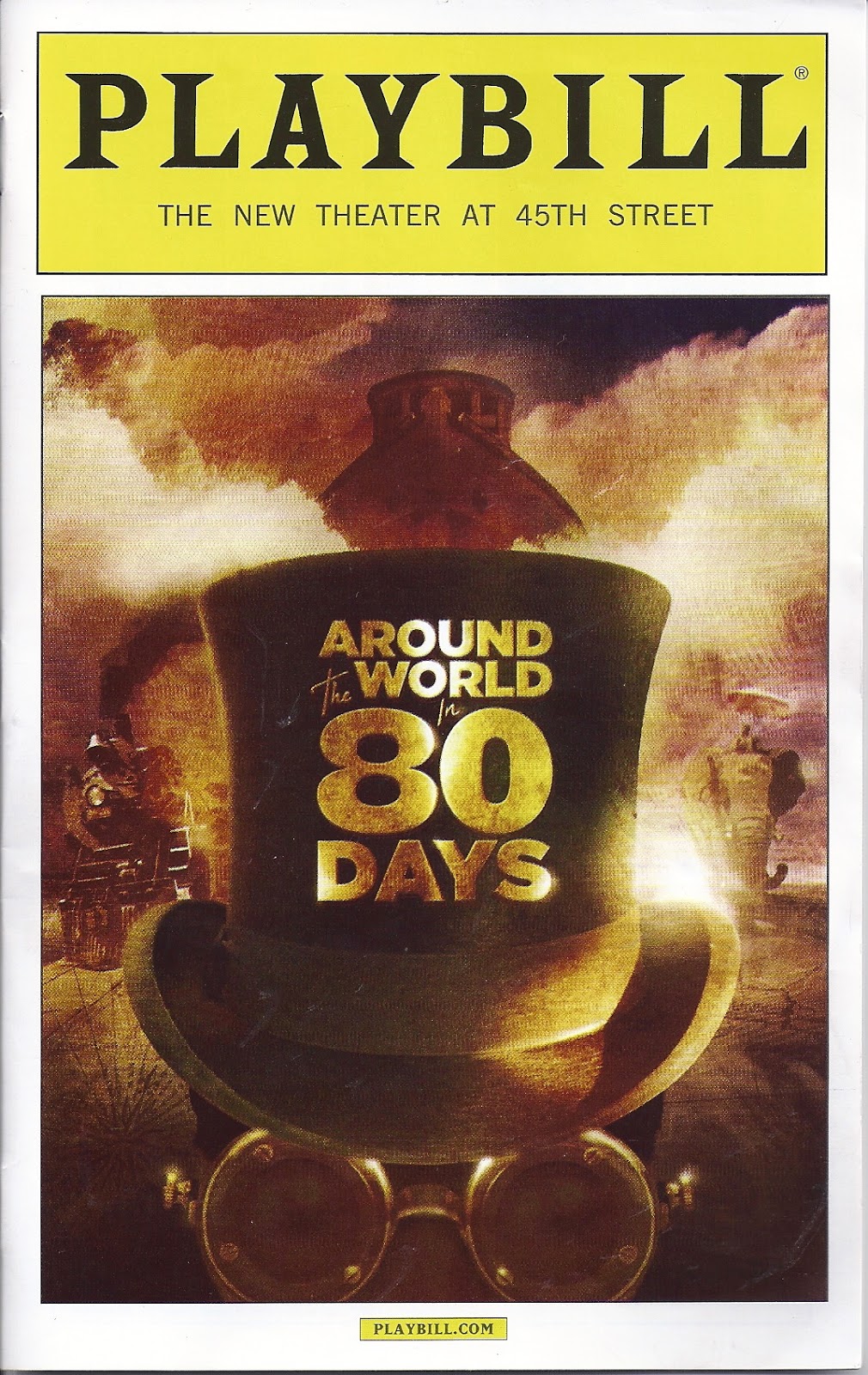
49. Review of AROUND THE WORLD IN 80 DAYS (July 3, 2013)

49. AROUND THE WORLD IN 80 DAYS


If you’re looking for something a little different Off Broadway, yet in the Broadway district, I’d advise you to get on board the speeding trains, boats, and elephant (well, speeding for a pachyderm) racing from London to Suez to Bombay to Calcutta to Hong Kong to Yokohama to San Francisco and across the USA on the way back to London in this charming revival of AROUND THE WORLD IN 80 DAYS. Mark Brown’s adaptation of Jules Verne’s 1873 novel about Phileas Fogg’s race to win a £20,000 wager by doing what the title says was first seen locally at the Irish Repertory Theatre in 2008; while I didn’t catch that version, a little research reveals that the new production, staged with terrific originality by Rachel Klein, is a totally different beast, although the original also was lauded for its creative staging and performances.


The New Theatre at 45th Street.

            John Segarra, replacing Bryce Ryness, who left early in the run to star in Broadway’s upcoming FIRST DATE, plays the cool-as-ice, stiff-upper-lip Englishman, Phileas Fogg, who never meets a problem he can’t resolve by naming the right price, while an energetically versatile team of four others portray multiple roles, the most protean being Jimmy Ray Bennett in 16 parts. Each of the others has a principal role in addition to smaller ones, with the acrobatic John Gregorio concentrating on Passepartout, Fogg’s French valet; the determined Steven Guarino on Detective Fix, following Fogg on his journey because he suspects him of a bank robbery; and the physically striking Shirine Babb on the Indian princess, Aouda, who provides the romantic interest. Everyone is called on to use multiple accents, especially high British ones, and they are all required to go through complexly choreographed theatrical high jinks with perfect timing.

            The New Theatre on 45th Street, a depressing hole in the wall when I visited it last season, has been transformed into a remarkably eye-catching space in which there is not only a wonderfully realized, two-level stage set (by Robert Kovach), with compasses, ropes, steering wheels, staircases, doors, and windows, but also delightfully painted side walls that surround the audience with the gears, steam pipes, tubes, and other paraphernalia of a 19th-century English factory. The theatre’s seats have been attractively reupholstered to match the décor, and a 6.1 surround sound system has been installed to totally immerse the audience in the unique sound effects created by Sean Hagerty. Whereas photos of the 2008 production show the actors wearing authentic-looking clothes from the 1870s, designer Kae Burke and director Klein have gone a step further in this production, giving the period costumes numerous theatrical flourishes that say both when the play is taking place and that nothing should be taken seriously. I especially liked Passepartout’s toque and matching jacket, whose lozenge-like pattern reminded me of Arlecchino from the commedia dell’arte.

            Of particular note in this mélange of cartoonish inventiveness is a huge clock overhead at stage left, on which an animated Victorian clock face is used not only to tell the passage of time but to serve as the screen for Kate Freer’s inspired projections that map the journey of Fogg as he circumnavigates the globe. And, pulling it all together, is the awesomely adaptable lighting of Ben Kato.

            This is the kind of show that allows the director to pull no punches in displaying her ingenuity, using minimal props to suggest multiple ideas, such as the dryer hose that represents an elephant’s trunk, or the revolving parasols that evoke a train’s spinning wheels. The action, which combines both narration and dialogue, is almost entirely at breakneck speed, and the actors must not only move like the wind, but practically dance their characters and speak clearly while shooting out their words like machine gun bullets.

            Some, like me, may find the relentless pace a tad overwhelming and hope for some reprieve, but they will be disappointed because the only opportunity to relax comes with the intermission. I suspect that the breathless staging may have made the fun less funny for me than it was for others, but the rest of the audience seemed to be having a terrific time, so why bother quibbling?

            There’s a lot to like here, and young audiences especially should get a kick out of this tour de force. I don’t know how long it’s going to run, but, if I were you, I wouldn’t wait 80 days to see it.   

Wednesday, July 3, 2013

48. Review of SIREN'S HEART: NORMA JEAN AND MARILYN IN PURGATORY (June 3, 2013)

48. SIREN’S HEART: NORMA JEAN AND MARILYN IN PURGATORY


This one-woman show, whose program offers what might be yet another subtitle (Norma Jean Sings Songs Marilyn Never Sang), and seems to have been around somewhere or other since 2011, is not the Marilyn Monroe musical you’ve been waiting for and that TV’s SMASH failed to deliver. It’s a second-rate enterprise that imagines Marilyn talking to us about her life and loves from Purgatory, with Louisa Bradshaw doing an impression of Marilyn that works about 10 per cent of the time.

Perhaps she was a bit more svelte two years ago (the program photos certainly suggest this), but the formfitting dresses Ms. Bradshaw wears do not do her any favors, and her attempt to replicate Marilyn’s vocal and facial idiosyncrasies have been done better by drag queen Monroe impersonators. Ms. Bradshaw’s acting, sad to say, makes Monroe look like Helen Mirren by comparison, especially with her amateurish tendency to suck in her breath in phony chuckles on three-quarters of her lines. Wherever director Lissa Moira has gone, it’s time for her to come back and caffeinate this drearily dull performance.

The show’s music mixes segments of songs Marilyn sang in the movies (like “I Want to Be Loved by You") with new songs written by Walt Steppe, who also wrote the play. It was astonishing to note that three have lyrics borrowed from William Butler Yeats and one from Gerard Manley Hopkins. There are also a couple of completely original numbers, such as “The Shiksa Strip.” (Well, the venue is the Actors Temple Theatre, after all). The new lyrics don’t challenge the poetry of Yeats and Hopkins, an example being: “I know it wasn’t your decision, I’m in love with your circumcision.” Ms. Bradshaw, accompanied on the piano by Gregory Nissen, sings the more familiar material in a manner reminiscent of Monroe, but uses a full-out personal style for the others that is often flat and mostly unmemorable.

As with most shows at this theatre, which houses several at once, the scenery is barebones minimal, consisting of a white Victorian couch, a coffee table, a wig table, a full-length mirror, and fuzzy photos of Marilyn entertaining the troops in Korea, Kim Novak, Rita Hayworth, Marlene Dietrich, Orson Welles, Yves Montand, and Elvis Presley mostly hanging from black drapes. Hand-held photos show us Peter Lawford and Arthur Miller, but I didn’t catch any of Joe DiMaggio.  

Marilyn’s story, familiar from so many books and documentaries, is told by Ms. Bradshaw as she dons and doffs a blonde Marilyn wig several times, and at one point puts on a black wig to briefly portray Jane Russell. For a surprising amount of time the actress either shows her own blonde hair or simply wears the  unattractive stocking cap over which she will place a wig. Those who know Marilyn Monroe’s story will pick up most of the references, but others, mostly younger folk, will probably not have a clue about any of the people and movies mentioned, no matter how enormously famous or popular they once were.

            I looked at my watch too many times during the performance of this intermissionless hour and a half show. And since I don’t want to have you looking at yours while reading this, I’ll keep the rest to myself and hope you make good use of the time I’m saving you.


47. Review of THE UNAVOIDABLE DISAPPEARANCE OF TOM DURNIN (July 2, 2013)

47. THE UNAVOIDABLE DISAPPEARANCE OF TOM DURNIN


As I headed down the steps to the F train at 47th Street and Sixth Avenue last night, so did David Morse, the star of THE UNAVOIDABLE DISAPPEARANCE OF TOM DURNIN, which I’d just seen in the Roundabout Theatre production at the Laura Pels Theatre on 46th.  Often, I will fudge when I meet an actor this way right after a performance (when you go as often as I, it’s not an uncommon experience) and say something complimentary regardless of what I really thought, just to be polite, but in Morse’s case I was totally sincere in offering my congratulations on a truly excellent job. He thanked me and said it isn’t easy playing someone everyone hates and, before he went uptown and I down, we chatted briefly about how difficult a job he has in bringing sympathy to the Bernie Madoff-inspired character he plays.
 
 
The Laura Pels Theatre.
 

            THE UNAVOIDABLE DISAPPEARANCE . . ., by Steven Levenson, who wrote the fine office politics play, CORE VALUES, seen earlier in the season, is lucky to have Mr. Morse in its leading role, as the writing is decidedly uneven and a couple of the performances are equally shaky. Although there are vast differences between the play’s story and that of Mr. Madoff, the similarities are close enough so that few spectators will miss the connection.

A middle-aged man, Tom Durnin (Mr. Morse), shows up at the small and shabby exurban home of his 23-year-old son, James (Christopher Denham), who makes his scanty living as a stethoscope salesman. Tom, formerly a star lawyer, has just been released after five and a half years in prison, where he was sent after being convicted of cheating friends and relatives out of all their money by getting them to invest in a fraudulent company. Now, insisting he’s paid his debt, he tries to win back his children and his divorced wife, Karen (an excellent Lisa Emery). James, disgusted with and ashamed of his father, whose crime forced him to drop out of Yale, resists having anything to do with him, although he allows him to crash at his home for a month while Tom, who works as a barista at a nearby Borders (the play is set in 2009), finds his footing. Tom also tries to get back into his former firm by pressuring his son-in-law, Chris (well played by Rich Sommer, of MAD MEN), with a possibly trumped-up blackmail threat. A subplot involves a budding romance between James and a flaky young woman, Katie (Sarah Goldberg), he meets in a community college writing course, which he hopes will help him become a novelist.

            The driving force in all of this is Tom’s determined effort to convince his ruptured family to forgive him, despite what he keeps insisting was his “mistake.” He uses all the manipulative intellectual and emotional ploys that made him a success, but the pain he has caused his loved ones proves a gigantic obstacle for even a man of his abilities. Mr. Morse’s behavior is so rooted in the moment, so grounded in desperation, that you are tempted momentarily to want him to find forgiveness, until you realize how much you are as much a victim of his wiles as any of the characters in the play. The play explores not only his propensity for lying, but that of James, whose mendacity is of another order but nevertheless has the power to inflict deep pain on loved ones.

            Mr. Levenson’s play, despite its having several powerful scenes, keeps hitting wrong notes. Why is it necessary, for example, to have both the highly intelligent Tom and Karen fail to correct a simple error despite their being corrected by James? Tom keeps saying Snoopy Dog, no matter how often James says it’s Snoop Dog, and Karen insists on noting that James sells catheters regardless of James’s telling her it’s stethoscopes. The subplot about James and Katie is forced and inorganic, and seems like stuffing needed to fill out an hour and a half of intermissionless stage time. James and Katie read some of their writing to their class, and, while her sample is clearly inadequate, his is pretty bad as well, although he’s considered the class’s star pupil. What he reads takes place in the Ukraine, where he’s never been, but he finally learns the lesson that you must write about what you know; thus the play ends with a coda in which he reads a passage that reflects his own experience and that comments on what he’s just gone through. As he stands there in an amber spotlight, not unlike Tom at the end of THE GLASS MENAGERIE, this previously clueless writer has magically morphed into a budding literary talent.  

            Scott Ellis’s direction does what it can with this sometimes unconvincing material. Beowulf Boritt’s set, which uses a turntable at stage left to show both James and Karen’s residences, with a grassy lawn at stage right for the scenes outside the writing class, provides an adequate physical environment, supported by Donald Holder’s lighting and Jeff Mahsie’s everyday costumes.

Christopher Denham’s James and Sarah Goldberg’s Katie offer the weakest performances, both of them finding a single note on which they keep harping. Hers is a sing-song, girlish intonation, with mannered readings that reflect a type of vacuous young woman who appears too often in contemporary plays, TV, and films. His is a whiny, eyes-down, self-pitying depression that persists long after the point of his disaffection has been made.

But this is a play about Tom Durnin and his embodiment in the outstanding acting of David Morse. To return to what Mr. Morse said when we met in the subway, playing someone everyone hates isn’t easy. The same could be said for watching THE UNAVOIDABLE DISAPPEARANCE OF TOM DURNIN, a play about someone everyone hates.

Tuesday, July 2, 2013

46. Review of IT'S JUST SEX (July 1, 2013)

46. IT’S JUST SEX
 
 
When Jeff Gould’s IT’S JUST SEX begins, the scene is just what you might expect from a play with such a title. Phil (Matt Walton), a handsome man in his briefs and a rumpled shirt and tie, and Amanda (Molly Fahey), a brunette hooker in lingerie who could be straight from a Victoria’s Secret catalogue, are carrying on hot and heavy; Amanda is on the couch with her legs signaling V for victory and Phil’s head is zeroing in on its target when Joan (Jackie Debatin), Phil’s beautiful blonde wife, walks in on them. That, however, is one of the very few suggestions of onstage sex in this woefully unfunny play that has transferred to New York from Los Angeles, where it was purportedly a hit. Maybe LA has a different vibe when it comes to this kind of banality, but the best thing I can say about IT’S JUST SEX is that, while it shares the same stage at the Actors Temple Theatre with CUFF ME: THE FIFTY SHADES OF GREY UNAUTHORIZED MUSICAL PARODY!, it’s not nearly as bad. Oy vey!

            Let me clear one thing up right away. Despite the title’s promise of naughty farce in the vein of NO SEX PLEASE, WE’RE BRITISH, which seems a classic by comparison, IT’S JUST SEX is actually a mildly serious attempt at a comedy-drama about marital sexual relations. If it didn’t have three couples, instead of two, you might consider it a very distant relative of, believe it or not, WHO’S AFRAID OF VIRGINIA WOOLF? Of course, that probably wasn’t playwright Gould’s intention, but when you have a couple in a strained conjugal relationship hosting a cocktail party for two similarly troubled couples and the evening slowly devolves into a wife-swapping situation and its inevitable aftermath of regret, recrimination, and reconciliation, it’s hard not to remember VIRGINIA WOOLF’s invocations to “Hump the Hostess.”   

            On the plus side, the cast is attractive, all of the women especially so. And they're not untalented; just not used well. And that, more or less, is the plus side.

As for the rest, we have direction (by Rick Shaw) that seems to be afraid to do more than 30 in a 65 miles an hour zone; characters whose unexceptional personas are essentially interchangeable—apart from Lisa (Gina LaPiana), a mildly spicy Puerto Rican dish in a sizzling red dress; low-energy acting that needs someone to stick a pin into it; writing that would not get past the pilot stage if this were the sit-com it often resembles; and a shadow sequence showing the offstage couples having sex that any high school theatre program could do better. The dialogue is filled with puerile banalities and tired double entendres, like Phil’s suggestion that he might as well remove the first three letters from “welcome” on the front doormat, or his crack about sleeping with a hooker being “glorified masturbation.” There also are several awkward scenes, as when the elegant Joan attempts to perform fellatio on her reluctant husband despite the presence of their ill at ease friends.

            As noted, Gould has created a situation in which, as a result of a night of spouse-swapping, each couple is placed in a position where, sparked by a game of “Tell the Truth,” they are forced to confront their particular marital problems. The issues are familiar and not without import, but their treatment is clichéd and unimaginative. To his credit, Gould tries to balance the serious implications of the various conflicts with humor, and comes closest when one of the men, Greg (Michael Colby Jones, in the show's best performance), who has been having impotence problems, declares that his wife, Lisa (Elaine Hendrix), is always undercutting his manhood. Greg is challenged to name one example, so he whips out his smart phone, where he’s recorded every instance, and recites a litany of her put downs, something I wouldn’t be surprised many in the audience wish they’d thought of themselves.

            The biggest problem with IT’S JUST SEX is that it isn’t.