Sunday, July 21, 2013

59. Review of THE CIVIL WAR (July 19, 2013)


59. THE CIVIL WAR
 
 
Left to right: Jim Stanek, Alyce Louis Alan, Adam Fontana, in THE CIVIL WAR.


An hour and a half after leaving WANDA’S MONSTER near Union Square, I was sitting at the Lucille Lortel watching another play aimed at kids, but this one was for somewhat older ones and its subject was a real monster, America’s Civil War. Arthur Perlman’s THE CIVIL WAR, a small but ambitious musical recounting the horrendous conflict that saw America at war with itself in the 1860s, may have “education” written all over it, but, for all the horrors it depicts, it turns out to be a damned good show. Maybe too good for its own sake, since a one-hour musical about a conflict that took well over 600,000 lives is not necessarily something you want to walk out of with a lighter step than when you went in.

            Provided free to children (grades 3 to 9 are aimed at) as part of a special program by the excellent Theatreworks company, THE CIVIL WAR--a touring show in its New York premiere--uses a cast of only five multitalented performers, four men and a woman, to cover the war’s history. That history is embedded in the personal stories of a runaway slave, Zac (Max Kumangai), who goes to war for the Union army; his former owner’s son, Will (Adam Fontana), once his boyhood pal, who fights for the South; a girl, Jackie (Alyce Alan Lewis), who so wants to join the Confederate army that she enlists as a drummer boy, hiding her gender; and an Irish immigrant named Johnny (Jim Stanek) who joins the Union army.  

            Most of the music is traditional, including “Father Abraham,” “Dixie,” “Free at Last,” “The Fighting 69,” and “When Johnny Comes Marching Home Again,” but, strangely, “The Battle Hymn of the Republic” is omitted. An energetic new song, "The Tale of the Blue and Gray," credited to Jeff Lunden (music) and  Arthur Perlman (lyrics), is seamlessly woven into the show's musical fabric. The music is cleverly integrated with the highly episodic book, which encompasses, sometimes tongue-in-cheek, the principal highlights of the five-year hostilities. A running theme is the repeated attempts of the Union army to capture Richmond, Virginia, with one famous general after the other—all portrayed by the Falstaffian Michael Thomas Walker (who also gives us a rotund Lincoln) as fatuous braggarts—until the appearance of Ulysses S. Grant. To illustrate the progress of certain major battles, a wall map is used on which magnetized Northern or Southern flags are placed over the named locales.


Jim Stanek (left) and Michael Thomas Walker in THE CIVIL WAR.

            Although each actor has a principal role, they also play others, switching from gray to blue civil war caps to indicate which side their characters are on. They perform with sprightly energy, sing effectively, move in well-imagined choreographic patterns (created by Tracy Bersley), and even do an Irish jig at one point. The company works fluidly as a true ensemble and deserves warm plaudits for its enthusiasm and sincerity. The performances don’t seek subtlety, but manage nonetheless to be truthful and convincing even when their roles sometimes border on the cartoonish; one amusing scene, for instance, has two male actors playing women wearing hoop skirts, but with only the hoops showing and not the skirts.
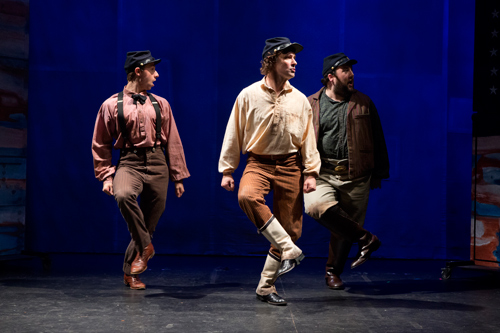
 
 
Left to right: Adam Fontana, Jim Stanek, Michael Thomas Walker in THE CIVIL WAR.
 
            Director Jonathan Silverstein must be given a tip of the hat (regardless of its color) for bringing this potentially problematic material to life with imaginative flair on an essentially bare stage. Designer Kevin Judge furnishes the space with just a few crate-like boxes and four vertical panels on wheels, seen at first with a rough painting of the Stars and Stripes linking them together. During the action they are maneuvered into intriguing new combinations, and their surfaces provide flaps and openings that allow for additional visual interest. They can also be tilted and used in battle as tank-like weapons. Sydney Maresca’s costumes, deceptively simple, allow the characters to remain strictly in period while adding additional accents when needed to suggest the differing characters wearing them. Half a dozen poles serve as universal props, being brooms, guns, or carrying poles as needed. Tying the visual elements together into a truly effective whole is David Lander’s wonderfully diverse lighting, including the strobe effects he employs for several slo-mo battle scenes or the specials that illuminate a soldier who has died in combat.

            THE CIVIL WAR succeeds in squeezing an enormous amount of material into an easily digestible hour of entertaining pedagogy. The personal stories are stereotypically familiar, but they clearly dramatize the choices that some people had to make in those trying times. Despite the deaths we witness (and there are several), the tone veers toward the elegiac only momentarily, and the spirit is mostly upbeat and inspiring. This may not be true to history, but the important points are made effectively enough to register with most young people. We learn, for one thing, that despite the need for cannon fodder, the North at first refused to enlist black soldiers. “Your kind ain’t allowed,” says a recruiter, and the would-be soldier replies, “They need 300,000 and they’re showing me the door,” which surely registers with many kids. (In 1863, necessity forced a change in the law, which certainly didn’t stop anti-black feeling in the Union army.) Another important one is that not everyone in the South saw the war as having to do with the slavery issue. Many fought because they simply believed they had to defend their rights from the government’s encroachments.
 
 
Left to right; Jim Stanek, Adam Fontana, Michael Thomas Walker, and Alyce Alan Louis in THE CIVIL WAR.

Naturally, in such a reductionist piece, some standard points, necessarily or not, will be overlooked. For example, no mention is made of Lincoln’s death, not even during the postscript segment that concludes the show. And, even though Gettysburg is touched on, Lincoln’s address there is not.  There’s nothing new, of course, about carnage being the source of entertainment, and if one child in ten emerges from THE CIVIL WAR with a better idea of what transpired than they had when they went in, the show will have done its job.

Saturday, July 20, 2013

58. Review of WANDA'S MONSTER (July 19, 2013)


58. WANDA’S MONSTER: THE MUSICAL


On Friday, July 19, at 10:30 a.m., a day before my 73rd birthday, I entered my second childhood when I visited the Vineyard Dimson Theatre on E. 15th Street to see WANDA’S MONSTER, effectively staged by Adrienne Kapstein. This is a musical version of a popular 2002 children’s book by Eileen Spinelli, with music and lyrics by Laurie Berkner and a book by Barbara Zinn Krieger. Only around 25 people were present in the audience, the majority of them preschoolers, some of them looking as if they had just popped out of the oven. TV comic actress Rachel Dratch was in my row with her tiny tot taking part in whatever little activities the actors asked of the children.

            It’s hard to critique a show like this, since it’s geared for such a young audience. Perhaps the best gauge of how well it’s working is to watch the reaction of the kids. Although this was definitely not the most clever or imaginative children’s show I’ve seen over the past year, it worked its spell just fine and, aside from the usual dashes to the bathroom, the little ones were good as gold.

            The 60-minute show, much of which is sung to sprightly pop tunes and simple lyrics (“Monster Boogie” seems to be well known), is about five-year-old Wanda (Laura Hankin, who’s actually a young woman), who talks to her stuffed animals, which she thinks are real, and who is afraid of the  monster she thinks is living in her closet. I’m sure a lot of people reading this are going to think Spinelli’s stolen their story since most of us have had similar fantasies in our early lives (and many of us still have them).  Wanda’s eight-year-old brother, Bobby (Nick Flatto, another grownup actor), is the designated cynic, and Granny (Jamie Kolnik) is her big support. No parents are visible in Wanda’s world, although we know they disapprove of her fantasies. The monster (amusingly played by James Ortiz) is a big, purple, fluffy, clumsy, shy, Maurice Sendak kind of guy, with large horns and long claws; he’s the kind of shy critter who’s more afraid of his own shadow than anyone could be of him, making him just the sort of fearsome thing that kids need to lovingly embrace if they’re going to fall asleep at night.

Bobby, unlike any 8-year-olds I’ve ever known, wears a bowtie and skinny jeans, while  Granny is unlike most grannys any kid seeing this show is likely to have met; she’s a hot-looking, Joan Jett-type biker chick rocker in zebra-striped tights and a black leather jacket. This is an innovation not in the original book, where Granny is more conventional. But she belies her image by saying things that ease Wanda’s anxieties and getting her eventually to bid her monster farewell. She also opens the show with a medley of songs accompanied by two male backup singers.

The show, presented by Making Books Sing, looks like it’s built to travel. The set is sufficient to establish we’re in Wanda’s bedroom, and the closet is a framework structure that can turn around so we can watch the monster while he’s in it. The costumes are bright and cheerful (although I wish the kids’ clothes looked more like what kids those ages really wear), and the monster makes a big impression on the tots. So if you’ve got a theatergoer in the making around, you might want to boogie him or her down to see the monster on E. 15th Street.

57. Review of THE DESIGNATED MOURNER (July 18, 2013)


57. THE DESIGNATED MOURNER


There is some very interesting chatter going on in the Shiva Theatre, on the first floor of the Public Theatre. The chatter is embedded in, or should I say embodies most of, THE DESIGNATED MOURNER, Wallace Shawn’s play, which originally was staged at London’s Royal Court Theatre in 1996, had its New York premiere in a South William Street venue seating only 20, and, with the same three actors from that production, is now being revived in front of 99. The play is in two acts, and, the night I saw it, enough people to fill all the seats at the 2000 performance had departed after the first act, which lasts about an hour and 45 minutes. Even before that, after only half an hour or so, two men clomped out noisily, making me wonder if Mr. Shawn, watching them go from his seat on stage in the role of Jack, might offer some comment, much as he had when a couple of latecomers arrived about 10 minutes into the show. He told those people not to be too concerned, that nothing much had happened, and that he’d merely been talking about this and that to the audience before they arrived. No one else came late, but had they, even toward the end of the three-hour performance, Mr. Shawn could almost as easily have said the same thing, i.e., that nothing much had happened and he’d merely been talking to the audience about this and that. But therein lies the rub, since you must pay attention in order to appreciate that more than this and that is being said. The problem is that the style of the writing and performance can easily deter the kind of strict attention the material requires.  

            THE DESIGNATED MOURNER does have a plot, more or less, and concerns three people living in an unnamed country, possibly Latin American, under a dictatorial rule. The political activities in the background are never made precisely clear. When the conservative government begins to fear an uprising by guerrilla forces, it purges thousands of citizens, imprisoning and executing many intellectuals, regardless of how tenuous their relationship to the rebels. Jack is a disaffected English professor, his father-in-law is a noted poet named Howard (Larry Pine), who wrote on politics in his youth, and then there is Jack’s ghostlike wife, Judy (Deborah Eisenberg), her sharply angled face wearing eerie whitish makeup with her lips brightly reddened; Jack has cut himself off from Judy and Howard, even taking up with Peg, a lemonade stand girl. Jack considers Howard a “highbrow” and fears the elimination of “lowbrow” culture if the revolution succeeds. He recounts how he expressed his growing disdain for highbrow culture by defecating on a book of John Donne’s poetry. Howard and Judy meet their demise, leaving only Jack, who is not unhappy to see their loss and who remains as the designated mourner, the one who remembers those no longer with us, in this case the effete artist-intellectuals who did nothing to assert their responsibility in their oppressive society.


Wallace Shawn and Deborah Eisenberg in THE DESIGNATED MOURNER.

Described thusly, the play would seem to demand some sort of dramatic action, but Shawn deliberately avoids providing it. What we learn of the political background comes out in long, discursive monologues, only occasionally broken by flashback conversation, with the characters speaking, for the most part, directly to the audience. The actors sit in chairs or on a double bed upstage. Movement is minimal. No one raises their voice, the tone remains civilized and conversational, and a fundamental sincerity is conveyed, but never in a confrontational or overtly emotional way. When the evening ends, if you’ve stuck it out, you may be hard put to isolate clearly what on earth you’d been listening to for so long. You might take away some thoughts on complacency in a totalitarian society where the elite are allowed to survive until they come to be seen as a potential threat; you may wish to meditate on the difference between highbrow and lowbrow culture, and what this means for society; you may contemplate the idea of intellectuals struggling unsuccessfully to stay above the fray in a fascist dictatorship; but no real effort is made to make this or any other point the play’s driving force. You come to the theatre, you listen to the chatter, and you go home, either to go over in your mind what you’ve just experienced or to simply move on to something else. To emphasize the casual nature of the experience, Mr. Shawn simply walks off through a door at the end, waving goodbye. He then reappears on the auditorium floor to again wave the audience home. There is no curtain call.
 
 
Wallace Shawn, Larry Pine, and Deborah Eisenberg in THE DESIGNATED MOURNER.

With three superb actors speaking the words (and Mr. Pine, Mr. Shawn, and Ms. Eisenberg are definitely that), the majority of them delivered by the always affably entertaining and incisively acidic Mr. Shawn, there is definitely enough here for some audiences. Those who saw the earlier New York performance (with the same cast and director, AndrĂ© Gregory) were reportedly absorbed in the venue’s living room-like ambience, where they were like guests invited to share in their hosts’ rambling ruminations.  In the larger space of the Shiva, intimate as it is for most purposes, that sense of communal interplay—at least to someone who missed the 2000 version—seems lost. The seating is on bleachers, with the all the chairs covered in white cotton slipcovers, their numbers stenciled on in black. They face a wide stage on which John Lee Beatty’s set presents walls painted to resemble concrete slabs, much as in a prison (a motif continued into the auditorium), and there are doors at both sides of the stage, as well as a window at stage right suggesting an odd jumble of windowpanes. There are a few pieces of furniture, dominated by a double bed at center. In one of the few modest pieces of staging, all three characters sit or lie on the bed, which is where Howard, presumably ill, remains most of the time. In act two, with Howard gone, the bed and most other furnishings are piled together under a gray cloth against the rear wall.

Apparently, to make sure we don’t miss anything, each actor wears a mic that is placed on him or her by a stage assistant in full view of the audience. In act two, standing mics are used. The effect may be intended to heighten the self-dramatization of the speeches, although I did appreciate the enhanced audibility of the speaking.  

To a certain extent, logorrhea can be engrossing when, as is the case here, what is being said is clever enough, but when the pacing and performance style resist traditional theatrics over an extended time period, boredom and restlessness are sooner or later bound to arrive. If your appetite runs in this direction, you will find enough here to satisfy you. I was only half-satisfied.  

Thursday, July 18, 2013

56. Review of SERIOUS MONEY (July 18, 2013)


56. SERIOUS MONEY


In 1987 the movie WALL STREET excoriated the manipulative business practices of the American stock exchange as represented by the lizard-like trader Gordon Gekko, so memorably embodied by Michael Douglas spouting lines like “When I get a hold of the son of a bitch who leaked this, I'm gonna tear his eyeballs out and I'm gonna suck his fucking skull.” Or, “one percent of this country owns half our country's wealth, five trillion dollars. One third of that comes from hard work, two thirds comes from inheritance, interest on interest accumulating to widows and idiot sons and what I do, stock and real estate speculation. It's bullshit. You got ninety percent of the American public out there with little or no net worth. I create nothing. I own. We make the rules, pal. The news, war, peace, famine, upheaval, the price per paper clip. We pick that rabbit out of the hat while everybody sits out there wondering how the hell we did it. Now you're not naive enough to think we're living in a democracy, are you buddy? It's the free market. And you're a part of it. You've got that killer instinct. Stick around pal, I've still got a lot to teach you.” And, of course, “greed, for lack of a better word, is good. Greed is right, greed works. Greed clarifies, cuts through, and captures the essence of the evolutionary spirit.”
 

Atlantic Stage II, on W. 16th Street between 8th and 9th Avenues.

            That same year, British playwright Caryl Churchill enjoyed success with SERIOUS MONEY, a bitingly satiric exposĂ© of the very same kind of ruthlessness and greed within the context of the English stock market, known as the City, with a Gekko-like banker named Zac Zackerman (David Barlow) as a central figure. A hit in London, it bombed on Broadway in a production starring Alec Baldwin. Last year it was revived Off Broadway for a brief run by the Potomac Theatre Project, and now that production, ingeniously directed by Cheryl Faraone, has been brought back, with minor cast changes, in a stingingly stirring staging at Atlantic Stage II. Against the background of Margaret Thatcher’s deregulation of the UK’s financial markets (an event known as the “Big Bang”), which allowed a whole new army of money obsessed troops to march in and take over, Ms. Churchill’s play, like a dramaturgical MRI, exposed their excesses and corruption. Her play may take place in the mid-1980s, but conditions since then have only worsened, so SERIOUS MONEY remains as seriously funny now as it was a quarter century ago.

            Like WALL STREET, SERIOUS MONEY also has brilliant writing illuminating the financial gluttony running rampant in the English stock market following the Big Bang. Many of these are in rhymed couplets, as for example, when Zac says:


The financial world won’t be the same again

Because the traders are coming down the fast lane.

They don’t even know it themselves, they’re into fucking or getting a Porsche, getting a Porsche and a Mercedes Benz.

But you can’t drive two cars at once.

If you’re making the firm ten million you want a piece of the action.

You know you’ve got it made the day you’re offered stock options.

There are guys that blow out, sure, stick too much whitener up their nose.

Guy over forty’s got any sense he takes his golden handshake and goes.

Because the new guys are hungrier and hornier.

They’re Jews from the Bronx and spivs from South California.

It’s like, Darwin says, survival of the fit.

Now, here in England, it’s just beginning to hit.


The plot is built around an upper-class woman named Scilla Todd (Tara Giordano) whose brother, Jake (a fine Mathew Nakitare), dies under mysterious circumstances. Unsatisfied with the conclusion that it was suicide, she is convinced he was murdered because of his shady dealings in the market, and, partly because there may be serious money in it for her, she determines to get to the truth of the matter. This brings her into the web of all-American arbitrageur Marylou Baines (an excellent Megan Byrne, who also plays a supposedly ethical British stockbroker) and her sycophantic personal assistant, T.K. (Noah Berman). Meanwhile, another plot line concerns the efforts of Zac and corporate raider Billy Corman (Alex Draper) to take control of a company called Albion, with various complications introduced by a sexpot Peruvian businesswoman named Jacinta Condor (marvelously limned by Jeanne LaSala Taylor) and her Nigerian associate, Nigel Abjibala (Aubrey Dube), purportedly a trader in cocoa.

            Everything is played at a frenetic pace, with plot complications piled on one another as the action shifts instantaneously from locale to locale, and backward and forward in time, usually with Zac informing the audience in direct address of where the story is going. Helping to move the episodically structured piece along is a spare set consisting of little more than an occasional piece of furniture, with four unusual chandeliers created out of upside down champagne bottles at each corner of the space. Telephones attached to long cords are pulled out of various unexpected places, sometimes creating a web-like environment when numerous phones are in action (this was in the pre-cell phone days). Countless lighting cues keep altering the look of the space, and every bit of movement is carefully staged by Ms. Faraone in a nonstop parade of directorial creativity. Expansive musical numbers, “The Futures Song” and “Five More Years,” conclude each act of this two-hour and ten minute show, with the entire cast dancing and singing to raucous music played by an upstage pianist revealed when a curtain parts. And there is even a prologue taken by Churchill directly from Thomas Shadwell’s THE VOLUNTEERS, OR STOCKJOBBERS, a remarkably prescient play about the London stock market written in 1693.

Enormous credit must go to the wonderful ensemble of actors, some of those in minor roles being students at Middlebury College, with which the PTP is closely associated. David Barlow, so vivid as Stucley in THE CASTLE: A TRIUMPH, which is playing in repertory with SERIOUS MONEY, does another bang-up job as Zac, the driven American banker. In THE CASTLE he has a very authentic British accent, but here is every inch the American mover and shaker, although his New York accent is sometimes tinged with a middle-American sound. The British accents of the entire cast, in fact, seem remarkably well honed, regardless of which regional characteristics are on display. Tara Giordano’s Scilla is another memorable performance, as is Alex Draper’s, who plays both the dynamic Billy Corman and a more restrained jobber named Frosby. He was not the only actor whose transformation from one role to another (many play multiple roles) was unusually deft. I still am not sure how he managed to make himself look nearly bald in one scene and to have a slicked down head of hair a moment later; if he used a wig, it fooled me.  

The theatre’s A/C was not working last night, which was horribly humid. I’m a great shvitzer, so if I had found myself too uncomfortable while watching a mediocre show I wouldn’t have hesitated to leave at intermission. That I didn’t means that, with SERIOUS MONEY, some serious theatre (which includes being funny, of course) is going on down in the depths of Atlantic Stage II (four floors below ground).

Wednesday, July 17, 2013

55. Review of THE CASTLE: A TRIUMPH (July 17, 2013)


55. THE CASTLE: A TRIUMPH


Why Howard Barker subtitles his 1985 play, THE CASTLE, “A Triumph,” is unclear to me, just as so much else in this sometimes fascinating but more often frustratingly obscure exercise in epic dramaturgy. The play is presently being produced by the Potomac Theatre Company (PTC) in repertory at Atlantic Stage II with Caryl Churchill’s SERIOUS MONEY, another British play with a very dark core. The PTC has had a close connection with the prolific Barker’s work since Richard Romagnoli, who staged the current production, directed THE CASTLE’s American premiere back in 1989, but this is its first New York staging. Barker, proponent of what he calls “Theatre of Catastrophe,” is a tough nut to crack and, while I was impressed with much of what I saw in this production, I found the experience ultimately unsatisfying.

            THE CASTLE is set in 12th-century England and has a Shakespearean veneer in both structure and language, although you won’t find too many “shits,” “fucks,” and “cunts” in the Bard’s poetic lexicon. Some of this is funny, but it eventually becomes more like a dramatist’s tic, unrelieved, despite lots of sturm and drang, by enough human interest to make it consistently appealing. THE CASTLE is preoccupied with many serious themes, political, theological, and sexual, but Barker’s provocative manner is too obtrusive to allow for any serious identification with his characters and their dilemmas.

            A band of knights has returned to their homeland after seven bloody years of fighting the infidels during the Crusades. Instead of their wives waiting faithfully for them, like Penelope in THE ODYSSEY, they find to their disgust that the women have established their own nonreligious, nonhierarchical new society in which sexual freedom runs rampant, and the women have multiple babies by multiple partners, including old men. Ann (Jennifer Van Dyck), wife of the men’s leader, Stucley (David Barlow), is now the lover and associate of Skinner (Jan Maxwell), a witch who seems to have the most power among the women. To counter this subversive world, Stucley, employing the genius of a stoic, dignified Arab, Krak (Quentin Mare), an engineer Stucley has brought back from the Holy Land, leads the men in the erection (pun intended) of a huge new, extremely well-fortified castle, meant to reestablish the male power structure; however, a revelation toward the end hints at the coming of gunpowder, which will make all such fortresses vulnerable, just as the arms race implies the ever increasing power of new weapons to overcome the old. This premise leads to various side issues, including the establishment of a new religion when Stucley points out the Bible’s failure to note the presence of Christ’s “cock,” suggesting the need for a theology in which Christ’s sexuality is preeminent.

            Having read (or plodded through) the play before seeing it, I was surprised by the many levels that Romagnoli as director brings to it, and by the quite powerful performances of the leading players, whose intelligence and technical abilities are able to mine the verbally clotted lines for surprisingly clear motivations and transitions. Nevertheless, despite some truly strong actors and highly effective rhetorical moments, one never for a moment believes in the personal relationships among the characters; too much attention is paid to stylistic choices of presentation, including an abundance of direct address not indicated in the script. Even Brecht, for all his yada yada about the “alienation” or “estrangement” effect, sought fundamental reality in his characters’ interpersonal behavior.

            Set designer Jon Craine has imagined an apparently inexpensive and innovative way to represent the multi-scened drama by hanging long, cotton sheets that represent pillars or whatever you wish them to be, and having them gradually yanked down, altering the visual perspective, as the action progresses. In act two, coils of barbed wire hang threateningly overhead. Excellent lighting by Hallie Zieselman is supplemented by terrific sound effects designed by Cormac Bluestone, including the roar of a jet flying over the audience near the finale. And Jule Emerson has contrived costumes many of which manage to suggest the 12th century yet with a few creative touches that allow them to allude to modern day garments making even the mirrored sunglasses worn by Stucley in his dictatorial mode look appropriate in the medieval context.


Jennifer Van Dyck and David Barlow.

            Of the actors, Jennifer Van Dyck as Ann has a richly theatrical voice and commanding presence that make you pay attention to her whenever she’s on stage, and David Barlow, although physically slighter than I imagined his character from the script, is continuously imaginative and interesting as Stucley.  Brent Langdon as Nailer, the priest, is highly expressive in his efforts to accommodate Stucley’s arguments as a way of reestablishing the church. The star turn belongs to Jan Maxwell in the highly demanding role of Skinner, and she demonstrates why she has won so many awards; unfortunately, even she is unable to sustain interest in her voluble and eccentric character; she is punished for killing someone by having to drag along his rotting corpse. Unfortunately, her many muddy lines in one long speech after another in act two become increasingly unintelligible, or, after nearly two and a half hours, simply too much trouble to bother about.
            A few critics have accepted the title at face value. For me, though, THE CASTLE: A TRIUMPH is not.    


Monday, July 15, 2013

54. Review of THE TWO-CHARACTER PLAY (July 14, 2013)


54. THE TWO-CHARACTER PLAY


A lot of serious theatergoers get excited whenever a new revival of a Tennessee Williams play lands on the boards, but some may forget that there are two Tennessee Williamses. Most familiar is the lyrical, sensual, and psychologically penetrating dramatist who gave us such great American classics as A STREETCAR NAMED DESIRE, CAT ON A HOT TIN ROOF, and THE GLASS MENAGERIE. However, even in those plays there are hints of the experimental playwright who would emerge full blown in the 1960s, discarding conventional narrative for more untraditional methods in works like THE MILK TRAIN DOESN’T STOP HERE ANYMORE, IN THE BAR OF A TOKYO HOTEL, and THE TWO-CHARACTER PLAY. These later plays were all critically and commercially unsuccessful, yet Williams himself supposedly found fulfillment in them, calling THE TWO-CHARACTER PLAY “my best play since CAT. Maybe better.” I beg to differ.


Lower lobby at New World Stages.


Stage 5 venue at New World Stages.

            The Broadway premier of THE TWO-CHARACTER PLAY (originally titled OUT CRY), which starred Michael York and Cara Duff-MacCormick, ran for only 12 performances in 1973. There are only two reasons I can offer to see its current revival, directed by Gene David Kirk (who previously staged a similar version in London with other actors), at New World Stages. Those are the performances of Brad Dourif and Amanda Plummer, who both fit snugly into the schizophrenic personas of the siblings Felice and Clare, the title characters. Both actors have made much of their reputations by playing kooky, unstable characters, and Plummer, especially, knows how to bring to vivid theatrical life someone whose balminess is convincingly, if not painfully real. Like her celebrated father, Christopher, whom she increasingly resembles, she possesses not only a talent for incisive character embodiment, but vocal powers that allow her to use her instrument in countless expressive ways. Unfortunately, she and her costar, like the characters they play in this revival, are trapped in a drama from which there is no escape until the run whimpers to its end. (The theatre was perhaps 60 percent full at the start; after the intermission, about 40 percent remained.)

            Ironically, THE TWO-CHARACTER PLAY is playing in New World Stage’s Stage 5 venue, where I was subjected last season to the Japanese torture of Williams’s IN THE BAR OF A TOKYO HOTEL. The leading actress in that ill-fated production kept calling for her lines, and, oddly, there’s a moment in THE TWO-CHARACTER PLAY where Ms. Plummer also calls “Line!,” but here it’s part of the script—or is it? My query arises from the context of the action, which imagines that Felice and Clare, having been determined by the other actors in their company to be insane, have been abandoned (in “a deep Southern town called New Bethesda”) and left to their own devices. Convinced that the show must go on they agree to perform their own “Two-Character Play,” which imagines them to be themselves, a reclusive brother and sister confined within the house in which they grew up, where their father killed their mother and then shot himself (a gun plays a part in the performance). There they are subjected to fear of the outside world, represented by abusive neighbors. Themes of isolation, claustrophobia, confinement, agoraphobia, fraternal dependency, and the like play out during the play within the play as we wonder what is real, what is illusion, what is performed, and what is lived. There are clearly autobiographical strains at work, most notably Williams’s relationship with his own sister, Rose, who was lobotomized.

            Everything takes place within the rickety-looking framework of Alice Walkling’s unattractive stage set, which indicates with lumber alone where the walls should be. Two giant sunflowers, symbols of something or other, are painted on the upstage wall, visible through the framework. The lighting is presumably manipulated by Felice, who frequently retires to an offstage switch to noisily bump up the intensity or create a new effect, although this conceit (and, it could be argued, that of the entire production) gradually is forgotten as the lighting devolves into cues handled by an actual technician, as when the play ends with Felice and Clare in a spotlight that isolates them before going out. If they’ve been abandoned, why is someone lighting them so dramatically? (The so-so lighting is by Jake Fine.) If the play followed Williams’s own dialogue, it would just end, with no special effects, and the audience might not even know it was over when it was.

            Still, this is the kind of talkative play, filled with pregnant pauses, where logic is not foremost on anyone’s mind, and all that counts is whether you can sympathize with the plight of these lost and helpless thespians, ensnared within the metaphoric world of theatre itself, a moody place where imagination can run free, but where it is sometimes difficult to come to grips with the difference between sanity and madness. Making sense of the “plot” from moment to moment is fruitless; Williams seems too enamored of the excesses of the era’s experimentalism, as seen in the far superior plays of Beckett and the early Pinter. You will either be bored to exhaustion (as I was) or intrigued by this little-seen facet of a favorite playwright’s art.  

Sunday, July 14, 2013

53. Review of FOREVER TANGO (July 14, 2013)


53.  FOREVER TANGO


When you enter the Walter Kerr Theatre you are faced by the increasingly unfamiliar sight of a formal Broadway curtain, bright red, fringed in huge gold tassels, and highlighted with gold flourishes along its swags. Aside from several stunning gowns worn by the female dancers in this return visit of FOREVER TANGO, this is the biggest blast of color on display in this dance and concert show, which first appeared on Broadway in 1998 (458 performances and four previews) and returned in 2004 (114 showings plus six previews). The present show is set for a limited run of ten weeks. A comparison of its 2004 program with the current one reveals that perhaps half the show is new, and the other half old, although almost the entire company has changed. Luis Bravo, who created the original and has been with the show throughout its history, remains the director. The choreography, as in the past, is credited to "The Dancers."


Walter Kerr Theatre, W. 48th Street.

            The cast is composed largely of champion tango couples, and each gets to demonstrate its innovative versions of Argentina’s passionate national dance. Unlike its earlier incarnations, which had no specific stars, the present FOREVER TANGO lists three guest stars, singer and five-time Grammy winner Gilberto Santa Rosa (to be replaced on July 30 by Luis Enrique), and dancers Karina Smirnoff and Maksim Chmerkovskiy, the exceptional Ukraine-born pair who became famous on TV’s DANCING WITH THE STARS.
Gilberto Santa Rosa. Photo: Walter McBride

            There are several company numbers that involve all or most of the dancers, but most of the evening’s dance sequences are performed by couples, each more sensual, dramatic, and physically enthralling than the other. The women, of course, with their heads of radiantly gorgeous hair, are icons of sexy glamour, dressed in stunningly slinky gowns from which perfect, stiletto-heeled legs thrust, twist, and kick in surprising permutations, as supple derrieres suddenly shimmy faster than the speed of light. Their men, often dressed in black, sometimes with rakish fedoras, are sleek panthers, their Valentino hair so slick you could skate on it, capturing a sense of lust and danger as they smoothly maneuver their women around the stage in ever more flashy combinations, with each routine ending in an inventive pose suggestive of domination and submission. As appropriate for the tango, the mood is deadly serious, with eyes focused on some ulterior goal, or locked with one’s mate in intensely electric contact. Everyone is conscious of their own gorgeousness, and during the curtain calls, several female dancers, especially the spectacular Victoria Galoto (she’s on the program cover with Juan Paulo Horvath), revel in it. Two dancers, Natalia Turelli and Ariel Manzanares, however, do a couple of comically inflected dances that allow some smiles to break into the otherwise somber proceedings.

Maxsim Chmerkovskiy and Karina Smirnoff. Photo: Walter McBride
Juan Paulo Horvath and Victoria Galoto. Photo: Walter McBride
            There is no set to speak of, just a black backdrop on which stars are sometimes illuminated, and a two-tier platform for the 11-member orchestra of four bandoneons (something like a cross between a concertina and an accordion), two violins, a viola, a cello, a bass, a keyboard, and a piano; VĂ­ctor LavallĂ©n, the bandoneon player-conductor, displays his virtuosity at several points. The dancers perform downstage of the musicians, who remain in view throughout. Since all but one of the musicians is gray or white-haired, their appearance makes a striking contrast with the youth and beauty of the dancers.

            The show is not all dance by any means. Guest star Gilberto Santa Rosa, wearing a tuxedo and carrying a mike, does several solos (all the songs are in Spanish), and a rather hefty portion of the evening is devoted to instrumental performances. These non-dance segments bloat the evening to a too-long two hours and 15 minutes (with one intermission). Still, few people chose to leave during the extended, danced-through curtain calls.

            But even without the concert-like performances, a show like this, no matter how talented or good-looking the dancers, is likely to pall unless you’re an avid dance fan. If you’re addicted to TV dance contests, you may find a couple of hours of this stuff delightful, but, remember, the dancing is all tango (or tango-like) so the lack of variety can eventually be problematic, there’s no thematic through-line that contextualizes what you’re seeing, and all the singing is in Spanish. By the end of act one, I felt I’d had a good time and had seen enough. Sitting through act two of FOREVER TANGO began to make me feel like the title might actually come true.