Wednesday, September 4, 2013

83-87: Review of THE HILL TOWN PLAYS: SCARCITY, ASHVILLE, WHERE' WERE BORN, KILLERS AND OTHER FAMILY, STAY


  83-87: THE HILL TOWN PLAYS:

SCARCITY; ASHVILLE; WHERE WE’RE BORN; KILLERS AND OTHER FAMILY; STAY


The Rattlestick Playwright’s Theatre production of the five plays in Lucy Thurber’s HILLTOWN PLAYS cycle represents a bold risk for a small Off Broadway company; regardless of my or other commentators' critical response, it is a venture that deserves loud applause for its artistic audacity. The plays are being produced at four important Greenwich Village venues, the Cherry Lane Theatre (SCARCITY and ASHVILLE), the Rattlestick itself (WHERE WE’RE BORN), the Axis at One Sheridan Square (KILLERS AND OTHER PEOPLE), and the New Ohio Theatre (STAY). Aside from the sheer logistical problems of putting on five shows simultaneously at four different theatres, the courageous artistic director, David Van Asselt, must have worried about how the plays, which were not specifically written in tandem but which are all closely related, would work together, provided audiences went to see all five of them. That last point is very important, of course, since someone could, for example, see one, be disappointed, and then skip the rest. This is only one of the multiple marketing problems the company must have faced.


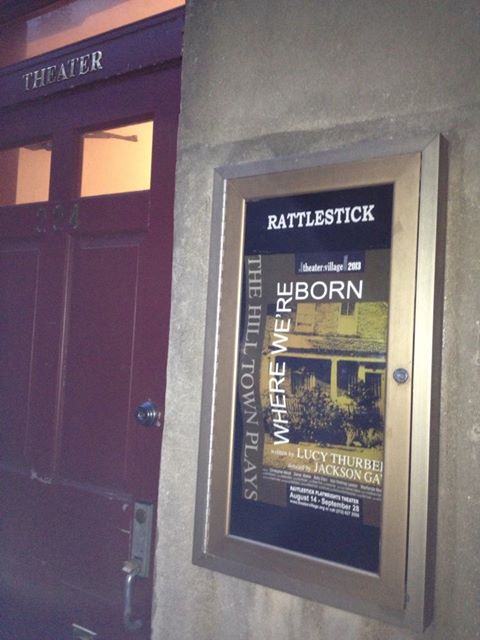
Rattlestick Playwrights Theatre, on Waverley Place, where WHERE WE'RE BORN is playing. 
 

New Ohio Theatre, Christopher Street, where STAY is playing. 

            Four of the five plays have been seen in New York before (three in Rattlestick productions), so the only non-revival is ASHVILLE. The original productions were offered as individual plays, not as part of a cycle. Because of the cycle programming, some spectators will choose to see them in the chronological order with which they chart the story of the central female character. She is the same person in the SCARCITY and STAY, except at different ages, but Ms. Thurber gives her different names, different circumstances, and different surrounding characters in the other three plays; with a small number of exceptions, these differences are not particularly great. Since they were apparently conceived as stand-alone plays, they can be seen and appreciated individually, without seeing the whole cycle; they can be seen out of order; or they can be visited in the chronological sequence of the heroine’s life, which is how I viewed them and why I would recommend that procedure for those not put off by my comments below. The chronological sequence would be SCARCITY (set in 1992), directed by Daniel Talbott; ASHVILLE (set in 1997), directed by Karen Allen; WHERE WE’RE BORN (set in 2003), directed by Jackson Gay; KILLERS AND OTHER FAMILY (set in 2009), directed by Caitriona McLaughlin; and STAY (set in 2013, although taking place in 2007 when first produced), directed by Gaye Taylor Upchurch.


Deirdre O'Connell and Gordon Joseph Weiss in SCARCITY. Photo: Sandra Couldart.


Gordon Joseph Weiss, Natalie Gold, Will Pullen, and Deirdre O'Connell in SCARCITY. Photo: Sandra Couldart.


Izzy Hanson-Johnston and Will Pullen in SCARCITY. Photo: Sandra Couldart.  

All five plays are covered in this overview, so I’ll avoid discussing each in detail and confine myself to more general remarks. The central female figure in SCARCITY and STAY, the bookend plays, is Rachel, first seen as a rather mature 11-year-old (Izzy Hanson-Johnston) and then as a 32-year-old college professor and promising writer (Hani Furstenberg) at a small, elite New England school. In ASHVILLE she’s Celia (Mia Vallett), a 16-year-old high school student; in WHERE WE’RE BORN she’s Lilly (Betty Gilpin), a 19-year-old college student; in KILLERS AND OTHER FAMILY she’s Elizabeth/Lizzie (Samantha Soule), a 28-year-old doctoral candidate, now living in New York. All these characters hail from a rural area among the “hill towns” of western Massachusetts, referred to sarcastically by someone in STAY as Massatucky, a dig at the expense of the region's widespread poverty and the predilection of its white-trash residents for indiscriminate swilling, smoking, screwing, and swearing. At least that’s how many of the characters in the first four plays are depicted.


James McMenamin and Mia Vallet in ASHVILLE. Photo: Sandra Couldart.


Aubrey Dollar and Mia Vallett in ASHVILLE. Photo: Sandra Couldart.


Mia Vallet, Joe Tippett, and Tasha Lawrence in ASHVILLE. Photo: Sandra Couldart. 

In SCARCITY and STAY, Rachel’s closest bond is with her brother, Billy, a 16-year-old high school "brainiac" in the first play (Will Pullen) and a 37-year-old lawyer (McCaleb Burnett) in the second. For the teenaged Celia in ASHVILLE, her principal male friend is her lover, Jake (Joe Tippett), a blue-collar worker who appears to be in his 20s and wants to marry her, while for Lilly in WHERE WE’RE BORN it’s her brother-like cousin Tony (Christopher Abbott); and for Lizzie in KILLERS AND OTHER FAMILY it’s an actual brother again, this one a screw-up fugitive from justice called Jeff (Chris Stack) who hopes to flee to Mexico with his buddy, Danny (Shane McCrae), who has brutally beaten a girl to death. Except for Tommy (Brian Miskell), a wealthy college boy in STAY, all the men would easily match many of the items listed on Jeff Foxworthy’s list of 300 things that define a redneck. They curse incessantly, chain smoke (both cigarettes and weed), pour Jack Daniels down their gullets as if it were Poland Spring, spend their spare time (or all of it) bullshitting and fighting, and wearing their racism and infidelities like badges of honor. Billy, whose academics are good enough to get him into Deerfield and Harvard Law, manages to extricate himself from this backwoods bog, but even he loses control over his instincts and slides back into the primordial ooze; the wonder is that he managed to become a successful lawyer in a high-powered firm before he erupted over a triviality and struck his boss’s daughter.

 
From left: Christopher Abbott, MacKenzie Meehan, Betty Gilpin, and Daniel Abeles in WHERE WE'RE BORN. Photo: Sandra Couldart.


Betty Gilpin and MacKenzie Meehan in WHERE WE'RE BORN. Photo: Sandra Couldart. 

The only other family member who appears in multiple plays is the heroine's loose-mouthed, loose-living, but, in her own perverse way, loving mother, called Martha in SCARCITY and Shelly (Tasha Lawrence) in ASHVILLE. She doesn't show up in person again, although she's referred to, but in STAY she is constantly calling and leaving messages on the answering machine. Her prerecorded voice belongs to Deirdre O'Connell, who plays her in SCARCITY. 


Shane McRae and Samantha Soule in KILLERS AND OTHER FAMILY. Photo: Sandra Couldart.


From left; Samantha Soule, Shane McRae, Aya Cash, and Chris Stack in KILLERS AND OTHER FAMILY. Photo: Sandra Couldart. 

There's a strong core of talented New York actors involved in this super-ambitious project, from young and upcoming men and women to more experienced veterans, such as Ms. O’Connell and Mr. Weiss. While everyone—including, of course, the directors—works hard to make the material live and breathe, the results are often uneven, with emotional transitions bordering on the kind of intense but not wholly convincing mixture of reality and theatricality seen in classroom improvs. The acting occasionally veers into excess, most notably in the case of Pamela Shaw, who plays Gloria, the garishly outlandish wife of Louis (Michael Warner), the cop, in SCARCITY. The older heroines are acted by physically lithe, vocally strong, and emotionally sensitive actresses; sometimes they are excessively sensitive, I might add, given the need to express such a stockpile of insecurities. These insecurities involve the women's growing sexual awareness, which takes most obvious form in their interest in other women: these lesbian lovers are represented by Amanda (Aubrey Dollar), married to Joey (George West Carruth), in ASHVILLE; Franky (MacKenzie Meehan), Tony's lover in WHERE WE'RE BORN; Claire (Aya Cash), Lizzie's girlfriend/roommate in KILLERS AND OTHER FAMILY; and Julia (Mikaela Feely-Lehmann), Rachel's "creepy" student in STAY.


Hani Furstenberg and Brian Miskell in STAY. Photo: Joan Marcus.


Jenny Seastone Stern, Hani Furstenberg, and Mikaela Feely-Lehmann in STAY. Photo: Joan Marcus.

 
McCaleb Burnett and Hani Furstenberg in STAY. Photo: Joan Marcus. 

The almost exclusively unpleasant male characters are well played. Still, too many of the younger men look like they've been spending all their off time when not boozing, cruising, or schmoozing at the gym. As might be imagined, shirtless scenes abound, but several women also get to display their toned physiques. There is also a striking (no pun intended) amount of violence on display, male on male, male on female, and female on male. The fights can be pretty brutal and the actors in some instances should be getting hazard pay. Uncledave's Fight House staged the violence in each of the first four plays, while J. David Brimmer handled the far less arduous fisticuffs in STAY, where the most dramatic slugging occurs offstage.

 Among other physically demanding requirements are the sex scenes, both male-female and female-female; although Rachel in SCARCITY is too young for such hanky-panky, her older manifestations engage in some heavy-duty lovemaking, often in passive-aggressive scenes where she resists and then succumbs to her passion for another female. But her sexual ambivalence is also expressed through several aggressive engagements with men; one vigorously staged scene between Lizzie and Danny, the murderer, borders on rape before she chooses to complete the act. Play after play refers to the physical attractiveness of the women, both in a complimentary way and, when the speaker comments on herself, as an attempt at self-assurance.

Another thread is the alleged smartness of the heroine, referred to frequently as if to underline the tragedy of her being a prisoner of her domestic circumstances while having the potential to smash the chains binding her to her roughneck world. The words “smart” and “stupid” (and their equivalents) bounce through the lines like a rubber ball. Playwright Thurber, however, must do more to convince me that the heroine is smart than to have her or others tell me she is, or to cite the books she’s reading or has read; for all the talk about the intelligence of Rachel-Celia-Lilly-Elizabeth, only Rachel as a child seems wise, and that's partly because the things she says are not what you'd expect to hear from someone so young. The older versions of the character constantly make questionable choices that belie her supposed brilliance. I've read in interviews where Ms. Thurber defends her heroine's continuing to loyally support the folks she grew up with, regardless of their behavior. Perhaps this might be true for her immediate family, but I find it hard to accept that she'd still be so strongly attached to the ragtag bunch of losers represented in the plays by these mostly ambitionless drunks, psychopaths, and even killers. 

I don’t know Lucy Thurber’s personal biography, but there’s a strong impression that the plays are autobiographical accounts of her own struggles to overcome and flee from an environment of alcoholic, crude, and physically violent parents. When mom and pop aren’t behaving like cretins, there are enough other specimens around to serve as sterling replacements. Perhaps I’m going out on a limb here, but the plays suggest that Ms. Thurber has written them to exorcize her personal demons, to somehow escape through dramatic art the horrendous world of her childhood and upbringing. As one watches the plays over the course of a week and sees the same patterns of inappropriate behavior enacted in different forms, with a band of characters who gradually morph from individuals into stereotypes, it becomes difficult to avoid the writing’s therapeutic purpose. As Lizzie in KILLERS AND OTHER FAMILY admits, “There’s something wrong with me.” This is not necessarily a bad thing, as much great theatre stems from personal anguish and suffering. But to be great art it needs to transmute that pain onto a higher, more universal level. Instead, this cycle asks that you spend 8 to 10 hours over the course of a week immersed in the most disturbing moments of the victim’s life; when that life seems little more than a ground hog’s day repetition of similar traumas happening to a not especially interesting person, at different stages of her life, you want to escape from the theatre just as much as she does from the world she’s bound to.

The plays are thinly plotted, most of them lacking sharp central conflicts, and seem more like extended situations that give rise to emotional reactions than conventional dramas with strong narrative arcs. The most decisively dramatic is SCARCITY, whose principal thrust concerns a young female schoolteacher, Ellen (Natalie Gold), who takes a deep interest in promoting Billy’s move from his local high school to Deerfield Academy; her interest seems predicated as much on Billy’s academic promise as on her repressed sexual feelings toward him. (The play contains other pedophiliac hints stemming from the behavior of Rachel’s loutish, unemployed dad, Herb [Gordon Joseph Weiss].) The desperate attempts of Louis the cop to seduce Billy and Rachel’s slatternly mother, Martha (Didi [Deirdre] O’Connell), even provide a subplot. While the play is melodramatically overwrought, it held my interest far longer than the remaining works, a couple of which (ASHVILLE and STAY) proved decidedly soporific. Each has at least one or two potent scenes, but the kind of plotting that creates continual interest in what happens next is sacrificed for more momentary, and not always believable, theatrical effects. Arguments, for example, frequently leap out of nowhere, sparked more by the need to enliven the action than because of organic need. By and large, dialogue--often crisp and colorful, but just as often dull and prosaic--character relationships, and emotional states of mind take precedence over gripping storytelling.

Naturalism is the prevailing mode, but in STAY, Ms. Thurber opts for the surrealistic presence of an alter ego for Rachel called Floating Girl (Jenny Seastone Stern), a sort of psychological Tinker Bell, hanging out on top of bookcases and the like, offering verbal and physical reactions to Rachel’s conflicts (in a manner slightly reminiscent of the invisible friends in FIRST DATE). Floating Girl’s presence also permits the playwright to inject ambiguously “poetic” dialogue into the script. Both Floating Girl and the poetry, which try to raise the stylistic bar in Ms. Thurber’s writing, are dead ends and would be better off floating elsewhere.

The physical elements of the productions are all acceptably realized, but with nothing markedly original about any of them. Raul Abrego designed the set for SCARCITY, and Rachel Hauck designed STAY, but John McDermott created the other sets. SCARCITY takes place in a hardscrabble house interior; ASHVILLE mixes three contiguous row house apartments, no walls separating them, with a center area shared by the two of the apartments;  WHERE WE’RE BORN offers another seedy interior, but it  has a small exterior area outside the front door, and its wall-less bedroom is set off by several trees presumed to be outside; KILLERS AND OTHER FAMILY bumps up the decorative aspect with its realistic, if familiar, depiction of a white New York apartment whose French doors are adorned with multicolored panes; and STAY, which includes polished wooden flooring on two levels, replaces walls and with bookcases, doors, and a decorative window to establish a faculty office at one side that cleverly opens up to create an apartment when a bookcase unit is rolled off to one side.  

Ms. Thurber has said that she sought to trace the evolution of her female lead over time. But, for me, the impression grew I was watching a single play in multiple iterations. As Billy says to Rachel in STAY, where her writer character’s work is based on her own experiences, “Your life’s a sheet of paper that’s been copied too many times.” In aggregate, the cycle expresses the confusion and agony of a young woman described as talented and bright seeking to abandon her harmful, closed-minded, poverty-stricken environment and find a better place in the world where she can free both the social person and the literary artist locked inside; unhappily, much as she tries to escape, that past will always come knocking at her door, or more likely, walk in without knocking.

            Ms. Thurber has said that the plays are "about the culture of poverty in America." Naturally, class differences pursue her heroine as well, and there are frequent clashes between the working-class world she comes from and the bourgeois life she seeks while constantly being reminded of her roots. Ms. Thurber herself encapsulates the essential dilemma of the plays in STAY, when Rachel declares: “Poor boys, poor girls, drinking it up in the country with abusive parents. Violence equals love—love equals violence—lack of connection—lack of hope—no escape—no escape—no escape—no escape.”  Although the conclusion to STAY suggests some sort of redemption and a brighter future, it is via a theatrical convention of magic realism and not as the result of the natural course of events.

            After a week in the company of these cringe-worthy people, I found myself sharing Rachel-Celia-Lilly-Lizzie's longing to flee, even though the playwright has done her best to dramatize not only the characters' flaws but whatever decent qualities they might have, however miniscule. Having watched five plays in which normalcy is to be angry and hostile, to start arguments and fights on the slightest pretexts, to suck tobacco and drown in beer and whisky, and to do the nasty whenever opportunity knocks, I too wanted to run away and never look back. When the cycle ended I was able to find release by stepping into the street and jotting down these comments. Rachel-Celia-Lilly-Lizzie, however, will be forever encased in the emotional amber of Lucy Thurber’s HILL TOWN PLAYS.

           Postscript: I'm aware, of course, that other theatregoers will feel completely the opposite. On leaving one of the shows I ran into a respected acquaintance who writes theatre criticism for a local outlet. He and his companion, who had just finished the cycle, asked me and mine, who still had two plays to go, what we thought. We expressed our middling responses and were greeted with wide-eyed stares of astonishment. His friend kept saying, as she processed our reaction, "How interesting!" as if only people from Mars could have felt as we did. In fact, she walked with me to the subway, detained me on the sidewalk, and held me there as we argued the merits of what we'd seen.  I appreciated her passion for the plays, but, as I descended the subway steps, I continued to feel that, thus far, at any rate, THE HILL TOWN PLAYS were an uphill climb. And the climb, I'm afraid, continued to the end.


Thursday, August 29, 2013


UPDATE ON UPCOMING SHOWS

September is shaping up with some very exciting prospects and I wanted to keep you informed of what I’ve already booked, since I won’t be reviewing anything for several days. That's because of my current immersion in the five-play cycle of plays by Lucy Thurber being presented by the Rattlestick Playwrights Theatre, at various Off-Broadway venues, with two at the Cherry Lane, one at the Rattlestick itself, one at the Axis Theatre, and one at the New Ohio. I’ve already seen SCARCITY and ASHVILLE, and will be attending WHERE WE’RE BORN, KILLERS AND OTHER FAMILY, and STAY over the rest of the week. The entire series will be covered in a single review, as per the request of the press rep, so mum’s the word until then.

            After that I’ll be traveling to the Flea on White Street to see the Bats perform THE RECOMMENDATION, a new play by Jonathan Caren, described in these words: “Aaron Feldman is popular and connected. He is everything his best friend Iskinder Iudoku is not, but when Feldman gets pulled over for a broken taillight, he is introduced to a world where privilege means nothing and Iskinder has the advantage. A play about friendship, class and where loyalty has its limits.” Then there’s a new work about Freud, FINAL ANALYSIS, at the Alice Griffin Jewel Box Theatre at the Signature on W. 42 St. and another work by the same company in the same venue, BREAKFAST WITH MUGABE. The former is described thusly: “FINAL ANALYSIS, was part of the 2012 Midtown International Theatre Festival and was honored with seven MITF Awards, receiving an unprecedented 13 nominations. The play, directed by Ludovica Villar-Hauser, is set in turn-of-the-century Vienna--the crossroads of civilization, a major confluence of art, music, science and politics. But, festering beneath the facade of frivolity and joy, the city is rotting at its core, sickened by moral corruption, obsessed with death, and ravaged by a growing hatred of the Jews. Against this background, Gustav Mahler, the great composer and conductor, falls in love with the talented, tempestuous Alma Schindler; Joseph Stalin meets a dangerous young man over a game of chess; Ludwig Wittgenstein, destined to become a dominant force in world philosophy, runs into an old schoolmate with unpleasant consequences, and in the midst of this, Sigmund Freud faces what he has always denied:  the essential, evil nature of man.”

            BREAKFAST WITH MUGABE, already the recipient of a positive review by the New York Times, is described this way: “Fraser Grace’s thriller is inspired by newspaper reports that Robert Mugabe, severely depressed, and convinced he was haunted by the ghost of a dead comrade, was treated by a white psychiatrist. It premiered at the Royal Shakespeare Company’s Other Place in 2005,” and then transferred to the West End, with other important productions following.

            59E59 will be presenting THE LIFE AND SORT OF DEATH OF ERIC ARGYLE: “Eric Argyle is having a bad Sunday. It’s late. He’s still in his pyjamas. A room full of people are staring at him. And he died at 11.42am, two days ago. An issue that people don’t seem all that receptive to.” And then I’ll be off to FETCH CLAY, MAKE MAN, at the New York Theatre Workshop, a play that examines a true but surprising relationship. “In the days leading up to one of Cassius Clay's most anticipated fights, the heavyweight boxing champion forms an unlikely friendship with the controversial Hollywood star Stepin Fetchit.  With a rhythmic script by award-winning performer and playwright Will Power, who received rave reviews for his hip-hop productions of Flow and The Seven at NYTW, and direction by Tony Award winner Des McAnuff, FETCH CLAY, MAKE MAN explores the improbable bond that forms between two drastically different and influential cultural icons. One a vibrant and audacious youth, the other a resentful and almost forgotten relic, together as they fight to form their public personas and shape their legacies amidst the struggle of the Civil Rights Movement of the mid-1960s. This true story is as powerful and poetic as Clay himself while also humorous and irreverent like Fetchit's signature act. Finding commonality in contradiction, FETCH CLAY, MAKE MAN examines the true meaning of strength, resilience and pride.”

            On the evening of the day I see FETCH CLAY, MAKE MAN, I’ll be privileged to attend Lear DeBessonet’s staging (with 200 actors!) of THE TEMPEST, a huge civic undertaking sponsored by the Public Theatre and being premiered at the Delacorte in Central Park before moving to other NYC venues. “Public Works is the Off-Broadway company's new program, which aims to build audience engagement in all five boroughs of New York City.The Tempest will feature individuals from such diverse groups as Children's Aid Society (Manhattan); DreamYard (Bronx); Fortune Society (Queens); Brownsville Recreation Center (Brooklyn); and Domestic Workers United (all boroughs). Participants will be cast in lead and ensemble roles alongside professional actors.”

            THE HATMAKER’S WIFE will follow at the Peter Jay Sharp Theatre on 42nd Street, with Rachel Chavkin (NATASHA, PIERRE AND THE GREAT COMET OF 1812) at the helm of Lauren Yee’s “whimsical and poignant new play [in which] a young woman moves in with her boyfriend expecting domestic bliss, but instead has trouble getting comfortable. Her strange new home seems determined to help out - and soon the walls are talking. They reveal the magical tale of an old hat-maker and his long-suffering wife, who runs away with his favorite hat. This sweet and surreal story bends time and space to redefine the idea of family, home, and true love itself.”

            Then comes BRENDAN AT THE CHELSEA, at the Acorn on Theatre Row, described as “a warm and funny play set in the 1960s when the notorious Brendan Behan absconded from Ireland to New York and set up residence in the bohemian Chelsea Hotel where his neighbors included Arthur Miller, Bob Dylan and other artists. He’s drunk, broke, hung over and way past the delivery date of his latest book; then a wire arrives from Dublin with the kind of news that’s guaranteed to put his blood pressure through the roof.” The next night brings PHILIP GOES FORTH, a revival of a 1931 George Kelly comedy at the Mint, and yet another comedy revival the night afterward, Shaw’s YOU NEVER CAN TELL, at the Pearl.

            A solo show from Ireland follows, I CAN SEE CLEARLY NOW (THE WHEELCHAIR ON MY FACE), written and performed by Sonia Kelly, at 59E59, with a play by Horton Foote scheduled for the next day at the Signature. It’s called THE OLD FRIENDS and stars musical theatre great Betty Buckley. A couple of days later Orlando Bloom and Condola Rashad costar as the fated lovers in ROMEO AND JULIET, the first Broadway revival of this Shakespearean classic in well over 30 years, with a new play by Regina Taylor at the Signature a day later. It’s title is STOP.RESET and it's described as follows: "As e-books outsell printed books, Alex Ames, the owner of Chicago’s oldest African American book publishing company, must question each of his employees to determine who is still relevant in a rapidly changing world. When he meets J, a mysterious youth plugged into the future, Mr. Ames is forced to discover just how far he will go to survive. A new play from Residency Five playwright Regina Taylor, stop. reset. asks powerful questions of legacy, identity and survival in a world where the real and the virtual are more closely tied than we think."

            Then there’s something by Ethan Coen, of the movies’ Coen brothers, at the Atlantic, WOMEN OR NOTHING. This is Coen's first full-length play. It’s “about two women so desperate to have a child that one of them will even sleep with a man. Who the man is, what he thinks is going on, what the women think about what he thinks, and what the mother of one of the women reveals about her own colorful past—it all defies belief. Why then does it all make sense?” Finally, there’s ARGUENDO, staged at the Public by the adventurous Elevator Repair Service. “In Barnes v. Glen Theatre, a 1991 First Amendment case brought by a group of go-go dancers, the justices of the U.S. Supreme Court debate whether dancing naked in a strip club is an exercise of artistic expression or a crime. In ARGUENDO, ERS presents the case's oral argument, verbatim, revealing a compelling intellectual struggle and the court's often-absurd sense of humor. There will be a 20-minute talk back following every show, included in the price of admission.”
 
            All this and it will only be September 22, with another week still remaining in the month for additional shows. Let's hope these productions turn out as well on stage as they sound on paper, and that the season before us proves a memorable one.


Wednesday, August 28, 2013

82. Review of AWAKE AND SING (August 27, 2013)


82. AWAKE AND SING

Do you remember how surprised the judges were the night that Susan Boyle began to sing as a contestant on BRITAIN’S GOT TALENT? Here was this extremely unprepossessing woman who, the moment her voice began emitting the sounds of “I Dreamed a Dream” from LES MISERABLES, instantly converted skeptics into believers. I experienced a modest version of that feeling last night when the actors in a downtown revival of Clifford Odets’s socially conscious 1935 masterpiece AWAKE AND SING began to speak. I admit having gone with a cynical sense that I was going to see something bizarre, an Asian-American theatre company (the National Asian American Theatre Company), doing a play about a Jewish family in the Depression-era Bronx, living in a cramped fifth-floor walk-up, and furiously confronting the issues of capitalism and Marxism, as well as various domestic and romantic problems. It wasn’t so much the subjects of conversation or the way families interact that raised my doubts, but rather how American actors from such different ethnic backgrounds could be believable in this world. For one thing, apart from their looks, how would they capture the sounds and inflections associated with that period? Odets’s dialogue is meant to sing with the immigrant-influenced melodies of the Bronx’s colorful streets, which can still sometimes be heard in New York-based gangster flicks of that era. But no sooner did the Berger family, seated around the dining room table, begin to bicker and fuss, than the voices of 1930s working-class New York Jews came pouring forth from actors with faces and names suggesting China, South Asia, and places indeterminate. And soon, even their appearances, despite a plethora of racial origins, were transformed into those of the Berger family of 1933 (when the play is set), whose antecedents probably came from Central or Eastern Europe.
Walkerspace, 46 Walker Street. (Home of the Soho Rep.)

The actors in this company do not share a single ethnicity, and indeed some actors probably possess multiple backgrounds (if the name Jon Norman Schneider is any indication). The point, however, is that, while you never forget for an instant that you are seeing actors who are clearly not what Odets had in mind, their full-hearted grasp of his characters and intentions soon makes you marvel at how universal theatre can be when well performed, regardless of its ethnic origins. Will we one day, do you think, see a non-Asian cast tackle, let’s say, a play by David Henry Hwang? Or, what would be equally politically incorrect in 2013, a non-black cast in a play by August Wilson?

As I noted in my Encyclopedia of the New York Stage: 1930-1940,  AWAKE AND SING, whose title comes from a passage in Isaiah 26:19, “Awake and sing, ye that dwell in dust,” is a propagandistically inclined work in its implied criticism of the capitalist system and its depiction of the problems of Jewish assimilation to an alien culture, but its success has long been attributed to the rich humanity of its characters. It is set among the squabbling members of the Berger family, a poor three-generation tenement household beset by the typical economic problems associated with the times. Hennie Berger (Teresa Avia Lim) loves disillusioned, one-legged racketeer and WW I vet Moe Axelrod (Sanjit De Silva), although she’s married to the pathetic Sam Feinschreiber (David Shih); the marriage was arranged for the sake of the family’s reputation by Hennie’s demanding mother, Bessie (Mia Katigbak), because of Hennie’s pregnancy by an unnamed lover. The kindly, cultured grandfather, Jacob (Alok Tewari), a Marxist barber, is opposed to the couple’s hypocritical nuptials. Hennie eventually runs off to live with Moe. Another thread follows the problems of the rebellious young son, Ralph (Mr. Schneider), whose romance with a poor orphan girl is frowned on by Bessie. He, too, finds sympathy from the old man, who always reminds him that “life isn’t found on dollar bills.” Toward the end, Jacob kills himself so Ralph can inherit his insurance money and awake and sing.

This is a difficult play to cast even with actors whose ethnicity matches that of the characters, but the NAATCO’s troupers do a strong job of confronting the problems. Rather than transpose the play into a world less specifically 1930s Bronx-Jewish, director Stephen Fried has had his company strive to snare that world’s behavioral and speech patterns. While some are more successful than others, they nonetheless offer a no-frills reading of the play that communicates in terms that are never less than clear and compelling. Unlike the 2006 Broadway revival, with its technically complex scenic conceit, this low-rent version's set is perfectly acceptable: the audience of around 50 sits on either side of the rectilinear space, with a bedroom behind the wall at one end, and the kitchen and other rooms offstage behind an archway at the other. The action takes place around the dining room table and on some living room furniture. Furthering the general feeling of authenticity are Moria Sine Clinton's period costumes. 

Sanjit De Silva makes a handsome and believable Moe, although he tends to push too hard for such a tiny space. His limp, too, could be more consistent. Mia Katigbak is a convincing Bessie, a struggling housewife wanting to do what she thinks is best for her family yet forced into actions that sometimes make her a monster. Jon Norman Schneider’s Ralph, while not as charismatic as actors who have played the role before (John Garfield originated it), is earnest and sincere, while Teresa Avia Lim’s Hennie is attractive in an everyday way and her responses to the world in which she is trapped are always credible. Alok Tewari’s grandfather, who uses a slight Yiddish accent, seems a trifle young for the part, even with his gray beard, while Andrew Ramcharan Guilarte overdoes some of Uncle Morty’s mannerisms. Henry Yuk offers a sympathetic Myron, Bessie’s pliable husband, but David Shih’s Yiddish-accented schlemiel of a Sam Feinschreiber comes off too much like a refugee from FIDDLER ON THE ROOF.

The nontraditional casting of this AWAKE AND SING demonstrates that the play remains strong and worthy of revival, regardless of its actors’ backgrounds, and also that the NAATCO has the talent and imagination to step out of the box and undertake revivals that expand their artistic vistas. Dumplings and kreplach can make beautiful theatre together.

Tuesday, August 27, 2013

81. Review of THE CHEATERS CLUB (August 25, 2013)


81. THE CHEATERS CLUB


Back in 2006 my family and I took a cruise ship vacation to Mexico. On the way it stopped at Key West where we joined one of those haunted house tours. These take you to sites associated with notorious deaths while the tour guide asks if you see any “orbs” floating around in your photos; these supposedly are nearby wandering souls. For months after that we thought we saw orbs in many pictures we took; more likely, they were created by lens dust. Derek Ahonen’s new play, THE CHEATERS CLUB, produced by the Amoralists at the Abrons Arts Center (at the venerable Henry Street Settlement), uses such a tour to bookend a Southern Gothic story of ghosts and spirit possession in the city of Savannah, Georgia. Like many old southern cities, Savannah does a flourishing trade trying to scare out-of-towners to death.

 
Henry Street Settlement, Henry Dejur Theatre, Grand Street.
 
            The program notes discuss a particular night that allegedly occurs in Savannah every 333 years. The night is called Geist Übernachtung and “the last documented occurrence . . . was in the year 1680,” which would make 2013 the year the next one would appear. I can’t vouch for the authenticity of this story, since the Internet fails to list a single mention of Geist Übernachtung. It does state, though, that Savannah is “America’s most haunted city,” and the names of numerous ghost tours available there are listed. So it’s likely that Geist Übernachtung, which probably means something like “overnight with ghosts,” is the playwright’s concoction, designed to support his freewheeling and absurd (but not absurdist) plot. According to his notes, the legend of Geist Übernachtung  holds that on this night “the barriers between the natural and supernatural worlds are temporarily dissolved and the disembodied spirits of the wandering dead may easily cross back into the realm of the living.” This allows for situations that involve spirits taking possession of anyone, dead or alive, if a medium performs the proper rituals.


Left to right: Bryan Anthony, Matthew Pilieci, Jordan Tisdale, David Nash (at rear), Sarah Lemp, and Kelley Swindell. Photo: Russ Rowland.

            Much of the auditorium seating is unused, probably so the empty seats (mostly in the side sections) are covered with cheesy cobwebs like those you see decorating houses on Halloween. The conventional proscenium stage is provided with a red curtain, hiding the scenery until the play proper begins. In a sort of prologue played in the auditorium and before the curtain, a Mephistophelian tour guide, Vladimir Anton (Zen Mansley), introduces us and two corny tourists (Janette Johnston and David Lanson) to the local ghostly lore, but even before the curtain rises we get a taste of how the play will try to blend farce and spookiness when the flamboyantly theatrical Vladimir refers to his landmark Off-Broadway production of a  one-man "kabuki UNCLE VANYA," signaled by karate chops. This kabuki UNCLE VANYA, unfortunately, becomes a running gag almost whenever Vladimir is on stage. (There’s a similarly misguided kabuki-karate conflation in AVI HOFFMAN’S STILL JEWISH AFTER ALL THESE YEARS.)

            When, at last, the curtain rises, we see Alfred Schatz's rather elaborate, if clumsy and not particularly attractive setting, of a hotel, with a small lobby area down right, the hotel’s saloon occupying most of stage left, and three bedrooms on a second level joined by an outside corridor. The rooms (as well as the lobby) have front walls covered in scrim so that lighting makes them either transparent or opaque. (If you’ve ever seen pictures or a production of DESIRE UNDER THE ELMS, you’ll have an idea of what the bedrooms over the saloon look like.) Scenes played in and near the stage left bedroom are partly blocked by poor sight lines, and I was seated dead center. These facilities will be used by a band of four talkative tourists from New York, three of them siblings: a brashly profane guy, Tommy (Matthew Pilieci), his gay brother, Jimmy (Byron Anthony), and their foxy sister, Cathy (Cassandra Paras). The quartet is rounded out by their somewhat shy black friend, Vonn (Jordan Tisdale), a newcomer to the siblings' Cheaters Club, so-called since each is married and they’ve come to Savannah on an annual pilgrimage (a different city every year) to engage in extramarital dalliances. Soon enough, they encounter the Chaney family, headed by Mama (Sarah Lemp), the proprietor of the Chaney Inn, a good-looking, speed-talking, garrulous middle-aged Southern belle with a Georgia accent as thick as Spanish moss. Then there are her seemingly catatonic son and assistant, Lee (James Rees), whose Lurch-like behavior inexplicably vanishes as the play progresses; her other son, the straight-faced gay bartender Lawrence (David Nash); and her daughter, the sexy barmaid cum cabaret singer Lana (Kelley Swindell). Nor must we forget the hotel’s domestic, a voodoo woman named Ola May (Serena Miller), who figures significantly later on. Lots of townspeople walk by or frequent the bar. The number of characters (leads and supporting) who scream their lines, use vulgar language, or behave obnoxiously makes one wonder if they haven’t been taking lessons from the cast of SCARCITY, which I saw the day before.

            Terrible things happen to the Cheaters Club members in the first act. In act two of this two-and-a-half-hour effort (and I do mean effort, for both those on stage and those in the audience), the club members’ spouses come down from New York to find out what happened to their loved ones. These additional instruments in the orchestra of blaring caricatures are Jimmy’s wife, Susan (Vanessa Vaché); Cathy’s husband, Pat (Wade Dunham); Jimmy’s husband, Charlie (James Kautz); and Vonn’s white wife, Linda (Anna Stromberg). By the end of the play we will have had lots of lightning and thunder effects, lamps flashing on and off, smoke and green lights, strobes, furniture bobbing up and down, an open tomb from which multiple corpses are removed, spirit possession, resurrections, and bundles of exposition to help clarify the muddy complications of Mr. Ahonen’s bloated plot. (The elaborate lighting is by Brad Peterson and the eerie sound effects and original music by Phil Carluzzo. Niiamar Felder is responsible for the many costumes.)  

            A great deal of work has gone into THE CHEATERS CLUB, which Mr. Ahonen also directed, but its exaggerated style and complete lack of nuance grow increasingly hard to take, and, for all the hoary thrill-house effects, the only fear one feels is that this exercise will never end. Despite the play’s title, the Amoralists have not cheated when it comes to casting, and no one appears to double in any roles. The most memorable moment comes during the curtain call when the 26-member cast lines up across the stage on both levels. It was memorable as well because it meant the show was over.