Monday, April 9, 2018

198 (2017-2018): Review: THIS FLAT EARTH (seen April 5, 2018)

“When Bad Things Happen”

Like such recent plays as Scott Z. Burns’s The Library, Julia Cho’s Office Hour, Simon Stephens’s Punk Rock, and Nathaniel Sam Shapiro’s The Erlkings, Lindsey Ferrentino’s This Flat Earth is about schools and gun violence; however, it can’t quite make up its mind as to just what it wants to say about the issues. 
Above: Lynda Gravatt. Below: Ella Kennedy Davis, Ian Saint-Germain, Lucas Papaelias, Cassie Beck. Photo: Joan Marcus.
Ferrentino (Ugly Lies the  Bone), whose Amy and the Orphans, now at the Laura Pels, is about a woman with Down syndrome, has her heart in the right place when it comes to subjects of immediate emotional concern. She crafts individually effective scenes but struggles to mold them into well-focused, unified dramas, with consistently believable characters.
Ian Saint-Germain, Ella Kennedy Davis. Photo: Joan Marcus.
The most striking thing about This Flat Earth, whose 90 minutes take place in a New England seaside town, is Dane Laffrey’s impressive two-story set, craftily lit by Christopher Akerland. It shows a walkup whose upper floor is the flat of an elderly woman, Cloris (Lynda Gravátt), a widowed former cellist; the lower is the residence of Dan (Lucas Papaelias), a failed comedian with a low-paying job at the water company, and his 13-year-old daughter, Julie (Ella Kennedy Davis). An actual cellist, Christine H. Kim, sits at audience left, accompanying some scenes with classical selections.
Ian Saint-Germain, Ella Kennedy Davis, Lucas Papaelias. Photo: Joan Marcus.
The building is on a hill in a working-class neighborhood, overlooking the more affluent homes closer to the ocean. Dan, despite where he lives, has somehow managed to get Julie into the seaside area’s prestigious school, where she plays violin in the orchestra.
Lynda Gravatt, Lucas Papaelias, Ella Kennedy Davis. Photo: Joan Marcus.
As Julie and her classmate/incipient boyfriend, Zander (Ian Saint-Germain), hang out in her room, carrying on in typically awkward adolescent ways, we discover that their school has recently been the target of a mass shooting, and that their friend, a wealthy girl named Noelle, was one of the victims. Earlier in the day, a nationally publicized memorial ceremony was held, with the vice-president (Zander jokes about his bad breath) attending.
Lucas Papaelias, Cassie Beck. Photo: Joan Marcus.
Dan, a caring, single dad, whose wife’s death is barely touched on, is a nice guy who delivers Cloris’s paper and always stops to tell her a joke (from his cellphone). He also helps Noelle’s grieving mother, Lisa (Cassie Beck), store the boxes of fundraising popcorn Noelle sold, despite his obvious lack of space. She reciprocates by inviting him and Julie over to her fancy house for a barbecue, an idea Julie finds “creepy.”
Ian Saint-Germain, Ella Kennedy Davis. Photo: Joan Marcus.
The walls in the building are so thin, we’re asked to believe that the tenants in one apartment can listen to what’s happening or being said in another, which is partly why Julie, using the fire escape outside her bedroom window, eventually begins to enter Cloris’s apartment.
Ella Kennedy Davis, Lucas Papaelias. Photo: Joan Marcus.
There she befriends the old lady despite the latter’s avowed dislike of kids and insistence that her place is a “kid-free zone.” In one of several feeble grasps for laughs, Ferrentino has Julie confuse Cloris’s name with a certain brand of bleach.
Ella Kennedy Davis, Lucas Papaelias. Photo: Joan Marcus.
This clichéd relationship between the uptight child and the cranky but inherently maternal senior becomes even harder to accept when Cloris, having no instrument (she sold hers for a dishwasher), teaches Julie to play the cello by miming the movements.
Ella Kennedy Davis, Lynda Gravatt. Photo: Joan Marcus.
The big crisis comes in a thoroughly implausible scene after Lisa—preoccupied with guaranteeing the school’s safety—discovers that Julie doesn’t belong there and that Dan must send her elsewhere. “Heads up” or not, such decisions are not delivered by one parent to another at their home.
Lucas Papaelias, Ian Saint-Germain, Ella Kennedy Davis, Cassie Beck. Photo: Joan Marcus.
Just as hard to buy is Julie’s anger at learning that the massacre at her school wasn’t an isolated incident but was one of countless others. Zander reminds her of all the safety drills but we’re expected to accept that this otherwise intelligent girl had no idea of what they were for because she doesn’t watch the news.
Cassie Beck, Lucas Papaelias, Ella Kennedy Davis. Photo: Joan Marcus.
Early on, based on Julie’s insecurities (she refuses to go back to school until the problem is “fixed”), it seems the play is going to explore the effects of trauma on schoolkids exposed to gun violence.

But This Flat Earth keeps shifting subjects, like a playwright’s garage sale of disposable ideas: these include adolescent sexual stirrings, flat-chested Julie’s preoccupation with breasts, the differences between the haves and the have-nots, school zoning, the contrast between adult childishness and childish adultness, and even a discourse on the superiority of the cello to the violin.

In the penultimate scene, Julie makes two quite touching speeches in Lisa’s presence, one of them offering a hint as to This Flat Earth’s title. They appear in the play at a moment that might have brought satisfying closure to what’s come before. The playwright, however, has chosen a less propitious way to end her play.

This comes in a scene between Cloris and Julie, wafted on a cello-accompanied breeze of magic realism mixed with a sprinkling of Thornton Wilder: the old woman looks into the future and describes, with heavy irony and a dash of humor, what lies in store for Julie, Dan, the town, and the world in general. She even offers a familiar bromide about why terrible things happen.
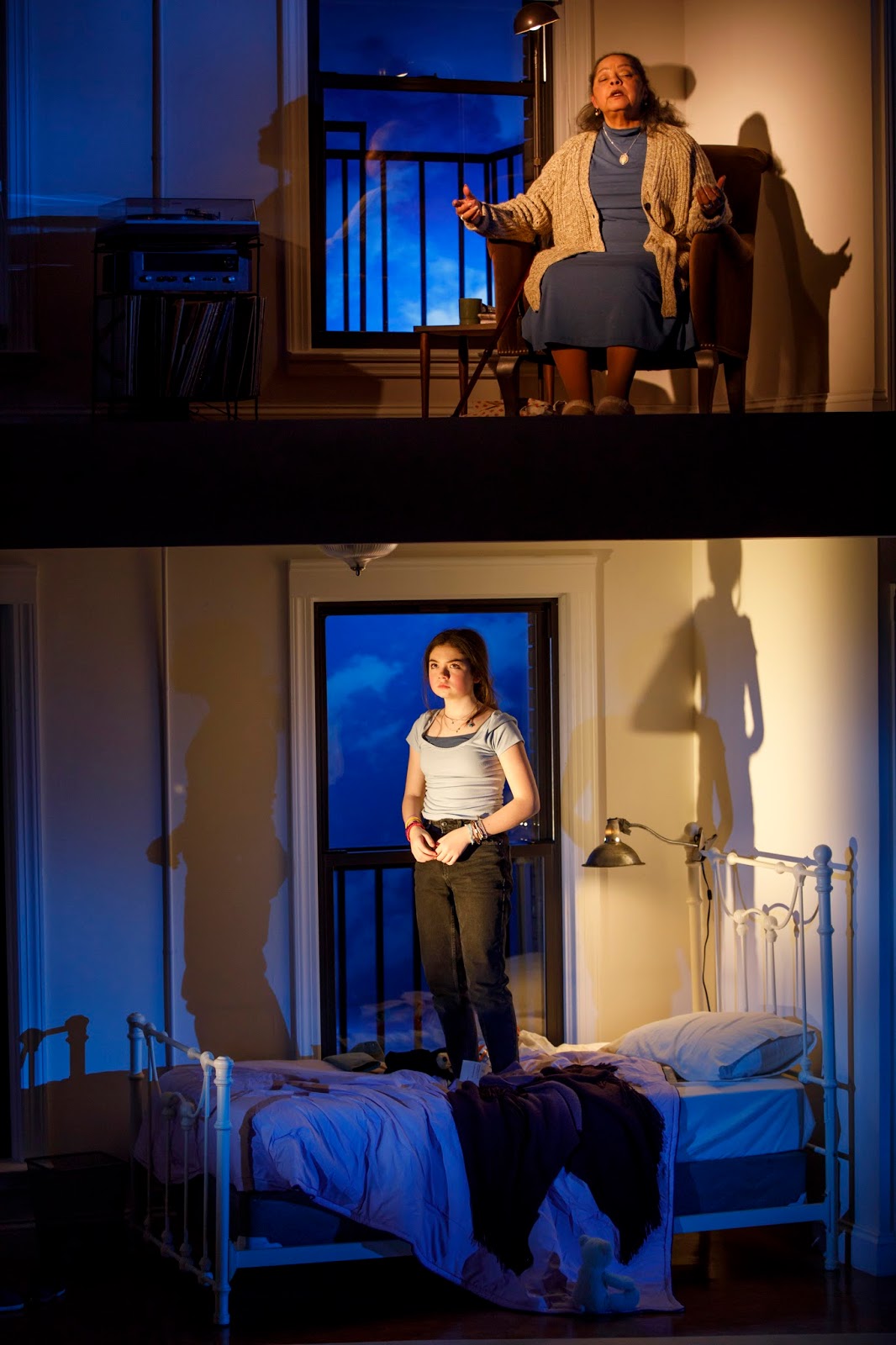
Lynda Gravatt, Ella Kennedy Davis. Photo: Joan Marcus.
Gravátt, with her lovely combination of gravity and lightness, and the baby-faced Davis, a deeply impressive, delicately sensitive young actress in a breakout performance, carry the unnecessary scene off nicely. But it's not enough to rescue the unmemorable This Flat Earth, which even lauded director Rebecca Taichman (Indecent) can do little to inflate.

OTHER VIEWPOINTS:

Playwrights Horizons
416 W. 42nd St., NYC
Through April 29


197 (2017-2018): FEEDING THE DRAGON (seen April 7, 2018)

"A King's Daughter"


For my review of Feeding the Dragon please click on THEATER PIZZAZZ.


Thursday, April 5, 2018

196 (2017-2018): Review: GOLDSTEIN (seen April 5, 2018)


“All That Glitters”

Like many others in the attentive audience crammed into Off Broadway’s uncomfortable Actors Temple Theatre—a still practicing shul—watching the multi-generational musical Goldstein, I recognized similarities to what I know of my own family history. You know the drill: immigrants arriving, starting businesses, raising families, passing on, and leaving a legacy that becomes part of the American fabric.
Jim Stanek, Aaron Galligan-Stierle, Megan McGinnis, Amie Bermowitz. Photo: Jeremy Daniel.

Goldstein is distinctly reminiscent of other plays, most recently Old Stock: A Refugee Love Story, still playing at 59E59 Theaters, which looks at a similar dynamic from a Canadian perspective. It’s also the kind of nostalgic, across-the-decades approach Belva Plain made widely popular in such multi-generational novels as Evergreen

Plain’s novels attempted to avoid the pitfalls of writing about such circumstances. She once said, “I got sick of reading the same old story, told by Jewish writers, of the same old stereotypes—the possessive mothers, the worn-out fathers, all the rest of the neurotic rebellious unhappy self-hating tribe.” The book for Goldstein sometimes stumbles in just this way, yet, judging by the tissues dabbing nearby eyes and noses, that may be one of its strengths.

It’s narrated by the boyishly friendly Louis Goldstein (Zal Owen), who has come to the Actors Temple (where he says his family used to take him) to talk about his Pulitzer Prize-winning new book, Goldstein. It’s an autobiographical account of the Goldstein family, beginning with his grandmother Zelda’s (Amie Bermowitz) arrival from Russia in 1918 with $10 in her pocket.

Seven actors (most playing more than one character) perform the story, which several of its participants—deceased and living—claim is an insulting distortion of what happened. Louis’s beloved, now wheelchair-bound, Aunt Sherri (Megan McGinnis), for example, sings: “YOU WEREN'T THERE. YOU DON'T KNOW. WE WERE LOVING, WE WERE CARING. THIS BOOK TAKES US DOWN BLOW BY BLOW.” Not much actually comes of this truth v. fiction argument, however.
Amie Bermowitz, Megan McGinnis. Photo: Jeremy Daniel.
We meet Zelda on board the ship that brought her here, having a shipboard romance with a man who promises to marry her when they’re settled in. But Zelda, treated like a servant by the sister-in-law she boards with on the Lower East Side, never hears from him again. She ends up marrying the Trotskyite Louie Rudolph (Jim Stanek), with whom she opens “Rudolph’s,” a dress shop in Elizabeth, NJ.

Louie’s last name is really Goldstein, not Rudolph, having been changed to hide his crime of military desertion. Eventually, he goes to prison for a year, while Zelda discovers her hidden strength as a saleswoman while improving the business in his absence.

Over the course of 90 minutes, births and deaths succeed one another. Zelda and Louie have two children, Nathan (Aaron Galligan Stierle) and Sherri. Sherri’s hopes of becoming a doctor are dashed by parental disapproval. She falls in love with the butcher’s son, Sammy Leftofsky (Owen), who joins the navy during World War II and dies on a ship commanded by Nathan. Sherri never does get married.
Megan McGinnis, Zal Owen. Photo: Jeremy Daniel.
Nathan becomes a shrink and marries Eleanor (Sarah Beth Pfeifer), who becomes the nagging Zelda’s pincushion. Nathan and Eleanor have two kids, Miriam (Julie Benko) and Louis (our narrator), whose homosexuality (seemingly indispensable in these narratives) creates a typical family crisis. In the big reveal, Louis learns the secret of just why Zelda never heard from the man she fell in love with all those years ago.

Naturally, stories like this, with their struggles, secrets, mistakes, tragedies, choices good and bad, are universal. Goldstein, while pleasantly entertaining, doesn’t add much to the genre. Its family is rather ordinary and its great romantic secret rings the bell of predictability.
Jim Stanek, Zal Owen, Sarah Beth Pfeifer, Megan McGinnis, Amie Bermowitz. Photo: Jeremy Daniel.
It takes some time to become invested in the characters, whose situations and behavior border on the clichéd and whose humor is generally as flat as a matzo. While the lyrics in several songs are quite effective, too much of the music—accompanied by piano, clarinet, and flute—is generic; it could easily fit a show called Smith. In fact, there’s precious little here—apart from an occasional intonation, shoulder shrug, or “oy gevalt”—that highlights the material’s dormant Yiddishkeit.

Yet it can’t be denied that there’s a nostalgic sincerity to Goldstein that, ultimately, may affect you, particularly toward the end with its message of forgiveness for those who came before you, who were only trying to do their best, regardless of what you thought of them.

Alexander Woodward’s quite plain, bare-bones set, little more than a sparsely furnished wood-paneled room, serves for all scenes (which also sometimes use the central aisle). It’s given some life by Andrew W. Griffin’s lights, especially toward the end, but Maureen Freedman’s more-or-less period costumes add little of visual interest.
Megan McGinnis, Julie Benko, Amie Bermowitz, Zal Owen, Aaron Galligan-Stierle, Jim Stanek, Sarah Beth Pfeifer. Photo: Jeremy Daniel.
Each ensemble member sings quite well and their acting serves the material satisfactorily. Bermowitz’s Zelda has the right motherly touch, Stanek’s Louie conveys a man burdened by responsibility, Pfeiffer’s Eleanor is believably irritated by Zelda’s needling, and McGinnis’s Sherri subtly expresses her character’s various age differences. Brad Rouse’s direction treats the material with respectful affection, as does Sarah O’Gleby’s minimal choreography.  

This musical may not strike as rich a lode as one might hope for, but then again, all that glitters is not Goldstein.

OTHER VIEWPOINTS:

Actors Temple Theatre
339 W. 47th St., NYC
Open run


195 (2017-2018): Review: LOBBY HERO (seen April 3, 2018)

"Lonergan's on Again"


For my review of Lobby Hero please click on THE BROADWAY BLOG.


Wednesday, April 4, 2018

194 (2017-2018): Review: SYMPHONIE FANTASTIQUE (seen April 2, 2018)


“A Murmuration of Puppets”

Not long before I left my house to see Symphonie Fantastique at the HERE Arts Center I happened to watch a brief video on Facebook showing a flock of countless starlings—a murmuration of them, to be precise—creating one beautiful cloud-like pattern after the other before they finally settled down to roost.


Symphonie Fantastique, puppet master Basil Twist’s unusual project in which a team of puppeteers moves objects about in a tank of water to the accompaniment of a musical score, creates a somewhat similar effect. Instead of a mysterious natural phenomenon, Twist provides a remarkably well-crafted artistic creation. It also happens to be—I hate to say it—dramatically dull.
Christopher O'Riley. Photo: Richard Termine.
This revival, whose red carpet performance the night I went drew a highly enthusiastic audience, celebrates the piece’s 20th anniversary. It demonstrates the brilliant imagination of the strikingly versatile Twist, a MacArthur Fellow and rightfully so. Symphonie is not what one would expect from the man responsible for, to take one example, the exquisite, Japanese-influenced Dogugaeshi, which first exposed me to his art.
Photo: Richard Termine.
In Symphonie Fantastique, a work the now 48-year-old Twist devised after taking home and mending a discarded aquarium, we discover how a variety of fabrics, feathers, and other items can be put to aesthetic use when manipulated under water, beautifully lit, and accompanied by powerful music. Twist has a very broad interpretation of puppetry, considering anything that can be made to seem organic or lifelike as grist for his mill. In Symphonie Fantastique nothing resembles humans or animals—although it’s easy to imagine fish, eels, or even underwater vegetation. See here for a preview.
Photo: Richard Termine.
The music accompanying the puppetry is Hector Berlioz’s Symphonie Fantastique, an 1830 composition inspired by Berlioz’s passion for an English actress he had seen on stage in Paris. The composition has been transcribed for a single pianist, Christopher O’Riley, who sits downstage right, with just enough light to read the score, while the stage area itself reveals what could easily be taken for a large, flat-screen TV. Actually, it’s one side of a 1,000 gallon tank of water, its perimeter completely masked.
Photo: Richard Termine.
Each of the five movements in Berlioz’s composition is preceded and concluded by the rise and descent of an artificial, red tab curtain. As O’Riley offers his virtuosic performance, a team of five invisible puppeteers in wet suits cause numerous shapes to float, dance, twirl, circle, leap, and sway within the tank, all of it jolted to life under Andrew Hill’s magnificent panoply of lighting effects. Even the water dances, as multiple spouts conspire to mingle jets of spray and bubbles with the ever-changing objects.
Photo: Richard Termine.
While there’s nothing especially funny in any of this, the audience laughed loudly during the breaks between movements. Presumably, this was in response to humorous behavior by the pianist, hidden from me by the bushy-headed man in front of me, who was either Oskar Eustis or his doppelganger.  
Photo: Richard Termine.
At the end of the show, the audience is invited backstage for a fascinating glimpse of the technical apparatus that produced what they’ve just witnessed. There, walking on the wet floor among lighting cables, they’ll squeeze through a narrow space filled with technicians, puppeteers, fellow audience members, and the many props used in the performance.
Photo: Richard Termine.
Despite there actually being a written story or “program” written by Berlioz to help follow his music, Twist eschews it. In his “creator’s note,” he declares: “I want the audience to enjoy the music and the visuals for what they are. I feel Berlioz would agree with me. Later in his life, Berlioz wrote there was no need to provide the written program. . . .  He insisted that the music stood on its own.”
Photo: Richard Termine.
So, essentially, Symphonie Fantastique is either a piano concert accompanied by charmingly choreographed, abstract images, or vice-versa. Some will search for hints of a narrative context in the swirling, twisting shapes, perhaps even anthropomorphizing what they see—could those two red feathers be lovers? Is that white shape the woman Berlioz yearned for? Otherwise, they’ll simply appreciate the experience as a pleasant way to pass 55 minutes without having to think at all.
Photo: Richard Termine.
Twist finds inspiration in the ideas of Russian artist/musician Wassily Kandinsky (1866-1944), who decried the 19th century’s preoccupation with material phenomena at the expense of life’s “inner sphere,” or “cosmic element,” which he considered especially lacking in drama, opera, and ballet.
Photo: Richard Termine.
In his search for artistic expression beyond the bounds of realistic representation, Kandinsky sought answers in synesthesia, “that interdependence of the sense from which some gather the impression of ‘seeing’ sounds in terms of colour, or hearing colours as sounds,” as Richard Drain explains it. In Symphonie Fantastique Twist also seems to be attempting the production in the spectator of what Kandinsky called a “spiritual vibration,” free from the need to represent the outside world.
Christopher O'Riley. Photo: Richard Termine.
To me, though, the most immediate predecessor of what Twist accomplishes is the first selection in Walt Disney’s astonishing Fantasia (1940), the segment in which a world of exquisite abstract images accompanies an orchestral rendition of Bach’s “Toccata and Fugue in D Minor.” As its name suggests, Fantasia is itself a Symphonie Fantastique. It is, however, by no means a drame fantastique.

OTHER VIEWPOINTS:

HERE Arts Center
145 Sixth Ave., NYC
Through May 31


Monday, April 2, 2018

193 (2017-2018): Review: THREE TALL WOMEN (seen March 30, 2018)


“Three Terrific Actresses”


The 1993-1994 season was a distinguished one in New York theatre history, if only because it was when two major American plays, both recently revived, opened there. One was Tony Kushner’s Angels in America: A Gay Fantasia on National Themes, produced on Broadway, the other was Edward Albee’s Three Tall Women, seen Off Broadway, and now on Broadway for the first time. Joe Mantello, who played Louis in the original Angels in America, interestingly, is now the director of Three Tall Women
Glenda Jackson, Laurie Metcalf. Photo: Brigitte Lacombe.
The return of the play, which won Albee his third Pulitzer Prize and re-lit his fading star, deserves celebration on its own merits, of course, but even more because of its three leading ladies in the roles of A. B, and C. These anonymous roles, first played by Myra Carter, Marian Seldes, and Jordan Baker, are now (the late Seldes aside) in the even starrier hands of Glenda Jackson, Laurie Metcalf, and Alison Pill.

Metcalf and Pill, of course, are among our busiest actresses, on both stage and screen, so we take their gifted presences for granted. If you’re a theatre lover (and even if you’re not), however, you should be rushing to get tickets so you can bask in the radiance of the 81-year-old Jackson, returning to the boards after a quarter of a century layoff while she busied herself with more mundane duties as the Member of Parliament for Hampstead and Kilburn. 
Glenda Jackson. Photo: Brigitte Lacombe.
Jackson made an indelible impression on me (and countless others) even before she became a star when I saw her 53 years ago in Peter Brook’s visiting production of Marat/Sade. The image of her whipping Ian Richardson’s Marat with her long hair as he reclined in his tub is as vivid as if I’d seen it yesterday. I won’t live another 53 years, of course, but, however long it is, I suspect that the memory of her electric performance in Three Tall Women will always be good for a tingle.

Wearing a silver, marcelled wig, her lips a bright splash of red across her deeply lined, heavily powdered face, her slender frame with its fragile bones connected to a spine of steel, she is A, a wealthy, cantankerous, 92-year-old matriarch (she maintains she’s only 91). Dressed in nightshift and dressing gown, she’s at home in her elegantly appointed bedroom, beautifully designed by Miriam Buether and lit by Paul Gallo. Her arm in a sling, she sits in an upholstered armchair while holding court in the company of two other women. The first half of the play is dominated by her and her memories.
Laurie Metcalf. Photo: Brigitte Lacombe.
The other women are B (Metcalf), 52, A’s hard-working, paid companion, wearing slacks and blouse, and C (Pill), 26, a pretty, blonde attorney. C, dressed smartly in a well-tailored business ensemble of black jacket, skirt, and heels, is there to sort out the old lady’s messy legal paperwork.
Alison Pill, Glenda Jackson, Laurie Metcalf. Photo: Brigitte Lacombe.
When the play is dominated by A and her memories, she’s an imperious, queenly figure, but she’s also incontinent, demanding, complaining (everyone’s out to rob her, she often gripes), homophobic, anti-Semitic, and self-contradictory. 

At times she appears to be suffering from dementia only for her to remember experiences—such as those regarding how she dealt with men and married into money—in great detail or to make bitingly funny remarks. At one point, she provides a hilariously risqué monologue about her husband’s “pee-pee” and a diamond bracelet that brings to mind Jerry’s monologue about the dog in Albee’s The Zoo Story.
Alison Pill. Photo: Brigitte Lacombe.
B, while fully aware of A’s difficulty, acts as her mediator, assuming a wryly cynical, water-off-a-duck’s back acceptance of A’s inconsistencies and rampant bitchiness, which she humors, while doing everything she can to make A comfortable. The impatient C, however, is increasingly frustrated by A’s contrariness, and, to her own disappointment, unwilling to “be nice.”

We also learn that A has a son, but that there’s a coolness between him and his mother; the situation, which becomes more stringently apparent later, when the wordless son himself appears, reflects Albee’s own bitter relationship with his adoptive mother, who refused to accept his homosexuality, regardless of his literary fame.

Part one ends with A suffering a stroke. There’s no intermission between the two parts of this hour and 45-minute play, but when the second half begins, a dummy of A lies in the bed, while the women appear in glamorous dresses (for which the great veteran, Ann Roth, is responsible).
Laurie Metcalf. Photo: Brigitte Lacombe.
C now represents A in her 20s, B in her 50s, and A in her energetic 70s. At the same time, they have about them something of the characters they played in the first part, but never too obviously. The set, too, has been altered so that the bed’s headboard has been removed and the rear wall is mirrored to reflect the audience.
Alison Pill, Glenda Jackson, Laurie Metcalf. Photo: Brigitte Lacombe.
B and C contemplate the invalid in the bed, commenting on their respective views of ending up like her, or even the optimistic C’s becoming the world-weary B. Gradually, the audience realizes that B and C are younger versions of A, who soon enters herself, decked out in a fancy lavender dress, and no longer the sometimes irrational, uncomfortable character of part one.

While it’s impossible to accept on a literal level the idea that these three sharply different characters could actually be the same person, you can enjoy Albee’s conceit only if you accept his broader vision about how people evolve over time, sometimes radically, perhaps even having trouble recognizing earlier versions of themselves.

As they converse, waiting for A’s death, B and C recall the parts of her life they experienced, including their gay son, who walked out many years ago and, while never forgiven by B, found a kind of reconciliation with A. This becomes clear when he (uncredited) silently materializes at his mother’s bedside.

This prompts a discussion of how each version of A, in turn, changed over the years, and how, because of the lies we’re told, no one is prepared for the changes that come to all of us. Soon, the women contemplate which part of life is the happiest, the final hint suggesting that, perhaps, it comes when life is drawing to its end.

Listening to Albee’s thoughts, sometimes blazingly clear, sometimes tantalizingly cloudy, and often burst out-laughing funny, expressed by these masterful actresses produces solidly satisfying theatre.

Jackson’s razor-sharp diction and her commanding voice, more distinctive than ever, makes her every utterance a gem; she can bring the house down with a single throwaway word. A four-time Tony nominee, Jackson should be a favorite to finally land the trophy this time around. Metcalf, again as flawless as the Hope diamond, brings her distinctive human warmth and sense of humor to B, while rising star Pill makes even the less fully developed C deliciously easy to swallow.

Three Tall Women is essentially plotless theatre but the humming motor of its performance and the perceptive wisdom of its dialogue prevent any hint of creeping stasis. Joe Mantello and his cast faced a tall order and delivered the goods.

OTHER VIEWPOINTS:

Golden Theatre
252 W. 45th St., NYC
Open run


Sunday, April 1, 2018

192 (2017-2018): Review: THE LUCKY ONES (seen March 29, 2018)


“Better Luck Next Time”

It’s been only three months since Shaun and Abigail Bengson—the married indie-musician team called The Bengsons—closed Hundred Days, their flawed but promising first full New York production at the New York Theatre Workshop. 


Abigail and Shaun are now back, just a few blocks east, at Alphabet City’s Connelly Theatre, with their new musical, The Lucky Ones, produced by Ars Nova. Directed by Anne Kauffman, who also directed Hundred Days, it’s larger scaled than the earlier show, but it’s a similarly autobiographical (mostly) musical play/concert, given a stripped-down, café theatre-like approach. And it’s similarly flawed but promising.
Company of The Lucky Ones. Photo: Ben Arons Photography.
Once again we view a sparsely adorned, brick-walled stage, designed by Rachel Hauck, dressed with little more than stacking chairs, musicians’ platforming, and microphones. Amith Chandrashaker’s lights help make it nice to look at, and Ásta Bennie Hostetter’s quotidian costumes clarify who’s who.
Abigail Bengson, Shaun Bengson. Photo: Ben Arons Photography. 
Occasionally, a chorus is ensconced in a loft area behind the audience; the venue, built in 1874 as part of what originally was a church orphanage, served for the orphans’ choir. Seeing the chorus, if you’re suitably flexible, requires you to swivel your head.  

The Lucky Ones, being largely autobiographical (“a true story, even the parts that never happened,” Shaun declares), allows The Bengsons to play themselves. Joining them are 14 actor-singers (five of them forming the “ensemble”), plus the two musicians who make up the Bengsons’ electro-folk band, Dani Markham and Pearl Rhein.
Shaun Bengson. Photo: Ben Arons Photography.
 The book, by The Bengsons and Sarah Gancher, who also collaborated on the much simpler Hundred Days, introduces Abigail’s family when she, her middle sister, Emily (Ashley Pérez Flanagan), and her older sister, Phoebe (Jennifer Morris), were growing up in a town Abigail calls Lotus, which she locates in “a part of Vermont that happens to be in Maine.”

Their hippie-like parents, Sherrill (Myra Lucretia Taylor) and Tom (Tom Nelis), run the progressive Summerhill-like Blue Mountain School, where students are instructed to question everything. The sisters attend it along with their neighboring cousin, Kai (Damon Daunno), son of their mother’s sister, Mary (Maryann Plunkett), whose daughter is Amber (Amelia Workman).

The rambling, not particularly enthralling story describes Abigail’s dysfunctional family (including her philandering dad); the free-range, ultraliberal upbringing the children received; the arrival of a sweet new student named Emma (Adina Verson); Kai’s attraction to her; the drug-fueled hallucinations that put him under an angel’s spell (Zach McNally) and drove him to commit a horrible act of violence; and efforts to resolve the family’s issues in later years. The program includes a family tree illustration with cartoons showing the relationships of all the characters.
Damon Daunno. Photo: Ben Arons Photography.
Very little action moves the narrative forward, creating a sense of stasis. What we witness is mainly offered in the form of memories and comments on the memories, much of it based on verbatim transcripts of interviews with those involved. For an example of how memories sans action can create artistically exciting theatre no better example could be cited than Albee’s Three Tall Women, now in revival on Broadway.

While the rather dreary tale is often lightened by the music, as the play progresses over an unnecessarily long two hours (with one intermission), talk begins to take precedence over music, the words becoming boring blather. Just because the memories are expressed in articulate language doesn’t make them as fascinating to an audience of strangers as they must be to The Bengsons. Some of what we hear, in fact, recaps material about Abigail and Shaun already visited in Hundred Days, making The Lucky Ones its prequel.

Anne Kauffman deserves credit for her physical staging, especially the breakfast scene early in the show where most of the characters are introduced, but Sonya Tayeh’s unusual choreography is the most memorable visual component. Kauffman, though, has failed to shape or edit the material in a compelling way, allowing its incipient sense of self-indulgence to eventually overshadow everything.
Abigail Benson and company. Photo: Ben Arons Photography.
Luckily, The Lucky Ones has a first-rate cast, veterans Nelis, Taylor, and Plunkett giving the production a genuine touch of class supported by promise in all the younger players. (Fun fact: Plunkett was the last actress to play Shaw’s St. Joan in New York prior to its current incarnation with Condola Rashid.)

Abigail Bengson, who plays guitar and drums, has a versatile, powerful voice and an expressive presence offset by the softer tones and less intrusive personality of Shaun Bengson. Their music, which appears to have given them a following, touches various styles, from bluegrass to rock, some of it broadly accessible, some of it narrowly idiosyncratic, is not an ideal fit for narrative musical theatre. 
Tom Nelis. Photo: Ben Arons Photography.
Whereas the music often emerges from the dialogue, it just as often—when Abigail is singing—has a self-conscious, stand-alone quality that fails to engage the narrative and draws more attention to the singer than what she’s singing. 
Adina Verson, Damon Daunno. Photo: Ben Arons Photography.
If you’re familiar with The Bengsons, enjoy their sound, and don’t mind an overwritten, unkempt script, you can consider yourself one of the lucky ones. For myself, I wish them better luck next time.

OTHER VIEWPOINTS:

Connelly Theatre
220 E. 4th St., NYC
Through April 21