Wednesday, September 11, 2019

69. (2019-2020): Review: L.O.V.E.R. (seen September 10, 2019)


“Just a Five Towns Girl”


L.O.V.E.R., originally produced in Croton Falls, NY, and then in Los Angeles, is a middling, sexually-oriented memoir cum one-woman play by and starring actress Lois Robbins. Seen locally last year at the United Solo festival, it's now playing at the Pershing Square Signature Center. 

Since I confess my previous unfamiliarity with her, I assume the same is true of many who might wonder, what’s Lois Robbins to us or we to her that we should care for her? 
Lois Robbins. All photos: Joan Marcus.
Lois Robbins is an attractive, youthful-looking woman at around the mid-century mark, with the svelte dancer’s physique of someone half her age. She takes pleasure in displaying it when the script allows her to remove her long, clinging sheath—worn with sneakers—so she can prance about in pale pastel tights.

Robbins has had a reasonably substantial career in all the entertainment media. You can watch clips of her film work here on IMBD, beginning with one showing her opposite British heartthrob Jonathan Rhys Meyers in The Aspern Papers, an indie also starring Vanessa Redgrave. Her principal claim to fame seems to be her work on various daytime TV soaps.
Lois Robbins.
More to the point, she’s from a Jewish family in the Five Towns section of Long Island (where my own daughter raised her family). It’s a geographical origin (near JFK) she finds slightly embarrassing although she’s clearly proud of her ethnicity, insisting she can play “Jewish” despite never getting cast as such. Although her script, which is more in the “then-I-laid” than the “then-I-acted” vein, doesn’t cite particular movie. TV, or theatre work, she constantly refers back to her upbringing, including her demanding father’s snide remarks and her mother’s pearls of parental wisdom.

This background, and her New York-area personality, should make her story that much more immediate to a local audience. Indeed, the vast majority of those around me were middle-aged women, clearly her target audience, who seemed to appreciate the shifting focuses of her self-deprecating tale of self-gratification, evolution from ugly duckling to "stunning" (as an admirer says), sexual development, search for love in all the wrong men, theatrical ambitions, marriage, parenting, and health issues.
Lois Robbins.
I say “self-gratification” because the play begins with Robbins sprawled across a washing machine as she tells us that she had her first orgasm at age three. She proceeds to explain how, as she grew up, she couldn’t resist “the feeling” she got from direct contact with the soft and hard parts of her furniture, as well as the vibrations of her washing machine.

Her detailed account of her masturbation mastery suggests we’re in for an autobiographical Fifty Shades of Grey but, alas (or amen), her story largely drops the radically risqué to concentrate on her more conventional romantic and sexual experiences (including her rejection of a threesome) as she simultaneously pursued her career in New York and the West Coast. None of the men or things she does with them are particularly unusual, though, and, much as they may seem unique to her, sound relatively common in our sexually liberal times.

Finally, Robbins found Mr. Right in the shape of the spouse she calls (like everyone else she mentions) by a pseudonym, Arthur, despite his being the enormously wealthy Andrew Zaro, a fact she neglects to convey. Robbins's survival from a serious--if, tragically, all too familiar--health scare and the raising of her own kids fill out (or bloat, depending on your perspective) the narrative,.

Fewer topics and more of the outrageousness promised at the start might have salvaged the piece. A successful, recent example of such an approach would be Jacquelin Novak: Get on Your Knees, a one-woman show preoccupied with relationship issues in the context of the actress’s obsession with fellatio.

It’s also hard not to see in Robbins’s relationships (including an actual “affair”) a tendency toward passivity and victimization, as if it were always the men who were responsible, not only for making the initial connection but for whatever difficulties ensued.

Director Karen Carpenter gussies up Robbins’s rather unsurprising, disappointingly unfunny material by moving the lithe, physically expressive performer up, down, and around Jo Winiarski’s skeletal set of a three-tiered structure of steps and landings dressed with white sheeting, over which hang an assortment of seven, small, glass lighting instruments. Jeannette Oi-Suk Yew’s lighting is called on frequently to alter the mood from one sequence to another (indicated by moving LED ribbons saying things like, “THE GIRL,” “THE TEENAGER,” “THE WOMAN,” “THE PATIENT,” etc.). Jane Shaw’s expert sound design, with music, crowd noises, and other effects, also contributes mightily.
Lois Robbins.
Robbins is polished and pleasant, but (a few moments of genuineness aside) she comes across more as an actress than the spontaneously charming person she needs to be. Nor is she helped by material filled with commonplaces that aren’t enhanced by her occasional tendency to giggle, as if that might make them seem wittier than they are.  

At two points, Robbins provides different words to spell out her acronymic title. I came up with my own but maybe it's best not to repeat it.

Pershing Square Signature Center/Alice Griffith Jewel Box Theatre
480 W. 42nd St., NYC
Through November 2

OTHER VIEWPOINTS:


Saturday, September 7, 2019

67 (2019-2020): Review: SINCERITY FOREVER (seen September 5, 2010)

"Heads Up"


If you’re planning to kill two plays with one ticket at the Flea Theater in order to see both Bad Penny and Sincerity Forever on the same evening, be aware—as noted in my review of the former—that you’ll need a separate ticket for each.
Amber Jaunai, Nate DeCook, Vincent Ryne. All photos: Allison Stock.
These works, of course, are part of the Flea’s Mac Wellman: Perfect Catastrophes, A Festival of Plays, celebrating the iconoclastically gnarly work of Flea cofounder Wellman, the prolific writer who heads the distinguished BFA Playwriting Program at Brooklyn College.

And, even if you concur with my less-than-enthusiastic response to Bad Penny, the first half of the bill, if you’re planning to see them in succession you’ll likely to find it worth your while to stick around for Sincerity Forever, even though it means killing an hour between the plays in a not particularly engaging part of Tribeca.

Originally produced at the Berkshire Theater Festival, in 1990, where it won an award, and seen later that year in Brooklyn as part of the 1990 Fringe Series, Sincerity Forever was dedicated to the late Senator Jesse Helms “for the fine job you are doing of destroying civil liberties in These States.” This tongue-in-cheek honor presumably led the National Endowment for the Arts to request that Wellman remove the credit he gave it for an N.E.A. playwriting fellowship, with the writer noting in the published script that he “was wrong, SINCERITY FOREVER was not made possible by the generous assistance of the N.E.A. I don’t know what I was thinking.”

This gives you an idea of Wellman’s feisty political heart, which he pours into Sincerity Forever, a stinging, one-act putdown of American life as seen through the preternaturally ignorant eyes of seven teens living in the fictional, Deep South, small town of Hillsbottom. Moreover, most of these drawling characters dress as if Ku Klux Klan sheets and coneheads were standard cool kids gear.

The thinly plotted play's offbeat characters and structure are accompanied by a heightened, sometimes bizarre, blend of redneck locutions, colorfully distorted grammar, colloquial teenspeak, formal rhetoric, and extreme profanity. At the same time, it’s more linear and thematically accessible than Bad Penny. It’s also better directed (by Dina Vovsi) and performed (by the Bats, the Flea’s resident company of young actors-in-training). It’s still weird, though, as well as over-the-top and WTF?

More than half of its eight scenes are conversations among pairs of teens sitting in cars. These are Judy (Malena Pennycook) and Molly (Charly Dannis), who have two scenes together; Hank (Nate DeCook) and Tom (Vince Ryne); Judy and George (Peter McNally); and Lloyd (Jonathan Ryan) and Tom. Another teen, Melvin (Alex Hazen Floyd), joins in later on.

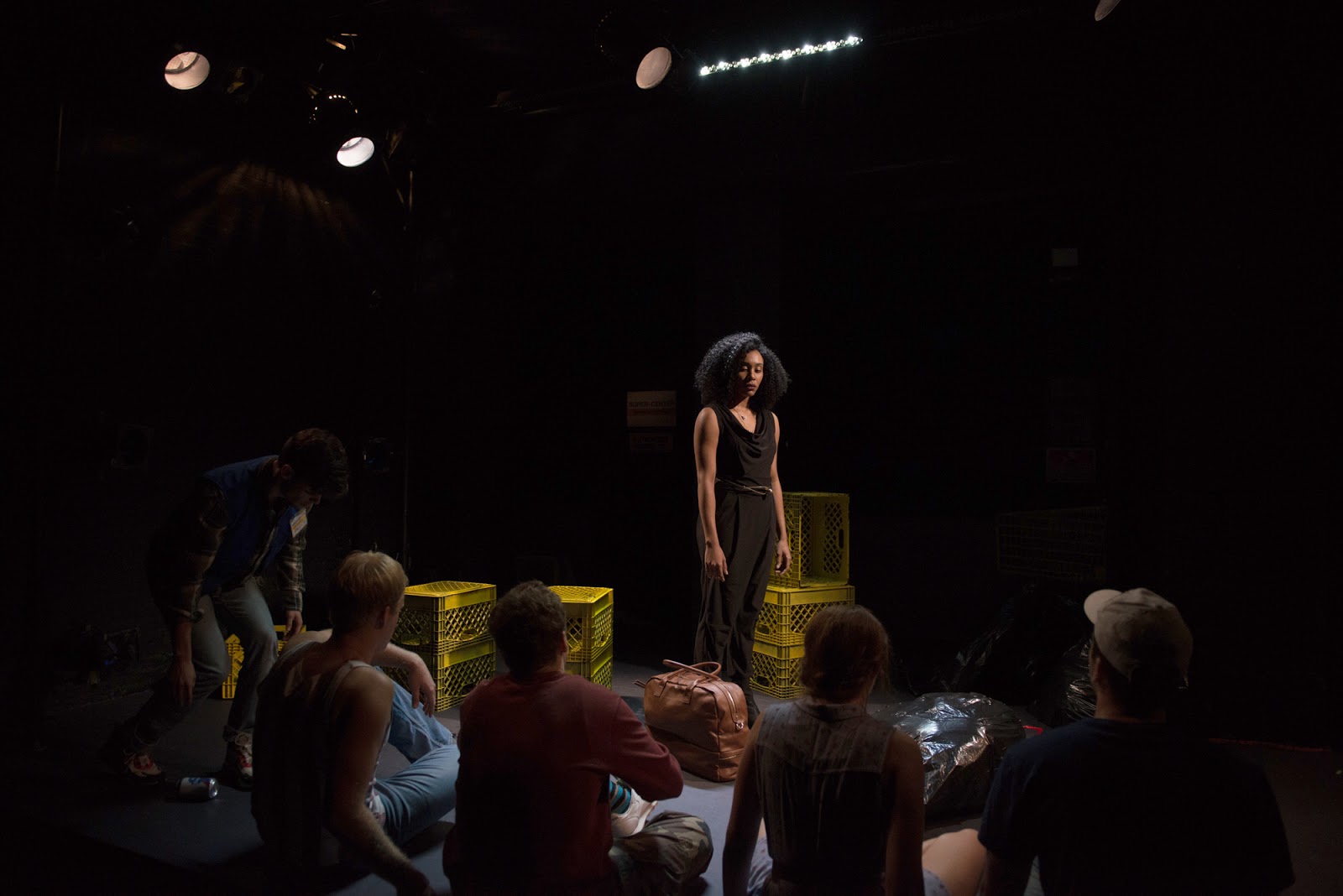
Stirring things up are a pair of disputatious demons from the tribes of Belial and Abaddon: Furball #1 (Zac Porter), wearing a fur vest, and his Goth partner, Furball #2 (Neysa Lozano). Bringing the wrath of God to town, however, is the suitcase-carrying Jesus H. Christ (Amber Jaunai), played here as an angrily intense African American woman.

Frank J. Oliva’s sceneryless stage, nicely lit by Becky Heisley McCarthy, uses little more than plastic milk boxes, with a narrow beam hanging across the stage about two feet from the ground. As the characters talk while sitting directly behind the beam, we discover American youths practically reveling in their know-nothingness. They think that those who profess knowledge are only faking it, and take pride in being “ignorant forever in absolute sincerity.” Sincerity, you see, is a virtue high enough to forgive any other lapses.

Their comically convoluted conversations are larded with references to God’s secret plans, religious faith, their souls, the search for meaningfulness, heaven and hell, death, romantic crushes (hetero and homo), jealousies, coolness, sex, catastrophic ills, like nuclear pollution, and even the purity of their families’ ancestral, Aryan stock, with invocations to the Norse god Wotan (a.k.a. Odin).

The teens believe their lives are being disrupted by the presence of a mystic Furball that must be destroyed. Those fuzzy aliens—who like jiving to a heavy beat—are demons who thrill to their own monstrosity while hating everything these “empty-headed purveyors of the American dream,” with their “fake cant and bullshit,” hold dear. In fact, one insists it’s all “deeply insincere.” On the other hand, they claim sincerity for themselves, even quarrelling bitterly over which is more sincere. Thus, the arrival of Jesus, bearing an “apparatus” that can detect a Furball’s presence and ready to use her mind to obliterate any she might find.
Malina Pennycook, Amber Jaunai, Alex Hazen Floyd, Vincent Ryne.
Wellman enjoys keeping us off guard by playing games with his language and situations, including having characters, once they're infected by the Furballs, repeat dialogue earlier said by others, or even to have them argue using the Furball’s own particular insults. “Something bad’s gotten into us,” admits someone.

Toward the end, the kids go haywire, with a climactic cacophony of overlapping arguments (as indecipherable as those in Bad Penny) before Jesus delivers a lengthy diatribe. She explains her mission, noting “what a sorry place this world is,” blasts everyone for their vanity, hypocrisy, and distortion of Christian values, casts aspersions on “dumb-ass” sincerity, and wonders why she should  even bother with mankind.
Amber Jaunai.
Not all of this comes across clearly, however, nor am I sure I grasped more than a handful of Wellman’s points, but the writing and staging manage to hold the attention much of the time. The KKK costumes, interestingly, seem intended more to symbolize the kind of ignorance that informs American racism than to reflect actual racist behavior. Apart from a few references, like those to Aryan ancestors, or a quickly passing homophobic/anti-Semitic/racist comment, the usual KKK tropes of cross-burnings, lynching, or slurs are ignored.

As noted in my Bad Penny review, Wellman writes for a niche audience—to which I admit not belonging—that greatly appreciates his quirky, nontraditionalism.  But, given Wellman's esteem as a maven of the avant-garde, I sincerely suggest that, for those interested in an important example of late 20th-century “experimental theatre,” Sincerity Forever, unlike Bad Penny, deserves a heads up. 

Flea Theater/The Siggy
20 Thomas St., NYC
Through September November 1

OTHER VIEWPOINTS

66 (2019-2020): Review: BAD PENNY (seen September 5, 2019)


“Tails Down”


Mac Wellman, the prolific, multi-award-winning playwright, novelist, essayist, and poet heads the Brooklyn College’s MFA Playwriting Program (we were colleagues before my 2007 retirement from the Theatre Department). He's made it one of the most successful in the country: think Annie Baker, Young Jean Lee, Thomas Bradshaw, etc. Wellman's also a cofounder of Tribeca’s Flea Theater, which is presently offering five of his short plays in a festival called Mac Wellman: Perfect Catastrophes.
Joseph Huffman, Emma Orme, Baile de Lacy, Lambert Tamin. All photos: Allison Stock.
Wellman has held high the banner of nontraditional, avant-garde, post-absurdist theatre throughout his abundant career. His nonlinear, linguistically challenging, intellectually slippery, politically charged, and morally determined plays fly in the face of conservative, realistic theatre, with which he has notably taken issue. These idiosyncratic qualities are present in the first two of the festival’s plays, the black comedies Bad Penny and Sincerity Forever (reviewed separately).

Like many of Wellman’s works, these are niche plays, loved by his followers (only a few of whom were there when I went) but caviar to the masses, who would generally prefer the theatrical equivalent of hot dogs and burgers (like me, I guess).
Rear: Baile de Lacy, Dana Placentra, Lambert Tamin; front: Katelyn Sabet, Alex J. Moreno, Caroline Banks; right: Emma Orme.
Be aware that, while they’re presented on the same evening, the tickets are sold separately. If you intend to see them back to back—most who attended when I did chose not to do so (unless Bad Penny convinced them not to return)—be prepared to find something to occupy you nearby between 8:00 and 9:00 pm. Thomas Street is not located in a particularly jumping downtown spot. I was lucky because my plus-one lives a few blocks away.

Bad Penny, originally given a site-specific performance in 1989, near the lake at Central Park’s Bow Bridge, where the action transpires among a group of strangers, is here performed in a small outdoor patio area directly behind the Flea's Pete Theater. To suggest the park setting, the concrete ground is covered with AstroTurf. A single row of metal, plastic, wood (with a picnic table), and canvas chairs (the low, beach-type folding ones) circles the space. Several blankets and yoga mats are spread about for audience members to sit on. The place, designed by Jian Jung, resembles a nursery school play area more than it does Central Park, or any park, for that matter.

Tall, glass windows (one is also a door to the interior) line one side of the space. Although a considerable amount of important action will occur on the inside of the windows, only those opposite the wall can see it, depriving at least a quarter of the audience of the view.
Joseph Huffman, Emma Orme, Dana Placentra, Baile de Lacy.
This is part of the reason director Kristan Seemel’s production only further clouds the  already hard-to-grasp dialogue and behavior. Things are even further dulled by the insistent hum of what seem 100 air conditioners, not to mention, when I attended, repeated helicopter noise.

The confusion created by mingling the actors—the Bats, the Flea’s resident company of young actors-in-training—with the audience, which at first makes it difficult to separate the normally-dressed actors from spectators, requires a few minutes before we can tell who’s who. In short, the production, for all the actors’ enthusiasm, would seem to serve the already problematic play poorly. I say “seem” because this may be precisely what’s being sought.

My wife is one who never leaves a dropped penny behind but insists on rescuing it from abandonment. Bad Penny suggests this might not be such a good idea. The bad penny retrieved by Kat (Bailie de Lacy)—a young woman (designated as Woman One) who’s had mental problems, is obsessed with myth, and ponders whether the sky is real or an illusion—appears to be attracting bad luck.

This is expressed through her exchanges with others she encounters, beginning with Man One (Jason Huffman), calling himself Ray X, “a freelance memory fabulist and metaphysician and card player” from Big Ugly, Montana, who’s left his Ford Fairlane 500 on the East Side because of a flat.  Carrying the tire, which he says he yanked off with brute strength when his jack broke, he’s searching in vain for a gas station.
Caroline Banks, Baile de Lacy, Emma Orme.
Eventually, the others (Alex J. Moreno, Emma Orme, and Lambert Tamin) join in, backed by a chorus of three (Caroline Banks, Dana Placentra, and Katelyn Sabet, reduced from the original’s 12), as we hear (or would if there weren’t so many distractions) frequently nihilistic references to  ugliness, gruesome upbringings, consumerism, toxicity, suspicion, conspiracy theories, trolls, normalcy, a cancer-curing cheese, bulldogs, the meaning of our seemingly senseless existence, and man’s decline into “crummy, little, cheesy, lousy, liars, and con-artists.”  

An important mythical element is the Charon-like Boatman (Ryan Leslie Stinnett) who—although not provided here with anything resembling a boat—is coming for the man with the tire after Kat gives him the penny (which was stolen from the Boatman). Much of what is spoken is incomprehensible, not only because of the ambient noise, the long lists of colorful adjectives, or the densely worded discourse, but because they sometimes shout at and over one another. This too is likely part of the agenda.

Wellman’s script reveals considerable wit mingled with numerous provocative notions. Very little, however, comes through in the Flea’s jumbled production. As it proceeded, I couldn’t help observing a whitehaired, well-known reviewer across from me, someone to whom I’ve been saying hello for years only for him to glance at me as if I were not only a stranger but a pest needing swatting. While he could easily be one of Wellman’s disgruntled characters, his grumpy expression throughout so thoroughly matched my own feelings, I was ready to hand him a newspaper with which to swat away whatever he wanted.

Flea Theater/The Pete
20 Thomas St., NYC
Through October 7

OTHER VIEWPOINTS:


Thursday, September 5, 2019

65 (2019-2020): Review: BETRAYAL (seen August 31, 2019)


"Pauses, Poses, and Pinter" 

In the 1960s, British playwright Harold Pinter (1930-2008), who went on to earn a Nobel Prize, was married to actress Vivien Merchant but having a seven-year fling with BBC-TV personality Joan Bakewell. This personal experience was one of several important influences on his 1978 drama about marital infidelity, Betrayal, now receiving its fourth (and, possibly, best) Broadway production since 1980.
Charlie Cox, Zawe Ashton, Tom Hiddleston. All photos: Mark Brenner.
I recall being unimpressed by that mostly lauded 1980 staging, largely because I considered its three usually outstanding American stars, Roy Scheider as Robert, Blythe Danner as Emma, and Raul Julia as Jerry, to be unconvincing as highly-educated Brits. I missed the 2000 revival, starring Liev Schreiber, Juliette Binoche, and John Slattery, as Robert, Emma, and Jerry. None was English, but, in 2013, when the potentially awesome all-British cast of Daniel Craig, Rachel Weisz, and Rafe Spall played the the same roles, my response (unlike that of most viewers) was only ho-hum.

For the current, limited-run, revival at the Bernard B. Jacobs Theatre, which originated earlier this year during London’s Pinter at the Pinter season, the biggest name among the English leads is Tom Hiddleston (Loki in the Avengers movies), who plays Robert. This is not to say his bright costars, Zawe Ashton (Velvet Buzzsaw) as Emma and Charlie Cox (Philip, Duke of Crowborough on “Downton Abbey”) is Jerry, are in any way diminished by his charismatic presence. They play their roles with the diamond-cutting precision of master jewelers.

But that is still not enough to convince me that Betrayal is more substance than style. In fact, the brilliance of the acting here in Jamie Lloyd’s unconventionally minimalist, finely tuned staging only serves to emphasize the play’s technical glitter over its emotional heartbeat. In the interest of brevity, allow me to adapt the capsule summary of the plot from my review of the 2013 production.

It tells the story of how, in 1968, Jerry, a literary agent (Pinter’s avatar), a married man and father, falls for and begins his affair with Emma. She is the gallery-owning wife of Robert, a publisher who is Jerry’s closest friend (his best man, in fact). The affair lasts seven years and ends in 1975. For much of the time, the lovers conduct their clandestine romance in a rented flat. Meanwhile, Robert begins his own affair, as does Jerry’s wife, Judith. A coda, set in 1977, two years after the affair ends, brings the former lovers together at a pub, and Emma reveals that she is now involved with another writer, one of Jerry’s clients whose publisher is Robert.

What makes this otherwise straightforward tale of adulterous love, male bonding and deception, and scratched memories (à la Proust) intriguing is its backward chronology, with the 1977 post-affair coda actually being the first scene, and with the play then proceeding to eight scenes set, respectively, in 1975, 1974, 1973, 1971, and 1968 (1977 has two scenes and 1973 has 3).

And what makes this production intriguing is its abandonment of realistic scenery in favor of an essentially bare stage, designed by Soutra Gilmour, using only a couple of chairs, and very few other props. Instead of recognizable locales, we see a low, beige, color-textured wall running straight across the upstage area beneath a black ceiling in which multiple, embedded lighting strips run parallel to the wings. Jon Clark’s exceptional lighting paints the background with a mood-enhancing palette, casting the actors’ razor-sharp silhouettes on the wall, as well as varying the spatial feeling with shuttering effects.
Charlie Cox.
In line with this spare, visual restraint are both Pinter’s remarkably polite, reticent, outburst-free script and the actors themselves, each model-slender, wearing the same clothing throughout, their every movement calibrated for effect. Lloyd creates an almost Becketian world in which each gesture, twist of the leg, or crook of the neck--even the way Robert eats a meal--seems choreographed for imagistic impact, almost as if you could take a picture of any moment and get a Vogue-worthy shot. Ashton’s Emma seems especially prone to standing in ways that seem more poses than positions. 
Zawe Ashton, Charlie Cox, Tom Hiddleston. 
Souter’s perfectly-tailored costumes further enhance the physical attractiveness, Robert’s black garb balanced by Jerry’s grayish jacket, with the principal source of color being Emma, the triangle’s pulse, perpetually barefooted in an elegant, high-shouldered, blue, silk blouse and slightly bell-bottomed jeans. 
Charlie Cox, Zawe Ashton, Tom Hiddleston.

Duologues are performed, often with those involved sitting in spindle-backed wooden chairs as the third member of the trio remains upstage, near the wall, present but not present, a constant reminder of his or her significance to the others in the layered strata of betrayal. And while the set may be ultrasimple-looking, it’s actually mechanically complex, using slow-moving concentric turntables that allow the chairs and actors to circle in opposite directions to fascinating effect. 
Tom Hiddleston, Zawe Ashton.
The tall, high-cheekboned Hiddleston, a classically-trained actor who has starred as Hamlet and Coriolanus, is in his element, as are his colleagues, in digging into Pinter’s pregnant pauses, elliptical sentences, and subtextual currents. Lloyd’s direction exploits the playwright’s mannerisms for all they’re worth, and the stage is often electric with unspoken thoughts and repressed feelings. 
Tom Hiddleston, Zawe Ashton, Charlie Cox.
But, over the course of 90 minutes, the plot’s revelations gradually lose power because, after all, the backward trajectory has begun by telling us the result of what has already happened and whose origins the play is seeking to uncover. There are few surprises in store in such a pattern, everything that transpires seeming only to put us on a path of diminishing returns. 

Betrayal is getting a first-class revival here, interestingly directed and designed, and played with just the kind of knowing reserve, cutting psychological insight, and brittle wit great British acting can provide. Every ounce of meaning would seem to have been squeezed from the dramatic tube. Yet,  in this coolly sophisticated, bitingly cerebral environment, the result is more head than heart, or, as I suggested before, more style than substance. All things considered, however, it’s definitely the best of my three Betrayals.

Bernard J. Jacobs Theatre
242 W. 45th St., NYC
Through December 7

OTHER VIEWPOINTS:


64 (2019-2020): Review: EUREKA DAY (seen September 4, 2019)

"A Shot in the Arm"


For my review of Eureka Day please click on THEATER PIZZAZZ.


63 (2019-2020): Review: TECH SUPPORT (seen August 29, 2019)

Good news! The second paperback and Kindle volumes in the Theatre's Leiter Side series (covering 300 reviews for the 2013-2014 season!) are now available on Amazon.com, where you can order them at their ridiculously low prices! 

"All Calls Will Be Monitored"


If you’re that rare individual who never had to call a tech support helpline to fix some problem—my own calls usually have been about computer, purchasing, or financial issues—then you probably won’t appreciate the mildly satirical, SNL-like opening scene of Tech Support, a mediocre time-traveling comedy written and directed by Debra Whitfield in the intimate Theater C at 59E59. 
Margot White. All photos: Russ Rowland.
In the scene, set in the spring of 2020, Pamela Stark (Margot White), an attractive, 40-year-old, New York City dealer in antique books, is on her landline struggling to resolve a wireless printer problem. At the same time, she's trying to figure out how to operate her new cappuccino machine. Add to that some sassy feedback from Siri, as well as well as a phone message she's leaving being cut short for lack of time at the other end.

A nervous wreck, not only because of her technical difficulties but because her husband has served her with divorce papers, Pamela is on the verge of losing it, especially when she learns she’s number 267 on the list waiting for a live representative. Yes, you’re thinking, been there, done that. But things soon shift and, for the most part, leave the tech satire high and dry.

When, to Pam’s delighted surprise, someone finally gets on the line, he has an East-Indian accent but bears the decidedly non-East Indian name of Chip, a mildly amusing reminder of the location of call centers that want us to feel like we're talking to fellow Americans, not folks in Delhi. This leads to an incipient phone relationship between the desperate Pam and the professionally reserved Chip that soon, for no reason other than the playwright's whim, turns into a nightmare when a female voice instructs Pam to select one of the numbers being recited.

Although she doesn't realize it at first, these are actually specific years, so, presto, Pamela is whisked back in time to the same lower Manhattan apartment in 1919. Again, it’s not a fantasy, electric shock, a spider's bite, or the result of drugs or a knock on the head. It's really happening.
Margot White, Mark Lotito. 
The place Pamela lives in, she discovers, was Mrs. Blackwell’s boarding house 100 years ago. What today is her studio apartment was in 1919 a common room occupied by two young suffragettes, Maisie (Leanne Carrrera) and Grace (Laurel Friedman), a handsome, young man named Chip (Ryan Avalos), and the widowed, middle-aged proprietor, Charlie (Mark Lotito). Bewildered, Pam keeps responding with her 2020 locutions, which meet with gentle bemusement. Even her stylish black pants suit (soon replaced by a properly dignified 1919 ensemble) raises barely a hair on anyone’s eyebrows.

The premise: shifting Pam around in time, from 1919, to 1946, to 1977 (judging from hints like “Stayin’ Alive” and the ERA amendment). Oddly, we never revisit 2020, The goal: to satirize changing fashions, language, mores, and the onslaught of progress in the form of advances in modern appliances. We learn that people before us were also forced to confront new technology in their daily lives. It's not a new idea but it has potential for comic treatment.
Margot White, Leanne Cabrera. 
The devices covered are not only today’s, like wireless printers, coffee machines, and cell phones, but minor ones from back in the day, like the Wireless Vac-u-ette (an actual non-electric vacuum cleaner), electric pop-up toaster (invented in 1919), and Tupperware. The script also seeks laughs by implying that the Coca-Cola of 1919 had a kick in it, although Snopes.com explains that whatever traces Coke had of cocaine by then were too tiny to have any discernible effect.
Margot White, Mark Lotito, Leanne Cabrera, Ryan Avalos, Laurel Friedman.
As suggested by the presence of such things as suffragettes, a pregnant woman who helps introduce the (unnamed) subject of abortion, and ERA activists, we note that a principal concern is the rise of feminism and its demands.

Whitfield’s ambitious attempt has the potential to be a funny, meaningful look at the difficulties of coping with progress. But, unlike Mark Twain’s novel on a roughly similar subject, A Connecticut Yankee in King Arthur’s Court, the playwright is unable to milk the comedy for meaningful laughs. Instead, she gets lost in the weeds of Pam’s relationships with the people she meets along her never-explained time travels, including an unconvincing romance with one of the Chips she befriends—much younger than her—whose name inspires her with the idea for a certain little computer invention. Get it?   
Ryan Avalos, Leanne Cabrera.
Tech Support is clumsily directed and inadequately designed. Natalie Taylor Hart’s unattractive apartment set—its upper border decorated with panels resembling computer circuitry—serves for both exteriors and interiors, although which is which is sometimes hard to discern. The actors themselves shift the furniture, one item being a bed that looks about as big as the bucket seat of a car with its back pulled down. 

Elliott Forrest's video projections of city views, as well as hyperkinetic effects to reflect time shifts, add a touch of visual interest, and Deborah Constantine's lighting is serviceable. Some of Jackie O’Donnell’s costumes are sufficiently period-correct, others--especially the men's--are not. You may also wonder why, when the action shifts to 1946 and Pam is still wearing her floor-length, 1919 outfit, no one seems to notice.
Margot White, Ryan Avalos.
Margot White struggles to make Pamela cutely but smartly appealing. She lacks the kind of comic timing and nuance required and too often resorts to overacting, sometimes emitting a self-conscious chuckle to express the character’s confusion. Admittedly, the role is a challenge that would probably defeat anyone playing it. 

For example, Pamela is highly educated but, even after she realizes her dilemma, fails to use it to her advantage. Thus, instead of knowing better, she keeps using 2020 references that no one understands. And, rather than exploiting her predicament by using her latter-day knowledge (like the hero in Twain's novel)—except when showing someone how to operate a toaster or open a Tupperware container—she just goes with the flow, a victim rather than a conqueror of circumstance.  

Tech Support is in need of tech support, even if it means being number 267 on the list.

59E59 Theaters/Theater C
59 E. 59th St., NYC
Through August 21

OTHER VIEWPOINTS: