Thursday, March 5, 2020

177 (2019-2020): Review: THE PERPLEXED (seen March 4, 2020)


“Nattering Nabobs”

It takes a certain amount of chutzpah to title a play The Perplexed when it’s inevitable that perplexity will be reflected in the public and critical response. And that’s true of Richard Greenberg’s drawing-room misfire, a two-and-a-half hour talkathon from which a number of attendees departed at the break the night I went. 

Greenberg can be one of our most delightfully urbane light comedy dramatists—a sort of latter-day S.N. Behrman or Philip Barry—as in his The Assembled Parties, produced on Broadway in 2013 by the Manhattan Theatre Club in 2013 under the direction of Lynne Meadow. 
Company of The Perplexed. All photos: Matthew Murphy.
Meadow and the MTC are also behind The Perplexed, Off Broadway at the MTC’s City Center Stage 1, where Santo Loquasto has filled the stage with an eye-catching, split-level, Fifth Avenue library-cum-parlor, replete with side rooms leading from a central gathering space that take the eye in multiple, intriguing directions. 
Eric William Morris, Zane Pais.
The play itself gathers its 10 characters around the central premise of a wedding party but, like the set, wanders down multiple paths that seem to go nowhere other than to bloat the lengthy, nearly plotless play with garrulous, too rarely laugh-worthy conversations. Intended to charm by allowing us to listen to ultra-articulate, well-educated, sophisticates discussing their world-weary woes, often in rambling philosophical discourse, it succeeds only in creating a hothouse of petty artificialities that jump from one to another, connected mainly by their shared dyspepsia. 
Margaret Colin, Gregg Edelman.
Driving the loquacity along is the wedding of Isabelle Stahl (Tess Frazer) to Caleb Resnik (JD Taylor), each the offspring of wealthy families engaged in a longstanding feud that, it’s hoped, will subside once the children are wed. 

Lurking in the background, but never seen, is the malign persona of the elderly, ultra-rich Berland Stahl, grandfather of the bride, in whose home the event is occurring. Though never seen, he participates in an offstage battle royal with his son, Joseph (Frank Wood), Isabelle’s father, which provides the principal dramatic event of this desultory play. So much is made of Berland, in fact, that you keep expecting him to make a delayed entrance—like Tartuffe in Molière’s play—but, alas, that never happens.
Margaret Colin, Gregg Edelman, Patrick Breen, Eric William Morris.
Otherwise, each of the characters—most of them upper-class New York Jews—is a nattering nabob disclosing or bloviating about their preoccupations and hang-ups. For example, Micah Stahl (Zane Pais), Isabelle’s brother, “a star med student,” unashamedly talks about his work as a gay porn actor, a potentially scandalous item recently revealed in the press. He openly answers questions from Caleb’s curiously curious lawyer father, Ted (Gregg Edelman), about “water sports,” and whether Micah is “less pisser than pissoir.” 
Gregg Edelman, Ilana Levine, Eric William Morris, Margaret Colin.
Cyrus Bloom (Eric William Morris), a nice-looking southerner, originally a successful banker, became a rabbi, gave that up to become a teacher, and is still searching for his path. Everyone seeks his Talmudic wisdom, while he struggles with his own feelings for Isabelle, over whose marriage he’s been roped into officiating. 

Caleb’s mother, Natalie Hochberg-Resnick (Ilana Levine), is a meddler who prides herself on being a do-gooder, while Isabelle’s mother, Evy Arlen-Stahl (Margaret Colin), a City Council member with aspirations to become Council Speaker, is a card-carrying member of the grammar police. She traipses about in a red dress stained at the bottom from a water main break in her district. Instead of drying, the dress only gets wetter after yet another pipe bursts.
Margaret Colin, Patrick Breen.
The sole nonfamily member is Patricia Persaud (Anna Itty), Berland’s always smiling Guyanese nurse. In an extended colloquy, James Arlen (Patrick Breen), Evy’s disillusioned novelist brother whose literary touch is failing, questions her as to how she can be so happy given the problems faced by dark-skinned foreigners in this strange land. It’s the unassuming Patricia, however, who injects a hint of drama into the proceedings when she declares she’s going to report Joseph for assaulting his father. What could be an inflammatory situation is defused in a questionable way, though, by Caleb, questionable because of its deus ex machina contrivance and because Patricia seems too smart to fall for it.
Margaret Colin, Frank Wood, Ilana Levine, Gregg Edelman.
The Perplexed looks handsome, its cast nicely dressed by Rita Ryack, although one might wonder why Patricia, wearing ordinary professional gear, isn’t more spruced up for so formal an event in the household where she works. Kenneth Posner lights the sprawling set’s nooks and crannies well, also suggesting the oncoming evening through the upstage windows. And the actors go through their paces professionally, if uninspiredly, under Meadow’s assured command.

During the rambling conversations as we listen and try to stay awake, we’re to understand that, just offstage, are all the schmoozing party guests, who, like Berland, never bother to pop a nose into the library. One can only surmise that they read the script beforehand and knew they’d have a better time at the bar.

New York City Center Stage I
131 W. 55th St., NYC
Through March 29


176 (2019-2020): Review: THE UNSINKABLE MOLLY BROWN (seen March 3, 2020)


“Row, Row, Row Your Lifeboat”


The Unsinkable Molly Brown, original book by Richard Morris (Thoroughly Modern Millie) and score by Meredith Willson (The Music Man), is not a familiar musical theatre classic on the level of Oklahoma! or West Side Story. A modest hit with 532 performances after it opened in November 1960, it’s never had a Broadway revival and is best known from its 1964 movie version starring Debbie Reynolds, nominated for an Academy Award, and costarring Harve Presnell, who played opposite Tammy Grimes in the Broadway original.
David Aron Damane, Beth Malone. All photos: Carol Rosegg.
But its less than golden theatrical history hasn’t prevented it, like the aforesaid classics, from being thoroughly renovated for a woke contemporary audience, as demonstrated by its current Off-Broadway revival by the Transport Company at the Abrons Arts Center on the Lower East Side. The result, however, doesn’t actually sink but it does list dangerously, especially in act two.
Company of The Unsinkable Molly Brown.
This revamped, overlong version (two and a half hours), the work of Dick Scanlan (Thoroughly Modern Millie), has been in development in a number of staged readings going back to 2009. A full staging was seen in 2014 in Denver (where much of the plot transpires), starring the delightfully cast Beth Malone. Happily, she also heads the Transport production, which offers even more revisions.
David Aron Damane, right, and company.
In brief, Scanlan has thoroughly revised Morris’s script (published in the February 1963 issue of Theatre Arts, in case you’re a collector), radically changing the plot and dialogue, reducing the cast from around 35 to 16 (with much doubling), and greatly simplifying the visual elements.
Beth Malone, David Aron Damane.
Musically, the show offers 10 of Willson’s original songs, including the best known, “I Ain’t Down Yet,” along with such generally entertaining numbers, redolent of mid-century Broadway, as “Belly Up the Bar, Boys,” “I’ll Never Say No,” “Beautiful People of Denver” (with some new lyrics by Scanlan), and “May Never Fall in Love with You.” Five other Willson songs have been interpolated, including “He’s My Friend,” written for the movie, while five new songs, with music by Willson and lyrics by Scanlan have been added.
Shina Ann Morris, Paula Leggett Chase, Kaitlyn Davidson.
Yet, despite what would seem a plethora of musical numbers, long passages go by without any, as the new book devotes so much time to dialogue scenes that the show often gives the impression of being a play with songs instead of a traditional musical.

There is no overture, the action beginning in front of the show curtain as Margaret “Molly” Brown (Malone)—her real nickname was actually “Maggie”—is being questioned in a Senatorial hearing regarding her experiences aboard the Titanic, whose sinking she not only survived—thus the nickname that gives the show its title—but became famous for the bravery she displayed in doing so. Much as it seems like a framing device, the show never returns to the hearing.
Company of The Unsinkable Molly Brown.
Having perused the 1960 script beforehand, I was continually surprised by just how different Scanlan’s version of the story was from Morris’s. Margaret Tobin Brown (1867-1932), of course, was a vibrantly eccentric, nouveau riche woman born dirt poor in Missouri, who moved to the silver mining town of Leadville, Colorado, and fell in love with a poor miner named J.J. Brown (David Aron Damane; the 1960 version calls J.J. “Johnny”). They became fabulously rich when J.J. discovered a rich vein of gold, and assumed social prominence in Denver, although faced with rejection from the highest elites.
Beth Malone, Kaitlyn Davidson, and company.
The previously uneducated Molly acquired erudition (including foreign languages) while never abandoning her earthy vernacular, eventually was separated from J.J., devoted herself to philanthropic endeavors, and became famous, as noted, as a Titanic survivor/heroine.

Scanlan’s adaptation seeks to provide a more accurate depiction of Molly Brown’s biography, with emphasis on her good deeds and her proto-feminist, suffragist behavior. He delivers infusions of liberal concerns, many reflecting those of today, such as voting, the treatment of immigrants, the unequal distribution of wealth, the role of women, and the importance of unions. At a few points, in fact, the audience couldn’t help clapping at what it apparently took as slaps at our current administration.
Beth Malone.
Snappily staged and choreographed by nine-time Tony nominee Kathleen Marshall (Wonderful Town, Anything Goes), this is a polished production with Broadway quality performers doing first-rate work.

The reed-slim Malone (Fun Home), her hair worn boyishly short, is unsinkable as the raucous, insistently spunky Molly, a friendly bolt of lightning juicing everything around her. Damane, a baritone built like an NFL linebacker, makes a powerful, if stolid, J.J., while the ensemble—all of whom dance, sing, and act with suitable panache—provides versatile support in a variety of roles.

Scenically, the show has a rather neutral look in a set by Brett J. Banakis that uses a rear wall covered with old newspaper pages to set the period tone, regardless of what furniture is placed before it. He provides a clever idea, though, when gold is discovered (behind a door in the back wall!) and a jagged line lights up across the wall, suggesting a vein of ore. Later, the set above that line flies off, displaying an outline for the Denver scenes that hints at the Rocky Mountains.

Sky Switser’s costumes convey the essence of turn-of-the-late 19th and early 20th-century clothing without being too fussy, but the new script avoids the comic opportunities created in the original for scoffing at the overdone clothing worn by the newly wealthy J.J. and Molly when they try to put on airs. (The pretty gown worn by Molly when she gets dolled up is by Paul Tazewell.) Peter Kaczorowski’s lighting does its best to make everything look interesting, especially during the scene in Lifeboat #6 when Molly rises to the occasion.
David Aron Damane, Beth Malone.
The Unsinkable Molly Brown has lots of glowing ore to mine in its appealing music and performances, but it also contains too much plotting, an excess of obvious wokeness, and a heaviness where ebullience is required.

In this vein, I’ll conclude by offering related examples of how Morris’s telling differs from Scanlan’s. Morris’s script hints at Molly’s possible liaison, while abroad, with a European prince. That’s now completely gone. On the other hand, much is made by Scanlan of Molly and J.J.’s marital problems following her discovery that he had an affair.

Morris’s happy ending is a romantic one, with Molly and J.J. happily united before the palatial Rocky Mountains mansion J.J.’s built for her. The assembled company thereupon sings “I Ain’t Down Yet,” followed by a wordless, music-only reprise, with everybody joining in for the final phrase: “I ain’t down yet.”

In the current version, J.J. (now ailing and leaning on a cane) appears at the dock where the Titanic survivors have gathered. Seeing his condition, Molly hugs him, which so moves the immigration officer he agrees to take in the illegal immigrants. The political point made, everyone cheers and Molly turns directly to us, saying, with no music, “We ain’t down yet.” Curtain.

Abrons Arts Center
466 Grand St., NYC
Through March 22


Wednesday, March 4, 2020

Guest Review 22 (2019-2020): Review: ONE GREEN BOTTLE


“#MeFirst”

By John K. Gillespie (guest reviewer)

Noda Hideki, Glyn Pritchard, Lilo Baur. All photos: Terry Lin.
Those who know Japanese playwright-director-actor Noda Hideki’s work would hardly be surprised by the helter-skelter farce One Green Bottle, adapted by Will Sharpe from Noda’s script. Spectators enter LaMama’s famed performance space to find a makeshift noh stage, with a very short hashigakari (bridge connecting the backstage area to stage right) and two pillars barely three feet high (faux replicas of noh stage pillars), one, downstage right, with electrical outlets and wires, the other, downstage left, made of wood. Spectators sit mainly in front of the stage, but, as in traditional noh, also off stage right near the hashigakari. Off left, a single musician, Tanaka Genichirō, produces mixed musical sounds from noh and kabuki.

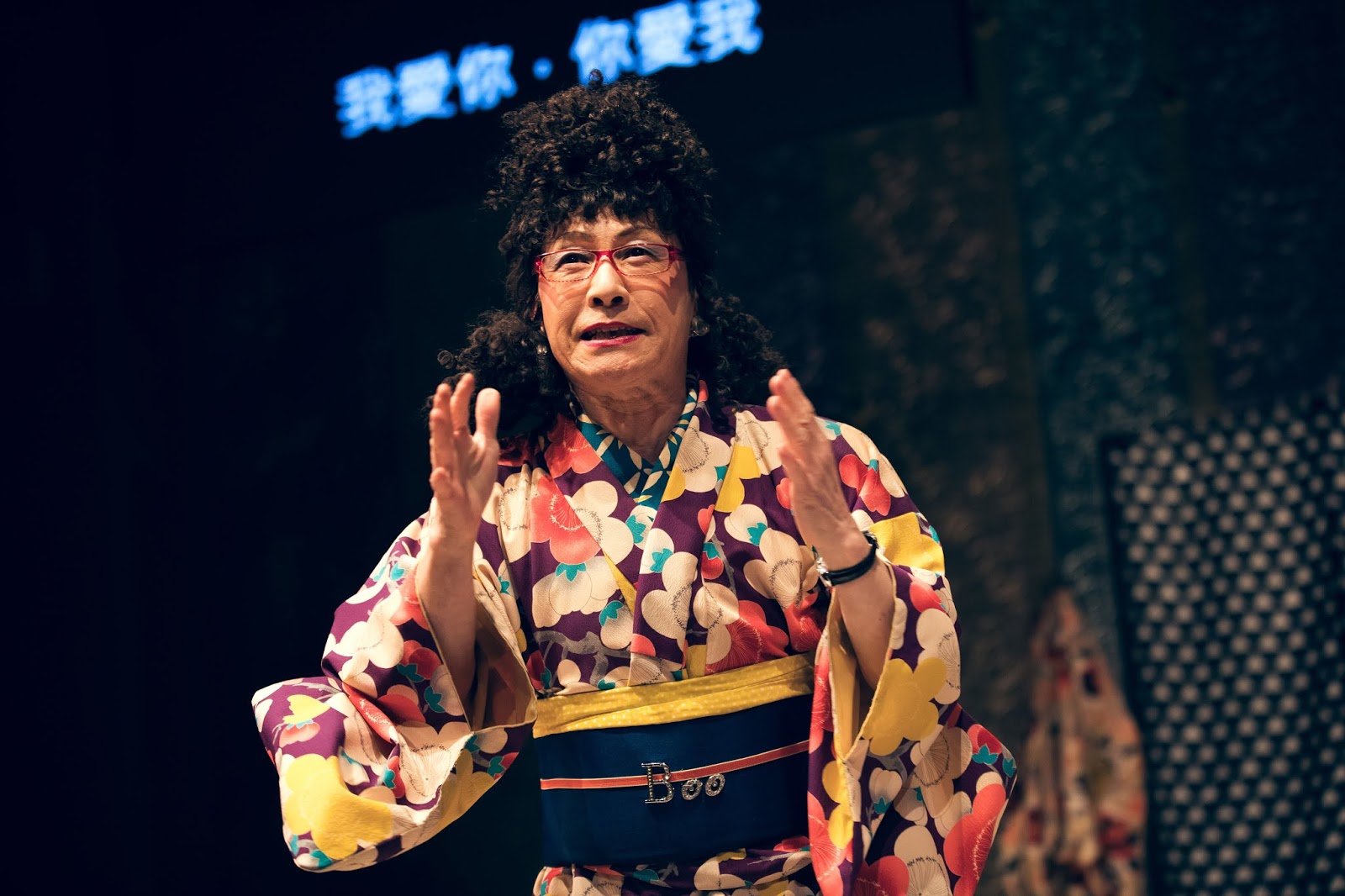
Suddenly, the father, Bo, a noh actor, played by Lilo Baur, a Swiss actress, wearing standard noh costume, traverses the hashigakari slowly and deliberately (the noh movement advisor is Tsumura Reijirō), and enters the stage. Initially, all three actors attempt this sort of movement—not well, I might add, but perhaps that is simply integral to the farce. Then the mother, Boo, Noda’s role, enters wearing a flower-patterned kimono, her hair styled in outrageous 1940s glam, recalling the long-popular Japanese comic strip Sazae-san (by Hasegawa Machiko, running 1946 till 1974; also an animé), and immediately tangles with Bo, her husband, over whether she ever listens to him.
Noda Hideki.
Soon, daughter Pickles, played by Glyn Pritchard, a Welshman, in a strange, space-travel outfit (all costumes by Hibino Kozue), appears, adding fuel to the family fire. One can hardly ignore the gender bending—a female plays the father, males play mother and daughter—engendering considerable humor (the gentleman next to me laughed seemingly at every line) not to mention Noda poking fun at the traditionally all male noh and kabuki.

At stake in the family squabble is who stays home that evening to care for their pregnant dog, Princess. Bo claims his acting fame gives him the right to attend a highly important engagement, Boo has a Boyz of Noise concert she refuses to miss, and Pickles, denigrating Boyz of Noise as “not even music,” declares that, over tapas, she and her high-tech friends are going to develop important apps.

Asserting his (self) importance, Bo shouts to the two women, “Let me man-splane!” Noda’s characteristic wordplay is evident, as when Bo claims he must make his engagement, because of his “high standing,” to which Boo, unwilling to lose out, retorts that she is “standing very patiently.” And Pickles, digital-age child concerned about machines’ dominance, loudly asserts that “we are all ones and zeros” and that she and her friends must develop apps “to save the world.”
Glyn Pritchard.
The ensuing knock-down-drag-out fight wreaks total havoc on their home, well designed by Horio Yukio and lit by Christoph Wagner, with nearly everything destroyed, including their cellphones, landline phone, and the large television set embedded in the stage-rear wall. All brandish their inviolable personal agendas, none giving an inch, insisting that someone else look after pregnant Princess. In the melée, Boo retrieves Princess’s metal cuff with chain and somehow manages to clamp it on Bo, but he finagles Boo into position to chain her, and, before long, they shackle Pickles as well.           
Noda Hideki, Glyn Pritchard, Lilo Baur.
The rapid-fire action is punctuated by all manner of sound, ably designed by Hara Marihiko and engineered by Fujimoto Junko, including a TV loudly on the blink, electrical appliances shorting out, a squawking phone, a singing bowl, the use of hyōshigi (wooden clappers used in kabuki) and the sort of drum used in traditional Japanese performance that is held over the right shoulder and hit with the left hand, with music composed by Tanaka Denzaemon XIII.     
      
What are we to make of this sordid scene? The quick action is vintage Noda. He emerged over 30 years ago with his troupe Yume no Yuminsha (Dream Wanderers), adapting tales from manga (comics) and well-known stories, such as Tom Sawyer and Shakespeare’s comedies. Performances featured multiple characters, cutesy and childlike, tiered stages, cacophonic sound, ceaseless water-sprite movement, wordplay (often using archaic words drawn from Japanese classical theatre to give his performances a distinctly different feel) all appearing, beyond the immediate fun, to go nowhere in particular; the performance was the thing. His plays sold out, despite tickets being costly.

In 1992, he disbanded Dream Wanderers, went to London, improved his English and broadened his theatrical horizons so that some plays were hardly identifiable as Japanese. By 1993, he established NODA • MAP, a Japanese company with global reach. He often collaborates with British playwright Colin Teevan and actress Kathryn Hunter. Noda’s work now is considerably more interesting conceptually and structurally than before 1993 and provides rich roles for actors, often non-Japanese. He has gained multiple awards and continues to be active as playwright-director and versatile actor, becoming artistic director of Tokyo Metropolitan Theatre in 2009.
Glyn Pritchard, Noda Hideki, Princess.
His accomplishment in this play is substantial, beginning with the Japanese title, Omote ni deroi! (表に出ろいっ!), smacking of yakuza (gangster) argot, meaning something like, “get the fuck outside (of the house) and we’ll settle it there!” There would appear to be no obvious connection to the English, One Green Bottle, unless one knows the ditty (as per one of several version): “Ten green bottles, hanging on the wall. And if one green bottle should accidentally fall, there’d be nine green bottles hanging on the wall.” Which continues till there is only one bottle, then none left, recalling the American children’s song, “Ten Little Indians.”

So, at the end of One Green Bottle, who’s left? As it happens, Bo, Boo, and Pickles are all there at the end, singing the ditty. But the family dysfunction has taken over and the destruction is complete. Bo intones: “We have imprisoned ourselves in our own home.”
           
That sorry state of affairs provides telling context for Pickles’s extended monologue when she articulates her existential vision. She claims her family is not Bo and Boo but “a family of free thinking individuals who . . . reject the ubiquitous toxicity of ridiculous societal pressures to think of [me] as a person . . . actually alive . . .  [to] embrace the near certain fact that we are inside a computer program . . . about to suffer a catastrophic failure. . . .” 

Boo thinks such doomsday musings are evidence that Pickles is in a cult, which, of course, she is, while Bo asks, “What makes you so sure the world is about to implode under the weight of its own absurdity?” This injects a meta-pattern into the play, since that’s exactly what has happened to his family, though Bo ironically fails to perceive it. Pickles reinforces this and gets to the heart of things, avowing to Bo and Boo that her cult members “understand me. They make me feel welcome [and] understood. I just want to be less lonely and you two don’t help with that. . . .”
           
Pickles is onto something here. She admits to taking medicine promoted by the cult: a truth pill. Truth may be the one aspect that this family needs to grasp what has befallen them. But truth, like the family and their home, has been destroyed. The only way left to them—to all of us, this play suggests—is to take the right medicine. In this way, Noda lifts the specific family issue before our eyes beyond the personal to a national level and provides trenchant comment on the current me-first drift of Japanese society with its demise of traditional, nuclear families, a complex demise loaded with ingredients such as self-regard taken to extremes.

From there, it’s hardly a stretch for his play to attain universal proportions. That might be easier to sense for Japanese, given their traditionally oriented, monolingual, mono-ethnic culture and their language where the word “individualism” (kojinshugi 個人主義) is defined as “selfish” and “egocentric” in Japanese dictionaries. There is, therefore, a starker contrast with Japanese tradition than with ours, though the impact of this play is quite timely beyond Japan, what with the global rise of populist nationalism and ubiquitous cries of “my country first.”
           
Although the play ends on a bleak note, there might be a thin silver lining: within the detritus-filled cloud, Princess (a stuffed dog) is brought on stage and delivers six puppies. Although she dies, she has birthed new life, not human but new life nonetheless. In addition, Boo, having inadvertently swallowed some of Pickles’ truth pills, pulls out a box hidden under the floor: it’s a series of locked boxes within each other, to reveal a set of Russian matroschka dolls. From the smallest, she digs out a tiny package and unwraps her apparently lost wedding ring. “I don’t like wearing it,” she says, “I just like knowing it’s there.”

New-born puppies and a long unworn wedding ring are not much to go on, but, with this dysfunctional family, it’s all there is.


LaMama Experimental Theatre Club
74A East 4th St., NYC
Through March 8

John K. Gillespie is one of the West’s leading scholar-translators of modern Japanese drama. He’s the co-editor, with Robert T. Rolf, of Alternative Japanese Drama: Ten Plays (University of Hawaii Press, 1992).

175 (2019-2020): Review: ABOUT LOVE (seen March 2, 2020)

"Summer of '33"


For my review of About Love please click on THEATER LIFE.


Sunday, March 1, 2020

174 (2019-2020): Review: MR. TOOLE (seen March 1, 2020)


MR. TOOLE


Anyone who’s read (not me) and admired A Confederacy of Dunces, John Kennedy Toole’s Pulitzer Prize-winning, picaresque novel of 1980, much of it about New Orleans, should be interested in Vivian Neuwirth’s semi-autobiographical drama, Mr. Toole, directed by Cat Parker, now being offered by the Articulate Theatre Company at 59E59 Theaters.
Ryan Spahn. All photos: Ken Howard.
  
Linda Purl, Julia Randall, Stephen Schnetzer.

Mr. Toole is not so much about the book, whose contents are not discussed, but about the back story of the book’s publication, as told largely through the memories of Lisette (Julia Randall), a student at an all-girl’s Catholic college in New Orleans, where Toole (Ryan Spahn) taught. The literary work the play actually examines, to a degree, is T.S. Eliot’s “The Love Song of J. Alfred Prufrock,” which Toole lectures on and which expresses elements of Kennedy’s personality.
whRyan Spahn, Linda Purl.
Neuwirth, who was fascinated by Toole ("He had such theatrical flair"), was inspired to write the play when she came across his novel in a bookstore window and “took it home and devoured it.” She describes the writer’s strained but loving relationships with his troubled father, John (Stephen Schnetzer), and, more dramatically, his emotionally colorful mother, Thelma (Linda Purl). His mostly painful encounters with her are sometimes reminiscent of those between Tom and Amanda in The Glass Menagerie.
Linda Purl, Thomas G. Waites.
Central to the nearly two hour, intermissionless story is the difficulty Toole had in finding a publisher, his struggle to satisfy the demands of Robert Gottlieb, his editor at Simon and Schuster, his resulting suicide when the book was rejected, and his mother’s determination to get it published posthumously, which she did through the intercession of famous writer Walker Percy (John Ingle).
John Ingle, Linda Purl.
For personal reasons, I’m refraining from further comments on the play and production, and suggest you look elsewhere for reviews. (Several other critics were there when I went.) I will add, however, that one critic I briefly spoke to afterward told me she was “stunned” by the play, particularly the depiction of the mother-son relationship. I’ll also confess that, had I the time, I’d immediately get a copy of A Confederacy of Dunces to see what Simon and Schuster missed and Louisiana State University Press found in a book so admired it won the 1981 Pulitzer Prize.
Stephen Schnetzer, Linda Purl.
Interestingly, so many projected film versions of the book have been canceled that director Stephen Soderbergh, who headed one such project, declared it “cursed.” On the other hand, Jeffrey Hatcher’s financially successful theatre adaptation starring Nick Offerman played in Boston in 2015. Hopefully, it will come one day to New York so, if I never find the time to read it, I can stop being such a dunce and get a better idea of what all the fuss is about.

59E59 Theaters/Theater C
59 E. 59th St., NYC
Through March 15


Saturday, February 29, 2020

173 (2019-2020): Review: CAMBODIAN ROCK BAND (seen February 28, 2020)


"Khmer Rock"


Imagine, if you will, a Holocaust drama about a Jewish klezmer band, in which one of the musicians, failing to flee the oncoming Nazis in time, ends up in a concentration camp, where he’s tortured under the supervision of an Eichmann-like authority. Then imagine that this dire situation is surrounded by a heavy infusion of rambunctious, even joyous klezmer music, ending with a festive, musical explosion in which the audience is up on its feet, dancing at its seats, arms waving, as if watching a concert at the Beacon.  

Courtney Reed (C) and company. All photos: Joan Marcus.
Yes. A show combining genocidal horror with head-banging joy. Not an easy combination to imagine but that’s what—give or take a few drawbacks—playwright Lauren Yee and director Chay Yew have just about pulled off in Cambodian Rock Band, originally produced by the South Coast Repertory and subsequently seen at a number of other venues. The show, of course, isn’t about the Nazi Holocaust, but deals instead with the similarly apocalyptic reign of Cambodia’s fanatical communist party, the Khmer Rouge, under the murderous leadership of Pol Pot in the late 1970s, leaving two million dead in its wake.
Courtney Reed, Joe Ngo. 
The musician at its heart, Chum (Joe Ngo), is a guitarist in a Cambodian rock band, the Cyclos, and the music that they play, coming from several sources, is mainly from the playbook of Dengue Fever. That’s the overheated name of an acclaimed American band that originated in the 1990s doing covers of Cambodian rock from the pre-Khmer Rouge days, the original musicians having died or disappeared during the mass slaughters and detentions.

Yee’s two-act play, whose script declares “some of this really happened,” at first seems a condensed introduction to the Khmer Rouge’s bloody period of power, from 1975-1979. Her dramaturgic hook is the return in 2008 to Cambodia of Chum, who eventually fled to America, where he and his wife raised a daughter, Neary (Courtney Reed, Aladdin).
Company of Cambodian Rock Band.
Chum’s return is related to Neary’s work for the International Center for Transitional Justice, concerned with war crimes. She’s investigating the deeds of a Khmer Rouge leader known as Duch, responsible for the deaths of 20,000 at the notorious S-21 prison, once a school, now a museum. Seven people are known to have survived but evidence of an eighth has come to light, and Neary needs to find that person. Dad doesn’t think this a good idea.

Act one, set both in 2008 and 1975, sets up the background by educating the audience about the Khmer Rouge’s atrocities, as well as its socially and technologically oppressive ideology (a ban on music was one of its lesser restrictions). Artists and intellectuals were considered no better than dust. At the same time, it establishes—often through broad comic strokes—the father-daughter relationship between Chum and Neary that opens a door into the past revealing what Chum endured. Linda Cho’s costumes precisely capture each period’s look, especially those of the bell-bottomed, polyester 70s.

Finally, it presents Chum’s psychedelic surf rock band finishing its one and only album just before the Khmer Rouge takes power. The act is so concerned with exposition, though, that it’s easy to wonder where its dramatic heart is. (Another seven songs—including Dylan’s “The Times They Are A-Changin”—are heard in act two.)
Moses Villarama, Francis Jue.
Reed, who also plays Neary, is star-quality good as Sothea, the lead singer, both because of her considerable charisma and beauty (her sinuous hand and arm movements based on Cambodian dance will light many fires) and her stunning vocals.
Joe Ngo, Abraham Kim, Francis Jue, Courtney Reed, Moses Villarama.
Weaving the present-day events together with the past, and providing the show with a theatrically inviting premise, is Duch himself, played as a Cabaret-like host by Francis Jue (Soft Power), addressing us directly with a fascinating blend of insinuating panache, sardonic humor, and wicked charm. He even mocks words like “genocide.”
Moses Villarama, Joe Ngo, Courtney Reed, Abraham Kim.
In act two, however, he takes on a far darker tone as the set assumes the look of an interrogation room, with Duch ripping off his emcee persona and exposing his insidious side in confrontations with Chum. Like Adolf Eichmann, he’ll fall back on the excuse that he “was just following orders.” Chum, for his part, will have his own guilty secrets to deal with.
Francis Jue.
Chay Yew’s lively direction swings back and forth between bold theatricality and basic realism, although the former generally gets the edge. Joe Ngo—himself a son of Khmer Rouge survivors—gives a dynamic performance as Chum. (He’s played it in two previous productions.) He starts off, though, with such clownish behavior that, in contrast to the grounded personality of Reed’s Courtney, it borders on annoying. However, when, over the arc of the performance, you watch the demands placed upon the actor—who also must be an expert musician—you forgive the early exaggeration and applaud him for sculpting an unforgettable portrait.
Joe Ngo, Francis Jue.
Yee’s language is always vibrantly alive, and, while her plotting is sometimes awkward and contrived (the story depends on a huge coincidence), she nevertheless manages to compel attention throughout its two hours and 15 minutes. Cambodian Rock Band maintains its entertainment value while making a significant contribution to educating audiences about the Khmer Rouge’s carnage, including footnotes on America’s own responsibility for what happened.
Joe Ngo, Francis Jue.
Cambodian Rock Band is hard to categorize, however, since its music—like what you’d hear in certain jukebox musicals—is unconnected to its story; many lyrics are actually in Cambodian. Even with 13 numbers, it’s hard to call it a musical. Whatever you call it, you won’t soon forget it.
Company of Cambodian Rock Band.
I admit to having felt a bit uncomfortable at joining in the celebratory finale (Jue, dashing among the audience as the music blasted away, gave me, of all people, a cowbell to beat) but I also felt I’d been present at a work of raw theatrical power. Unquestionably, Cambodian Rock Band rocks.

Pershing Square Signature Center/Irene Diamond Stage
480 W. 42nd St., NYC
Through March 22