Showing posts with label Elyse Orecchio. Show all posts

Monday, October 7, 2019

GUEST REVIEW (2019-2020) 13: FOUND

“Hello, Dollies!”***

By Elyse Orecchio (guest reviewer)

From time to time 
Theatre's Leiter Side posts reviews of Off-Off Broadway shows my schedule prevents me from seeing. If you are interested in reviewing Off-Off Broadway, please contact me so we can discuss. I hope you find the expanded coverage useful. Sam Leiter

If you’d told me how much fun I was about to have at Found, an immersive theatrical experience in Chelsea, I wouldn’t have believed you. I entered with my mind admittedly closed, as I typically don’t enjoy absurdist hooey. Turns out I walked out making a mental list of the friends I’d encourage to go see it, particularly those who are art enthusiasts.  
Tracy Weller. Photo: Eraj Asadi.
Look, there’s a reason that New Yorkers endure inhumane rents for apartments, where closets are converted into showers. It’s because we don’t like to be bored. We get our entertainment in unsuspecting places, from the duo belting a romantic aria on the subway platform to the man with one leg doing backflips outside the Port Authority. 

I ended up finding entertainment at the cell theatre (Nancy Manochercian, founding artistic director) in Chelsea, where Found, with its “explosion of dolls” and other perverse, whimsical installations, delivered on its promise of a sensory whirlwind. This project, a collaboration between visual artist Mikel Glass and Mason Holdings, converts the townhouse theatre into a four-story visual arts exhibit with multimedia elements that include videos of little girls in beauty pageants everywhere, and a salon-type hair dryer that plays music when you stick your head in it. 

Upon entry, I helped myself to a tasty green cocktail that was flowing through a system of crooked pipes, mad scientist lab-style. I found my stiff drink necessary as I meandered through oil paintings depicting strange stuff, like Bart Simpson making his way through the birth canal. 

Soon I was called to the basement, where three of us were invited to choose an outfit for a woman in her underwear. She had me help her into the dress I selected. For a moment, it was like I had a personal living doll, which was in keeping with the doll theme. I was invited to hug her for 53 seconds (she had another guest set her cell phone timer) and then snap a selfie. When the job was done, she ran out of the room screaming. As we made our way upstairs, I wondered what all the selfies would look like in the next few weeks as she wears various combos of hats, shoes, and outfits. 

Up in the attic, aka “Heaven,” we were met by Mikel Glass, the artist who created this world. There, surrounded by strewn-about dolls, a film projector, and a live harpist strumming exquisite melodies, Glass broke the fourth wall and engaged our group in a discussion about the show. He told us the story of his daughter’s lost doll, and what it meant to her, which got him thinking about every doll he encounters on the street, how they once all belonged to a child, and how each had a story. Glass explained that it can be boring and sleepy to walk through a typical art gallery, and he wanted to challenge the way people can experience art. He also objected to the perception of dolls as creepy. 

We then proceeded to a room with, yep, lots more creepy dolls, each one of them found on the street and sent to Glass per his request. There, a woman playing an old-fashioned housewife engaged us in absurd conversation, asking questions like, “Is that your thumb? Do you have floors? What’s your blood type?” (It was later apparent she was asking if you were suitable to give a doll a home). I decided she was my favorite actress because she was as engaging and invested as she was wacky. It was later that I found out she was Tracy Weller, founder and artistic director of Mason Holdings, the company responsible for the production, which makes a lot of sense.

I was then taken to a room where all the art was made entirely out of wood, from pizza slices and tea bags to paper shopping bags and even paintings. A character forced me to give her something if I was to be allowed to touch the art. I perused my bag and gifted her a wrinkled map of Acadia National Park, which seemed to please her.

I crossed a floor of those little plastic balls you find in a ball pit to climb into a small tent, where a character invited me to add anything I wanted to a painting of my choice. I made some quick brush strokes and moved on, but enjoyed my small contribution to a collaborative art piece (even if it does look like a child’s scribblings).

Finally, I was brought to another floor where an actress in pigtails was competing in a beauty pageant. She invited me to play with a life-sized version of one of those toy structures you find in a pediatrician’s office, where you move colored blocks around various tracks. Here's where you insert your own commentary about young pageant contestants as dolls.

On the way out, in exchange for jotting down our dream for a better world on a Post-it (90% of the answers I saw on the wall were Trump-related), we were given Ben & Jerry’s ice cream. It was even Cherry Garcia, my husband’s favorite. 

If nothing I’ve said makes any sense, just watch this short clip. I’m really glad this video exists, because describing the show pushes the limits of my capabilities. I expect the reactions to Found will be across-the-board, from people rolling their eyes real hard to avant-garde enthusiasts who are all in. The one thing I can say for sure is: go. Why? You live in NY, and this is just the kind of batty stuff you do when you’re here. The only promise I can make is you won’t be bored. 

P.S. Tickets are discounted on Halloween; the 45 minutes you spend at Found will be a worthwhile stop amid the trick-or-treating and parading.

cell theatre
338, West 23rd St., NYC
Through October 31

Elyse Orecchio studied musical theatre at Emerson College, acting at CUNY Brooklyn College, and English Linguistics & Rhetoric at CUNY Hunter College. She has worked in nonprofit communications for more than a decade. She lives in Sunnyside, Queens, with her husband Joe, kids Theo and Melody, and three cats. eorecchio@gmail.com @elyseorecchio


Monday, July 15, 2019

GUEST REVIEW 9 (2019-2020): LADYSHIP


“A Show of Support”****

From time to time Theatre's Leiter Side will be posting reviews of Off-Off Broadway shows my schedule prevents me from seeing. If you are interested in reviewing Off-Off Broadway, please contact me so we can discuss. I hope you find the expanded coverage useful. Sam Leiter

On July 13, there was a blackout in New York City that shut down Broadway. Unable to go on, several shows, including Hadestown, Waitress, and a Carnegie Hall choir, took their acts to the streets. Hours earlier, at the New York Musical Festival (NYMF), a less dramatic event prevented a production from proceeding as scheduled: a leading actress, Maddie Shea Baldwin, was too ill to perform in LadyShip. This being a NYMF show, there was no understudy. Rather than cancel, the cast instead put on a concert production, with co-writer Linda Good filling in for the under-the-weather player.


You might expect the audience to have been cranky about this, as they had paid for a full production. But just as New Yorkers offered their support when the lights went out on Broadway and took to the streets to help control traffic, the LadyShip theatregoers applauded wildly when Linda Good sang her big solo and gave the cast a standing ovation at the end.  
Caitlin Cohn, Jordan Bolden. Photo: Russ Rowland.
Yes, perseverance was the theme of the day, also dominating the musical created by the twin pop indie duo Linda and Laura Good, who wrote the book, music, and lyrics. LadyShip, directed by Samantha Saltzman, is based on the trueand not widely knownstories of the thousands of women who were sent on ships from London to colonize Sydney, beginning in the late 18th century. If British male convicts were the bottom of the barrel, then what would you call the female population gifted to them as wives to birth future generations?  
Trevor St. John Gilbert, Quentin Oliver Lee, Justin R.G. Holcomb. Photo: Russ Rowland.
Through the song “The Bloody Code,” we learn how the British government concocted a plan to populate the Australian colony by sending female convicts (which is to say, poor women and young girls who commited petty crimes to survive) on ships to Sydney to serve a seven-year sentencethat is if they could survive the 10-month journey overseas as prisoners below deck with moldy biscuits as food and wooden shelves as beds.
Jennifer Blood, Caitlin Cohn, Noelle Hogan, Maddie Shea Baldwin. Photo: Russ Rowland.
Representing the hordes of female convicts transported on ships are six characters, more or less recognizable as players in any period piece: the wholesome young sisters, the feisty street dweller from the school of hard knocks, the mother who will do what it takes to return to her children, the noblewoman fallen from grace, and the sweet little orphan who yearns for a better life. 
Caitlin Cohn, Quentin Oliver Lee. Photo: Russ Rowland.
The men of the cast include the tormented law-abiding captain, the villainous captain’s nephew (luckily, he has no mustache or, surely, he’d twirl it), the young romantic lead, and the burly, brutish seaman. 
Noelle Hogan, Caitlin Cohn, Maddie Shea Baldwin. Photo: Russ Rowland. 
The company of 10 skillfully breathes maximum humanity into the token characters, singing the well-crafted score with an exuberance that held my attention for the two-hour performance. Caitlin Cohn plays Mary with quiet strength, Noelle Hogan is superb as 11-year-old Kitty, and Trevor St. John-Gilbert and Quentin Oliver Lee deliver rich vocals. The trio of musicians (Simone Allen, Christopher Anselmo, and Charlotte Morris) provides lively accompaniment. 
The company of LadyShip. Photo: Russ Rowland.
Considering the rough threats to the passengers, including mothers being separated from their children, slavery, starvation, and rape, LadyShip is surprisingly uplifting, with healthy doses of comedy, female friendship, and joyous music. While in future iterations it would be great to see the characters more developed, LadyShip successfully, and in the spirit of its clever title, explores the strength women draw from each other in suffering. 

Pershing Square Signature Center/The Alice Griffin Jewel Box Theatre
480 W42nd st., NYC
Through July 14

Elyse Orecchio studied musical theatre at Emerson College, acting at CUNY Brooklyn College, and English Linguistics & Rhetoric at CUNY Hunter College. She has worked in nonprofit communications for more than a decade. She lives in Sunnyside, Queens, with her husband Joe, kids Theo and Melody, and three cats. eorecchio@gmail.com @elyseorecchio


Friday, May 10, 2019

Guest review 4: DR. JEKYLL AND MR. HYDE


“It Takes Two” ****

By Elyse Orecchio (guest reviewer)


From time to time Theatre's Leiter Side will be posting reviews of Off-Off Broadway shows my schedule prevents me from seeing. If you are interested in reviewing Off-Off Broadway, please contact me so we can discuss. I hope you find the expanded coverage useful. Sam Leiter 
 
Part parody and part earnest adaptation, Dr. Jekyll and Mr. Hyde at the SoHo Playhouse feels like Mel Brooks and Lin-Manuel Miranda got stoned, wrote a sketch for SNL in which Kate McKinnon played all the parts, and it was so good they made a full-length production of it and won critical acclaim. 
Burt Grinstead. Photo: Cooper Bates.
While this production, written and performed by my new favorite couple, Burt Grinstead and Anna Stromberg, is certainly satire, it doesn’t feel like a full-on parody. To its credit, it’s an honest-to-gosh retelling of Robert Louis Stevenson’s The Strange Case of Dr. Jekyll and Mr. Hyde. Well, okay, with some liberties taken. With just two actors and minimal technical requirements, I hope it becomes a mainstay in high schools and colleges.

I had a good time even before the show began. The theatre was filled with smoke (even downstairs at the bar!) and sounds of wind howling and crows echoed. When the announcement came on telling us to silence our phones because the execution was about to start, I figured this was the sort of production that was going to either be really brilliant or really terrible; somewhere in the middle wasn’t likely. Unlike the show, I’m not going for suspense—it was well executed (yuk yuk).

In case you only know Jekyll and Hyde as a campy theme-restaurant, it’s the story of a scientist, Dr. Jekyll, whose brother is murdered for being a psycho serial killer, which sparks the doc to conduct research on the good and evil parts of the brain. (In the 19th century it was widely believed that the left side was responsible for the ability to be rational and civil, while the right side related to being impulsive and primal. If I sound smart, it’s only because I crammed by consulting this most literary source.)

When Jekyll is denied a grant to conduct this research that his peers feel should be left to God, he takes his experiment into his own hands and transforms into Edward Hyde, the base embodiment of his inner immorality who’s really good at killing and getting laid. Thus begins the battle of good vs. evil. And also lots of “Hyde/hide” puns.
Bert Grinstead, Anna Stromberg. Photo: Cooper Bates.
Grinstead and Stromberg’s performances seem as vocally taxing as they are exhilarating, and I desperately hope they are drowning themselves in Throat Coat between shows. Grinstead is convincing in the dual role, playing a sweet, adorkable Jekyll and a creepy, menacing Hyde. He gives everything he’s got to both characters, hurling himself across the stage, crawling and leaping and growling to the point where he’s drenched in sweat by the end of the show.

Every second of the quick-paced production is occupied with action, as Stromberg works feverishly and hilariously to portray every other person in the play. As director and costume designer, she creates fully distinct characters using simple wardrobe items—the maid dons an apron, Jekyll’s heartthrob Sarah has a petticoat, the lawyer sports a cap, the professor wears a monocle, the socialite rocks a fascinator, and so on.

My favorite is her Dr. Lanyon, the scholar who refuses Jekyll his research grant because it’s too ungodly. I laughed steadily throughout the show, but I lost it when Stromberg emerged as Lanyon with a big fat paunch, represented by a sort of pillow that hangs from her neck over her belly and is wrapped in a tuxedo!

Stromberg’s quick-change skills are impressive as she flawlessly flits about from character to character, adopting with ease their particular speech pattern, accent, vocal inflection, and costume. There is, of course, one obligatory Mrs. Doubtfire moment in which Stromberg accidentally-on-purpose screws up and wears the maid’s apron while portraying Utterson, the lawyer.

As the characters rapidly rotate, so do Grinstead’s super savvy set pieces, black Tetris-like blocks that connect in various ways to create bookshelves, stairs, a flower garden, a fireplace, and more. I was floored at how many possible configurations these blocks formed, and I couldn’t wait to see what they would become next. Adam Earle and Matt Richter’s fun lighting provides motifs for various characters, such as romantic pink hues for Sarah’s appearances and maniacal green tones for Hyde.

This is the sort of production that lives or dies on its script. If the dialogue had stunk, it would have been excruciating. The writing is clever, unpretentious, and provides an all-around good time. It didn’t surprise me to learn that Grinstead and Stromberg are married. The production is the clear result of a collaboration between two people who can really riff off each other. I’m sure they giggled their way through writing and rehearsals. And perhaps took turns going on vocal rest.

SoHo Playhouse
15 Vandam St, NYC
Through May 25

OTHER VIEWPOINTS:

Elyse Orecchio studied musical theatre at Emerson College, acting at CUNY Brooklyn College, and English Linguistics & Rhetoric at CUNY Hunter College. She has worked in nonprofit communications for more than a decade. She lives in Sunnyside, Queens, with her husband Joe, kids Theo and Melody, and three cats. eorecchio@gmail.com @elyseorecchio


Tuesday, May 7, 2019

Guest review 2 (2019-2020): MARY, MARY


“Romance Served Up Retro-Style” ****

By Elyse Orecchio (guest reviewer)


Before there was Nora Ephron, Jean Kerr reigned as the queen of witty playwriting. Her comedy Mary, Mary premiered on Broadway in 1961; it was one of the longest-running plays of the decade, with more than 1,500 performances, and was adapted as a film in 1963, with Debbie Reynolds.

And yet I had never heard of Jean Kerr before this weekend; I’d only known the name of her husband (renowned theatre critic Walter Kerr). In producing her work, Retro Productions pays service not only to classic female playwrights, but new audiences who can be inspired by them. Artistic director Heather E. Cunningham notes: “It is not often that we think of female playwrights when we think of the 1960’s, and when searching for our next production I made the decision to only consider plays written before 1980 by women.” 
Meghan E. Jones, Robert Franklin Neill, Heather Cunningham, Chris Harcum, Desmond Dutcher. Photo: Kyle Connolly.
As a Xennial (born between Gen X and Gen Y), I had a thing or two to learn about the world of Mary, Mary. As a great touch, Retro Productions provides a Pop Culture Glossary of references in the play, ranging from Orville Prescott and Duck Soup to IBM and Alaska. The clever glossary allowed me to understand why my neighbors were laughing at a Gerold Frank joke; now I know he was the pioneer of the “as told to” form of autobiography.

Following that standard rom-com formula, Mary, Mary is centered around two men and two women who form a variety of “will-they, won’t they” combinations, even though, of course, we know the two who will. They are Bob and Mary McKellaway, who haven’t seen each other in nine months and are two weeks away from having their divorce finalized.
Heather Cunningham, Chris Harcum, Desmond Dutcher. Photo:Kyle Connolly.
Bob (played to full comedic effect by Chris Harcum) is impossibly sensible and square, while his ex, Mary (played with wisdom and sensitivity by Heather E. Cunningham), is—as the play’s title suggests—a contrarian. She’s a wisecracking magazine editor, while he’s a stuffy book publisher.

They are brought back together by Bob’s tax lawyer, Oscar Nelson (a delightful Desmond Dutcher), to prepare for an audit. To complicate things further, Bob’s got a bubbly, young new fiancée (or a deductible, according to Oscar) who is dying to meet Mary and get notes on being married to Bob. Meghan E. Jones is perfectly ridiculous as Tiffany Richards, and I mean that as a compliment.

Then there’s Bob’s old Navy buddy-turned-movie star, Dirk Winston (a cliché played with great believability by Robert Franklin Neill), who shows up to convince Bob to publish his memoir and ends up wooing Mary. Their courtship infuriates her ex-husband, who can’t seem to make sense of his jealousy: “Life with Mary was like being in a telephone booth with an open umbrella—no matter which way you turned, you got hit in the eye.”
Desmond Dutcher, Meghan E. Jones, Chris Harcum. Photo: Kyle Connolly.
Bob and Mary slowly find their way back to each other through inside jokes and a mutual fondness for cigarettes (the bubbly fiancée doesn’t smoke). This Xennial derived pleasure from the silver-haired audience filling the majority of the seats in the Gene Frankel Theater. I enjoyed their laughter and nostalgia, made obvious by their knowing sighs during those intimate moments best understood by couples who have been together long enough to finish each other’s sentences without knowing they’re doing it.

While the first act lags at times, the second act is laden with energy and physical comedy, thanks to shenanigans involving sleeping pills, a locked door, and a lost key. When all five actors are romping about on stage, they reach their peak laughter from the audience. Think: Neil Simon meets Lucille Ball. 
Heather Cunningham, Chris Harcum. Photo: Kyle Connolly.
All scenes are set in Bob’s apartment/home office, and I have to pause to commend the design team on the stunning set (Jack and Rebecca Cunningham, Heather’s parents, both veteran designers) evoking the 60s on the Upper East Side. The gorgeously painted blue walls and retro props (Sara Slagle) along with a really neat, beautifully lit (Asa Lipton) window, all serve up an era long gone.

So much of theater these days is about an outrageously fresh take on a classic piece that sometimes it’s nice to see a revival that doesn’t try to put a modern lens on old themes. Director Shay Gines’s Mary,Mary is wonderfully straightforward. Now and then ya just wanna see a good old-fashioned rom-com.


Gene Frankel Theater
24 Bond St., NYC
Through May 18

Elyse Orecchio studied musical theatre at Emerson College, acting at CUNY Brooklyn College, and English Linguistics & Rhetoric at CUNY Hunter College. She has worked in nonprofit communications for more than a decade. She lives in Sunnyside, Queens, with her husband Joe, kids Theo and Melody, and three cats. eorecchio@gmail.com @elyseorecchio


Monday, April 29, 2019

Guest review 11: ELECTRONIC CITY


 “#firstworldproblems” **

By Elyse Orecchio (guest reviewer)

From time to time Theatre's Leiter Side will be posting reviews of Off-Off Broadway shows my schedule prevents me from seeing. I hope you find the expanded coverage useful. Sam Leiter


Since its premiere in 2003, Electronic City by Falk Richter has been translated into 40 languages, and I wonder if it makes sense in any of them. One can argue that I should know what I’m getting myself into when I sign up for experimental, avant-garde theatre touted as “absurdist humor.” To that I say touché—take my review with a grain of salt from someone who is perhaps not the target demographic (though I do very much like the New Stage Theatre Company’s performance space, nestled in a nifty basement beneath a Upper West Side hostel).

The story revolves around Tom (Brandon Lee Olson), a man who travels so much for work that all the airport business lounges and hotel rooms look the same to the point where he forgets where he is. Poor baby!
Chris Tanner, Beth Dodye Bass, Rikin Shah, Bjorn Bolinder. Photo: Lee Wexler.
Drawing more empathy is the character of Joy (Jeanne Lauren Smith), a cashier whose register breaks down, causing hysterics as a bunch of businessmen queue up impatiently. Somewhere in there is a sort-of love story between Tom and Joy, who enjoy a quick airport romp and attempt to continue their courtship long-distance. Too bad Tom can’t even remember what country he’s in, let alone his girlfriend’s name.

Director Ildiko Nemeth has updated the piece to reflect modern advances in technology, but it feels like the changes have been slapped on in the form of Facebook and Instagram projections on the walls (projection design by Eric Marciano and Hao Bai). This show is determined to show how disconnected and alienated we all are in the digital world. However, without exploring social media’s role in making connections, it’s even harder to extract meaning from an already abstract production. Why should Tom forget where he is in an era where connection is more readily available than ever?
Bjorn Bolinder, Beth Dodye Bass, Rikin Shah, Tatania Kot, Chris Tanner, Jeanne Lauren White. Photo: Lee Wexler.
I know, I know. I’m taking this plot point too literally. It’s not about being physically lost, silly; it’s a metaphor. One that’s played over and over again but in different ways, sometimes with random words running across the walls, sometimes with video projections of emojis, and almost always with the cast roaming frenetically about the stage like they’re participating in an acting class improv.

The cast wanders around in matching black clothing and wigs to suggest, I guess, the sameness of all us robots in the fictitious-but-not Electronic City. For me, the actors are this production’s greatest asset, as they’re fully invested and energetic.
Jeanne Lauren Smith, Chris Tanner, Beth Dodye Bass, Tatania Kot, Rikin Shah, Bjorn Bolinder. Photo: Lee Wexler.
The staying power of Electronic City and its many productions around the world prove there’s clearly a connection and appeal for audiences that appreciate multimedia theatre and dark/absurd humor. If you’re in that demographic, you may enjoy your experience. And if not, there’s an affordable hostel upstairs if you and your date wish to redeem your evening.


New Stage Performance Space
36 W. 106th St., NYC
Through May 10

Elyse Orecchio studied musical theatre at Emerson College, acting at CUNY Brooklyn College, and English Linguistics & Rhetoric at CUNY Hunter College. She has worked in nonprofit communications for more than a decade. She lives in Sunnyside, Queens, with her husband Joe, kids Theo and Melody, and three cats. eorecchio@gmail.com @elyseorecchio


Friday, April 26, 2019

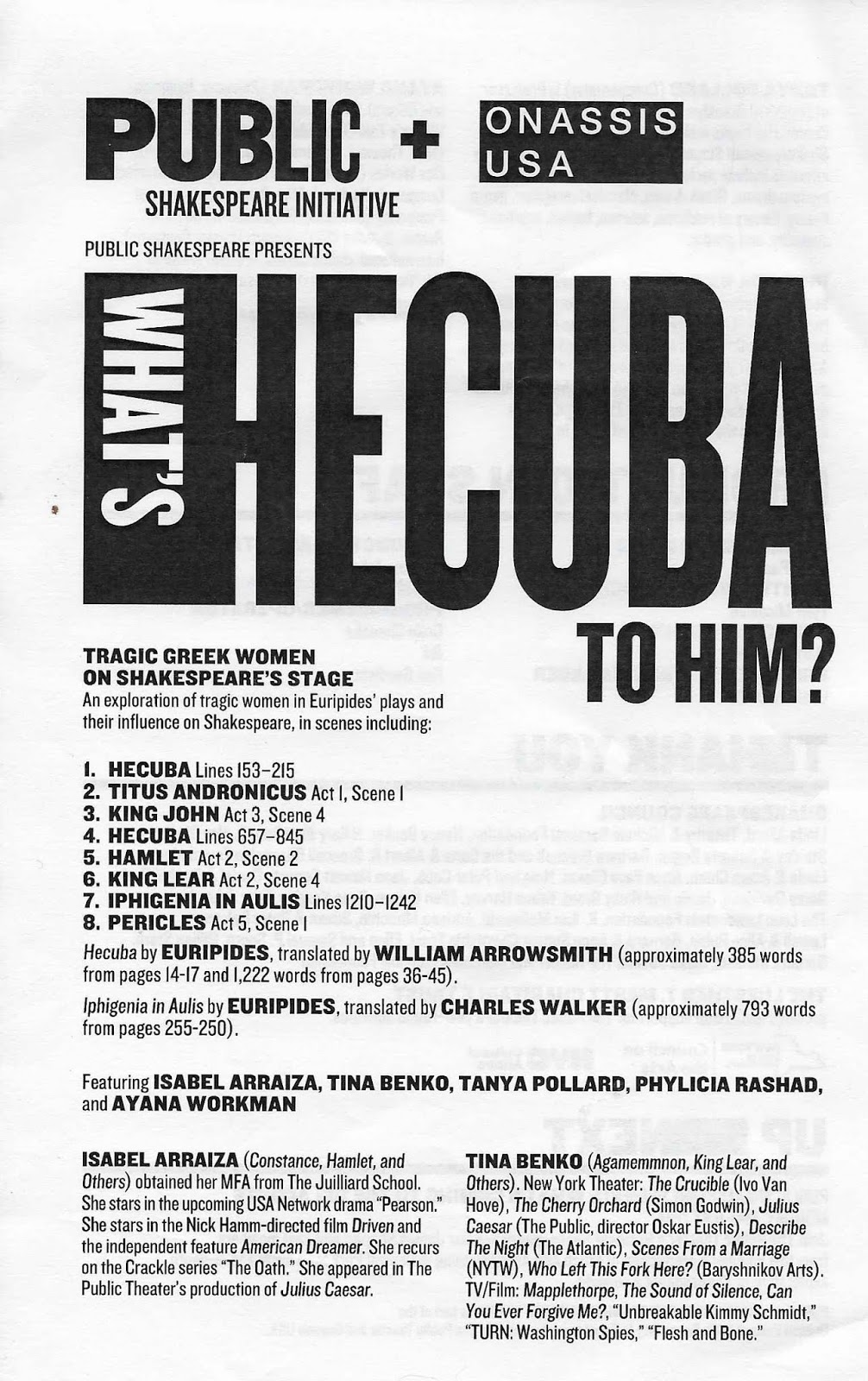
Guest review 8 (2018-2019): WHAT'S HECUBA TO HIM?


“Brush Up Your Euripides!” ****

by Elyse Orecchio (guest reviewer)

This event is part of the Onassis Festival 2019: Democracy Is Coming, co-presented by the Public Theater and Onassis US. For more, read Theatre’s Leiter Side’s coverage of Choir! Choir! Choir! and Antigone: The Lonely Planet.


No more scholarly papers for me—from now on I’d like to have all my arguments presented on stage by Phylicia Rashad, please. She, along with an entourage of four other formidable women, served up some serious Shakespeare through an Ancient Greek lens in What’s Hecuba to Him?, a one-night engagement at the Public Theater. Hecuba, perhaps Euripides’ most tragic heroine, was brought to life by Rashad—making the audience sit up in its chairs whenever she approached the mic.

The audience was offered a simple thesis. To paraphrase, it’s widely thought that Shakespeare couldn’t have possibly read Hecuba and many other ancient Greek texts, as they weren’t widely circulated and he wouldn’t have had the access or education. But this night on stage was all about proving Shakespeare was well versed in Hecuba, the evidence being right there in his passages, plots, and characters.

Incidentally, this is where the clever title of the event comes into play— “What’s Hecuba to him?” is of course a famous line from one of Hamlet’s soliloquies. In the context of the evening, it asks what is Hecuba to Shakespeare.

The stage was lined with four microphones, panel-style, and the commentator was Tanya Pollard, Professor of English at Brooklyn College and CUNY’s Graduate Center, where the editor of this blog is Distinguished Professor Emeritus of Theatre. She has literally written the book on Greek tragic women and Shakespeare:

The Greek plays most popular in the period were not male-centered dramas such as Sophocles’ Oedipus, but tragedies by Euripides that focused on raging bereaved mothers and sacrificial virgin daughters, especially Hecuba and Iphigenia.—Abstract,      

Pollard eloquently offered a series of arguments to support her thesis that the Bard was quite brushed up on his Greek tragic women. There to help her prove it were four actresses performing readings from Euripides and Shakespeare alternately. In other words, Pollard set ‘em up and the ladies knocked them down.

When Tamara in Titus Andronicus appeals to the king to spare her child’s life—it comes from Hecuba (lines 153-215). In both cases, her child is being served up as a sacrificial offering and mom is like WTF. When Constance is grief-stricken over her son in King John—yup, it’s also Hecuba (lines 657-845), as evidenced in the way the speeches parallel each other in structure.

Euripides frequently explored women’s suffering in childbirth. Pollard showed how Shakespeare riffed on these themes. Hamlet (played by a spirited Isabel Arraiza) bemoans being “unpregnant” (the whiner is known for not feeling man or woman enough in this moment), while King Lear (a commanding and really funny Tina Benko) compares his sorrow to a mother’s hysterica passeo (basically a woman afflicted with a wandering womb; I’ll leave you to figure that one out).

In case you’re wondering, I’d say thesis proven, Professor Pollard!

The night ended with an extra helping of scholarly geekery; the audience was invited to continue discussions over wine and cheese in the lobby, where Ms. Pollard, the performers, and the Public Shakespeare Initiative team were readily available to chat—how fitting for a democracy-themed festival. 
  

Public Theater
425 Lafayette St., NYC
One-night engagement


Elyse Orecchio studied musical theatre at Emerson College, acting at CUNY Brooklyn College, and English Linguistics & Rhetoric at CUNY Hunter College. She has worked in nonprofit communications for more than a decade. She lives in Sunnyside, Queens, with her husband Joe, kids Theo and Melody, and three cats. eorecchio@gmail.com @elyseorecchio


Wednesday, April 24, 2019

Guest review 7 (2018-2019): CHIMPANZEE


“The Haunting Humanity of a Hominid Puppet” ****

By Elyse Orecchio (guest reviewer)

From time to time Theatre's Leiter Side will be posting reviews of Off-Off Broadway shows my schedule prevents me from seeing. I hope you find the expanded coverage useful. Sam Leiter

Wait, did that chimpanzee just get baptized?
Wait, did that chimpanzee just do the ‘happy baby’ yoga pose?
Wait, did that chimpanzee just accidentally pleasure herself with the hose of a vacuum cleaner? 
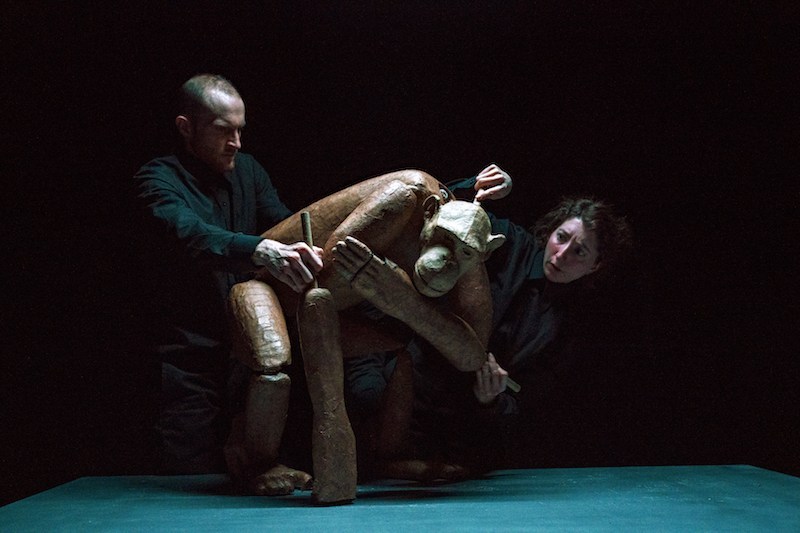
Chimpanzee. Photo: Richard Termine.
Watching this chimpanzee’s antics on stage at the HERE Arts Center, it’s easy to forget she’s a wooden puppet. “Wooden” is often a derogatory word used to describe an actor whose face doesn’t move. But in Nick Lehane’s Chimpanzee, the titular simian is bursting with animation, charm, and even a bit of cheekiness. Even though her face doesn’t move. Magnificently crafted by Lehane and expertly manipulated by three puppeteers, Rowan Magee, Andy Manjuck, and Emma Wiseman, this adorable ape will make a believer out of anyone who might have thought puppetry was just kid stuff. 
Chimpanzee. Photo: Richard Termine.
Presented by HERE’s Dream Music Puppetry Program, the hour-long nonverbal narrative is presented in short vignettes alternating between the aging chimp’s captivity in a biomedical lab and her memories of a happier life being raised in a home where humans lovingly tucked her into bed. So engaging is the childlike chimp that she holds our attention performing mundane everyday activities, like pouring a cup of tea or taking a bath. 
The Chimpanzee. Photo: Richard Termine.
In a particularly moving scene, she rubs the bald head of a baby doll and touches her own head in a moment of discovery. The puppet’s face doesn’t move, so why does it feel as though she has physically transformed? This is the marvel of puppetry done well.
Chimpanzee. Photo: Richard Termine.
Based on true events, Chimpanzee recounts the lives of chimps raised as human children in human homes in a series of cross-fostering experiments conducted in the United States. When funding dried up, or when the chimps became too mature, many went on to live as test subjects in biomedical facilities.
Chimpanzee. Photo: Richard Termine.
With only a simple platform and minimal props to set the scenes, Kate Marvin’s excellent sound design is a key player here. When the chimp is in the lab, we hear throngs of other chimps in the distance and the nerve-wracking click-clacking of footsteps and jangling keys, a constant reminder that this chimp—and many others—are on lockdown in a too-small space. The contrasting joyful sounds of children playing and a dog barking in her memories are a welcome relief from the jarring, jail-like scenes.  
Chimpanzee. Photo: Richard Termine. 
The life-sized chimpanzee puppet stands grand at full-length, making her listless demeanor all the more heartbreaking when she’s held in isolation. In the lab, she has little to do but sit idly in the fetal position, or helplessly bang the bars of her cage. The puppeteers infused her with such sadness and rage, I could hear the audience’s stifled breathing.
Chimpanzee. Photo: Richard Termine.
Hundreds of chimpanzees remain warehoused in labs today. This production shows the boundless capabilities of these incredible mammals. But just because there’s evidence they can be raised in human homes, should they? Chimpanzee provides the audience more questions than answers in this thought-provoking piece that refuses to stop monkeying around in my head.

HERE Arts Center
145 6th Ave, NYC
Through May 5

Elyse Orecchio studied musical theatre at Emerson College, acting at CUNY Brooklyn College, and English Linguistics & Rhetoric at CUNY Hunter College. She has worked in nonprofit communications for more than a decade. She lives in Sunnyside, Queens, with her husband Joe, kids Theo and Melody, and three cats. eorecchio@gmail.com @elyseorecchio