Monday, September 16, 2019

71 (2019-2020): Review: AMERICAN MOOR (seen September 12, 2019)

(THEATRE'S LEITER SIDE is now a book--two books, in fact. No, make that three books! The first covers the 2012-2013 season, when, at the age of 72, I began reviewing plays. It contains full reviews and shorter comments on 150 shows, as well as a brief memoir on how I got into this critical mess. The 2013-2014 season follows, with 300 substantial reviews, so many it had to be published in two volumes (May to November; December to April). Both are available at affordable prices (paperback and Kindle) at Amazon.com. Christmas is coming so why not consider them as gifts for your theatreloving friends and family? Click here for more information.)

"A Fury in His Words"


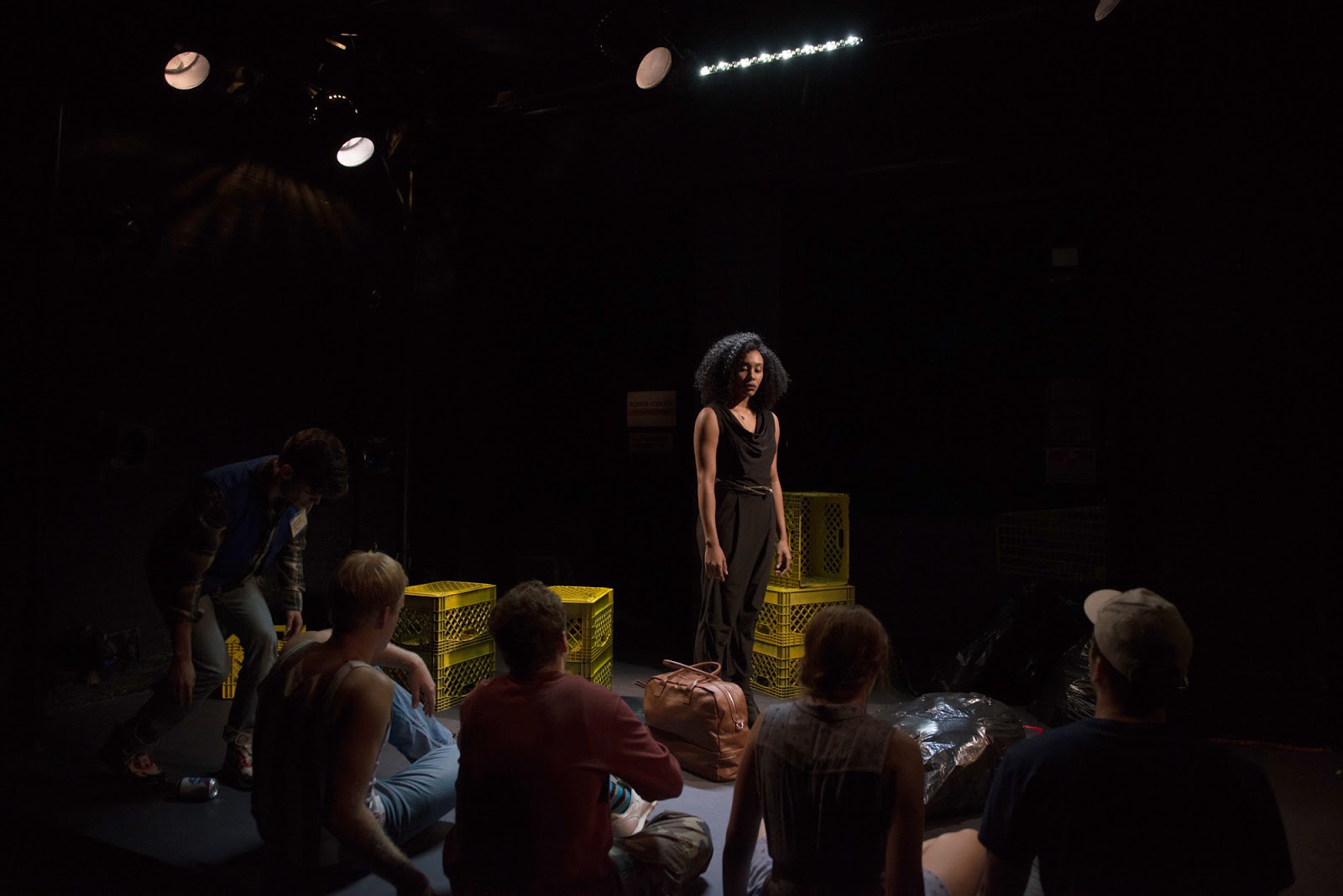
For my review of American Moor please click on THE BROADWAY BLOG.


DERREN BROWN: SECRETS (Reposting of May 2017 Off-Broadway review)

(THEATRE'S LEITER SIDE is now a book--two books, in fact. No, make that three books! The first covers the 2012-2013 season, when, at the age of 72, I began reviewing plays. It contains full reviews and shorter comments on 150 shows, as well as a brief memoir on how I got into this critical mess. The 2013-2014 season follows, with 300 substantial reviews, so many it had to be published in two volumes (May to November; December to April). Both are available at affordable prices (paperback and Kindle) at Amazon.com. Christmas is coming so why not consider them as gifts for your theatreloving friends and family? Click here for more information.)

Derren Brown: Secrets was reviewed by Theatre's Leiter Side after it opened at Off Broadway's Atlantic Theatre in May 2017. It just opened at Broadway's Cort Theatre to rave reviews. Scheduling conflicts made it impossible for me to see it on the available press dates so I'm reposting my original, highly positive review, which appears, for the most part, to conform to what I've read of the current production. To read the review please click here.


Thursday, September 12, 2019

7O (2019-2020): Review: ONLY YESTERDAY (seen September 11, 2019)

(THEATRE'S LEITER SIDE is now a book--two books, in fact. No, make that three books! The first covers the 2012-2013 season, when, at the age of 72, I began reviewing plays. It contains full reviews and shorter comments on 150 shows, as well as a brief memoir on how I got into this critical mess. The 2013-2014 season follows, with 300 substantial reviews, so many it had to be published in two volumes (May to November; December to April). Both are available at affordable prices (paperback and Kindle) at Amazon.com. Christmas is coming so why not consider them as gifts for your theatreloving friends and family? Click here for more information.)

"Let It Be"


For my review of Only Yesterday please click on THEATER PIZZAZZ.


GUEST REVIEW 12 (2019-2020); HERCULES


(THEATRE'S LEITER SIDE is now a book--two books, in fact. No, make that three books! The first covers the 2012-2013 season, when, at the age of 72, I began reviewing plays. It contains full reviews and shorter comments on 150 shows, as well as a brief memoir on how I got into this critical mess. The 2013-2014 season follows, with 300 substantial reviews, so many it had to be published in two volumes (May to November; December to April). Both are available at affordable prices (paperback and Kindle) at Amazon.com. Christmas is coming so why not consider them as gifts for your theatreloving friends and family? Click here for more information.)
  

(For the past few years, Theatre’s Leiter Side has enjoyed covering the expansive, community-based, Central Park productions sponsored late every summer by Public Works and staged by the gifted Lear DeBessonet. For some reason, however, I wasn’t invited this year. When the blog's talented guest reviewer, Elyse Orecchio, informed me that she had seen the show, I asked her to review it and she was kind enough to oblige. I hope you enjoy her commentary. SLL)


"Heroism and Humanity Redefined" ****

by Elyse Orecchio (guest reviewer)


When one of the Muses introduced Hercules in the prologue to the show named after him, all the 30-somethings in the audience leaned forward in anticipation of the familiar line from another Muse, “Honey, you mean HUNK-ules!”


But it never came. Instead, she responded, “Not to objectify, but . . . ” And,  just like that, it was clear to us 90s kids who knew every word from the 1997 Disney movie that we were about to watch Hercules: the 2019 edition. 
Jelani Alladin and company,. All photos: Joan Marcus.
This was an audience happy to be in the al-fresco room where it was happening at the Delacorte Theater. It was the last night of the one-week engagement, and most of the attendees were there because they snagged a coveted golden ticket via lotto. It was clear that this was a theater full of fans. 
Michael Roberts as Zeus, Tar-Shay Margaret Williams as Hera, and the company of Hercules.
The Public Theater mounted this musical adaptation of Hercules in partnership with the Public Theater's Public Works program, which aims to connect people via theatre. They enlisted hundreds of community members, from choral groups and a marching band to pint-sized children and white-haired seniors, playing all but the lead characters. 

While the stage certainly feels crowded much of the time, this model works well in the many scenes that take place with sweeping amounts of Thebians. Kudos to choreographer Chase Brock, tasked with the feat of having them all dance! 

The Delacorte is a fitting backdrop for this world of gods, titans, townsfolk, and monsters. Dane Laffrey’s understated scenic design consists mostly of some columns and stairs that are awarded ample displays of color, thanks to Tyler Micoleau’s lighting. James Ortiz’s multitude of magnificent puppets bring additional vibrancy to the stage. 

This production sure knows its audience, and caters to the NYC theatregoers with a Hamilton reference (a quote about Hercules Mulligan, naturally), a Gyro stand, and a city
more concerned with affordable housing than a hero who can whack mythical monsters. 

Happily, the crowd-pleasing moments also include classic favorites from the film: some of the biggest cheers of the night come from the line,  “Somebody call IX-I-I!” and the opening chords of the song “Zero to Hero.” 
Jeff Hiller as Panic, Roger Bart as Hades, and Nelson Chimilio as Pain.
Directed by Public Works founder and resident director Lear deBessonet and featuring a new book by Kristoffer Diaz, Hercules is laden with not-so-subtle references to the disconnected era we’re living in, with a clear message that there is heroism in just getting through it. The powerful dare-you-not-to-cry ending has the community stepping in to fight in place of Hercules (Jelani Alladin), who has traded his god-like strength for love in a deal with the god of the Underworld Hades (deliciously delivered by Roger Bart, who sings Herc’s big number, “Go The Distance,” in the film). 
Krysta Rodriguez as Meg and Jelani Alladin as Hercules in Hercules.
This is a detour from the movie plot, and one that culminates in Alladin’s powerhouse performance of a new song, “To Be Human.” In the movie, Hercules chooses to remain mortal over joining the gods, but he does it for love. Now, he professes the power and majesty of toiling through the days and the strength and unity of a community that toils together. In other words, it ain’t about a boy being gooey-eyed over a pretty face anymore (though he’s still that, too). 
James Monroe Iglehart (Phil), Jelani Alladin (Hercules), and the troupe.
Modern sensibilities are especially embodied in Megara, Herc’s love interest and Hades’s reluctant henchwoman. Like movie-Meg, she's forced by Hades to use her feminine wiles to seek out Hercules’s weakness (he doesn’t have any, except for his feelings for her). And like movie Meg, she is hardened toward men after trading her soul to save her boyfriend’s life, only to have him leave her (she's still reduced to a woman scorned; why this wasn’t updated, I don’t know). But as bitingly played by Krysta Rodriguez (TV's "Smash"), Meg is far from needing rescuing; good luck to anyone who tries! Megara has traded her iconic, hip-swiveling dress for a leather jacket and skinny jeans (costumes by Andrea Wood).

Meg’s rant, “Forget About It,” is one of a handful of new songs written by the film's composer ,Alan Menken, and lyricist David Zippel. Others feel like filler, and the song written for Hades, “A Cool Day In Hell,” is underwhelming, especially considering the underused capabilities of Tony-winner Roger Bart and comedian Jeff Hiller as Panic, Hades’s scene-stealing sidekick.

In another shift from the film, Herc’s immortal parents, Zeus and Hera, now passive-aggressively tell their son he lacks what it takes to become a hero and find his way back to Olympus. It's Hercules’s trainer, Philoctetes (seasoned Disney vet James Monroe Iglehart [Aladdin]), who allows the 18-year-old to finally be vulnerable--leading to a moving moment in which he-man Hercules breaks down because those closest to him won’t accept him unless he’s a hero. What makes an impact here is not his fear that he won’t measure up. It’s Herc’s frustration over the conditions others put on their acceptance of someone they love. In a time when we are questioning our expectations of what it means to be a man, particularly a black man, Alladin as Hercules finds his voice. His bio states, “This is for all those whose shoulders I stand on.”

As for this Disney kid, perhaps my favorite moment of the evening came after the performance was over. As the audience exited and the orchestra played the last of the score, the audience yelled in unison, “Yes, indeed!”at the button of the closing song. Here’s the reference for those of you over 40 and under 25. It was a wonderfully satisfying way to end this community experience.

DelacorteTheater
Central Park at W. 82nd St., NYC 
(closed September 8)

Elyse Orecchio studied musical theatre at Emerson College, acting at CUNY Brooklyn College, and English Linguistics & Rhetoric at CUNY Hunter College. She has worked in nonprofit communications for more than a decade. She lives in Sunnyside, Queens, with her husband Joe, kids Theo and Melody, and three cats. eorecchio@gmail.com @elyseorecchio


Wednesday, September 11, 2019

69. (2019-2020): Review: L.O.V.E.R. (seen September 10, 2019)


“Just a Five Towns Girl”


L.O.V.E.R., originally produced in Croton Falls, NY, and then in Los Angeles, is a middling, sexually-oriented memoir cum one-woman play by and starring actress Lois Robbins. Seen locally last year at the United Solo festival, it's now playing at the Pershing Square Signature Center. 

Since I confess my previous unfamiliarity with her, I assume the same is true of many who might wonder, what’s Lois Robbins to us or we to her that we should care for her? 
Lois Robbins. All photos: Joan Marcus.
Lois Robbins is an attractive, youthful-looking woman at around the mid-century mark, with the svelte dancer’s physique of someone half her age. She takes pleasure in displaying it when the script allows her to remove her long, clinging sheath—worn with sneakers—so she can prance about in pale pastel tights.

Robbins has had a reasonably substantial career in all the entertainment media. You can watch clips of her film work here on IMBD, beginning with one showing her opposite British heartthrob Jonathan Rhys Meyers in The Aspern Papers, an indie also starring Vanessa Redgrave. Her principal claim to fame seems to be her work on various daytime TV soaps.
Lois Robbins.
More to the point, she’s from a Jewish family in the Five Towns section of Long Island (where my own daughter raised her family). It’s a geographical origin (near JFK) she finds slightly embarrassing although she’s clearly proud of her ethnicity, insisting she can play “Jewish” despite never getting cast as such. Although her script, which is more in the “then-I-laid” than the “then-I-acted” vein, doesn’t cite particular movie. TV, or theatre work, she constantly refers back to her upbringing, including her demanding father’s snide remarks and her mother’s pearls of parental wisdom.

This background, and her New York-area personality, should make her story that much more immediate to a local audience. Indeed, the vast majority of those around me were middle-aged women, clearly her target audience, who seemed to appreciate the shifting focuses of her self-deprecating tale of self-gratification, evolution from ugly duckling to "stunning" (as an admirer says), sexual development, search for love in all the wrong men, theatrical ambitions, marriage, parenting, and health issues.
Lois Robbins.
I say “self-gratification” because the play begins with Robbins sprawled across a washing machine as she tells us that she had her first orgasm at age three. She proceeds to explain how, as she grew up, she couldn’t resist “the feeling” she got from direct contact with the soft and hard parts of her furniture, as well as the vibrations of her washing machine.

Her detailed account of her masturbation mastery suggests we’re in for an autobiographical Fifty Shades of Grey but, alas (or amen), her story largely drops the radically risqué to concentrate on her more conventional romantic and sexual experiences (including her rejection of a threesome) as she simultaneously pursued her career in New York and the West Coast. None of the men or things she does with them are particularly unusual, though, and, much as they may seem unique to her, sound relatively common in our sexually liberal times.

Finally, Robbins found Mr. Right in the shape of the spouse she calls (like everyone else she mentions) by a pseudonym, Arthur, despite his being the enormously wealthy Andrew Zaro, a fact she neglects to convey. Robbins's survival from a serious--if, tragically, all too familiar--health scare and the raising of her own kids fill out (or bloat, depending on your perspective) the narrative,.

Fewer topics and more of the outrageousness promised at the start might have salvaged the piece. A successful, recent example of such an approach would be Jacquelin Novak: Get on Your Knees, a one-woman show preoccupied with relationship issues in the context of the actress’s obsession with fellatio.

It’s also hard not to see in Robbins’s relationships (including an actual “affair”) a tendency toward passivity and victimization, as if it were always the men who were responsible, not only for making the initial connection but for whatever difficulties ensued.

Director Karen Carpenter gussies up Robbins’s rather unsurprising, disappointingly unfunny material by moving the lithe, physically expressive performer up, down, and around Jo Winiarski’s skeletal set of a three-tiered structure of steps and landings dressed with white sheeting, over which hang an assortment of seven, small, glass lighting instruments. Jeannette Oi-Suk Yew’s lighting is called on frequently to alter the mood from one sequence to another (indicated by moving LED ribbons saying things like, “THE GIRL,” “THE TEENAGER,” “THE WOMAN,” “THE PATIENT,” etc.). Jane Shaw’s expert sound design, with music, crowd noises, and other effects, also contributes mightily.
Lois Robbins.
Robbins is polished and pleasant, but (a few moments of genuineness aside) she comes across more as an actress than the spontaneously charming person she needs to be. Nor is she helped by material filled with commonplaces that aren’t enhanced by her occasional tendency to giggle, as if that might make them seem wittier than they are.  

At two points, Robbins provides different words to spell out her acronymic title. I came up with my own but maybe it's best not to repeat it.

Pershing Square Signature Center/Alice Griffith Jewel Box Theatre
480 W. 42nd St., NYC
Through November 2

OTHER VIEWPOINTS:


Saturday, September 7, 2019

67 (2019-2020): Review: SINCERITY FOREVER (seen September 5, 2010)

"Heads Up"


If you’re planning to kill two plays with one ticket at the Flea Theater in order to see both Bad Penny and Sincerity Forever on the same evening, be aware—as noted in my review of the former—that you’ll need a separate ticket for each.
Amber Jaunai, Nate DeCook, Vincent Ryne. All photos: Allison Stock.
These works, of course, are part of the Flea’s Mac Wellman: Perfect Catastrophes, A Festival of Plays, celebrating the iconoclastically gnarly work of Flea cofounder Wellman, the prolific writer who heads the distinguished BFA Playwriting Program at Brooklyn College.

And, even if you concur with my less-than-enthusiastic response to Bad Penny, the first half of the bill, if you’re planning to see them in succession you’ll likely to find it worth your while to stick around for Sincerity Forever, even though it means killing an hour between the plays in a not particularly engaging part of Tribeca.

Originally produced at the Berkshire Theater Festival, in 1990, where it won an award, and seen later that year in Brooklyn as part of the 1990 Fringe Series, Sincerity Forever was dedicated to the late Senator Jesse Helms “for the fine job you are doing of destroying civil liberties in These States.” This tongue-in-cheek honor presumably led the National Endowment for the Arts to request that Wellman remove the credit he gave it for an N.E.A. playwriting fellowship, with the writer noting in the published script that he “was wrong, SINCERITY FOREVER was not made possible by the generous assistance of the N.E.A. I don’t know what I was thinking.”

This gives you an idea of Wellman’s feisty political heart, which he pours into Sincerity Forever, a stinging, one-act putdown of American life as seen through the preternaturally ignorant eyes of seven teens living in the fictional, Deep South, small town of Hillsbottom. Moreover, most of these drawling characters dress as if Ku Klux Klan sheets and coneheads were standard cool kids gear.

The thinly plotted play's offbeat characters and structure are accompanied by a heightened, sometimes bizarre, blend of redneck locutions, colorfully distorted grammar, colloquial teenspeak, formal rhetoric, and extreme profanity. At the same time, it’s more linear and thematically accessible than Bad Penny. It’s also better directed (by Dina Vovsi) and performed (by the Bats, the Flea’s resident company of young actors-in-training). It’s still weird, though, as well as over-the-top and WTF?

More than half of its eight scenes are conversations among pairs of teens sitting in cars. These are Judy (Malena Pennycook) and Molly (Charly Dannis), who have two scenes together; Hank (Nate DeCook) and Tom (Vince Ryne); Judy and George (Peter McNally); and Lloyd (Jonathan Ryan) and Tom. Another teen, Melvin (Alex Hazen Floyd), joins in later on.

Stirring things up are a pair of disputatious demons from the tribes of Belial and Abaddon: Furball #1 (Zac Porter), wearing a fur vest, and his Goth partner, Furball #2 (Neysa Lozano). Bringing the wrath of God to town, however, is the suitcase-carrying Jesus H. Christ (Amber Jaunai), played here as an angrily intense African American woman.

Frank J. Oliva’s sceneryless stage, nicely lit by Becky Heisley McCarthy, uses little more than plastic milk boxes, with a narrow beam hanging across the stage about two feet from the ground. As the characters talk while sitting directly behind the beam, we discover American youths practically reveling in their know-nothingness. They think that those who profess knowledge are only faking it, and take pride in being “ignorant forever in absolute sincerity.” Sincerity, you see, is a virtue high enough to forgive any other lapses.

Their comically convoluted conversations are larded with references to God’s secret plans, religious faith, their souls, the search for meaningfulness, heaven and hell, death, romantic crushes (hetero and homo), jealousies, coolness, sex, catastrophic ills, like nuclear pollution, and even the purity of their families’ ancestral, Aryan stock, with invocations to the Norse god Wotan (a.k.a. Odin).

The teens believe their lives are being disrupted by the presence of a mystic Furball that must be destroyed. Those fuzzy aliens—who like jiving to a heavy beat—are demons who thrill to their own monstrosity while hating everything these “empty-headed purveyors of the American dream,” with their “fake cant and bullshit,” hold dear. In fact, one insists it’s all “deeply insincere.” On the other hand, they claim sincerity for themselves, even quarrelling bitterly over which is more sincere. Thus, the arrival of Jesus, bearing an “apparatus” that can detect a Furball’s presence and ready to use her mind to obliterate any she might find.
Malina Pennycook, Amber Jaunai, Alex Hazen Floyd, Vincent Ryne.
Wellman enjoys keeping us off guard by playing games with his language and situations, including having characters, once they're infected by the Furballs, repeat dialogue earlier said by others, or even to have them argue using the Furball’s own particular insults. “Something bad’s gotten into us,” admits someone.

Toward the end, the kids go haywire, with a climactic cacophony of overlapping arguments (as indecipherable as those in Bad Penny) before Jesus delivers a lengthy diatribe. She explains her mission, noting “what a sorry place this world is,” blasts everyone for their vanity, hypocrisy, and distortion of Christian values, casts aspersions on “dumb-ass” sincerity, and wonders why she should  even bother with mankind.
Amber Jaunai.
Not all of this comes across clearly, however, nor am I sure I grasped more than a handful of Wellman’s points, but the writing and staging manage to hold the attention much of the time. The KKK costumes, interestingly, seem intended more to symbolize the kind of ignorance that informs American racism than to reflect actual racist behavior. Apart from a few references, like those to Aryan ancestors, or a quickly passing homophobic/anti-Semitic/racist comment, the usual KKK tropes of cross-burnings, lynching, or slurs are ignored.

As noted in my Bad Penny review, Wellman writes for a niche audience—to which I admit not belonging—that greatly appreciates his quirky, nontraditionalism.  But, given Wellman's esteem as a maven of the avant-garde, I sincerely suggest that, for those interested in an important example of late 20th-century “experimental theatre,” Sincerity Forever, unlike Bad Penny, deserves a heads up. 

Flea Theater/The Siggy
20 Thomas St., NYC
Through September November 1

OTHER VIEWPOINTS