Sunday, December 15, 2019

135 (2019-2020): Review: THE CRUCIBLE (seen December 13, 2019)


“The Real Witch Hunts”

It’s impossible, while watching Eric Tucker’s magnetically gripping revival of Arthur Miller’s 1953 modern classic The Crucible, for Bedlam (i/a/w the Nora), not to shudder at the play’s resonances with the current impeachment mess. The Crucible, of course, conflates the Salem witchcraft trials of 1692-1693 with the communist-hunting HUAC hearings of the McCarthy era.
However, while the play originally was intended as a slap in the face of the commies-in-every-woodpile turmoil of the day, The Crucible takes no sides in the current political debate, each side arguably being able to find support in it for its positions.
What it does do with volcanic force, though, is to encapsulate the ever-more heated struggle between truth and lies, while exploiting the theme of guilt by association. And, of course, inspired by the refusal of some HUAC witnesses –like Miller himself—to name names, it explores a noble act of self-sacrifice to prevent others from being harmed.   
As I once wrote regarding a different production (with different actors than those named here), The Crucible examines the mass hysteria stirred up in a Puritan community by the accusations of witchcraft leveled by 17-year-old Abigail Williams (Truett Felt, ferocious) and other girls as a way of avoiding punishment for having been seen at night dancing in the woods. They blame their behavior on the Devil. Allegations of witchcraft are leveled by Abigail at various Salem women, including Elizabeth Proctor (Susannah Millonzi, deeply moving), wife of the independent-minded farmer John Proctor (Ryan Quinn, tragically heroic), Abigail’s employer, whom she seduced and whose wife she’d like to replace.

The townspeople respond in a superstition-fueled frenzy that brings powerful officials, led by the obdurate Deputy Governor Danforth (Paul Lazar, ruthlessly demanding), to Salem to seek out the devil worshippers; torture and the threat of hanging are deployed to force the defendants to name names. Motivated by personal animosities, including greed, vengeance, and envy, neighbors turn on neighbors, and reason to unreason. Tragedy ensues when the morally compromised Proctor performs a sacrificial act that saves his “name,” leading his equally condemned (and pregnant) wife to say, “He has his goodness now.”

Certainly, the maelstrom of passions, fears, imaginings, panic, and superstition is as viscerally present in this unusual, stripped-down, 14-actor production (13 when I attended) as it was in Ivo van Hove’s controversial rendering on Broadway, which I admired, in 2016. The auditorium seats in the old Connelly Theater in Alphabet City have been removed so that some audience members, seated on the stage, view the performance while facing the spacious auditorium’s rear. Others, in the auditorium itself, surround the action in a semicircular row. 
Costumes have been reduced by Charlotte Palmer-Lane to neutral modern styles, lots of them dark and scruffy, while John McDermott’s scenery-less set consists of little more than sturdy, old, mismatched, wooden kitchen chairs and tables, as well as a bed. These are moved about rapidly in cleverly orchestrated shifts (chairs roll on casters), serving for multiple purposes (tables, or tables on tables, become platforms, for example), but with all units (like the “offstage” actors) remaining exposed throughout. With scene flowing instantly into scene it sometimes takes a moment or two to determine where we are.
The cast, annoyingly, is listed in the program (handed out after the show) as an unindividuated ensemble, no one being identified by their roles. This requires interested theatregoers to determine who’s who on their own. If I were an actor brave enough to risk hanging by Salem’s court, I’d protest. 
Various actors play more than one role. Given the relative paucity of visual hints, this can be momentarily confusing. Distinctive performances in particular roles are given by Caroline Grogan as Mary Warren, the one girl willing to call Abigail a liar; Shirine Babb as Tituba, the Barbadian slave; Randolph Curtis Rand as the self-important, narrowminded Rev. Parris; Rajesh Bose as Giles Corey, who bravely endures death by the piling on of stones (“More weight,” he demands); Shaun Taylor-Corbett, as the clerk, Cheever, crawling like a dog on all fours; director Eric Tucker as the conscience-stricken Rev. Hale; Alan Altschuler as the hardscrabble landowner Thomas Putnam; and John Terry, playing not only his own roles but stepping in excellently—book in hand—to play those of the ailing Arash Mokhtar. 
For all his John Doyle-like minimalism, and his creative use of the simple assortment of battered furniture, Tucker respects the text. He’s inspired his cast to express their characters’ words, emotions, and motives with remarkable conviction, building moments of anxiety with considerable overlapping of dialogue and near-operatic explosions of anger and fright. This occasionally means a plethora of shouting but it never seems forced, even when—as in the opening scene at Rev. Parris’s house—the actors seem to be affecting an exaggeratedly melodramatic manner. This combination of heightened theatrical style and profoundly invested emotionality grabs you tightly and never lets go. 
Given the deep connection the actors make with their characters and the situations, however, Tucker’s penchant for gimmickry can seem intrusively unnecessary. Does he really need those postmodern microphones (soon enough discarded)? Or a cowboy-style revolver and holster at the Marshal’s hip? Or actors lighting their own faces in the dark with flashlights? Or small metal lamps maneuvered by the actors for spotlight effects? Les Dickert’s piercing lighting does well enough sticking to conventional means without such nods to clichéd avant-gardism. 
Bedlam’s The Crucible follows in the wake of other “experimental” revivals of the play, from the Wooster Group’s version, where it forms one part of L.S.D. (. . . Just the High Points . . . ), to the previously mentioned Ivo van Hove revival. An offbeat version of a three-hour American classic at one of New York’s less accessible venues may not be high on many holiday season lists. Serious theatregoers, though, should consider gifting themselves a visit to East Fourth Street to see this one before it closes.

Connelly Theater
220 E. Fourth St., NYC
Through January 29


Saturday, December 14, 2019

134 (2019-2020): Review: JAGGED LITTLE PILL (seen December 12, 2019)


“Perfectly Imperfect”

There are jagged little edges on Broadway’s newest jukebox musical, Jagged Little Pill, inspired by Alanis Morissette’s blockbuster album of 1995, composed and performed when the Canadian alt-rocker was only 19. (The show, later reworked, premiered last year at Cambridge’s American Repertory Theatre). Hyper-kinetically directed by Diane Paulus (Waitress, Pippin), and with a multi-themed book by Diablo Cody (the movie Juno), Jagged Little Pill weaves the songs (lyrics: Morissette; music: Morissette and Glen Ballard) into an original story. It gets its laughs but is mainly in the dark, angst-ridden vein of musicals like Next to Normal. 
Celia Rose Gooding, Derek Klena, Elizabeth Stanley, Sean Allan Krill. All photos: Matthew Murphy.
Orchestrated and arranged by Pulitzer Prize-winner Tom Kitt, with an eight-piece orchestra upstage, the show uses roughly half of the album’s 22 songs. Remaining are two unreleased numbers, “Predator” and “Smiling,” four from other albums (Supposed Former Infatuation Junkie and Under Rug Swept), one from the album Feast on Scraps, one from the bonus track of the album Havoc and Bright Lights, and one from the soundtrack of the movie City of Angels.
Celia Rose Gooding and company.
Jagged Little Pill, playing at the Broadhurst, removes the personalized specificity of the album, which expresses Morissette’s anger-fueled reaction to the breakup of a romantic relationship, and which spoke deeply to young people, especially women, growing up in the 90s. Instead, it employs the songs—favoring emotional over narrative expression—to enhance a dysfunctional family drama, laden with socially significant issues. Music originally written for a single voice has been divided either for multiple characters, for company-backed solos, or for all-company performance.
Derek Klena and company.
Judging by the enthusiastic response, across the gender and age (to a point) spectrum, this approach appears to raise few audience objections. My middle-aged daughter, an ardent Morissette fan, was impressed. I, however, a Morissette virgin already middle-aged when the album came out, was unable at first hearing to surf its wavelength without sometimes falling off. My appreciation remained superficial, suggesting that greater familiarity with the album, or even with Morissette’s unique voice (not heard here), might have led to a warmer response.
Celia Rose Gooding and company.
While many of the songs seem more or less organically related to their newfound contexts, others fit in less comfortably, like jigsaw puzzle pieces that look right until you try to squeeze them into their slots. Moreover, Cody’s book attaches the songs to a narrative with so many different issues that Jagged Little Pill nearly becomes a jagged survey of contemporary wokeness.
Elizabeth Stanley.
Bookending the show are Christmas scenes at the suburban Connecticut home of the well-to-do Healy family (a name hinting at what everyone in the family will require), with pretty, competitive supermom Mary Jane a.k.a. MJ (Elizabeth Stanley, excellent) composing an annual Christmas letter on her laptop. Mary Jane, we’ll soon discover, had a car accident earlier in the year, became addicted to painkillers like Oxycodone, lost her sex drive, and was reduced to buying back alley drugs. She also has a secret the plot will force her to divulge.
Nora Schell and company.
Her husband, Steve (Sean Allan Krill, epitomizing white bread suburbia), is a workaholic lawyer who compensates for MJ’s bedroom boredom by watching porn, duly noted when MJ admits to spying on his browser history. Super-son Nick (Derek Klena, appealing), partly because MJ makes his decisions for him, has been accepted to Harvard, while 16-year-old, adopted daughter Frankie (Celia Rose Gooding, power-voiced), is African American.
Lauren Patten and company.
Nick’s clay feet will be exposed when he witnesses but doesn’t report the party rape by his equally privileged high school friend, Andrew (Logan Hart, fine), of the less privileged Bella (Kathryn Gallagher, intense). Frankie, increasingly sensitive to her racial difference from her family, uses her feelings of alienation to become politically active, beginning with protests about her school’s refusal to provide girls with free sanitary napkins. She’s also bisexual, leading to an intense dalliance with the overtly lesbian Jo (Lauren Patten, the big takeaway) before she switches to cute boy Phoenix (Antonio Cipriano, cute).
Elizabeth Stanley, Kathryn Gallagher, and company.
This eventually triggers the 11 o’clock number, “You Oughta Know,” in which Lauren Patten’s Jo, feeling betrayed, puts on a musical display of such Tony-worthy, pyrotechnical fury that the producers added the audience’s clapping to the running time. On the other hand, having this secondary character do the show’s biggest number unbalances the dramatic structure.

Cody uses the Healy family dynamic to weave in not only problems of marital sex, opioid addiction, porn obsession, biracial family conflict, party rape, social media slut shaming, teen drinking, and sexual orientation, but—as per the student demonstrations that pop up—even passing glances at gun control and climate change.
Elizabeth Stanley, Heather Lang.
For a time, it’s push and pull over whose problem is the most pressing, MJ’s, Frankie’s, Bella’s, or Jo’s. Eventually MJ’s struggle dominates, after which a happy-ending-of-sorts rapprochement is reached, with the understanding of how “perfectly imperfect” everyone is, and the family again gathers around as mom composes yet another Christmas letter.
Celia Rose Gooding, Antonio Cipriano. 
Riccardo Hernández has crafted a complex set of flying and sliding panels, combined with the extensive video projections of Lucy Mackinnon, to move the many scenes along swiftly under Justin Townsend’s scintillating light design. Emily Rebholz’s costumes include a bevy of ultracool togs for the high-school kids, all of whom look more like mall rats than library brats.
Derek Klena and company.
Many shifts involve the constantly busy chorus, a good number of whom get a brief character scene or other noteworthy business. Most distinctive is Heather Lang, a lanky, blonde dancer who serves as the attention-grabbing doppelganger for Bella’s rape scene and as an anguished, flopping, flying, and flailing MJ in “Uninvited.” Ebony Williams is another eye-catcher with her unusually sinuous plasticity in the choreographic hands of Beyoncé collaborator Sidi Larbi Cherkaoui. The latter's dances often seem like gold-standard versions of the writhing, twisting, jumping, and punching routines sometimes offered by street and subway buskers.
Add caption
Jagged Little Pill, well-performed and slickly produced, never convinced me of its necessity. That is, its incorporation of Alanis Morissette’s music, written from other motives, in a story of family dysfunction and social unease, seems more a wishful concept than a work of organic integrity, a problem endemic to shows trying to hook popular songs to an unrelated story, be it White Christmas or Head Over Heels.
Company of Jagged Little Pill.
Just as Mary Jane concludes that we’re all perfectly imperfect, so can we declare that Jagged Little Pill is a perfectly imperfect jukebox musical.

Broadhurst Theatre
235 W. 44th St., NYC
Open run

Thursday, December 12, 2019

132 (2019-2020): Review: PUMPGIRL (seen December 11, 2019)


“Aggrieved, Arrogant, and Abused”

“Toxic masculinity” is a phrase we nowadays hear over and over. Director Nicola Murphy, who helped mold three masterful performances in Abbie Spallen’s Pumpgirl, in the Irish Rep’s intimate Scott W. McLucas Studio Theatre, uses it to describe the play’s world, noting “how it affects men and women, and how complicated recovery can be for both victim and abuser.” This is certainly true of Spallen’s play, set in Newry, a small, dead-end town near the southern border of Northern Ireland, but it’s hard to pin all the toxicity in this darkly dreary, rural world on its masculine component. 
Clare O'Malley, Hamish Allan-Headley. All photos: Carol Rosegg.
The three characters in Pumpgirl (seen at the Manhattan Theatre Club in 2007 following productions in Edinburgh and London) represent an adulterous triangle. One is the eponymous Pumpgirl (Labhaoise Magee), the nickname of Sandra, a young woman who works at a rundown gas (petrol) station, where diesel is more expensive than a few hundred yards down the road, across the border. Her baseball cap and notably butch appearance cause her frequently to be asked, usually with sniggering intent, whether she’s a man or a woman.
Labhaoise Magee.
Hammy (Hamish Allan-Headley), who wears a flashy, racing driver’s jacket (spot-on costuming by Molly Seidel). is a raucous, foulmouthed, hard-drinking, devil-may-care egotist who works in a chicken hatchery and gets his kicks driving in stock car races. Given to quoting Queen lyrics, his reckless style has earned him the label “No-Helmet” Hammy. Married, with two kids, he carries on with Pumpgirl, who, despite her appearance, seems thoroughly heterosexual. 
Hamish Allan-Headley.
And then there’s Sinead (Clare O’Malley), Hammy’s much put-upon, largely-ignored, attractive wife, who has a palpable distaste for Hammy’s presence, and finds herself obsessively entwined in an affair with Shawshank, an ex-con, quotation-spouting, drinking buddy of Hammy's, despite his unappealing looks. 
Events coalesce following a shocking act of sexual violence: betrayal, guilt, potential murder, and reckonings ensue. 
Clare O'Malley.
The McLucas’s interior—sharply lit by Michael O’Connor—has been completely rearranged by Yu-Hsuan Chen to provide a wide performance area, with an aisle runway. At our left is a double-bed, standing vertically, from which Clare often speaks. Nearby is her kitchen area. Toward center is a car seat, the focus of much of Hammy’s activity, especially when he’s racing, his unprotected noggin knocking against the invisible window. And at our right is the cashier’s counter and petrol pumps belonging the station where Pumpgirl, who also changes oil, does her thing. 

Spallen, however, hasn’t written a conventional play but, instead, a series of interlinked monologues in which the characters tell their stories, speaking other people’s words when necessary, a literary device not unfamiliar in other recent plays. The Irish Rep itself was the venue for such a play, Little Gem, just this past August, while the Keen Company did Molly Sweeney two months later. 
Hamish Allan-Headley, Labhaoise Magee.
Much as it has its value in providing actors with richly rewarding opportunities, the device isn’t always able to sustain interest over the course of the play's two-hours and five minutes, although it regains momentum as it barrels toward its second-act conclusion. Theatre is theatre, not oral interpretation, as exemplified by the two brief moments in Pumpgirl where the characters momentarily relate to one another. 

As in much other Irish writing, the colorful language is as much a dramatic component as any of the plot elements. Spallen is exceptionally adept at writing colloquial speeches, embedded with profanities, using stunningly apt metaphors that nonetheless sound as if they could have been spontaneously created by these unschooled characters. A simple example is when Hammy, rescued from a burning car by being doused with a fire extinguisher, declare that “It’s like being spunked by an elephant.”

The images are mostly unpleasant, cruddy ones, capturing the mundane feels, smells, sounds, and sights we daily experience, like the pieces of food lodged in seat cushions, or a husband’s rancid breath, or the noise of snoring. Spallen weaves them into a poetic prose that piles one atop the other, many spoken so fast and in such thick brogues you sometimes miss the forest for the trees.
Labhaoise Magee.
Magee, Allan-Headley, and O’Malley offer headily intense, emotion-packed, viscerally magnetic performances. You may not catch every word but you can’t help but be moved by the depth of conviction of the aggrieved Sinead, the arrogant Hammy, and the abused Pumpgirl. When the latter delivers a wrenching monologue toward the end, the tears streaming down her face, some visitors may have a hard time keeping their own cheeks dry.

Irish Repertory Theatre
132 W. 22nd St., NYC
Through January 22

Wednesday, December 11, 2019

131 (2019-2020): Review: ONE NOVEMBER YANKEE (seen December 10, 2019)


“Quibbling Siblings”

 There are three noteworthy presences in Joshua Ravetch’s One November Yankee at 59E59. Two are the actors Stefanie Powers (TV’s “Hart to Hart”) and Harry Hamlin (TV’s “LA Law”), both of them active in all media—including considerable stage activity—but especially well-known for their TV series work. Each remains remarkably trim and attractive, he at 68, she at . . . well, you can dig for it on your own but I assure you that, unless you already know, you’ll be surprised. 

Harry Hamlin, Stefanie Powers. All photos: Matt Urban at NüPOINT Marketing.
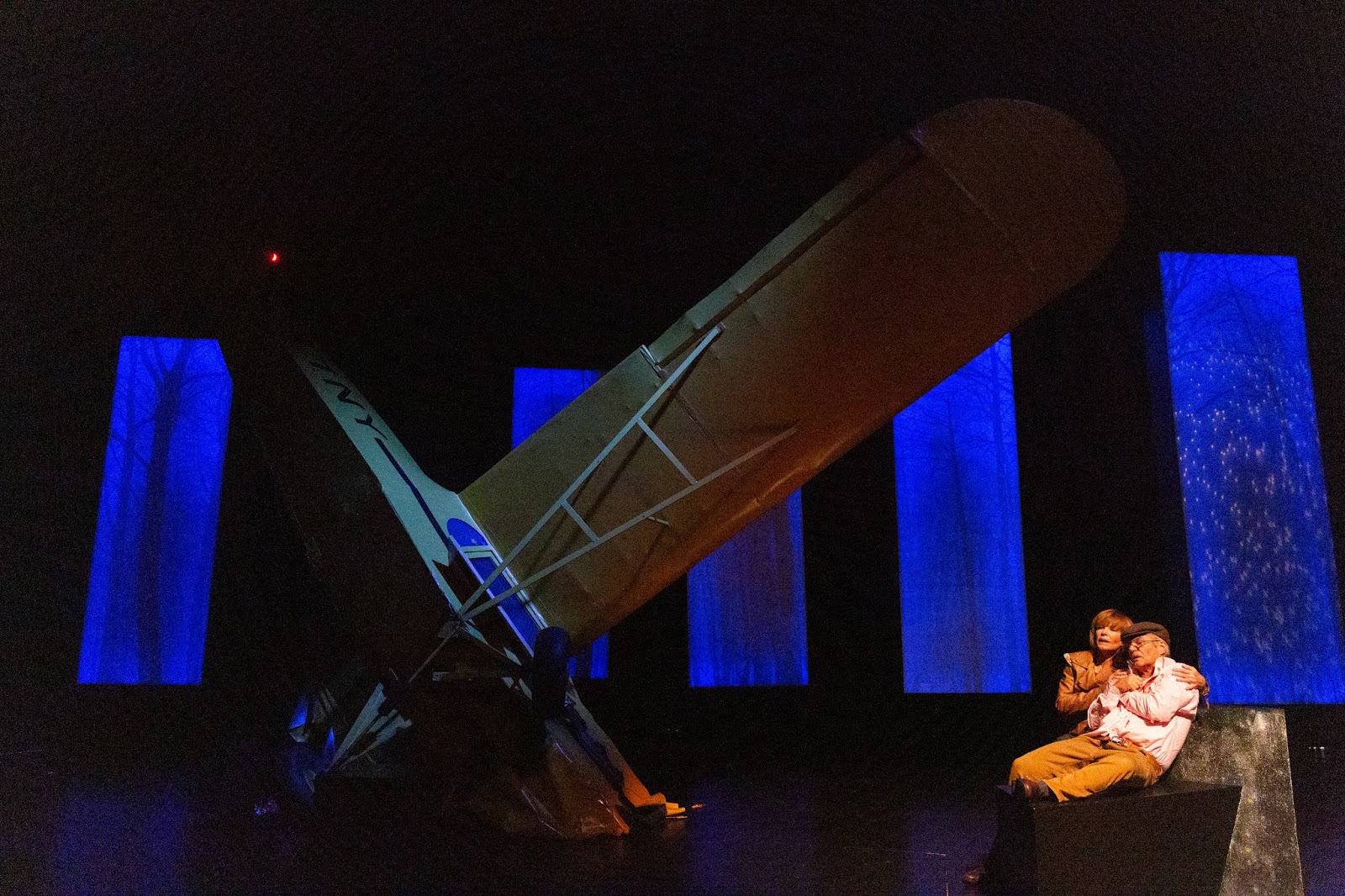
The third presence is inanimate, a realistic depiction of a wrecked, yellow Piper Cub, registration number 241-November-Yankee, upside down, its nose smashed into the stage floor of Theater B. It’s perhaps the most memorable scenic unit I’ve ever seen on that modest, little stage. Credit goes to Dana Moran Williams, who places it within a neutral setting ringed by vertical panels. One serves as a screen for an abundance of aviation videos (uncredited), accompanied by Lucas Campbell’s sound score of familiar music (including “Fly Me to the Moon”).

The 80-minute, two-actor, six-character play, directed by its author, escapes being a total wreck itself by virtue of its appealing stars, who recently appeared in its Delaware Theatre Company production. (It first was done in LA in 2012, starring Hamlin and Loretta Swit.) Linking four scenes together, with the same characters bookending the play, its plot navigates around the central image of that upside-down plane, which remains in place throughout.

In scenes one and four, it’s an installation art work at MOMA, created by the insecure, artsy-fartsy, silk-scarf-casually-tossed-over-his-black-shirt Ralph. The show is curated by his fashionista, pun-obsessed, Anna Wintour-like sister, Maggie, ruthlessly cutting in her disdain for her brother’s work. In scenes two and four, it’s an actual wreck, somewhere in the mountains of New Hampshire.
Harry Hamlin.
The MOMA scenes show us the bickering, expletive-larded, awkwardly-dialogued rivalry between the siblings, the chief purpose appearing to be a satire on the modern art world. It’s an environment where objects like a “Crumpled Plane,” as Ralph’s installation is called, can gain notoriety and instigate controversy over what is and isn’t art. (This has thematic possibilities, of course. Just this week, news of Pres. Trump’s impeachment was diverted for a few seconds by the sale for $120K of a rotting banana duct-taped to a wall.)

In scene two, the plane that inspired Ralph’s installation, headed for a Florida wedding, has just crashed. The survivors are siblings Harry and Margo. She, the incompetent pilot, is a librarian, albeit a fashionable one in her slacks and tight, Amelia Earhart-like leather jacket. (The costumes are by Kate Bergh.)

He’s a novelist still struggling for recognition, whose reaction to the accident is “This doesn’t happen to people like us!” by which he means, “Jewish intellectuals.” “It’s the kind of thing you read about in the New York Times and it’s always rich Republican Goyem.” And that, if it somehow makes you laugh, is about the apex of the play’s humor.

So Ronnie and Mia (we even get a “missing in action” joke) find themselves alone in the woods without cellphone service as snow begins to fall and hypothermia sets in. (Wouldn’t there be at least a blanket in the plane’s still accessible interior?) He’s bloody and has a broken leg. Nevertheless, the pair banter lightly, the seriousness of their situation taking second place to leaden attempts at humor based on fraternal squabbling.
Harry Hamlin, Stefanie Powers.
In scene three, five years later, at the same time the art exhibition is opening in New York, a pair of sibling hikers, Ronnie and Mia, come across the plane, the first people ever to spot it. Both are in shorts, hiking gear, and baseball caps, hers attached to phony-looking strands of shoulder-length, silver hair.

Initially shocked by their discovery, Ronnie and Mia's family issues soon dominate, even when they find the remains of the victims—like a jawbone and a watch, not to mention a huge volume of Proust’s In Search of Lost Time: Remembrance of Things Past. No matter how important their find, it plays copilot to their own remembrance of things past, like Ronnie’s of his brother’s death or of the plane that landed on the Hudson River.

During scene four, the conclusion, the exhibit opens just as news of the remarkable coincidence of the plane’s discovery is announced. Ralph and Maggie await the reviews before going to the exhibition’s after-party.

Perhaps there’s a message somewhere in here about the vagaries of fate and coincidence and the inter-connectedness of experience (think Six Degrees of Separation). However, the overall superficiality of the writing and characterizations, the implausibility of the action, and the too-frequently banal dialogue defeat any attempt to take the play seriously.  

When the image of a crashed plane upstages even actors like Harry Hamlin and Stefanie Powers, you may be forgiven for taking out flight insurance before you get on board.

59E59 Theaters/Theater B
59 E. 59th St., NYC
Through December 29


Monday, December 9, 2019

Sunday, December 8, 2019