Monday, October 7, 2019

85 (2019-2020): Review: KINGFISHERS CATCH FIRE (seen October 4, 2019)


“Strange Bedfellows”

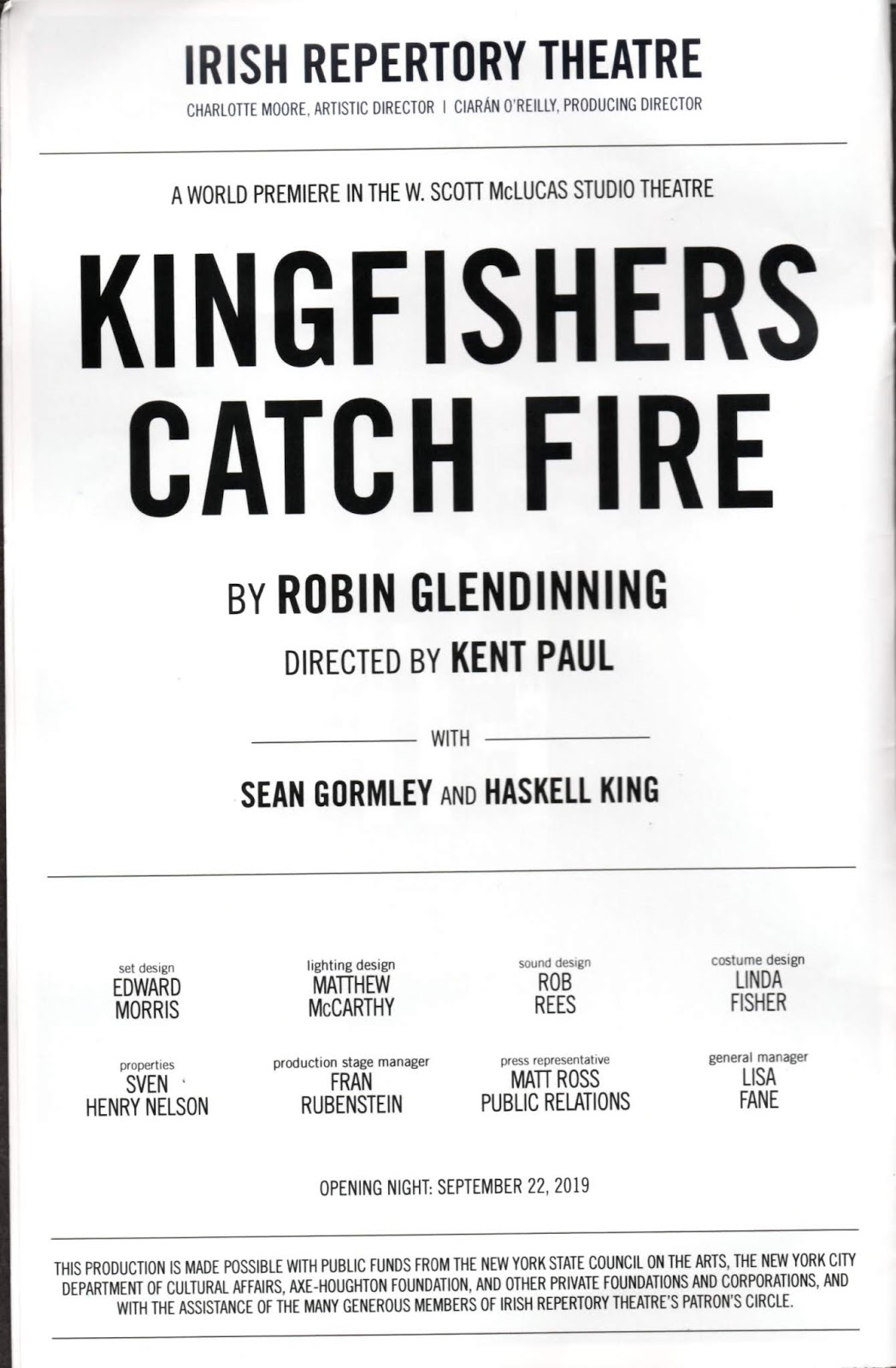
Col. Herbert Kappler and Msgr. Hugh O’Flaherty, the subjects of Irish playwright Robin Glendinning’s Kingfishers Catch Fire, now getting its world premiere at the Irish Rep, may not be names that immediately come to mind when you think of World War II. Even after seeing them in this talky, often draggy, but occasionally compelling drama, however, you’re likely to want to know more about them, if only to put the play’s abundant, methodically dosed-out exposition—some of which situates it as a Holocaust drama—into a broader context.
Haskell King, Sean Gormley. All photos: Carol Rosegg.
The stories of Kappler and O’Flaherty are gripping enough to have been previously dramatized. Most notable is the 1983 TV movie, The Scarlet and the Black, starring Gregory Peck as the priest and Christopher Plummer as the Nazi. There’s also God Has No Country, a one-man play by and starring Donal Courtney, given only a few performances. 
Haskell King, Sean Gormley.
There’s too much history involved to unpack in a brief review, so here are the outlines. In 1943, Rome was placed under German occupation, soon after the Italian government established an alliance with the Allies. Kappler, the SS chief of police in Rome, whose responsibilities included rounding up Jews for deportation to Nazi death camps, was in conflict with Msgr. O’Flaherty, the heroic Irish priest from County Kerry who used his Vatican position to rescue Jews and Allied servicemen. In 1944, following the killing by partisans of 33 men under Kappler’s command, the SS officer retaliated by ordering the execution of 335 prisoners in what was called the “Ardeatine Massacre,” for which he was, in 1948, sentenced to lifetime imprisonment in the Gaeta military prison.
Haskell King, Sean Gormley.
Remarkably, however, O’Flaherty began visiting Kappler in prison regularly, and the two developed an unusual bond, one so meaningful to Kappler, in fact, that, for all his religious skepticism, he eventually converted to Catholicism. The play dramatizes two early meetings between these strikingly different men, before Kappler’s conversion. Its time frame also prevents it from mentioning other fascinating aspects of Kappler’s life, such as how, in 1977, when he was dying of cancer, his wife managed to sneak the sickly, 103 lb. man out of prison in a suitcase and take him to West Germany, where he died.
Sean Gormley.
Given Kappler’s wartime deeds, penetrating intelligence, and ethical cynicism, and O’Flaherty’s genial, warm-blooded, sometimes faith-doubting humanity, there’s enough potential in their relationship to create a two-act, hour and 45-minute, discussion drama concerning their imagined conversations. Kappler, played by Haskell King, speaking with just a trace of a German accent, expresses piercing sarcasm layered with anger and vulnerability.

He’s costumed by Linda Fisher in a dark, green, military-type jump suit, but it’s so well-fitted that, along with a torn undershirt slashed to the belly, it seems mainly intended to emphasize the good-looking actor’s sexual appeal. The Irish-accented monsignor, played with wit and soul-searching humility by the dependable Sean Gormley, is garbed in the traditional, long-black robes of a church official.
Haskell King.
Kingfishers Catch Fire, which takes its name from a poem by poet/priest Gerard Manley Hopkins, printed in the program, is set in Kappler’s filthy cell, a dominant feature of Edward Morris’s set being a cruddy, seat-less toilet that would rival the one in Trainspotting for honors in a “worst toilet” competition. Kent Paul’s direction, otherwise excellent, includes a scene when the colonel drops his pants without a by-your-leave to use that receptacle. Even if meant to show Kappler’s disdain for his unwelcome visitor, it seems an unnecessary intrusion (extrusion?), the kind of thing you remember later even when more important moments should be on your mind.
Haskell King, Sean Gormley.
When the play begins, O’Flaherty is trying to get Kappler, preoccupied with physical exercising, to answer basic questions on the conditions of his incarceration. The officer rudely avoids them in favor of engaging in snarky dialogue with his clerical interrogator. As the minutes pass, however, the back and forth begins to elicit who these men are and what has brought them to this pass.

Soon, they’re talking about religious faith, Jesus Christ (whom O’Flaherty says told him to come here), biographical details from each man’s life, a photo given by the priest to Kappler of the prisoner's teenage son, Pope Pius XII’s response to the Jewish problem, O’Flaherty’s unhappiness at being tasked with annulling the unhappy marriages of wealthy Catholics, and the background to the massacre that eventually led to Kappler’s being found guilty of war crimes.

Much time is occupied with the relative justice meted out to the pessimistic Kappler for his deeds in comparison with what happened to others who were involved. There’s also Kappler’s rationalization of how the massacre itself came to be, and a detailed explanation of why the number killed was 335, leading to a stunningly graphic description of the gruesome event itself.
Haskell King.
Kappler’s multipronged guilt—involving the classical dilemma of a military officer’s need to follow orders with which he may not agree—is examined but atrocities committed by the other side are also considered, just as is the blood shed over the centuries in the name of Christianity. O’Flaherty’s vocation is significant, allowing for consideration of God’s responsibility for allowing such things to happen and for Kappler, who claims to favor Greek theology over Christianity, to wrestle with his own atheism. O’Flaherty’s struggle with his faith and his reluctance to proselytize are also on the table.
Sean Gormley, Haskell King.
Rich as the substance of the men’s debate is, it requires close attention to follow its densely packed arguments, often delivered in stiff, unnatural dialogue. It takes an effort to piece together the rhetorical specifics regarding the how, what, and why of the massacre. On the whole, though, the acting is good enough and the circumstances provocative enough to make Kingfishers Catch Fire burn with historical significance, moral relevance, and human feeling.

Irish Repertory Theatre/Scott W. McLucas Studio Theatre
132 W. 22nd St., NYC
Through October 20

OTHER VIEWPOINTS:


GUEST REVIEW (2019-2020) 13: FOUND

“Hello, Dollies!”***

By Elyse Orecchio (guest reviewer)

From time to time 
Theatre's Leiter Side posts reviews of Off-Off Broadway shows my schedule prevents me from seeing. If you are interested in reviewing Off-Off Broadway, please contact me so we can discuss. I hope you find the expanded coverage useful. Sam Leiter

If you’d told me how much fun I was about to have at Found, an immersive theatrical experience in Chelsea, I wouldn’t have believed you. I entered with my mind admittedly closed, as I typically don’t enjoy absurdist hooey. Turns out I walked out making a mental list of the friends I’d encourage to go see it, particularly those who are art enthusiasts.  
Tracy Weller. Photo: Eraj Asadi.
Look, there’s a reason that New Yorkers endure inhumane rents for apartments, where closets are converted into showers. It’s because we don’t like to be bored. We get our entertainment in unsuspecting places, from the duo belting a romantic aria on the subway platform to the man with one leg doing backflips outside the Port Authority. 

I ended up finding entertainment at the cell theatre (Nancy Manochercian, founding artistic director) in Chelsea, where Found, with its “explosion of dolls” and other perverse, whimsical installations, delivered on its promise of a sensory whirlwind. This project, a collaboration between visual artist Mikel Glass and Mason Holdings, converts the townhouse theatre into a four-story visual arts exhibit with multimedia elements that include videos of little girls in beauty pageants everywhere, and a salon-type hair dryer that plays music when you stick your head in it. 

Upon entry, I helped myself to a tasty green cocktail that was flowing through a system of crooked pipes, mad scientist lab-style. I found my stiff drink necessary as I meandered through oil paintings depicting strange stuff, like Bart Simpson making his way through the birth canal. 

Soon I was called to the basement, where three of us were invited to choose an outfit for a woman in her underwear. She had me help her into the dress I selected. For a moment, it was like I had a personal living doll, which was in keeping with the doll theme. I was invited to hug her for 53 seconds (she had another guest set her cell phone timer) and then snap a selfie. When the job was done, she ran out of the room screaming. As we made our way upstairs, I wondered what all the selfies would look like in the next few weeks as she wears various combos of hats, shoes, and outfits. 

Up in the attic, aka “Heaven,” we were met by Mikel Glass, the artist who created this world. There, surrounded by strewn-about dolls, a film projector, and a live harpist strumming exquisite melodies, Glass broke the fourth wall and engaged our group in a discussion about the show. He told us the story of his daughter’s lost doll, and what it meant to her, which got him thinking about every doll he encounters on the street, how they once all belonged to a child, and how each had a story. Glass explained that it can be boring and sleepy to walk through a typical art gallery, and he wanted to challenge the way people can experience art. He also objected to the perception of dolls as creepy. 

We then proceeded to a room with, yep, lots more creepy dolls, each one of them found on the street and sent to Glass per his request. There, a woman playing an old-fashioned housewife engaged us in absurd conversation, asking questions like, “Is that your thumb? Do you have floors? What’s your blood type?” (It was later apparent she was asking if you were suitable to give a doll a home). I decided she was my favorite actress because she was as engaging and invested as she was wacky. It was later that I found out she was Tracy Weller, founder and artistic director of Mason Holdings, the company responsible for the production, which makes a lot of sense.

I was then taken to a room where all the art was made entirely out of wood, from pizza slices and tea bags to paper shopping bags and even paintings. A character forced me to give her something if I was to be allowed to touch the art. I perused my bag and gifted her a wrinkled map of Acadia National Park, which seemed to please her.

I crossed a floor of those little plastic balls you find in a ball pit to climb into a small tent, where a character invited me to add anything I wanted to a painting of my choice. I made some quick brush strokes and moved on, but enjoyed my small contribution to a collaborative art piece (even if it does look like a child’s scribblings).

Finally, I was brought to another floor where an actress in pigtails was competing in a beauty pageant. She invited me to play with a life-sized version of one of those toy structures you find in a pediatrician’s office, where you move colored blocks around various tracks. Here's where you insert your own commentary about young pageant contestants as dolls.

On the way out, in exchange for jotting down our dream for a better world on a Post-it (90% of the answers I saw on the wall were Trump-related), we were given Ben & Jerry’s ice cream. It was even Cherry Garcia, my husband’s favorite. 

If nothing I’ve said makes any sense, just watch this short clip. I’m really glad this video exists, because describing the show pushes the limits of my capabilities. I expect the reactions to Found will be across-the-board, from people rolling their eyes real hard to avant-garde enthusiasts who are all in. The one thing I can say for sure is: go. Why? You live in NY, and this is just the kind of batty stuff you do when you’re here. The only promise I can make is you won’t be bored. 

P.S. Tickets are discounted on Halloween; the 45 minutes you spend at Found will be a worthwhile stop amid the trick-or-treating and parading.

cell theatre
338, West 23rd St., NYC
Through October 31

Elyse Orecchio studied musical theatre at Emerson College, acting at CUNY Brooklyn College, and English Linguistics & Rhetoric at CUNY Hunter College. She has worked in nonprofit communications for more than a decade. She lives in Sunnyside, Queens, with her husband Joe, kids Theo and Melody, and three cats. eorecchio@gmail.com @elyseorecchio


Sunday, October 6, 2019

Saturday, October 5, 2019

Friday, October 4, 2019

82 (2019-2020): Review: THE HEIGHT OF THE STORM (seen October 2, 2019)


"Tempest in a Weak Plot"

It was pouring on Tuesday night—the height of the storm, actually—when I arrived at the Samuel J. Friedman Theatre to see the aptly named The Height of the Storm. This is the Manhattan Theatre Club’s importation of Christopher Hampton’s translation of French playwright Florian Zeller’s play, as produced at Wyndham’s Theatre in London, and starring the distinguished British stars, Eileen Atkins and Jonathan Pryce. As in his The Mother and The Father, Zeller dramatizes the aberrant behavior of an aging character experiencing some form of dementia. It's a superficially intriguing drama whose principal contribution is the priceless acting of Pryce and Atkins.

Inspired by his subjects’ raddled minds, he creates plays that seem on their surface rational and straightforward until the mirror of life begins to fracture.  Is what we’re seeing actually happening? Is it all in someone’s erratic imagination? Is it a combination of both? As in The Height of the Storm, his plots are not particularly original, but he so manipulates the obvious that it becomes elusive and keeps his audience involved more by theatrical legerdemain than by anything much deeper.
Lucy Cohu, Eileen Atkins, Amanda Drew, Jonathan Pryce, Lisa O'Hare.
The Height of the Storm, in fact, reminded me of the not-all-that-dissimilar hocus pocus, designed to illuminate a narrative of marital betrayal, in Pinter’s Betrayal. Adultery, in fact, is the principal dramatic nugget in Zeller’s plot, such as it is. It tells the tale of an esteemed, elderly, French writer, André (Pryce), and his lovingly supportive wife, Madeleine, as they rumble around the huge kitchen of their discreetly shabby, rural pile, somewhere outside of Paris.

Where Pinter illuminates his subject by reversing the chronological order of his story, Zeller moves among the days when one, the other, or both of his leading characters are alive, and after one, the other, or both are dead, leaving the audience to suss out, if they ever do, which is which, and what is what.
Jonathan Pryce.
As Zeller explores the relationship between the sometimes roaringly crotchety, literary lion and his subtly commanding spouse, the action, meticulously directed by Jonathan Kent, shifts from what seem present-time scenes to those in the past, although it’s occasionally vague as to when is when. He focuses on the relationship between the married couple as well as those they have with their adult daughters. These are the earnest Anne (Amanda Drew), there to compile or edit André’s papers, and the flightier Élise (Lisa O’Hare), who arrives with her latest beau, a realtor (James Hillier), preoccupied with business on his cellphone, who takes some interest in the value of André and Madeleine’s house.  
Eileen Atkins.
Providing something from André’s past into which to sink our teeth is a mysterious, somewhat younger, voluptuous woman (Lucy Cohu), whose Germanic name (Mrs. Scharz? Mrs. Schwart?) Madeleine can’t get right, providing a few laughs. She may have been André’s lover but Zeller—who makes André's memory of her unstable—uses her exposition to toy with perceptions of truth and fantasy.

The lack of substance, or the conventionality of what substance there is, is not as important in these plays as the opportunity the dialogue and situations provide for nuanced, emotionally vivid emoting. Each actor from the Wyndham’s production is present, showing the typically high quality of British stage acting, but, as with the New York stagings of The Mother, which starred Isabelle Huppert, and The Father, with Frank Langella, The Height of the Storm weaves its spell through the power of its magnificent stars.
Jonathan Pryce, Eileen Atkins.
Atkins’s Madeleine is a model of stoic, knowing control, aware of just which buttons to press and which to avoid in handling her difficult husband. When she does, briefly, let rip, it’s a moment to remember. Pryce’s André, sometimes raging, sometimes hectoring, and sometimes frightened to the point of trembling, commands the stage with every gesture and inflection. When, toward the conclusion, the pair are alone, she promising her fearful husband, “I’ll always be there,” all the cerebration that previously has cooled our feelings flies out the window and we share, as nowhere else in the play, the depth of love and the pain of loss experienced at some point in every long-term human relationship.
Eileen Atkins, Jonathan Pryce.
Anthony Ward’s kitchen setting of towering, ceilinged walls, coming to an upstage apex with a booklined study at one side and a hallway at the other, uses a perspective forced just enough to suggest that things are a bit askew. Hugh Vanstone’s lighting has the awesome painterliness of a master, beautifully fading his characters in and out as per each moment’s needs. The original music of Gary Yershon and the sound design of Paul Groothuis greatly enhance the auditory ambience.
Jonathan Pryce.
Even if The Height of the Storm confuses you, or fails to satisfy your need for complex dramatic action, it will likely compel your interest, if only because of how ardently Atkins and Pryce capture the essence of mutual companionship. It’s the height of acting.

Samuel J. Friedman Theatre
261 W. 47th St., NYC
Through November 24

OTHER VIEWPOINTS:


Thursday, October 3, 2019

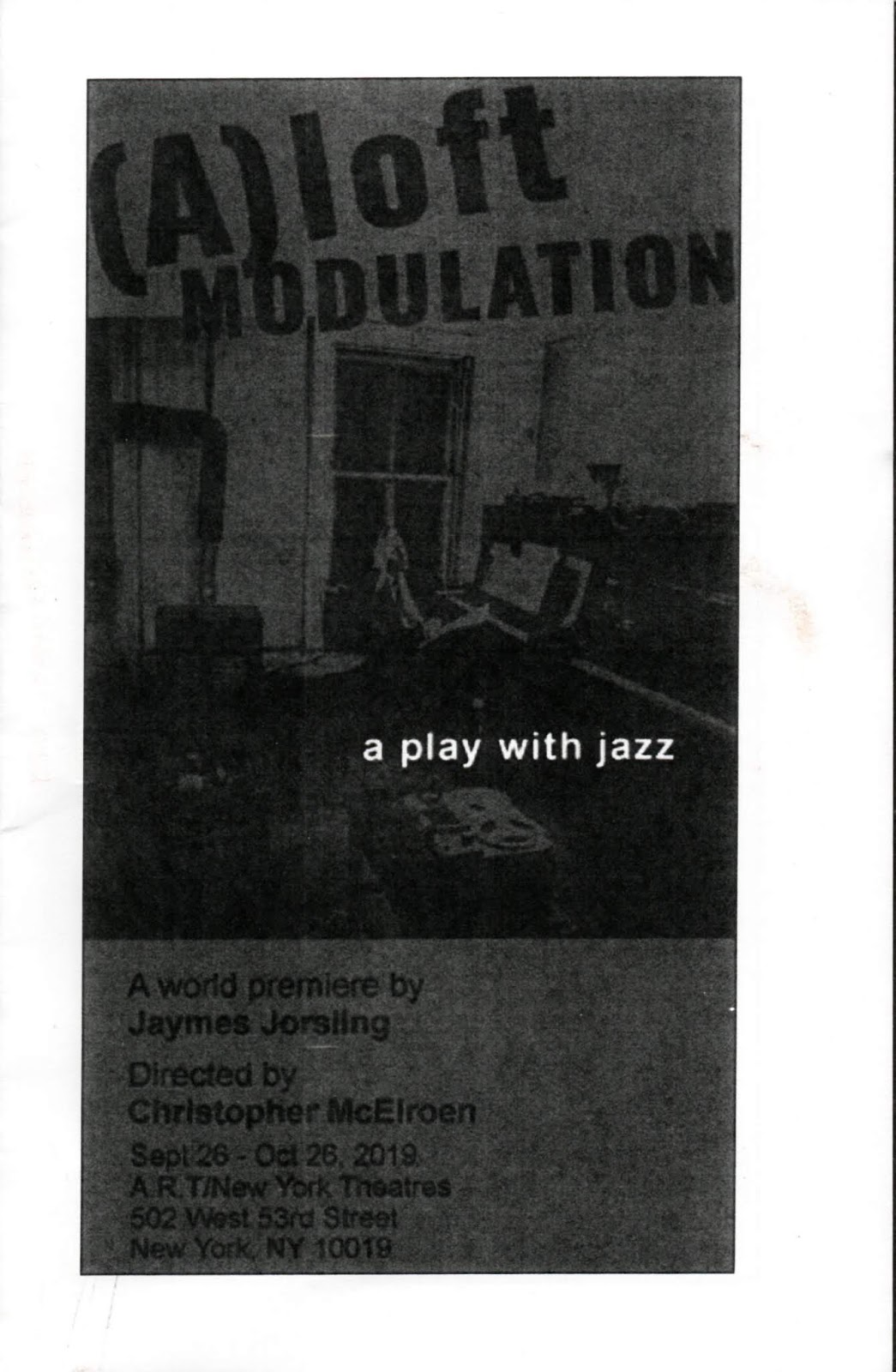
81 (2019-2020): Review: (A)LOFT MODULATION: A PLAY WITH JAZZ (seen September 29, 2019)


“All That Jazz”

Three of the shows I saw this past week had intermissions, leading some members of the audience at each to take their leave early. I sympathize with those who left two of those shows early, including whoever did so at (A)loft Modulation; A Play with Jazz, Jaymes Jorsling’s oddly titled, ambitious, but ramshackle play, performed with large infusions of live jazz, at the A.R.T./New York Theatre in Hell’s Kitchen.
Company of (A)loft Modulation. All photos: Joan Marcus.
Some background is necessary before we get to this fictional dramatization of a New York residence famous among jazz aficionados, produced by the american vicarious. Its story has been told previously in books and in Sarah Fishko’s well-received 2016 documentary, The Jazz Loft According to W. Eugene Smith.

Smith was an acclaimed photojournalist for Life, then America’s most popular weekly magazine. In the mid-1950s, he suffered personal and professional crises, including great dissatisfaction with how his work was handled by Life. So disturbed was he that he resigned, abandoned his wife and four kids in Croton-on-Hudson, and moved, in 1955, into a loft at 821 Sixth Avenue, in the then unsavory “flower district.” There, for a decade, he wallowed in booze and drugs while being a late-night host to artists and musicians, including such jazz icons as Thelonius Monk, Zoot Sims, and Charles Mingus. His neighbor in the adjoining loft was the notable jazz musician and Juilliard classical music teacher, Hall Overton.

Smith was a virtual hoarder of pictorial and aural mementoes of his years in what came to be known as the “Jazz Loft,” not only obsessively taking pictures—over 40,000—of its happenings, but keeping reel-to-reel recorders going surreptitiously to the point that 4,500 hours of conversation and music were taped. His archives ultimately were thoroughly researched and written about by Sam Stephenson, director of the Jazz Loft Project at Duke University, and the inspiration for Jorsling’s character, Steve Samuels.

Jorsling’s rambling, episodic play, presented on a cramped, cluttered, tri-level set designed by Troy Hourie, and complexly lit by Becky Heisler McCarthy, is set both in the 1957-1964 period and today, sometimes with characters from the past occupying the same space as those in the present (as in In Old Age, currently at the New York Theatre Workshop). The action jumps around among situations in the past and present, the former involving fictional characters based on Smith, Overton, and their friends, the latter focused on the conflicted relationship between the Sam Stephenson avatar, Steve Samuels (Kevin Cristaldi), and his wife, Annie (Julia Watt).
PJ Sosko, Christina Toth. 
The Smith character is Myth Williams (PJ Sosko), which, of course, inspires talk about mythology. Overton is Way Tonniver (Eric T. Miller), another symbolic moniker, and their substance-abuser friends are the drummer Reggie Sweets (Elisha Lawson), the sax player Sleepy Lou Butler (Charles Hudson III), the junkie Chip (Spencer Hamp), and the hooker Skyler, who becomes Myth’s photography acolyte. (For whatever reason, Skyler, played by the sleekly constructed Christina Toth in stylish red wigs—is costumed by Elivia Bolenzi [whose other costumes work better] to look more like a fashion model than a skanky streetwalker.)

Aside from Reggie, who’s probably based on drummer Ron Free, it’s not clear who these friends’ real-life equivalents were. The play takes a way-overlong two and a half hours to wander around in subplots concerning everyone’s stories, including those of two inquisitive local cops, one from each era. He's played by the same actor, Buzz Roddy, in more or less the same way (albeit with a tonally authentic NYPD attitude) but wearing different jackets.

One of the play's more consistent throughlines concerns a discovery about who actually wrote a famous jazz number. The problem is, it’s a fictional tune so, when the composer is finally uncovered, we couldn’t care less. It's not as if we learned that Duke Ellington didn't write "Sophisticated Ladies."

The general premise is that, as we watch various moments in the lives of the loft’s long-gone denizens during its heyday, present-day Steve is studying Myth’s tapes and photos of what we're seeing. He’s so fixated on documenting them (while trespassing in the abandoned loft) that, without asking Annie, he quits his job so he can devote his every minute to the task.

This creates ongoing tension between the couple, as Steve can think of no better reason to explain his need to do the work than because, unhappy at his job, his documentation is something that will make his life matter. It's a thematic point also expressed about his own work by Myth. Strangely, despite Annie’s insisting on knowing his end goal, Steve never volunteers that he’s going to write a book or produce some similarly useful outcome to justify his sacrifice.

As he listens to the tapes, headphones on, much of what he’s hearing is acted out as when it was first spoken. He works in a kitchen area down left, while the action is mainly performed on a slightly raised area at stage right, while other scenes are seen even higher in Way’s loft. There, saxophonist Jonathan Beshay, drummer Kayvon Gordon, and bassist Adam Olszewski, join the actor-musicans playing Way and Sleepy Lou for some intense jam sessions at multiple intervals.
Kayvon Gordon, Jonathan Beshay, Adam Olszewski, Eric T. Miller, Charlie Hudson III.
The loft scenes sprawl confusingly through the late 50s and early 60s, with video projections (credit Adam J. Thompson)—some of it distractingly live, à la Ivo Von Hove—and old radio sound bites (credit Andy Evan Cohen) providing occasional background exposition or atmosphere—the Cuban Missile Crisis, JFK’s assassination, a poem by Edna St. Vincent Millay, etc.

Meanwhile, we watch Myth’s clique take drugs, drink bourbon, contemplate their potential, talk about and have sex, drop names, spout profanity, suffer existential angst, and experience a suicide.The play also alludes (with few details) to Smith’s trip to Japan in 1964, when he famously documented the effects of the Minamata pollution tragedy. Often, simultaneous scenes in two time periods require the dialogue in one to be cross-cut with that in another. 
Eric T. Miller, PJ Sosko, Charlie Hudson III, Spencer Hamp. Photo: Joan Marcus.
Myth and Way, especially the former, lapse into intellectually pretentious dialogue that, even if borrowed from actual transcripts (I have no idea) is dramatically stultifying. Myth’s language is especially pretentious, using words like “esurient” even to a presumably uneducated harlot. His verbal pretentiousness is such that, instead of simply saying he quit his job with Life, he’s more apt to observe “I divorced myself from their jurisdiction.” 

The wonder is that, under Christopher McElroen’s sharp direction, the actors invest their artificial lines with a sense of truth. Otherwise, the only thing to trust in this bleary exercise, as my jazz aficionado plus-one assured me, is the superior quality of the original jazz (by Gerald Clayton) we hear.  

A.R.T./New York Theatres
502 W. 53rd St., NYC
Through October 26

OTHER VIEWPOINTS:


Tuesday, October 1, 2019

80 (2019-2020): Review: SUNDAY (seen September 28, 2019)


"Here's Booking at You"

“Is no-one else fucking bored?” asks a character midway through Sunday, British playwright Jack Thorne’s (the Tony-winning Harry Potter and the Cursed Child) often desultory exercise in Gen-Z, self-pitying, navel gazing, getting its world premiere at the Atlantic Theatre Company. It’s a dangerous line because many spectators are likely to be shouting in the affirmative, if only in their heads.
Maurice Jones, Sadie Scott. All photos: Monique Carboni.
Sunday is directed and choreographed by Lee Sunday Evans (no relation) at a just-about audible level and with a sleepy energy that periodically erupts in herky-jerky bursts of dancing to Daniel Kluger's thumpingly rhythmic music, the main purpose of which seems to be to rescue us from Morpheus’ grip. It's set in a New York apartment shared by two attractive young women, friends from college, who hold low-level jobs in publishing. They're Marie (Sadie Scott), white, and Jill (Juliana Canfield), black. The women's passion for reading (mainly Marie’s) is represented in Brett J. Banakis’s spare setting, dominated by a mountain of books, sturdily arranged so that, in a couple of visually effective moments, they can actually be climbed without toppling.
zane Pais, Juliana Canfield, Ruby Frankel, Sadie Scott, Christian Strange. 
As in so many recent sets, the exposed brick walls of the stage area—usually faux but nonetheless realistic—provide a neutral background for furnishings spread across the acting area in a style someone calls “sloppy chic.” A kitchen is at stage left and beds are up right and left. A freestanding door, right, is the portal through which pass the play’s seven characters. Masha Tsimring's evocative lighting does much to pull it all together, while Ntokozo Fuzunina Kunene's quotidian costumes do their job effectively.
Christian Strange, Sadie Scott, Ruby Frankel, Zane Pais, Juliana Canfield.
One character, Alice (Ruby Frankel), a lesbian, sometimes sits or stands in a niche high up on the back wall. She both participates in the situations as herself and—almost as if she were a novelist writing the play we’re watching—delivers expository narratives in which she comments on what and who we’re watching. None of this furthers the action, and most of it seems irrelevant, particularly at the end when she presents a detailed account of what happened to the characters we’ve met in the years afterward. Logically, this would mean she’s talking to us from the mid-21st century, the mundanity of her comments suggesting that, regardless of how these people lived and died, the future otherwise is not much different than the present.
Christian Strange, Sadie Scott, Ruby Frankel, Zane Pais. 
Sunday is practically two loosely joined plays, the first beginning when a black neighbor, Bill (Maurice Jones), in his late 30s, comes to the door to request that when Marie’s friends gather in her apartment, they keep the noise down because he needs his Sunday night sleep. Those friends, in addition to Alice, Marie, and Jill, are Jill’s boyfriend, the privileged, wealthy Milo (Zane Pais), and his black friend, Keith (Christian Strange), a middle-class guy who had a scholarship at Milo’s elite school. All postgrads, they’re here for one of their weekly book club discussions, this one focusing on Ann Tyler’s once-popular, 1982 novel, Dinner at the Homesick Restaurant. 

Oddly, in this period of electronic readers, the medium of choice, as represented by the scenic pile, remains the printed book. As anyone familiar with Gen-Z readers knows, the preferred delivery system among them is electronic. Even with two characters working in publishing, not a word is spent on the changing modes of publication in the digital age, nor does a single Kindle reader make itself known.
Sadie Scott, Zane:Pais, Ruby Frankel, Juliana Canfield.
The group, it should be noted, has pledged not to mention Donald Trump, but one bit is nonetheless devoted to repetions of his name. Perhaps that's because its mere mention perks up New York audience ears, the way the mention of New Jersey nowadays does when a cheap laugh is sought. The friends divide their interest between chatter about the novel and their drinking, drugging, snacking, and interpersonal distractions, which eventually tie into the novel’s themes.

As Alice tries steering the conversation toward the book, Keith insists on following his own track, leading to hypothetical scenarios based on Quora-like questions. This involves things like talk about morality and trust, or nostalgia for their only recently lost childhoods. The principal subject, toxic masculinity, bleeds into talk about the characters in the novel.
Ruby Frankel, Juliana Canfield, Zane Pais, Sadie Scott.
I wish I could say that you don’t have to know Tyler’s book to appreciate the discourse but that would be incorrect. I never read it, and had zero interest in hearing these not particularly interesting people analyze it, often vaguely, especially in ways meant to reflect how the group embodies its themes. Milo, for example, apparently represents Tyler’s depiction of toxic masculinity. After the friends depart, leaving Marie alone (Jill has left to stay at Milo’s, as she often does), Bill returns and play number two ensues.
Zane Pais, Chriswtian Strange, Ruby Frankel.
A gentle, reserved, depressive, he feels intellectually inferior to the well-educated but painfully lonely, self-doubting Marie, but nevertheless engages us in what evolves into an odd-couple love scene. His reticence to welcome Marie’s surprisingly frank sexual aggressiveness almost seems intended as a rebuttal of the toxic masculinity discussed earlier.  The delicately acted scene, which some have compared to Terrence McNally’s Frankie and Johnny in the Clair de Lune, shows us a much more engaging drama than the plotless, self-indulgence that occupies Sunday’s first part. 
Maurice Jones, Zane Pais, Sadie Scott, Juliana Canfield, Christian Strange.
Overall, Sunday’s lowkey, nuanced acting is believably naturalistic. However, apart from the Bill-Marie encounter that closes the play, and a few scattered moments in the book club scenes, there’s not enough here make us care about the characters, their preoccupations, or their ideas. I won’t repeat the line that opened this review but by now you surely know the answer.
Zane Pais, Ruby Frankel, Sadie Scott.

Atlantic Theater Company
336 W. 20th St., NYC
Through October 13

OTHER VIEWPOINTS: