Saturday, August 11, 2018

61 (2018-2019): Review: SUMMER SHORTS 2018: SERIES A (seen August 8, 2018)


"One Out of Three"


Summer Shorts, the annual two-program festival of American short plays at 59E59 Theaters, is the city’s premiere showcase for traditional one acts. Such plays run roughly a half hour or so in contrast to the now common practice of plays filling an entire bill for a mere 45 minutes to an hour, and sometimes two hours or more, without a break. Of those one-acts I’ve seen over the past seven years of the festival’s 12-year history, however, only a few have enhanced the status of the form, which also is true of the 2018 offerings.

Kate Buddeke, Joel Reuben Ganz. Photo: Carol Rosegg.
As is now standard, the festival offers two three-play programs, Series A and Series B, each an intermissionless 90 minutes. Two plays in Series A are by rising playwrights Robert O’Hara (Barbecue) and Abby Rosebrock (Different Animals) whose ascent, I’m afraid, suffers a loss of altitude with this departure. The third, best-selling novelist Chris Bohjalian’s (The Flight Attendant) first play, encounters turbulence but manages to stay aloft.

Each Series A play, without being notably polemic, touches lightly on some contemporary social issue that has been gently peeled, rather than ripped, from the headlines. “The Living Room” has a racial theme, “Kenny’s Tavern” takes place just before Trump’s election, and “Grounded” brings #MeToo to mind. Physical action is limited; the actors in each do little more than sit and talk.
Kate Buddeke, Joel Reuben Ganz. Photo: Carol Rosegg.
“The Living Room” is African-American playwright O’Hara’s metatheatrical fantasy about Frank (Joel Ruben Ganz) and Judy (Kate Buddeke), the last two white people on earth. They’re seated for our viewing pleasure in an eternal living room’s armchairs by an unseen, God-like, black dramatist. Sometimes, they comment surreptitiously on his personal and artistic proclivities.
Kate Buddeke, Joel Reuben Ganz. Photo: Carol Rosegg.
Frank and Judy, frustratingly aware that they’re only fictional entities, describe the violent story that got them here and that led to the birth of their baby, a doll sitting at one side. They suggest that they exist because, in view of all the money whites made off slavery (which they refer to as “bubblegum”), the unnamed writer is seeking reparations by making “a quick buck off a couple of White People trapped as White Characters in their living room!”

They also frequently mock the theatre’s conventions, like their existence between blackouts and lights up, the presence of the fourth wall, the artificiality of stage food, or props like the doll baby. The play’s points seem blunted to the point of pointlessness and its self-declared existence as a “satire” evokes barely any laughs. The characters—whose dilemma is faintly reminiscent of Six Characters in Search of an Author—remain locked in O’Hara’s brain, unable to escape, just as the actors, under his listless direction, fail to make much of a connection with the audience. 
Francesca Fernandez McKenzie, Stephen Guarini. Photo: Carol Rosegg.
In Rosebrock’s “Kenny’s Tavern” we’re in the seedy backyard behind the title locale, a dive bar in a North Carolina town. Laura (Francesca Fernandez McKenzie), a lonely, mid-20s English teacher at a magnet school, is downing shots with her early-40s dean and mentor, Ryan (Stephen Guarino). With the 2016 presidential elections days away, Laura, concerned about the political climate, talks about teaching Muriel Sparks’s novel The Prime of Miss Jean Brodie, which raises the theme of fascism.

Mariah Lee, Francesca Fernandez McKenzie, Stephen Guarino. Photo: Carol Rosegg.
Laura and Ryan are involved (although he’s resisted her desire to sleep together) but he’s also got someone else. Laura—who compares Ryan to Trump—is so distraught she’s threatening to leave. There's also Jaelyn (Mariah Lee), the underprivileged, underage, hillbilly-accented teen who serves them. Jaelyn, twice rejected by their magnet school (a term she doesn’t understand), provides the most interesting element by allowing Rosebrock to depict how the self-involved, politically blue teachers treat the self-hating, red-leaning Jaelyn (Laura even calls her a “gargoyle”).
Francesca Fernandez McKenzie, Stephen Guarino. Photo: Carol Rosegg.
But none of it amounts to much, plot or theme-wise, and the action slumbers until director Jess Chayes momentarily wakes it up with a bit of unconvincing ranting from Laura. “Kenny’s Tavern,” lacking both dynamic direction and acting, quickly recedes into the miasma of forgotten one-acts. Rosebrock’s future (she recently wrote a PhD dissertation on Chaucer), though, looks bright, with the Atlantic Theater scheduled to do her full-length Blue Ridge in the fall.
Mariah Lee, Francesca Fernandez McKenzie. Photo: Carol Rosegg.
Bohjalian’s “Grounded” (not to be confused with 2014’s long one-act of that title, whose 2015 revival starred Anne Hathaway) nearly rescues the floundering evening. Grace Experience plays Emily, a young flight attendant headed for London, nervous because it’s her first transatlantic assignment. She and the older, more experienced, worldly Karen (K.K. Glick) get to know each other as they fold napkins in preparation for takeoff and then, while seated and strapped in, as the plane ascends. 
Grace Experience, K.K. Glick. Photo: Carol Rosegg.
The play, like the flight, isn’t always smooth, but Bohjalian succeeds in creating relatable, well-written characters, each of them given convincing performances that are the evening’s real standouts. The central premise concerns Emily’s revelation that for many years, beginning when she was 15, a friend of her dad’s named Vladimir (cue the Putin jokes) took sexual advantage of her, although with her consent. Having come to the realization of her victimization, she ponders the ramifications of exposing the predator, which will cause suffering to those around him.
K.K. Glick, Grace Experience. Photo: Carol Rosegg.
“Grounded” starts off as a light comedy about an apparently clueless young woman making her first transatlantic flight, which belies the more serious purpose that slowly comes into focus. Emily’s dilemma has considerable contemporary pertinence, made especially palpable in the sensitive, emotionally rich performances of Experience and Glick. Director Alexander Dinelaris deserves kudos for helping shape the simple humanity of their work.
Grace Experience, K.K. Glick. Photo: Carol Rosegg.
Once it makes its point, however, the play tends to linger a tad too long, as if not quite sure how to wrap itself up. Finally, it’s hard for the audience not to wonder about the service on this airplane. Aside from an occasional word or two to nearby passengers, or a PA announcement, once the craft is in the air Emily and Karen seem more concerned about their chit chat than fulfilling their responsibilities to a planeload of passengers.
K.K. Glick, Grace Experience. Photo: Carol Rosegg.
Tying the plays together is Rebecca Lord-Surratt’s adaptably neutral curtain-like background, which accommodates the various settings, Greg MacPherson’s versatile lighting, Nick Moore’s sound design (apart from the odd choice of “Rhapsody in Blue” for “Grounded”), and Amy Sutton’s costumes.

Series A goes one for three, good for a baseball hitter but not good enough for an evening of one-act plays.

OTHER VIEWPOINTS:

59E59 Theaters/Theater B
59 E. 59th St., NYC
Through August 31


Monday, August 6, 2018

Saturday, August 4, 2018

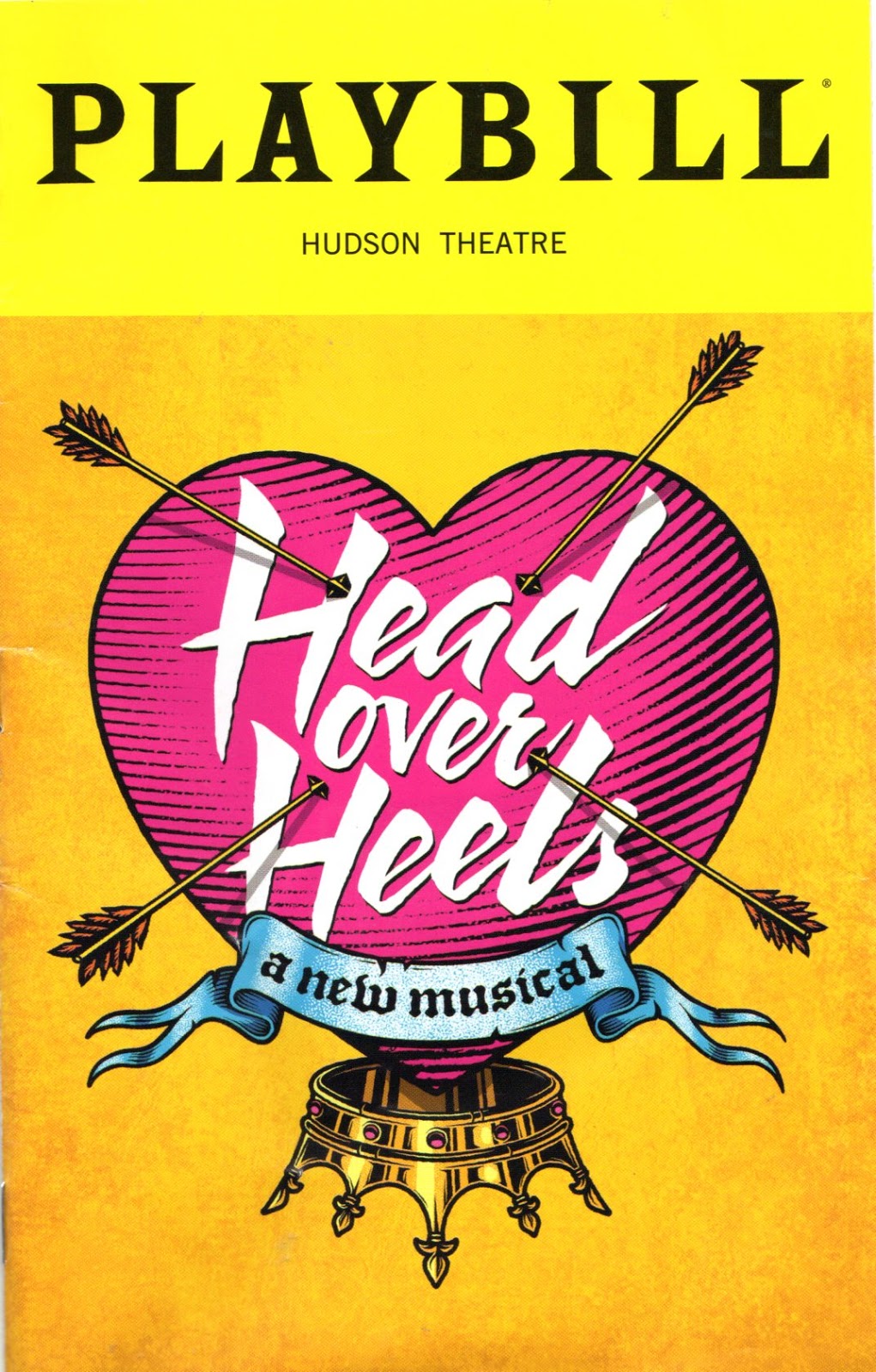
58 (2018-2019): Review: HEAD OVER HEELS (seen August 2, 2018)


"Going, Going, . . ."

I may not have been one of them but the night I saw Head over Heels—Broadway’s new jukebox musical with a pop music score by the Go-Go’s, the all-female, new wave, 80’s band led by Belinda Carlisle—many audience members were clearly head over heels about it. Among that enthusiastic crowd was my middle-aged daughter, who (unlike me) knew and relished every song and got a kick out of the way they were mashed into the idiosyncratic book, written by Jeff Whitty and adapted by James Magruder.  
Tom Alan Robbins, Jeremy Kushnier. Photo: Joan Marcus.
Actually, Whitty’s book is itself an adaptation, being a hip, tongue-in-cheek reinvention of a classic text (part pastoral romance, part drama) by Sir Phillip Sidney, written in the late 16th century and formally known as The Countess of Pembroke’s Arcadia, or The Arcadia for short.
Bonnie Milligan as Pamela (center) with Tanya Haglund, Samantha Pollino, Ari Groover, Amber Ardolino. Photo: Joan Marcus.
In this regard, Head over Heels, which premiered at the Oregon Shakespeare Festival and was later seen the Curran in San Francisco, appears to have opened yet another avenue to drive down for jukebox musical creators. Such shows typically use one of several templates to present a medley of well-known songs from one or more writers, singers, groups, or genres. They either present a bookless playlist (Smokey Joe’s Cafe); use the music to tell a story with some biographical relation—fully plotted or merely outlined—to the artists represented (Beautiful or Motown); or tie the songs together by means of a fictional plot (Mamma Mia!).

Head over Heels, however, takes the rare step of adapting (with obvious distortions) a preexisting text and finding ways of making the songs work within it. Indeed, if the score Shaina Taub wrote for the current adaptation of Shakespeare’s Twelfth Night in Central Park were made up of standards rather than new material it would be a sibling of what Whitty and Magruder have made of The Arcadia. Sidney’s original, in fact, is filled with the same kind of confused sexual relationships Shakespeare uses in Twelfth Night, of which Whitty takes full advantage.

And, given the historical proximity of Sidney to Shakespeare, who definitely felt his influence, it’s impossible not to think of the Bard while watching Head over Heels. Partly this is because of its determined use of faux-Elizabethan language but it’s also because of its themes and subject matter. With its cast dressed (and cross-dressed) in Arianne Phillips’s imaginatively heightened versions of Renaissance clothing, touched here and there with contemporary notions, the show retains the skeleton of Sidney’s plot.
Rachel York, Jeremy Kushnier, and company. Photo: Joan Marcus.
At its heart are Basilius (Jeremy Kushnier), king of Arcadia, and his wife, Gynecia (Rachel York), whose mutual hots have cooled. Then there are their two daughters, the perfectly beautiful older daughter, Pamela (Bonnie Milligan), who rejects all her male suitors, and the plain, younger one, Philoclea (Alexandra Socha), in love with the handsome young shepherd, Musidorus (Andrew Durand).
Peppermint and company. Photo: Joan Marcus.
For comic secondary characters we have the handmaid Mopsa (Taylor Iman Jones), on fire for Pamela; Mopsa’s father, the king’s comic sidekick and viceroy, Dametas (Tom Alan Robbins); and the Oracle of Delphi, Pythio (Peppermint), a flamboyant transgender performer with all that sass. Backing everyone up is an ensemble playing Arcadians and others, including Musidorus’ sheep (bah) and Pythio’s minions, the Owlettes (who?).
The Head over Heels company. Photo: Joan Marcus.
Arcadia’s wellbeing is signified by its having “the beat,” captured in the company’s rousing opening number to “We Got the Beat.” Soon, the Oracle of Delphi declares that Arcadia will lose the beat if each of four prophecies it pronounces comes true (signified by a colored flag falling from the skies). The king, especially concerned that a rival king will overcome him, does all he can to prevent disaster.

As the show bounces energetically through its two hours and 10 minutes, a succession of farcical developments transpire involving mistaken identity shtick based on gender-bending and transgressive sexual preferences. Much of this is inspired by Musidorus’ disguising himself as a blond-tressed Amazon in a Madonna-like, pointed-boobs breastplate, thereby embodying both male and female behavior. Shakespeare, of course, typically played with women dressed as men being the object of the male gaze, while Musidorus’ disguise (as in Sydney) as a woman opens the door to other possibilities.

Bawdy humor runs rampant, both verbally and physically. Pamela, for example, as yet unaware of her predilections, struggles while writing verses to find a word that rhymes with “China” (given the context, you get it at once). And just before she names the rhyme for “runt” the book conspires to stop her. When a double entendre needs a push (as it often does), the actors are perfectly willing to bump a hump or whatever is necessary to get the idea across.

Musidorus is so prone to speak in the densely literary language others call Eclogue (“Ah. Were you but content with me to dwell/On rudesby’s cot in the beaver’d bank our home/Shoot the fardels blow, or with osier-wand/Fadge not the puling cock!”) that he’s scolded for not speaking English. And then there’s the English itself, with its “doths,” “thees,” and “thous,” and mingling of archaisms with modern words and concepts (as when Pythio uses the self-descriptor “non-binary plural”).
The Head over Heels company. Photo: Jeremy Kushnier.
Worked in through the twists and turns is one Go-Go’s song after the other, among them the title song, “Beautiful,” “Vision of Nowness,” “Cool Jerk,” and such Belinda Carlisle solos as "Mad about You" and “Heaven Is a Place on Earth.” The latter will sound especially familiar, even if your musical IQ mixes Go-Go's up with Gaga, mainly because it’s ubiquitous on one of those insurance company commercials.

All are given the full treatment by a talented, big-voiced company, with lots of modern-day dance moves choreographed by Spencer Liff. The songs, though, contain nothing suggestive of the play’s period and, for all their rhythmic charms, are filled with so many banal, repetitive phrases (the beat being all, of course) and such a lack of character revelation that they do nothing for the Arcadian plot other than to highlight a passing emotion.

Talented as the cast is, under Michael Mayer’s direction it performs as though in a broad burlesque; in fact, the show resembles early, pre-stripper, baggy-pants burlesque, a form created in the 17th century to mock theatre with an inflated sense of itself. Given the dearth of truly funny thespians, the show is often sophomorically silly, with too much self-conscious mugging, signaling of jokes, and playing to the gallery, as if everyone thinks they’re in the funniest show on earth, or that it would be if they tried hard enough.

Bonnie Milligan, an actress-singer with Melissa McCarthy-like physical attributes, is deliberately cast against type as the preening beauty, Pamela. She’s got the best comedic chops, revealed in some chill moves and line deliveries. Andrew Durand’s Musidorus also reveals funnybone gifts, shown notably during an extended bit where, cross-dressed, he goes back and forth between femme and macho gestures. Regally commanding, Rachel York as Gynecia handles her raunchier moments with dignity; you know her Gynecia will be a worthy monarch when Arcadia shifts from patriarchal to matriarchal hands.
Andrew Durand, Alexandra Socha. Photo: Joan Marcus.
As Philoclea, Alexandra Socha, whose costume and headband suggest Pocahontas more than the Renaissance, has a big voice for her petite frame. The attractive Taylor Iman Jones, playing Mopsa, also sings well but one wonders if she wouldn’t be more interestin if made to look ugly, as Sydney intended her. Tom Alan Robbins’s Dametas works too hard at getting laughs, and Peppermint, the first transgender performer with a principal Broadway role, does little more than give Pythio the familiar bitchy sarcasm; her serpentine head moves, though, are enviable.
Taylor Iman Jones and company. Photo: Joan Marcus.
Kevin Adams has put a lot of effort into the often spectacular lighting, and Julian Crouch’s Renaissance sets—including a palace backdrop taken straight from Vicenza’s Teatro Olimpico—convey the period. He also provides a few more fanciful images, as when a giant serpent descends from the flies or when Mopsa vacations on Lesbos, singing “Vacation” as mermaids and fish splash in the phony waves around her.

Head over Heels is a must-see for Go-Go's fans. For everyone else, they’ll have to decide for themselves if they should go-go see it.  

OTHER VIEWPOINTS:

Hudson Theatre
141 W. 44th St., NYC
Open run


Wednesday, August 1, 2018

57 (2018-2019): Review: STRAIGHT WHITE MEN (seen July 31, 2018)


"Boys Will Be Boys"

Nearly four years ago, on November 15, 2014, to be exact, I saw Young Jean Lee’s Straight White Men when it premiered at Off Broadway’s Public Theater under the playwright’s direction. An entirely new production is now running on Broadway, under the bright direction of Anna D. Shapiro. 

Most of its cast is far better known than the Public’s (which did, however, feature New York theatre everyman Austin Pendleton, miscast as the father); their star power helps make it somewhat more entertaining but doesn’t greatly alter my modest reaction to the 2014 production. Thus the following is essentially what I wrote then except for a few insubstantial cuts and the use of red to mark new commentary. I’ve replaced the original actors' names and those of all the other contributors.

The eye-catching title of Young Jean Lee’s play, Straight White Men, is something of a red herring. Perhaps a more accurate title would be Some Straight White Men or Four Straight White Men. Lee’s title—assuming it relates only to Americans of that description—suggests something universal about a human subset that the very well-performed play fails fully to either exemplify or clarify. A multi-award winning Korean-born playwright of considerable stature who’s best known for her nonlinear experimental plays, which often examine issues of identity politics, Lee turns in this play—in a Second Stage production at the Helen Hayes—for the first time to a linear, naturalistic form.
In fact, however, the new version is not at all entirely realistic. For some reason, the ear-blasting music that attacks the audience on entering the theatre is now accompanied by a curtain of glaringly silvery strips. Comments have been written for the ushers and house management in case anyone is disturbed by the pounding rap music, which the script says is by female artists singing “sexually explicit lyrics.” It’s so loud, though, the singers could be microbes from Mars singing about interstellar travel for all anyone notices.

Moreover, curtain speeches have been given to two non-straight, non-cisgender male actors, here represented, in overtly offbeat costumes (by Suttirat Larlarb), by noted “non-binary” writer and performing artist Kate Bornstein, and Ty Defoe, an artist from the Oneida and the Ojibwe nations whose self-description is an Ojibwe word meaning transcending gender. Their amusingly tongue-in-cheek remarks on the topic of identity are offered as preparation for understanding the plight of the “straight white men” who figure in the play that follows.

Bornstein and Defoe speak no other words but will reappear during the play, as noted below. It almost seems as if Lee, uncomfortable with having written what appears in most respects a naturalistic play, felt compelled to add an unnecessary metatheatrical opening so as to maintain her avant-garde creds.

The action unfolds over three acts (separated by blackouts), covering 90 intermissionless minutes, in the generic family room of a white, liberal Midwestern home (designed by Todd Rosenthal and brightly lit by Donald Holder) belonging to a retired engineer and widower named Ed (Stephen Payne, Superior Donuts). Ed’s brood of three sons, all in their forties, has gathered to celebrate the Christmas holidays. 
The oldest is Matt (Paul Schneider, Bright Star), highly educated and strongly committed to social justice (he once got a school theatre teacher fired for producing an all-white Oklahoma!), but adrift, unable to make use of his knowledge and abilities. He’s been living with his accommodating dad as a sort of substitute mom, handling various household chores. Matt holds down a temp position doing menial work (Xeroxing) with a socially responsible organization, but is burdened by a large student loan debt.

The visitors are the middle son, Jake (Josh Charles, The Antipodes), a banker, recently divorced, with kids of his own, and the youngest, Drew (Armie Hammer, Call Me By Your Name), an unmarried college teacher (one four-hour class a week) who writes novels on political themes, and whose positive experience in therapy leads him to recommend it for Matt.

Aside from brief scenes where the dialogue engages with personal and social issues of white privilege, you’d never guess from their incessant adolescent hijinks, profanity (they especially love to throw the word “dick” around), fighting (staged by Thomas Schall), and crude horseplay that they were (apart from the rudderless Matt) accomplished professionals. It was hard enough to sit through this nonstop horseplay the first time—even the momentarily amusing, well-choreographed physical routines in which they engage—and it didn’t take long for it to set my patience on fire this time around. 

Ed, for his part, is a quietly bemused spectator to their childish behavior, not always getting it, but never raising his voice. He serves as the essentially neutral moderator when the play’s central issue comes into focus.

This happens when, as the family is eating Chinese take-out, Matt begins weeping (if only briefly); the play now begins to deepen as Drew reaches out to uncover the source of Matt’s unhappiness, drawing the others into the conversation and, if only sporadically, igniting something of a discussion drama.

Matt, for all his alleged brilliance (none of it ever demonstrated), can’t explain his sadness or his loser’s inability to use his gifts to move on in life. The causes of his unassertiveness are hard to grasp, and even he can’t articulate them, making his unanswered dilemma the play’s biggest question. One hint, albeit a discarded one, about Matt’s depression, a word he rejects, is that he feels guilty about his white privilege and is stepping back from more active use of his gifts so that some less privileged person can occupy his space. Of course, such a consideration, even if it were subconscious, wouldn’t prevent some other straight white man from doing whatever it is Matt might do.

To help give Matt the confidence he seems to lack, Ed stages a mock interview, as if hiring Matt for a job, but Matt handles it poorly, even after trying to emulate Jake’s performance when he demonstrates the proper way to do it. In the end, Ed’s forced to make a difficult, if belated decision, about his son.

The play has lots of vivid activity and offstage music (sound design is by M.L. Dogg) as the brothers roughhouse with each other; everyone dances wildly (movement is by Faye Driscoll) at one point to loudly thumping music (with Matt doing comically robotic movements), but this doesn’t make up for an essentially inert dramatic structure.

Straight White Men wants to confront issues of white privilege (Drew and Jake even play a version of Monopoly their late mother cleverly adapted into a game called Privilege), but, a few moments aside (some of it related to that board game), little of it goes very deep nor does it demonstrate much that might not also be associated with nonwhite, non-straight, non-male behavior, although the male component, despite the nearly total lack of misogynistic or patriarchal commentary in the Trumpian vein, is probably the most incisive. Generalizations are fun, but what do they really prove?

In 2014, I criticized Lee’s direction for including the annoying, if common, scene-shifting method of bringing “a handful of black-garbed stagehands, headsets and battery packs in place, onto a barely dimmed stage,” noting “it won’t do if you wish to sustain any sense of illusion.”  Now, however, I realize this approach was a deliberate choice, not a directorial misstep, because Anna D. Shapiro’s direction, following the revised script, goes it one better. 
Only two stagehands (a man and a woman) appear but they’re accompanied by Bornstein and Defoe, our identity-issue guides, who, like otherworldly presences, stand by silently as props are removed or rearranged. It seems to have little more purpose than give these otherwise unoccupied actors something to do while pointing to the deliberate theatricality of the shifts. It’s intrusive, distracting, and adds nothing to the play’s action or themes.

Stephen Payne (replacing the originally cast Tom Skerritt, and Dennis Arndt after him) is better casting for Ed than was Austin Pendleton, and he gradually grows on you; at first, though, his macho demeanor and raspy voice, resembling John Wayne on a diet of Camels, give him the aura of the local sheriff benignly overseeing his boisterous deputies. 

Josh Charles makes Jake a believable kid playing at being a grownup, and Armie Hammer does nicely at shading his leading man charisma with the hue of immaturity. Paul Schneider is fine as the enigmatic Matt, who, despite his own predilection for kindergarten behavior, can’t prevent us from seeing the man’s pain and confusion. 

Still, the sum total of their performances doesn’t enlighten this straight white man about his own condition. Perhaps, in Young Jean Lee’s eyes, that likely is itself part of the problem.    

OTHER VIEWPOINTS:

Helen Hayes Theatre
240 W. 44th St., NYC
Through September 9


Tuesday, July 31, 2018

56 (2018-2019): Review: TWELFTH NIGHT (seen July 29, 2018)


“The Food of Love”

Last week, as I subwayed home to Queens from a midtown show, I was so immersed in my book that I didn’t immediately notice I was sitting alone in my corner at the end of the bench. A fellow rider, sprawled across the opposite bench, had made a generous donation to my car of whatever he’d been digesting, and everybody had moved to the sides. Sometimes, it pays to have an insensitive nose.
Nikki M. James and the Blue community. Photo: Joan Marcus.
As soon as the next stop arrived, I jumped up and ran into the adjoining car, sitting down between two well-dressed African-American women, one of whom had a boy by her side. Seeing the program in my hand, the woman to my left showed me hers and had the boy with her stand up so I could see he was wearing a Public Theater t-shirt with the logo for Twelfth Night on it.

Quickly, this being the subway, I got into a lively discussion with the woman on my right, who told me that the boy, her13-year old son, was a cast member in the current Shakespeare in the Park revival of Twelfth Night, which incorporates the services of a numerous local citizens affiliated with various community organizations. The boy, whose name I neglected to get, is involved with the Brownsville Recreation Center, formerly the Brownsville Boys Club, where I once did a teaching internship.

Like the other community participants in Twelfth Night, he’s one of two approximately 50-member ensembles (Red and Blue) that appear. Sadly, I discovered that he was in the Red group and I’d be seeing the Blue when I was scheduled to attend. If his proud mom, to whom I gave my card, happens to read this, send me a shout out!

For several years now, the Public Theater has been producing three-performance runs (separate from the annual Shakespeare in the Park presentations) of heavily adapted, musicalized classical material at Central Park’s Delacorte Theatre. They operate under the rubric of its Public Works program, created by the wonderful director Lear deBessonet in 2012, which has become a model of civic engagement with theatre arts. Twelfth Night follows in the wake of The Tempest (2013), The Winter’s Tale (2014), The Odyssey (2015), an earlier Twelfth Night (2016) directed by Kwei-Armah, and As You Like It (2017), which I had to leave midway through because the weather that night had no regard for its civic duties.  

The current Twelfth Night, codirected by the Public’s artistic director Oskar Eustis and Kwame Kwei-Armah, the new artistic director of London’s Young Vic (where a separate version will be done this fall), is the first Public Works show produced for a five-week run under the Shakespeare in the Park banner.

A “reimagining” of the 2016 Central Park production (which I missed), it resembles its above-named Public Works predecessors in being a freely adapted, considerably shortened (to 100 minutes!), and heavily musicalized version of the Bard’s original. The idea, though, isn’t new, what with musical versions of Twelfth Night having occupied New York stages since Your Own Thing in 1968, Music Is in 1976, Play On! in 1997, and a 2009 Shakespeare in the Park staging using a symphonic rock score by the band Hem.
Shaina Taub and the Blue community. Photo: Joan Marcus.
The driving creative force here is Shaina Taub, the ultra-talented 29-year-old singer, musician, composer, and lyricist gradually becoming a major musical theatre presence. Taub, who has not only written a melodically delightful, unpretentious, and frequently enchanting score in the jazz, pop, and Broadway show tune modes, appears as Feste the clown, whom she makes a central figure.
Patrick J. O'Hare (holding beverage), Shaina Taub, Shuler Hensley, and the Blue community. Photo: Joan Marcus.
Among her first-rate songs are Toby Belch’s insult-laden drinking song, “You Are the Worst,” the lovely ballad, “Is This Not Love?,” a chorus line number featuring Malvolio and the ensemble in yellow top hats, and the fight preparation song, “What Kind of Man Are You Gonna Be?” (No playlist was provided so I’m guessing at the titles.)
Andrew Kober and the Blue community. Photo: Joan Marcus.
Taub’s lyrics are more contemporary prose than musicalized quotes from Shakespeare’s iambic pentameter, but they nicely fit the feel-good tone of the production. In her hands, Feste is a busker-like emcee in boldly striped colors and cap, and an accordion at her breast when she’s not at the piano. Although acting is not her forte, she comments personably on the story in song and speech.
Lori Brown-Niang (in pink), Shuler Hensley, and Blue community. Photo: Joan Marcus.
Conceptually, this is by no means a novel Twelfth Night, although purists will surely rage at its desecrations. The severely cut text, which nonetheless manages to hew closely to Shakespeare’s original, retains a few chunks of his dialogue—especially the most accessible ones—in a script mingled with contemporary dialogue. Some cast members are deaf, in recognition of which many lines are conveyed by the actors both aurally and in ASL, although you might wonder why the signing is as selective as it is.

This Twelfth Night’s relative faithfulness to Shakespeare contrasts it with Desperate Measures, the popular Off-Broadway musical adaptation of Measure for Measure. The latter is an entirely new work maintaining only an outline of its source. The Public’s show is essentially a Twelfth Night primer, an Eighth Night, if you will; nevertheless, it’s hard to escape the feeling that, entertaining as it is, its simplifications tend to patronize the wider audience to which it’s reaching out.

The many diverse nonprofessionals of all sizes, colors, shapes, and ages do things like banding together to suggest a sea tempest but, in general, dance  (to Lorin Latarro's choreography), sing, and mill about as Illyria’s lively townspeople. Apart from their vibrant presence, there are notably few unusual interpretive tricks up the show’s sleeves to differentiate it from other modern-dress versions.
Nanya-Akuki Goodrich, Ato Blankson-Wood. Photo: Joan Marcus.
Casting of the principals is as diverse as that of the community players, with actors playing roles they’d be unlikely to land in more conventional productions, and not necessarily because of ethnicity. The show makes no pretense at being realistic; two African-American performers play the identical twins Viola/Cesario (Nikki M. James) and Sebastian (Troy Anthony) but that can’t hide their considerable differences, especially their relative size. All that’s needed is similar costuming and the idea is clear.
Troy Anthony, Nikki M. James, Blue company. Photo: Joan Marcus.
Most of the staging, as in the comical combat (crafted by fight director Lisa Kopitsky) between Andrew Aguecheek (Daniel Hall) and Viola, or the confinement of Malvolio (Andrew Kober) to a Porta Potty (with hilarious aftereffects), presses hard on the farce pedal. The audience responds with frequent laughter to such business, as it does to occasional verbal interpolations along the lines of “Oh, shit!”

Nothing of particular interpretive significance is suggested by designer Rachel Hauck’s generic background of a manor house (attractively lit by John Torres) with three large doors and several second story balcony openings, nor by Andrea Hood’s dozens of bright costumes, which convey a party-time air more than one of any particular time and place.
Jonathan Jordan, Daniel Hall. Photo: Joan Marcus.
All the principals are fine and some have standout moments. These include Nanya-Akuki Goodrich as Olivia, Ato Blankson Wood as Orsino, Shuler Hensley as Toby Belch, Lori Brown-Niang as Maria, and Jonathan Jordan as Antonio (whose attraction to Sebastian the play enjoys stressing).
Blue company. Photo: Joan Marcus.
My advice is to leave your Shakespearean preferences and preconceptions at home, be more a partygoer than a theatregoer, enjoy the good vibes and sweet tunes of an eclectic New York community gathered for a worthwhile cultural purpose, and pray for balmy breezes to blow, to and fro.

OTHER VIEWPOINTS:

Delacorte Theater/Shakespeare in the Park
Central Park West at W. 81st St., NYC
Through August 19