Wednesday, October 17, 2018

102 (2018-2019): Review: POPCORN FALLS (seen October 16, 2018)


“More Butter, Please”

A lot of talent, effort, and energy has gone into James Hindman’s Off-Broadway confection, Popcorn Falls. What it needs, though, is more of the butter of unforced laughter. Originally produced last year, with positive reactions, at the Riverbank Theatre, Marine City, MI, Popcorn Falls is a play you visit more for the flavor of its gimmicky premise than the nutrition of its dramatic value.

Under the agile comic direction, however, of two-time Tony-winning Broadway star, Christian Borle (Something Rotten! and Peter and the Starcatcher), making his directing debut, it provides a digestible, if not always rib-tickling, theatrical snack. 
Adam Heller, Tom Souhrada. Photo: Monique Carboni.
The gimmick is to have two versatile actors, Adam Heller and Tom Souhrada, portray all 21 characters in the play’s comedically melodramatic plot. This concerns a bankrupt small town’s effort to avoid the fiscal necessity of  having their downtown area converted to a sewage plant. It’s a project sponsored by Mr. Doyle (Souhadra), the wicked head of the Cattaraugus County Budget Planning Committee. Doyle is foiled, though, by Mr. Trundle (Heller), the new mayor of Popcorn Falls, who, noting a loophole, decides to save the town by using local talent to start a theatre and put on a play (so much for original subject matter).
Tom Souhrada, Adam Heller. Photo: Monique Carboni.
Carefully written for its two-actor premise, the play introduces a panoply of exceedingly eccentric local yokels, male and female, young and old. Changing their voices, facial expressions, gestures, and postures, Heller and Souhadra deftly suggest who’s who by using only the most basic of props, like spectacles, hats, and the like. A shirt becomes an apron, a blanket a cat. By holding up a baseball cap at eye level, the person to whom one is talking is conjured out of thin air.

The actors transform from role to role with the speed of light either before our eyes or by exiting one of the doors at either side of the stage and entering almost immediately from the other. They often shape shift right before our eyes.

So many characters come and go, it’s necessary for Heller and Souhadra to exaggerate egregiously to avoid confusion. This, of course, only emphasizes the shallowness of the characters and makes us attend not to the obviously paper-thin narrative but to the constant stream of show biz shtick.
Adam Heller, Tom Souhadra. Photo: Monique Carboni.
After a while, watching Souhadra (who does more chameleon-like changes than Heller), dressed in a pale blue custodian’s shirt (labelled "Joe"), do his impressions loses its appeal. There’s Doyle, with his maniacal cackle; Austin, the doofus sheriff who can’t avoid poking folks with his stun gun; Mrs. Parker, the flamboyantly theatrical librarian; Floyd, the one-armed lumber yard dealer; Mrs. Stepp, the chain-smoking school teacher; Becky, the gentle bartender who keeps coyly sweeping back a strand of hair; and on and on.

Heller, who sometimes plays someone also portrayed by Souhadra, is better at straight acting than vaudeville caricatures, but he does nicely with a German called Hans, giving him the full faux-Nazi treatment, monocle and all. A few mildly off-color and scatological yocks don’t make up for a script so dependent on such broad stereotypes. I laughed more during ten minutes of The Play that Goes Wrong, another farce about putting on a play, than I did during all of Popcorn Falls.
Tom Souhadra, Adam Heller. Photo: Monique Carboni.
Borle’s lightning-fast, clever direction, which includes action in the small theatre’s aisle, does everything possible to wring laughs from the script, but it also allows for quieter moments to introduce touches of romantic sentiment. Costumes (by Joseph La Corte) and props may be minimal but Tim Mackabee has created a rather realistic set showing a wood-paneled meeting hall stage, with a curtained recess and solid, constantly used, doors. (Scenes in locales other than the hall simply ignore their surroundings.) Jeff Croiter’s volatile lighting and Jeffrey Lodin’s effective sound and music design give substance to the production but there’s not much they can do to make it funnier.
Adam Heller, Tom Souhadra, Photo: Monique Carboni.
Everyone involved has given Popcorn Falls their best effort but the show lacks enough comic butter to make it tasty enough. Orville Redenbacher, where are you?

OTHER VIEWPOINTS:

The Davenport Theatre
354 W. 45th St., NYC
Through January 6


101 (2018-2019): Review: EMMA AND MAX (seen October 15, 2018)

"What Would Fran Drescher Have Done?"


For my review of Emma and Max please click on THEATER LIFE.


Monday, October 15, 2018

100 (2018-2019): Review: FINAL FOLLIES (seen October 14, 2018)


"Three by Gurney"

The late A.R. (“Pete”) Gurney was a prolific playwright best known for his satirical depictions of the decline of Northeast WASP society’s martini and sailboat set, as in The Dining Room and The Cocktail Hour. His plays are usually guaranteed to provide a pleasant evening of thoughtful chuckles, even when his jibes aren’t specifically poking fun at the elites of his own social class.
Colin Hanlon, Rachel Nicks. Photo: James Leynse. 


Several major Off-Broadway institutions, like Primary Stages (responsible for Final Follies and five previous Gurney productions), have found his work congenial enough to do them regularly. That’s why you see Gurney’s features on the Mount Rushmore-like lobby mural at the Pershing Square Signature Center or why one of the spaces at the Flea Theatre’s new home is called The Pete.

While most of Gurney’s over 60 theatrical works are standard length, he also composed nine short plays, or one-acts, as they’re typically called. One, “Final Follies,” completed not long before his passing last year at 86, gives its name to and gets its world premiere in this lackluster three-by-Gurney program at the Cherry Lane. David Saint has directed all three plays, with mixed results.

“Final Follies” is joined by 1965’s “The Rape of Bunny Stuntz,” one of the playwright’s earliest works, originally produced at the Cherry Lane itself, and 1969’s “The Love Course.”  On his website, Gurney claimed that the latter had received many amateur productions but never, to his knowledge, a professional one. Seeing it may tell you why. He also said he hoped it would eventually be produced with another of his one-acts, “The Open Meeting.” Primary Stages, of course, has ignored that request in favor of the other plays.

The program has its occasional pleasures, mainly because of several performances. Each play uses the same James Youmans set outlining false prosceniums in LED strip lights, with images projected on a central upstage wall, all of it well lit by Cory Pattek. I’m sorry to report, though, that neither Gurney’s ironically titled final play nor those from his salad days is particularly memorable.

For a play written so recently, “Final Follies” has a curiously naïve, even dated quality in its depiction of a handsome, well-dressed, but feckless, alcoholic young man’s desperate attempt to earn money by becoming a porn actor. The folly here lies in Primary Stage’s decision to stage this final Gurney play.

Nelson (Colin Hanlon), unable to hold any of the jobs his loving, very wealthy grandfather (Greg Mullavey) arranged for him, answers an ad for an adult film actor in the Village Voice (of beloved memory). He’s interviewed and auditioned by Tanisha (Rachel Hicks), a stunning former porn actress turned casting director and script writer. Soon, he becomes a star in the films that the company advertises for the therapeutic benefits they offer married couples (as if such a rationale was needed in today’s world of 24/7 internet access).

Nelson’s jealous, hypocritical, churchgoing brother, Walter (Mark Junek), hoping to bring his brother down, shows grandpa a DVD of Nelson in action. To Walter’s chagrin, the geezer gets a rise out his grandson’s spectacular performance.
Gregg Mullavey, Mark Junek. Photo: James Leynse.
Everything on view is childish and unconvincing, sounding more like a no-longer-with-it old dramatist’s fantasies than a knowledgeable satire on the pornography industry. Also, the play’s romantic setup and conclusion is further proof that Gurney should have quit while he was ahead.
Colin Hanlon, Rachel Nicks. Photo: James Leynse.
There’s little to rave over in the acting although Rachel Nicks does good work. She also gets to wear a formfitting blue dress that provides the most eye-catching feature of the evening. In fact, the clothes that designer David Murin has given the actresses in each play are among the show’s most visually interesting features.
Betsy Aidem, Deborah Rush. Photo: James Leynse.
The best performance of all belongs to veteran Deborah Rush in the vapid “The Rape of Bunny Stuntz.” Rush, playing the titular suburban club lady, presides over a meeting of an undefined organization but is unable to proceed when she can’t find the key to the small, metal box containing the papers she needs. Bunny keeps delaying the meeting as she tries to get the key by having the caretaker, Howie (Pitir Marek), go to her nearby home to retrieve it from her preoccupied husband.
Deborah Rush, Piter Marek. Photo: James Leynse.
Meanwhile, lurking in a red Impala in the close by parking lot is an unseen guy in a black leather jacket who has the key, forcing the obviously repressed Bunny to interact with him. She insists she has no idea who he is even though we realize the pair has some guilty connection related to a hotel room encounter.
Deborah Rush. Photo: James Leynse.
Bunny’s harried assistant, Wilma (Betsy Aidem), struggles to get the meeting back on track, but eventually leaves, while Howie gets drunk and parties with the attendees waiting in the basement for the meeting to resume. Left alone, albeit with enough of us present for her to address, Bunny’s words gradually evolve into a confession.

Rush, wearing a perfectly coiffed wig in classic 60s bouffant style, and a pretty, flowered frock, is terrific at maintaining Bunny’s forced positivity and crumbling self-confidence in the face of potential embarrassment. The play, which seems designed to expose the secret sexual longings of uptight suburban matrons, holds little interest beyond the opportunities it offers for the actress playing Bunny.

After a 15-minute intermission, the 90-minute show concludes with “The Love Course,” whose comic purpose is to explore the way in which the erotic lives of teachers are tied up with the subjects they teach. After playing the meeting participants in “The Rape of Bunny Stuntz,” the audience now figures as the imaginary class.
Betsy Aidem, Piter Marek. Photo: James Leynse.
The married Prof. Burgess (Marek) and the single Prof. Carroway (Aidem) have a popular team-teaching partnership in their course on the literature of romantic love. However, Carroway has been denied tenure and will be leaving for a position at Mt. Holyoke, while Burgess has been removed from the classroom to serve as an administrator. This is their last class, and the romantic tensions between them, which also involve Burgess’s jealous wife (unseen), bubble to the surface.
Rachel Nicks, Betsy Aidem, Piter Marek. Photo: James Leynse.
Also involved are two representative students, Mike (Hanlon, much better here than in “Final Follies”) and his girlfriend Sally (Nicks), sitting in the first row. Mike, an electrical engineering student with no interest in the subject, is there only because Sally is crazy about the course and its teachers. Their relationship, naturally, is tied to the content of the course.
Colin Hanlon, Piter Marek. Photo: James Leynse.
The emotionally volatile Carroway is dressed in another Murin highlight, a showily colorful silk robe, although it does tend to make her look more like Mme. Arcati in Blithe Spirit, an image Aidem’s amusingly eccentric performance does little to dispel. The more professorially garbed Burgess, with his mop of unruly silver hair, also behaves so broadly that we understand at once why the pair is known for their flamboyant theatricality.

As they work out their conflicts through readings from Wuthering Heights and Antony and Cleopatra, their excessive antics push the work so far into farcical territory that the work quickly loses touch with reality and runs out of comic gas.

Final Follies does nothing to further polish A.R. Gurney’s reputation. Here’s hoping the next Primary Stages staging of the playwright’s work will bring back the shine.

OTHER VIEWPOINTS:

Cherry Lane Theatre
38 Commerce St., NYC
Through October 21


Sunday, October 14, 2018

99 (2018-2019): Review: WHAT THE CONSTITUTION MEANS TO ME (seen October 13, 2018)


“Crucible or Patchwork Quilt?”


There are often times when the American public shows intense interest in the United States Constitution. Usually, this is when a new amendment is being contemplated, a particular issue is before the Supreme Court, or a new appointment to SCOTUS is under consideration. The latter condition, of course, is largely responsible for the present moment being so darned hot.
Heidi Schreck. Photo: Joan Marcus.
Cable news programs have been doing their best to keep political junkies tuned to the wonky subject of constitutional interpretation. A small number of recent films and plays have looked at the Constitution through the eyes of particular individuals. Supreme Court Justice Ruth Bader Ginsberg, for example, is the focus of the popular docudrama RBG, while Justice Scalia is the basis for the Off-Broadway biodrama The Originalist. In the unusually compelling What the Constitution Means to Me (WTC), playwright-actress Heidi Schreck takes on the broader field of the Constitution itself, with particular reference to the fourteenth amendment and, in her dramatic context, its relation to the ninth. 
Heidi Schreck, Mike Iveson. Photo: Joan Marcus.

Schreck, whose Grand Concourse provided food for thought at Playwrights Horizons a few years ago, is a really smart cookie who, at 15, began earning college scholarship money while competing, and usually winning, American Legion debate contests focused on the Constitution. Over the past decade she’s been developing WTC, under various auspices, the version we see today having been created for 2017’s Clubbed Thumb’s Summerworks Festival, with director Oliver Butler at the helm. Its West Coast premiere was earlier this year at the Berkeley Rep, and it’s currently at the New York Theatre Workshop. 
Heidi Schreck. Photo: Joan Marcus.
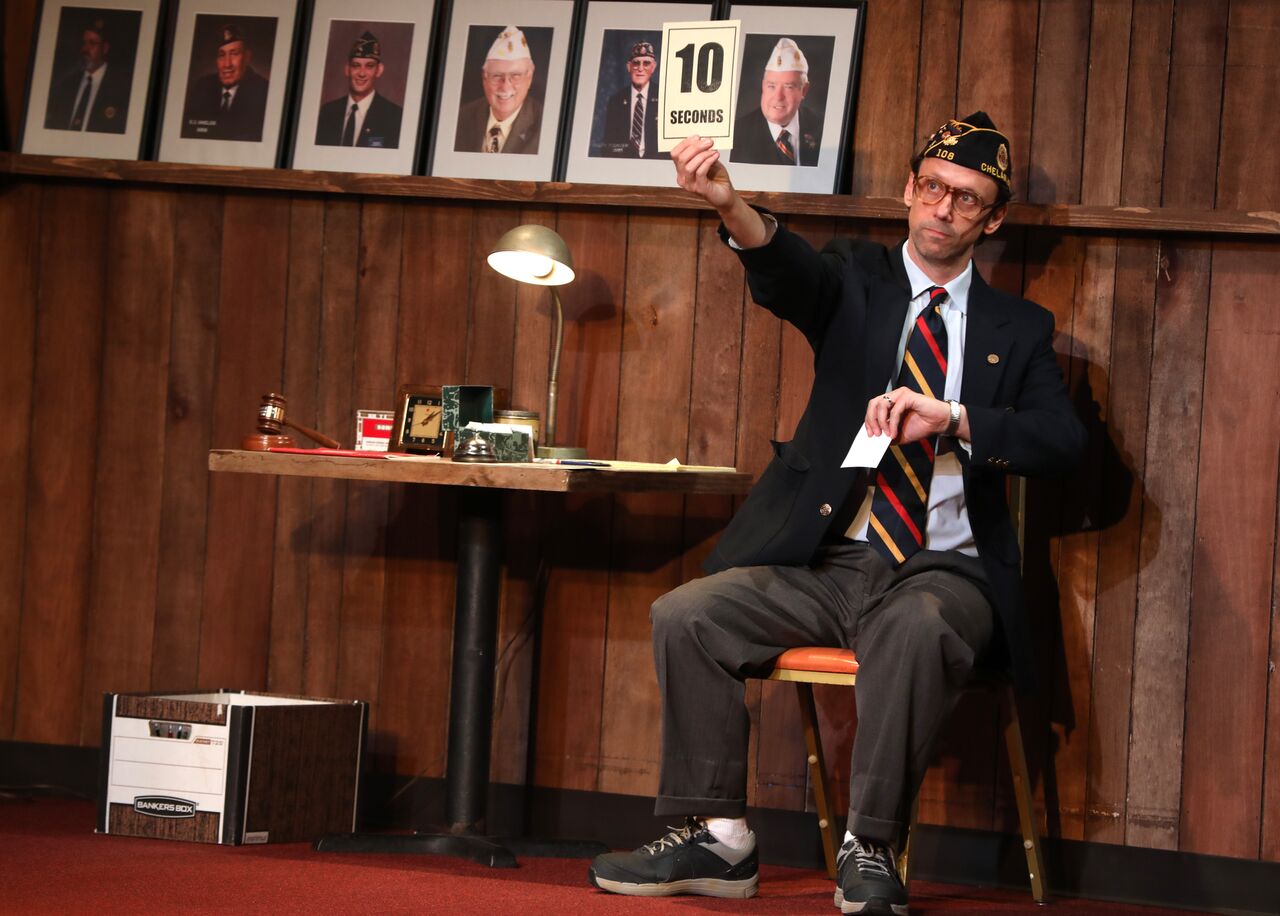
WTC’s premise is that Schreck, playing herself, is here to recreate one of her teenage debates from 1989, which took place at an American Legion post in her hometown of Wenatchee, WA, “The Apple Capital of the World.” Rachel Hauck’s design, lit by Jen Schriever, is a wide expanse representing the paneled walls of a Legion post, lined with dozens of photos of white men in military caps and backed by standing United States and American Legion flags. To further heighten the atmosphere, we’re asked to pretend we’re an audience of cigar-smoking white men. 
Mike Iveson. Photo: Joan Marcus.
Schreck remarks that her reconstruction has to rely on her memory of her 1989 speech because her mom discarded it (although she saved such detritus as 12-year-old Heidi’s hair when she cut it off to look like Annie Lennox). She then sets up the situation, for which a Legionnaire (Mike Iveson), in familiar cap and jacket, serves as moderator, setting up the ground rules, announcing the topics, holding up cards noting the time remaining in each segment, and ringing a bell to cut off speech.

In part one, the contestants must explain their understanding of the Constitution and how it relates to their lives; in part two, they must extemporize on an amendment they draw at random from a can. Schreck reverts to her 15-year-old self, delivering her speech about the Constitution being a “crucible”; her opponent’s theme, which Heidi disputes, is that the Constitution is a patchwork quilt. The amendment Schreck picks is the Fourteenth, Section One. Briefly, this concerns the equal protection of all citizens under the laws.

As the hour and 40-minute program proceeds, Heidi slips back and forth between her youthful self and her present one, the latter gradually becoming dominant as, driven by the constitutional question before her, she presents what is essentially a memoir of the spousal abuse suffered by her female antecedents, including what she witnessed in the lives of her mother and grandmother. Much of her time is occupied with arguments concerning violence toward women, women’s rights, and abortion. Occasionally, the narrative appears to drift off on tangents, which she herself notes, but nothing she says isn’t without relevance to her arguments.

While we never meet young Heidi’s opponent, Becky Lee Dobbins, from Lawrence, KS, the play’s loose structure allows us to hear from actor Mike Iveson, who temporarily sheds his Legionnaire persona to provide what Schreck calls “positive male energy” in the form of his personal story about his sexuality. Interesting as it is, it’s hard not to consider it an unnecessary distraction.
Rosdely Ciprian, Heidi Schreck. Photo: Joan Marcus.
Toward the end, an even more surprising metatheatrical twist arrives in the person of a 14-year-old, African-American schoolgirl named Rosdely Ciprian, who enters to debate Schreck on the question of whether or not the Constitution should be abolished, each debater taking the opposite position. Meanwhile, pocket-sized copies of the Constitution are distributed to the audience, which is asked to hoot, holler, and howl for or against contestants’ points (not unlike a Real Time with Bill Maher show). At the conclusion, an audience member is chosen to decide the debate winner.
Rosdely Ciprian. Photo: Joan Marcus.
While much of this debate is scripted, it also contains room for extemporaneous discussion. Regardless, Ciprian is an extraordinarily intelligent, remarkably knowledgeable kid (adorably, an audience question the night I went stumped her with the term “bucket list”), who one day might reasonably join SCOTUS itself. If a movie of Michelle Obama’s childhood were made, I couldn’t think of better casting. (Thursday Williams alternates with Ciprian and, I'm sure, is equally as gifted.) 

Rosdely Ciprian, Heidi Schreck, Mike Iveson.
Schreck herself delivers an awesome performance, filled with anger, vulnerability, astuteness, and pain, but also with welcome dollops of humor, often self-deprecating. She’s as potent an actress as she is a writer.

What the Constitution Means to Me is absorbing, and, given its driving pace, there’s certainly a lot to absorb. It’s an educational, if decidedly polemical, event that makes its lessons that much more pertinent by their connection to Schreck’s personal experiences. When it’s over, however, you may consider turning your attention to what the Constitution means to you.

OTHER VIEWPOINTS:

New York Theatre Workshop
79 E. 4th St., NYC
Through October 28


Saturday, October 13, 2018

98 (2018-2019): Review: ON BECKETT: EXPLORING THE WORKS OF SAMUEL BECKETT


“Professor Irwin”


Perhaps you remember the late comedian who called himself “Professor” Irwin Corey and whose hilarious persona was based on his being “The World’s Greatest Authority,” although his “authority” was expressed in clownish double talk. Another great clown named Irwin, first name Bill, actually is an authority, an appellation he probably would modestly decline.  
Bill Irwin. Photo: Carol Rosegg.
Bill Irwin’s funny and informative Off-Broadway show, On Beckett, at the Irish Rep, reveals not only this Tony winner's (Who's Afraid of Virginia Woolf?) expertise at discussing acting and clowning, but presents seven selections from the work of Nobel Prize-winning Irish writer and dramatist, Samuel Beckett. And, like Irwin Corey, he even gets to poke fun at academia when, donning a mortarboard and over-sized robe, he does his own take on silly professors.

If it weren’t for the brief appearance of young Finn Sullivan to play the boy in a scene from Waiting for Godot this would be a one-man show and Irwin would be a definite contender for an award as best solo performer of the season. He’s such a magnetic, charming, informative, and accessible personality, it’s a wonder On Beckett, which he conceived and apparently directed (no one else is credited), isn’t called Bill Irwin on Beckett. 
Finn Sullivan, Bill Irwin. Photo: Carol Rosegg.
Irwin appears on Charlie Corcoran’s bare, black, proscenium-framed stage, quite nicely lit by Michael Gottlieb, with only two black cubes and a black lectern-like prop to accompany him. Wearing a white shirt and simple black suit, he chats amiably about his love for Beckett’s words, which have gone viral in his head. We learn of his various career encounters with Waiting for Godot and of his regret that he’s never done Endgame (in which this reviewer once played the role of Clov!). Irwin longs to do another production of Godot, whose variant pronunciations he delightfully explains, because, like so many other Beckett thespians, he feels there’s still more in it for him to discover. 
Bill Irwin. Photo: Carol Rosegg.
Irwin’s discussion of Beckett is not, however, from a traditionally scholarly perspective but from that of an actor. Being the unusual player that he is, though, much of his approach derives from his joy in clowning. Although he’s played his share of serious stage, film, and TV roles, always excellently, his mark was made through his remarkable talents at physical humor, the kind honed in music halls, vaudeville, and silent movies.

Trim and youthful at 68, he remains eternally flexible, tripping (sometimes literally) with perfect skill through traditional shtick involving hats (especially bowlers, on whose Beckettian cachet he expostulates), canes, baggy pants, flipper-like shoes, and character silhouettes. Watching him sink and rise behind the lectern as if on a mechanical lift is only one of the visual plums he provides with elegantly humorous precision.

But, for all his rubbery grace and facial foolery, Irwin is also extraordinarily adept with language, and he scatters the evening with an array of Beckett selections demonstrating his impressive interpretive skills. The first part of the evening is devoted to a series of mostly arcane pieces from Beckett’s lesser-known, nondramatic writings, especially Texts for Nothing. Irwin rivets our attention by somehow transforming opaque, largely incomprehensible material into expressive streams of living text, even when we have no idea of what he’s saying.

Still, these obscure, oddly punctuated passages, including choices from Beckett’s novels The Unnameable and Watt, while brilliantly presented, are too dense to maintain continued interest. I felt relief when Irwin came to Beckett’s theatre writing, even though the actor claims he couldn’t find anything suitable to extract from Endgame, forcing him to focus on Godot. Of course, Beckett wrote other brilliant plays but Irwin references only those two. Wouldn’t it be wonderful to hear Irwin do, for instance, something from Winnie in Happy Days
Bill Irwin. Photo: Carol Rosegg.
Godot gives Irwin plenty to work with, particularly when he gets to Lucky’s puzzling, complex monologue, which he presents while holding a white rope extended from his neck as if Pozzo were at the other end. It’s a tour de force, of course, incoherent as it may seem. As with his renderings of the murky, nondramatic texts, Irwin makes the words sing while accompanying them with droll expressions and gestures.


On Beckett is filled with anecdotal features, both personal (including a bit about the late Joe Chaikin) and Beckett-related (as with Irwin’s commentary on how rigorously the writer’s estate oversees productions of his plays). He touches on some of Beckett’s main existential themes (which he calls “threads”), such as the human will to survive, but thankfully avoids going into the weeds.

It’s always inspiring to see Beckett well performed, even in the non-traditional context of a lecture-demonstration. Thus, seeing and hearing Bill Irwin explicate and demonstrate his approach to Beckett’s challenging material over a 90-minute stretch is an experience theatregoers, especially Beckett lovers, should relish. It also gives us hope that, before long, he’ll have the chance to do a production of Endgame. I somehow suspect that, if he plays Clov, he'll be a hell of a lot better than I. 

OTHER VIEWPOINTS:

Irish Repertory Theatre
132 W. 22nd St., NYC
Through November 4


Friday, October 12, 2018

97 (2017-2018): Review: GOODBODY (seen October 11, 2018)


“Gangster Guignol”


Begin with a healthy dose of blood, add a rounded teaspoon of sex, sprinkle it with profanity, top it with a layer of gory grand guignol, and mix it with a gaggle of comically hapless, gun-waving gangsters. The result: J.C. Ernst’s Goodbody, a cleverly conceived black comedy in the Quentin Tarantino mode, now being offered by the Crook Theater Company at 59E59 Theaters. 

Raife Baker, Amanda Sykes. Photo: Carol Rosegg.
Set and lighting designer Matthew McCarren has given 59E59’s tiny Theater C one of its most substantial-looking sets, an upstate New York barn interior surrounded by the audience on two sides. We see hay bales placed along wood-planked walls, with a ladder to an upper space. There’s also a vertical beam forming an annoying sightline obstruction that the otherwise smart director, Melissa Firlit, could easily resolve with some minor blocking adjustments.

Raife Baker, Amanda Sykes. Photo: Carol Rosegg.
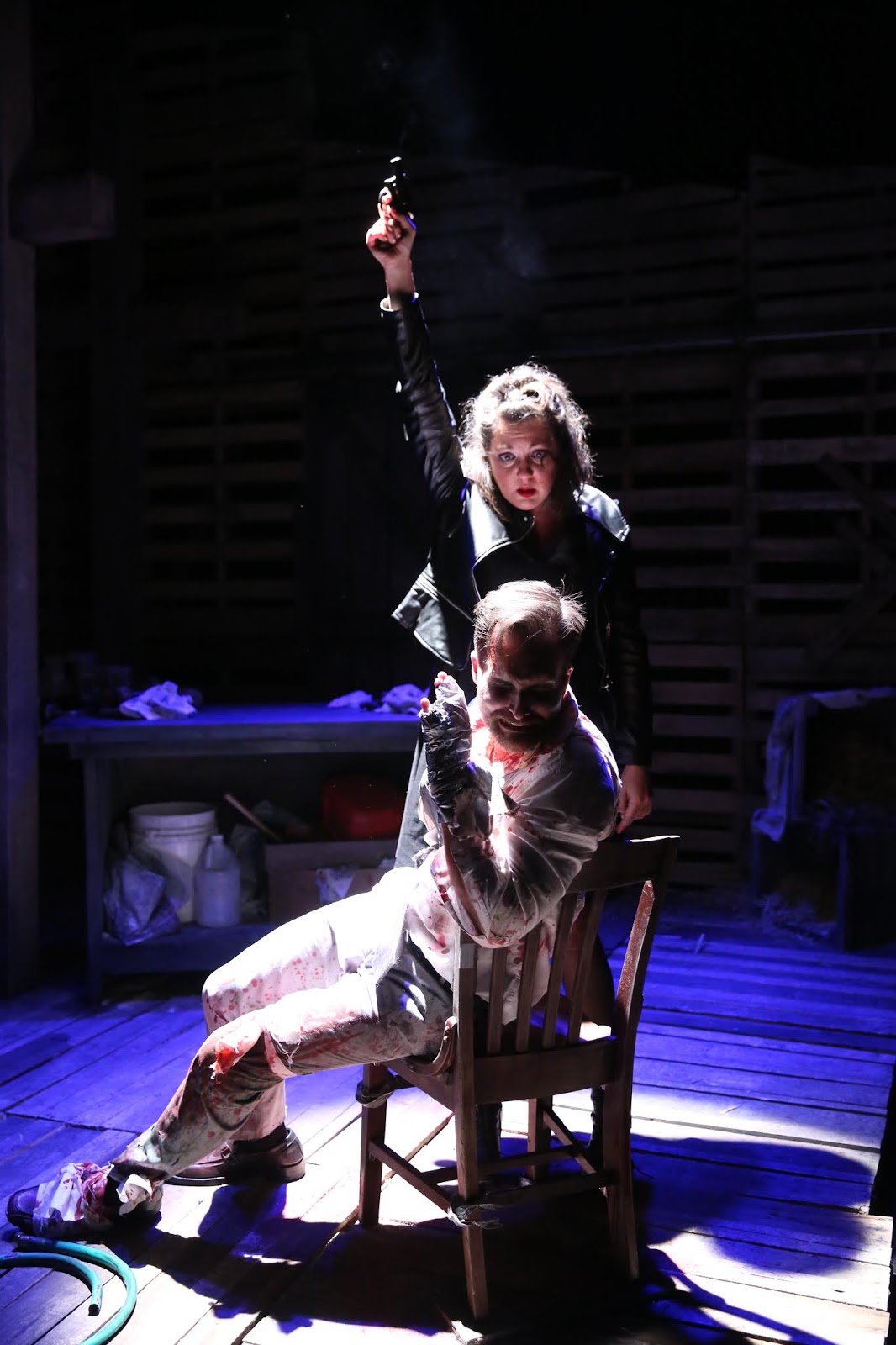
The action begins in medias res, so to speak, with the lights coming up on a seemingly dimwitted young woman, Marla (Amanda Sykes), in short black dress and black leather jacket, pointing a pistol toward the corpse—only his legs are visible—of someone she’s just shot. Sitting nearby, suffering from multiple broken bones, is Spencer (Raife Baker), a young man looking, as someone says, like he’s been run over by a lawnmower: one arm is duct-taped to his chest, the fingers of his other hand are also taped, there’s a tourniquet around one leg, and his face and clothing are drenched in blood.
Raife Baker, Amanda Sykes. Photo: Carol Rosegg.
Marla, apparently suffering from amnesia, says she has no idea of what she’s done, where she is, how she got here, who Spencer is, or what happened to him. She interrogates Spencer, whose pain-wracked efforts to take control keep failing, about the situation and their relationship. Gradually, the picture becomes clearer. Marla, we learn, is a cocktail waitress (from Gary, Indiana, the script emphasizes for jokey purposes) at high stakes poker games run by a mafia-like Irish family, the O’Learys. Heading it are two dangerously volatile brothers, Burt, whom Marla’s just shot, and Chance (Dustin Charles). Spencer is what might be called the brothers’ nonviolent fixer.
Raife Baker, Alex Morf. Photo: Carol Rosegg.
Joining Spencer and Marla midway through is Aimes (Alex Morf), a crooked but hilariously naïve cop, whose desk job with the police allows him to do paperwork that protects the O’Learys. There’s a sharp rivalry between the doofus Aimes and the sarcastic Spencer over Marla, whom Aimes loves but who’s had sex (in a public bathroom) with Spencer. Spencer, by the way, calls Aimes Twinky Twat for reasons that will be familiar to anyone who’s seen the movie American Pie.
Alex Morf, Raife Baker. Photo: Carol Rosegg.
All the threatening horseplay we observe is bound up with everyone’s involvement in a heist of the poker takings by Burt, and with the possibility of Chance’s imminent arrival. The situation is even more fraught because of the fear of how Chance will react on learning not only of his brother’s betrayal but of his death. And, indeed, things do get hairy when Chance arrives in the play’s last third and proceeds to torment the others until . . . Well, you may think you know the drill.
Raife Baker. Photo: Carol Rosegg.
For a first-time playwright, Ernst, an actor who cofounded Crook Theater with Raife Baker, who plays Spencer, shows a masterful command of fast and furious, not to mention funny and filthy, dialogue. Some of his bits are belabored and the play could lose a few minutes but he’s definitely on the right track. He captures perfectly Marla’s mix of innocence and something much darker; Spencer’s snappy, knowing arrogance and fear; Aimes’s straight-faced idiocy; and Chance’s malevolent thick-headedness. As the situations evolve, Ernst carefully peels away the skins of the various dramatic onions, exposing layers of lying and deception.
Dustin Charles, Alex Morf. Photo: Carol Rosegg.
On the other hand, the bizarre conclusion, which garners both guffaws and gasps, is surely over the top, but it’s not without sufficient foreshadowing. Whether or not you approve, you’ll probably long remember it. The protocols of reviewing prevent me from saying more other than to note that a bit of mid-play exposition, where the play’s title is mentioned, helps prepare us for what happens.
Raife Baker, Amanda Sykes, Dustin Charles, Alex Morf. Photo: Carol Rosegg.
Before seeing Goodbody, I read some of the script, immediately recognizing it as something with strong stage potential if only it were well cast and directed. Reader, it is. Director Firlit has elicited just the kind of humorously realistic tone required. Baker’s Spencer never overdoes being a desperate man in physical agony; Morf actually makes you like Aimes’s being such a jerk; Charles’s Chance has the sound and bearing to convince you he means what he says; and the vocally rich Sykes squeezes Marla for every drop of her twisted psyche. 

Dustin Charles, Amanda Sykes. Photo: Carol Rosegg.

There’s nothing supernatural in Goodbody but its gruesome garishness guarantees it as Halloween-appropriate ( but for mature audiences only).

OTHER VIEWPOINTS:

59E59 Theaters/Theater C
59 E. 59th St., NYC
Through November 4