Showing posts sorted by relevance for query Grand concourse. Sort by date Show all posts

Wednesday, November 12, 2014

106. Review of GRAND CONCOURSE (November 7, 2014)


106. GRAND CONCOURSE 


A lot of celebrities grew up in the vicinity of that famous Bronx thoroughfare, the Grand Concourse, among them Penny and Gary Marshall, Ralph Lauren, Calvin Klein. Robert Klein, and Rob Reiner. Heidi Schreck’s eponymous new dramedy, however, has nothing to do with them, nor with the history of that once fabled, now largely faded, street. Instead it deals with people living at the other end of the social spectrum, the drunks and derelicts requiring the services of a neighborhood church’s soup kitchen, one presided over for the past 15 years by a nun named Shelley (Quincy Tyler Bernstine). 
 
Actually, except for one character, the play is really about those who run the kitchen and not those who receive its largesse. In addition to Shelley there are Oscar (Bobby Moreno), a 30ish security guard/maintenance man from the Dominican Republic; Frog (Lee Wilkof), a dumpy, scraggly, but articulate old drunk and druggie, whose psychological issues have put him on the dole; and Emma (Ismenia Mendes), a pretty, middle-class, 19-year-old, her hair streaked in blue and red, who turns up at the kitchen to “give back,” as she says, by doing volunteer work. 
 
GRAND CONCOURSE puts its slow-simmering, lightly seasoned plot on a back burner while it concentrates on exploring its richly flavored characters and their interactions. Ms. Schreck’s dialogue, written in unpunctuated verse, has the tang of reality while being juicily theatrical. Despite the overall serious tone, it includes a satisfactory sprinkling of funny remarks. 
 
Shelley, 39, is a down-to-earth, basketball playing, do-gooder having considerable difficulty in sustaining faith in an increasingly stultifying vocation that tests her patience and powers of forgiveness; she uses a microwave to time her prayers, hoping to get beyond a minute and up to five. A modern nun, she eschews a habit in favor of mufti. (The costumes are by Jessica Pabst.) When she’s pushed to emotional extremes, the vulgarity of the streets flows trippingly off her tongue. Ms. Bernstine, a fixture on New York stages over the past few years, sinks her teeth deeply into this hearty role. As Shelley fulfills the requirements of her pressure cooker job, Ms. Bernstine beautifully balances the character’s piety with the everyday ordinariness of a secular employee. In the climactic scene at the play’s close, her struggle in responding to behavior she considers evil, even if not malicious, makes us ponder just how strained the quality of mercy can be. 
 
Oscar is an energetically animated, sweetly charming street dude, his various baseball caps worn backwards or to one side, his speech delivered in tastily accented Latino tones. A student at City College hoping to move on to better things when he graduates, his relationship with the girl he loves, Lydia, is endangered when the attractive newcomer, Emma, shows an unsettling interest in him. Mr. Moreno, so distinctive in last season’s THE YEAR OF THE ROOSTER, avoids making Oscar a stereotype; the stage tingles with electricity whenever he appears. 
 
Frog, the most overtly unconventional (and exaggerated) character, is a bundle of quirky, even paranoiac, old geezer mannerisms—including a passion for corny jokes—that make him both appealingly odd and potentially worrisome. There are times when the veteran Mr. Wilkof overdoes Frog’s clownishness, but, for all his eccentricities, he’s capable of evoking considerable pathos. 
 
The ladle that stirs Ms. Schreck’s dramatic pot is the psychologically damaged Emma, who presents herself as a college dropout suffering from a fatal disease. Her desperate need for acceptance, combined with a sincere desire to help the less fortunate, lead to impulsive (unexplained but seemingly bipolar) behavior that helps bring the action to a boil. Ms. Mendes, another rising talent, demonstrates considerable ability in making this vulnerable assortment of contradictions worthy of both compassion and rage. The play shows how Frog, Oscar, and Shelley respond to her, and asks us to consider what our own reaction would be. As Frog reminds us, we’re all “angels and assholes.” 
 
GRAND CONCOURSE examines issues of faith, forgiveness, depression, mendacity, and redemption in an episodic succession of 18 scenes covering what seems like at least a year. Each scene begins with a clicking sound as the fluorescent lights pop on. However, director Kip Fagan, who does very well with his actors, might have found a less distracting way of covering the scene shifts; as handled by the actors in dim light as pop music plays (Leah Gelpe did the sound design), they break the illusion in what is otherwise a work of, dare I say it, kitchen sink naturalism.
 
And I mean naturalism. This is the second production in a row at the Peter Jay Sharp Theatre (upstairs at Playwrights Horizons) set in an industrial strength (so to speak) kitchen. The red and white Madison Avenue restaurant kitchen of MY MANANA COMES is here replaced by Rachel Hauck’s totally credible, white soup kitchen (convincingly lit by Matt Frey). New York’s kitchen suppliers must be rejoicing at having found a regular customer on W. 42nd Street. 
 
The kitchen activity, by the way, includes a lot of slicing and dicing with demonstrably sharp knives. The day I saw the show the New York Times carried a story about the two cuts (one requiring five stitches) sustained by Hugh Jackman slicing lemons onstage during previews of THE RIVER, at the Circle in the Square; it’s hard not to wince every time a potato, carrot, or eggplant in GRAND CONCOURSE is cut into tiny pieces. When a character does get realistically nicked as part of the action, you can bet the stage manager is ready to call EMS just in case. 
 
GRAND CONCOURSE serves up a nourishing theatrical stew, filled with chunks of solid acting. It may take its time to heat up, but isn’t slow cooking the way to go nowadays?

GRAND CONCOURSE
Playwrights Horizons
416 W. 42nd Street
Through November 30
 

Monday, September 21, 2020

355. MOLLY. From my (unpublished) ENCYCLOPEDIA OF THE NEW YORK STAGE, 1970-1975

Kaye Ballard, Lee Wallace.

MOLLY [Musical/Business/Family/Jews/Period] B: Louis Garfinkle and Leonard Adelson; M: Jerry Livingston; LY: Leonard Adelson and Mack David; SC: Gertrude Berg’s radio and TV series, “The Goldbergs”; D: Alan Arkin; CH: Grover Dale; S: Marsha L. Eck; C: Carrie F. Robbins; L: Jules Fisher; P: Don Saxon, Don Kaufman and George Daley i/a/w Complex IV; T: Alvin Theatre; 11/1/73-12/29/73 (68)

Eli Mintz, Lisa Rochelle.

“The Goldbergs” was one of radio and, later, TV’s, most endearing weekly sitcoms, from 1929 through 1954. Its creator and star, Gertrude Berg, established in its chief character, Molly Goldberg, the quintessential picture of a wise, warmhearted, New York Jewish mother. A Broadway play by Mrs. Berg, Me and Molly, had run for 156 performances in 1948, and was partly responsible for the material in this unsuccessful musical.

Set in the Bronx during the deep Depression year of 1933, it chronicles the family’s business problems. The husband, Jake (Ed Koch lookalike Lee Wallace), is torn between remaining in New York, where he has been laid off from his garment center job, and moving to California to become a fruit grower. The romantic dilemma of the son, Sammy (Daniel Fortus), forms another plot line. Seeing to it that all works out well is Molly (Kaye Ballard), the indomitable, sentimental, philosophical matriarch.

Song titles include "There's a New Deal on the Way," "If Everyone Got What They Wanted," "Sullivan's Got a Job," "There's Gold on the Trees," "The Mandarin Palace on the Grand Concourse," "The Tremont Avenue Cruisewear Fashion Show," and "I've Got a Molly," among others.

Swen Swenson, Connie Day.

“[S]o thin” was the book, complained Clive Barnes, that it should have been “called a magazine.” Neither music, lyrics, nor choreography were inventive enough to help a capable cast (including Eli Mintz, the original Uncle David) from being laid off within two months. The company was led by the catastrophically miscast Kaye Ballard, daughter of Italian immigrants, who was unable to muster even a bissel of Molly’s Jewishness. John Simon thought the “boring” show a “soggy, limp, runny” mess, and Brendan Gill called it “atrocious,” “one of the ugliest shows ever to reach Broadway.”

Cast members included Swen Swenson, Connie Day, Lisa Rochelle, Justine Johnston, Toni Darnay, and Camila Ashland, among many others. 

Sunday, October 14, 2018

99 (2018-2019): Review: WHAT THE CONSTITUTION MEANS TO ME (seen October 13, 2018)


“Crucible or Patchwork Quilt?”


There are often times when the American public shows intense interest in the United States Constitution. Usually, this is when a new amendment is being contemplated, a particular issue is before the Supreme Court, or a new appointment to SCOTUS is under consideration. The latter condition, of course, is largely responsible for the present moment being so darned hot.
Heidi Schreck. Photo: Joan Marcus.
Cable news programs have been doing their best to keep political junkies tuned to the wonky subject of constitutional interpretation. A small number of recent films and plays have looked at the Constitution through the eyes of particular individuals. Supreme Court Justice Ruth Bader Ginsberg, for example, is the focus of the popular docudrama RBG, while Justice Scalia is the basis for the Off-Broadway biodrama The Originalist. In the unusually compelling What the Constitution Means to Me (WTC), playwright-actress Heidi Schreck takes on the broader field of the Constitution itself, with particular reference to the fourteenth amendment and, in her dramatic context, its relation to the ninth. 
Heidi Schreck, Mike Iveson. Photo: Joan Marcus.

Schreck, whose Grand Concourse provided food for thought at Playwrights Horizons a few years ago, is a really smart cookie who, at 15, began earning college scholarship money while competing, and usually winning, American Legion debate contests focused on the Constitution. Over the past decade she’s been developing WTC, under various auspices, the version we see today having been created for 2017’s Clubbed Thumb’s Summerworks Festival, with director Oliver Butler at the helm. Its West Coast premiere was earlier this year at the Berkeley Rep, and it’s currently at the New York Theatre Workshop. 
Heidi Schreck. Photo: Joan Marcus.
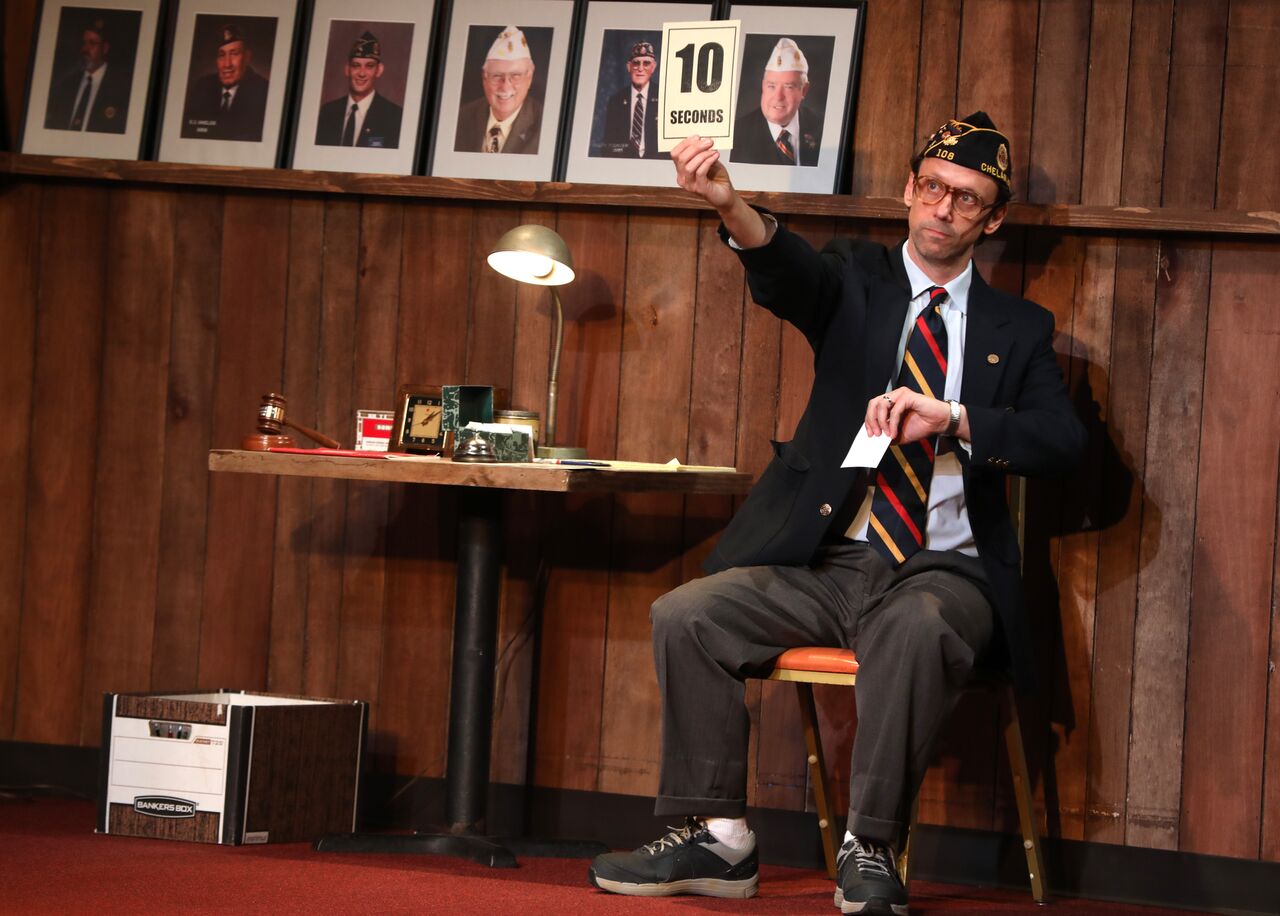
WTC’s premise is that Schreck, playing herself, is here to recreate one of her teenage debates from 1989, which took place at an American Legion post in her hometown of Wenatchee, WA, “The Apple Capital of the World.” Rachel Hauck’s design, lit by Jen Schriever, is a wide expanse representing the paneled walls of a Legion post, lined with dozens of photos of white men in military caps and backed by standing United States and American Legion flags. To further heighten the atmosphere, we’re asked to pretend we’re an audience of cigar-smoking white men. 
Mike Iveson. Photo: Joan Marcus.
Schreck remarks that her reconstruction has to rely on her memory of her 1989 speech because her mom discarded it (although she saved such detritus as 12-year-old Heidi’s hair when she cut it off to look like Annie Lennox). She then sets up the situation, for which a Legionnaire (Mike Iveson), in familiar cap and jacket, serves as moderator, setting up the ground rules, announcing the topics, holding up cards noting the time remaining in each segment, and ringing a bell to cut off speech.

In part one, the contestants must explain their understanding of the Constitution and how it relates to their lives; in part two, they must extemporize on an amendment they draw at random from a can. Schreck reverts to her 15-year-old self, delivering her speech about the Constitution being a “crucible”; her opponent’s theme, which Heidi disputes, is that the Constitution is a patchwork quilt. The amendment Schreck picks is the Fourteenth, Section One. Briefly, this concerns the equal protection of all citizens under the laws.

As the hour and 40-minute program proceeds, Heidi slips back and forth between her youthful self and her present one, the latter gradually becoming dominant as, driven by the constitutional question before her, she presents what is essentially a memoir of the spousal abuse suffered by her female antecedents, including what she witnessed in the lives of her mother and grandmother. Much of her time is occupied with arguments concerning violence toward women, women’s rights, and abortion. Occasionally, the narrative appears to drift off on tangents, which she herself notes, but nothing she says isn’t without relevance to her arguments.

While we never meet young Heidi’s opponent, Becky Lee Dobbins, from Lawrence, KS, the play’s loose structure allows us to hear from actor Mike Iveson, who temporarily sheds his Legionnaire persona to provide what Schreck calls “positive male energy” in the form of his personal story about his sexuality. Interesting as it is, it’s hard not to consider it an unnecessary distraction.
Rosdely Ciprian, Heidi Schreck. Photo: Joan Marcus.
Toward the end, an even more surprising metatheatrical twist arrives in the person of a 14-year-old, African-American schoolgirl named Rosdely Ciprian, who enters to debate Schreck on the question of whether or not the Constitution should be abolished, each debater taking the opposite position. Meanwhile, pocket-sized copies of the Constitution are distributed to the audience, which is asked to hoot, holler, and howl for or against contestants’ points (not unlike a Real Time with Bill Maher show). At the conclusion, an audience member is chosen to decide the debate winner.
Rosdely Ciprian. Photo: Joan Marcus.
While much of this debate is scripted, it also contains room for extemporaneous discussion. Regardless, Ciprian is an extraordinarily intelligent, remarkably knowledgeable kid (adorably, an audience question the night I went stumped her with the term “bucket list”), who one day might reasonably join SCOTUS itself. If a movie of Michelle Obama’s childhood were made, I couldn’t think of better casting. (Thursday Williams alternates with Ciprian and, I'm sure, is equally as gifted.) 

Rosdely Ciprian, Heidi Schreck, Mike Iveson.
Schreck herself delivers an awesome performance, filled with anger, vulnerability, astuteness, and pain, but also with welcome dollops of humor, often self-deprecating. She’s as potent an actress as she is a writer.

What the Constitution Means to Me is absorbing, and, given its driving pace, there’s certainly a lot to absorb. It’s an educational, if decidedly polemical, event that makes its lessons that much more pertinent by their connection to Schreck’s personal experiences. When it’s over, however, you may consider turning your attention to what the Constitution means to you.

OTHER VIEWPOINTS:

New York Theatre Workshop
79 E. 4th St., NYC
Through October 28