Thursday, March 8, 2018

172 (2017-2018): Review: RELEVANCE (seen March 6, 2017)


“Irrelevance”

Pay close attention to the opening scene of JC Lee’s Relevance, a moderately interesting play being given a dynamic performance by the MCC at the Lucille Lortel Theatre. It’s set at an MLA-type academic conference—the American Conference for Letters and Culture—and pits two celebrity feminist writers against each other. One is Theresa Hanneck (Jane Houdyshell, The Humans), a raging, silver-haired, white lioness of the Susan Faludi generation; the other is Msemaji Ukweli (Pascale Armand, Eclipsed), a young, ambitious, black woman clawing her way into the limelight.  
Jane Houdyshell. Photo: Joan Marcus.
Their conversation, which is being streamed live, is moderated by a youthful professor named Kelly Taylor (Molly Camp), in awe of both discussants. While struggling to keep the discourse civil, she can’t refrain from noting the activity it’s generating on social media, especially Twitter, where Theresa is being pounded. Unwisely, one might think, Theresa dismisses such platforms (except when it suits her purposes to refer to Reddit or BuzzFeed) while Msemaji takes pride in her considerable following. She obviously owes it a significant part in her success.
Jane Houdyshell, Pascale Armand. Photo: Joan Marcus.
Msemaji seeks diversity in the movement in contrast to the diversity-deprived predecessors she accuses of “righteous victimhood.” The discussion, however, although intended to highlight the differing positions of old-school vs. new-school feminism, remains largely unfocused, overshadowed by faux-academic dialogue and emotional fisticuffs.
Pascale Armand, Richard Masur. Photo: Joan Marcus.
This is particularly evident when Theresa, there to receive a lifetime achievement award and fighting to maintain her relevance, bulldozes her way through the conversation. She thereby puts Msemaji, who has been awarded a substantial monetary award by the institution—on edge with a hostility that barely gives the younger woman a chance to respond.
Richard Masur, Jane Houdyshell. Photo: Joan Marcus.
What follows, in scenes set at the conference hotel’s bar, Theresa’s room, and on the debate platform, details Theresa’s jealous anger at the rising young star whose popularity threatens to throw shade on foundational feminists like herself.

Theresa’s companion at the event is her avuncular literary agent, David (Richard Masur, Lucky Guy), her onetime lover, whose equanimity in supporting Msemaji allows Theresa to vent her spleen. You see, she’s learned things about Msemaji’s background that cast doubt on the authenticity of her narrative about being the product of an impoverished upbringing and the victim of rape. 
Molly Camp, Jane Houdyshell, Pascale Armand. Photo: Jane Marcus.
As they say of politics, the feminist issues here are local, focused on the classic conflict between the veteran refusing to go gentle into that good night and the newcomer, who showers her distinguished predecessor with praise while subtly undercutting her authority. Both women are shown in an unflattering light but one nonetheless will come out on top.

Playwright Lee, though, drives the play’s intermissionless 90 minutes with too much reliance on conventional plot points regarding personal secrets that, given today’s instant news cycle, you’d think everybody and her sister would be privy to. Theresa’s suspicion of David’s possible sexual interest in Msemaji is another familiar ploy in this dramatic cat fight. Lee knows how to stir the dramatic pot to create vigorously vitriolic dialogue but his situations and characters too often seem forced and inorganic.

Liesl Tommy’s (Eclipsed) spirited direction keeps the pot bubbling with intense, rapid-fire confrontations but her staging has a rhetorical quality that makes even the most intimate discussions seem like debates. These characters don’t have to be pontificating on a public platform to deliver their lines in full voice while facing the audience, as if needing to convince us of their points of view. The dialogue also smacks of self-conscious artificiality; even “public intellectuals” sometimes speak like ordinary people, avoiding such locutions as “that which dehumanizes,” “that which is tangible,” “that which oppresses you,” and the like.
Jane Houdyshell, Molly Camp. Photo: Joan Marcus.
None of the characters has a third dimension but Houdyshell provides a formidable presence as the Valkyrie-like Theresa, although, sadly, she stumbled frequently over her words the night I went. Armand combines beauty and self-righteous confidence as Msemaji, while Camp pushes Molly’s comic bewilderment too far. Masur, white-bearded, his hair pulled back in a bun, his sport jacket and jeans with rolled cuffs underlying his liberal hipness, is likable as the play’s down-to-earth raisonneur who, for all his apparent equanimity, has his own secret agenda.
Pascale Armand. Photo: Joan Marcus.
Clint Ramos’s attractive set uses a revolve to bring each scene—only the bar being less than instantly identifiable—quickly into view, Jiyoun Chang’s lighting effectively enhances the atmosphere, and Jeannette Oi-Suk Yew’s projections, especially those of rapidly accumulating Twitter comments, are perfectly coordinated with the action. Finally, Jacob A. Climer's costumes are all character-appropriate.

Relevance is generally entertaining but, like Theresa, it simply never lives up to its title.

OTHER VIEWPOINTS:

Lucille Lortel Theatre
121 Christopher St., NYC
Through March 11

"What Did the Folks Next to Me Think"

There was only one other person in my five-seat row besides me and my plus-one. A woman in her thirties, she declined to offer a grade but said she liked the show a lot.


Wednesday, March 7, 2018

171 (2017-2018): Review: HELLO, FROM THE CHILDREN OF PLANET EARTH (seen March 5, 2018)

“Not Now, Voyager”


Don Nguyen’s Hello, From the Children of Planet Earth, a tepid comedy now having its world premiere under the auspices of The Playwrights Realm, has a plot concerning a lesbian couple hoping to have a baby by artificial insemination. So what else is new?


Dana Berger, Kaaren Briscoe. Photo: Daniel J. Vasquez Productions.
From at least as far back as the 1948 movie Test Tube Babies, the concept has inspired films, TV shows, and stage plays, most of them comedies but a few, like David Rudkin’s 1973 play Ashes, rather dark. A few years ago, so many artificial insemination films were appearing it was considered a trend. 

Like Nguyen’s, some plots (the 2010 movie The Kids Are All Right and Ethan Coen’s 2013 play Women or Nothing, for example ) have focused on lesbians. The Vietnam-born, Nebraska-raised Nguyen’s twist is to see an allegorical connection between the AI theme and space exploration. The relationship, however, is too tenuous and the play itself too discombobulated for it to make an impact.
Jon Hoche, Jeffrey Omura. Photo: Daniel J. Vazquez Productions.
The play was inspired by the playwright’s own experience in being asked by two friends to be a sperm donor. Using two characters, Betsy and William, that Nguyen introduced in his play The Commencement of Willian Tan (2015), he places the action in 2012, just when the NASA space probe Voyager I, launched in 1977, was about to reach interstellar space.
Dana Berger, Jon Hoche, Jeffrey Omura, Kaaren Briscoe. Photo: Daniel J. Vazquex.
High school besties Betsy (Kaaren Briscoe) and William (Jeffrey Omura) haven’t seen each other in 17 years when, out of the blue, Betsy texts him (one wonders how she got his cell number) that she’d like to meet him. William, now a geeky NASA engineer responsible for tracking Voyager’s path, is so single-mindedly devoted to his work he’s never gotten married. His NASA buddy, Freddy (Jon Hoche), an obnoxious case of arrested development, insists that, despite her being a lesbian, Betsy wants to “bone” him, probably in a threesome with her smart-ass partner, Shoshana (Dana Berger).
Jeffrey Omura, Kaaren Briscoe. Photo: Daniel J. Vazquez Productions.
William, less ridiculous than Freddy, but equally adolescent, meets the women in a restaurant scene that’s set up so that they’re talking at cross-purposes. He thinks their questions refer to his interest in a three-way while what they’re really seeking is to learn if he’ll agree to be a sperm donor so Betsy, whose clock is ticking, can conceive.
Jeffrey Omura, Jon Hoche. Photo: Daniel J. Vazquez Productions.
This is all written, acted, and directed (by Jade King Carroll) for broad farcical effects—there was frequent laughter when I went, even at the most innocuous comments—but, eventually, things settle down. They don’t turn out as expected, though, and a touchingly tearful Betsy is forced to express the dark side of AI conception. Even the clownishly overwrought Freddy is allowed to become a bit more human.
Jon Hoche, Jeffrey Omura. Photo: Daniel J. Vazquez Productions.
Kimie Nishikawa’s sci-fi-looking set is an abstract, pick-up-sticks-like arrangement of beams and wooden units, some of it outlined with rows of glowing bulbs (Nicole Pearce did the lights). The action shifts back and forth between the women’s lives in Washington, D.C., and scenes at NASA’s Goddard Space Flight Center in Maryland, where William and Freddy track Voyager I and II with a single Apple laptop (“Fund NASA!,” you might think). William even tracks the probe with a program he wrote called “Heartbeat,” which ties in, of course, with Betsy’s ultrasounds.
Olivia Oguma. Photo: Daniel J. Vazquez Productions.
Meanwhile, a young woman, Farthest Explorer (Olivia Oguma), wearing futuristic space gear designed by Loren Shaw (Ari Fulton did the other costumes), keeps appearing on catwalks over the stage between scenes, offering cryptic commentary on her mission. Symbolizing Voyager 1, she wears a Golden Record about humans whose contents include greetings to any life forms she may meet, recorded in 55 languages: the English one forms the title of the play. Oguma does it nicely but it seems an unnecessary distraction in a play already veering off course without it.
Olivia Oguma. Photo: Daniel J. Vazquez Productions.
Hello, From the Children of Planet Earth is the kind of play in which the men have their private conversations while defecating in adjoining stalls that reveal only the pants crumpled around their ankles, or in which the sperm donor, given a thick stack of porn magazines, chooses instead to masturbate to a copy of Little Women he finds in the women’s bathroom. These and other puerile choices make it difficult to take anything seriously, whether it be the problems of infertility, the dilemma of aging single people needing to make family commitments, the connection between birth and space, or the crisis of losing touch with Voyager.
Olivia Oguma. Photo: Daniel J. Vazquez Productions.
One might think that the issue of race would be discussed in a play where, as played here, the parents are of notably different skin colors. Nguyen himself has noted that, despite himself being “an artist of color,” sometimes all he wants “is to see a play where actors of color on stage never have to mention their character’s ethnicity. So I don’t know if there’s an actual movement towards one end or another. I think it’s just what the play demands. Hello, From the Children of Planet Earth is about humankind in general, and the trials and aspirations of the characters . . . are ones I think anyone can identify with.” 

Perhaps, but the question nonetheless lingers—especially since we’re never allowed to forget Shoshana’s Jewishness—and might itself add some depth to this otherwise two-dimensional play.
Kaaren Briscoe, Dana Berger. Photo: Daniel J. Vazquez Productions.
There will surely be more plays about lesbians and artificial insemination. Some such stories really deserve to be told, like the one about a woman I know, a friend of my daughter’s, who grew up around my corner. This woman and her partner, using a turkey baster, were both artificially inseminated by the same family friend, without any doctor’s assistance. The women won a groundbreaking, widely publicized case in which they were allowed to cross-adopt each other’s child so they could get health coverage. 

Their tribulations, I’m sure, would make a far more compelling drama than what the sitcom/sci-fi silliness of Hello, From the Children of Planet Earth provides.

OTHER VIEWPOINTS:

The Duke on 42nd St., NYC
229 W. 42nd St., NYC
                                                              Through March 24        

“What Did the Folks Next to Me Think?”

The man to my left, in his 20s, nice-looking, lightly bearded, and wearing a wool cap, struggled to find a grade after saying he liked the show very much. I suggested 80 but he thought it should be a bit higher. 85? Maybe a bit too high. So I’m putting him down for an 83.


Saturday, March 3, 2018

170 (2017-2018): Review: KINGS (seen March 2, 2018)

“Lobby Villains”


Let’s face it. American politics has rarely been dirtier, or more in-your-face outrageous, than today, with a putrid stink from the White House inundating the nation daily. There are so many infected areas to be scrubbed that politically savvy playwrights have an unprecedentedly foul field when looking for a subject over which to pour their dramatic Lysol. Just think of the non-stop political narrative dominating TV’s late-night talk shows, the incessant chatter on cable news, and the endless comic and dramatic outpourings of shows like “Veep,” “Homeland,” “House of Cards,” “Our Cartoon President,” and so forth.

Zach Greiner, Eisa Davis. Photo: Joan Marcus.
From among this stinking swamp of slimy subjects Sarah Burgess (Dry Powder) has chosen in her new play, Kings, to expose the corruption wrought in the American political system by the disease of lobbying. I refer, of course, to the insidious practice of highly paid individuals persuading elected representatives to receive large donations in return for supporting legislation that will benefit self-interested institutions or donors. Although, oddly, the term “campaign finance” is never spoken, its implications regarding the influence of money in determining our laws underlines much of what transpires.
Eisa Davis, Zach Greiner. Photo: Joan Marcus.
Representative Sydney Millsap (Eisa Davis), a Gold Star widow, formerly a bigtime oil/gas accountant, having won a special election, has become the freshman congressional representative from Texas’s 24th district. As everyone keeps reminding her, she’s the first woman and person of color from there to hold the office, which makes her a rising star in what, although unnamed, is clearly the Republican Party.

As Kate (Gillian Jacobs), a young, attractive lobbyist, soon discovers to her deep frustration, when trying to get Millsap to support a questionable bill being pushed by an association of podiatrists, the new representative has very high standards. So high, in fact, she refuses to back issues she doesn’t believe in, regardless of how much money they might provide for her campaign needs. And she endures the loathsome task of fundraising only when she can bring herself up to it.

Even more contentious is her antipathy toward retaining the Carried Interest Fairness Act, with its loophole allowing hedge fund managers to avoid paying taxes. (The Act was retained in the recent tax overhaul.) I suspect that the average audience member at Kings—liberal or conservative—doesn’t have this topic, no matter its pertinence, high on the radar of their legislative concerns. Burgess, though, makes sure we know the wonky particulars of this boringly unsexy subject as she plots out Millsap’s objections.
Gillian Jacobs, Zach Grenier, Aya Cash. Photo: Joan Marcus.
Lauren’s friend and eventual antagonist is another young, attractive lobbyist (youthful good looks must be a job requirement), Kate (Aya Cash), who found success after having served as chief of staff for Texas Senator John McDowell (Zach Grenier); he's the eighth most powerful member of Congress, and a presidential hopeful. McDowell’s an essentially decent man but he plays the game by the rules and, in contrast to Millsap’s no-strings acceptance of donations, is inclined to assist the interests of his contributors.
Aya Cash, Gillian Jacobs. Photo: Joan Marcus.
Over the course of the hour and 40-minute, intermissionless play, Burgess shows the unbendingly ethical Millsap winning the grudging approval of Kate, who isn’t afraid to insult the congresswoman; Millsap actually respects Kate’s unflattering honesty, even after Kate says Sydney has “a messiah complex.”

The dramatist also reveals Millsap deciding that the only way she can effect change is to run for the Senate against the much-better-funded McDowell in the upcoming primary, thus allowing the candidates to square off against each other in a debate that is the play’s best scene.
Aya Cash, Zach Grenier. Photo: Joan Marcus.
Scene designer Anna Louizos, needing to shift locales in the 12-scene script quickly, uses a minimalist, alley-style setting, with the audience in bleachers at either side of the Public’s LuEsther Hall. This allows the action to shift smoothly among a ski resort on the slopes of Vail, homes in Washington, D.C., a speaking platform, a Dallas Chili’s restaurant, a Disney resort in Orlando, and a debate stage. On one side is a multicolored wall, on the other, a doorway, although spectators at the extreme sides can see only one of these.
Gillian Jacobs, Eisa Davis. Photo: Joan Marcus.
A pair of revolves allows seated conversations at tables (composed from scenic units reassembled for different purposes) to be seen from all angles as the disks very slowly turn. Jason Lyons lights things nicely, using colorful elements built into the scenic units and ceiling, and the shifts are helped by Lindsay Jones’s upbeat, rhythmic music. Paul Tazewell provides stylish clothes, particularly for the women.

Thomas Kail’s (Hamilton) direction does little to enliven the production or to make Kate and Gillian more than pretty mouthpieces. He does, though, get quality performances from the diamond-sharp Davis and the gruffly crafty Greiner (so much better than in his recent outing in Describe the Night), whose scenes, especially the debate, bounce with life. 
Burgess has a good ear for the things people like these might discuss; however, despite the occasional humor, the discourse is insufficiently absorbing. Her characters remain more positions than people, and, given the constraints of time and audience patience, the play never rises beyond a limited level of didacticism.

Perhaps the most significant takeaway is that lobbyists are often more knowledgeable about issues than the politicians they endeavor to influence; they, in fact, would seem to be the principal drivers of the legislation that affects our lives.

With the chaos now enveloping the highest levels of American politics and the intensity of the backroom fighting we hear about daily, Kings, regardless of its conflicts, seems patty-cake polite.

It’s hard to get excited about tax loopholes as the issue driving the conversation, or even the subject of lobbying, at a time when, as Millsap herself remarks, the American people have voted “a psychopath” (unnamed) into office. If you want to grab your audience by the throat by dramatizing lobbying, how about using the NRA as your whipping boy?

Burgess occasionally tries to lighten the mood by digressive scenes, like one about the senator’s poet son, or another at a Chili’s where Millsap offers a spirited defense of the restaurant’s fajitas as a sizzling platter of them is served. It’s about the only thing that sizzles in Kings.

OTHER VIEWPOINTS:

Public Theater/LuEsther Hall
425 Lafayette St., NYC
Through April 1

“What Did the Folks Next to Me Think?”
I was sitting next to a young woman I’d spotted the night before at the New York Theatre Workshop. She turned out to be a theatre journalist. Her assessment of Kings was a 50.


Friday, March 2, 2018

169 (2017-2018): Review: AN ORDINARY MUSLIM (seen March 1, 2018)

"Identity Crisis"

Edinburgh-born Hammaad Chaudry’s highly promising debut drama, An Ordinary Muslim, written as a master’s thesis at Columbia, where Chaudry was mentored by Tony Kushner, is set in London in 2011, just when the Arab Spring was sprouting. The play, though imperfect, offers a fascinating glimpse of a middle-class Pakistani Muslim family working out their personal issues against the background of their particular socio-religious world. In our divisive times, it’s instructive and helpful to witness the common humanity of people from worlds unfamiliar to most of us as they engage in everyday, profanity-seasoned conversations about what matters most to them.


In An Ordinary Muslim the characters—all but one of Pakistani heritage—talk among themselves about issues of assimilation, immigration, India-Pakistan partition, ethnic and religious prejudice, the wearing of the hijab, and secularism versus fundamentalism, among other things. These subjects are organic outgrowths of the situations and only occasionally become polemical as the characters seek to discover how they fit into modern UK society. 
Angel Desai, Ranjit Chowdhry. Photo: Suzi Sadler. 
At the action’s center is Azeem Bhatti (Sanjit De Silva), the London-born son of Pakistani immigrants. A suit-wearing, but tieless banker, he lives with his retired father, Akeel (Ranjit Chowdhry), who worked hard at second-rate jobs to make a life for his family after immigrating to England; his imperious mother, Malika (Rita Wolf); and his loving but vaguely dissatisfied wife, Saima (Purva Bedi). We also meet his hijab-wearing sister, Javeria (Angel), resentful of her mother, who lives in Manchester with her husband and two kids.

Purva Bedi, Rita Wolf, Ranji Chowdhry, Sanjit De Silva. Photo: Suzi Sadler.
It doesn’t take long to realize how dysfunctional this family is: the relationship of the constantly bickering Malika and Aleek is stained by his history of physical abuse; the pestering Malika, on the other hand, has done the same to Javeria, and shows no compunction about favoring one of her grandchildren (unseen) over the other. Saima contemplates wearing her hijab at work despite the discomfort this causes Azeem, who sees it as potentially provocative. At any rate, Saima’s unhappy at work and would like to quit, while Azeem is angry with everyone and everything.
Sanjit De Silva. Photo: Suzi Sadler.
The good-looking, clean-cut, well-educated Azeem resents that the world at large sees him as “an ordinary Muslim” while, in fact, he considers himself pious, although his religious attitudes seem to shift and he’s even got a drinking problem he’s trying to kick. His pride (and sense that he is being slowly emasculated) is such that he refuses to make even minor career-advancing accommodations in the face of what he perceives as anti-Islamic bigotry. He carries such a gigantic chip on his shoulder, especially about the treatment of Muslims, in both the colonial and post-colonial UK, that he can easily lose our sympathy by his constant venting. Even David (Andrew Hovelson), a liberal-minded, if patronizing, friend and colleague from whom he seeks a recommendation, is subject to his outrage.
Andrew Hovelson, Sanjit De Silva. Photo: Suzi Sadler.
While Azeem can perhaps be viewed as a potential troublemaker, giving us insights into just how “ordinary Muslims” become radicalized, it’s easy to see, in his relations with his loved ones, just how much he’s to blame for his own fate. This is highlighted when he digs a hole for himself by lying to everyone about having landed the managerial position he was aiming for.

Engrossing as the material often is, the play changes direction too sharply from the politico-cultural to the domestic, becoming a standard family and marital drama filled with the usual interpersonal angst, even including a whiff of infidelity. Without the ethnic context, it would be quite familiar.

In Act Two the play introduces two members of the Bhattis’ Pakistani community who try to enlist Azeem in the Tablighi Jamaat revivalist movement, Hamza (Sathya Sridharan), the youthful, bearded head of the local mosque (who has an eye for Saima), and his father, Imran (Harsh Nayyar), a respected Muslim leader. When the latter two become the targets of the self-righteous Azeem’s vitriol, the playwright may be stretching things too far. Azeem’s toxicity may be dramatically interesting but it doesn’t ring true for someone who’s gotten so far, regardless of his recent job issues.
Sathya Sridharan, Purva Bedi. Photo: Suzi Sadler.
Neil Patel’s set uses all of the spacious New York Theatre Workshop’s stage to represent its several locales--a pub and a mosque but chiefly the Bhatti’s tackily wall-papered house—with individualized units sliding on and off to be isolated under Lap Chi Chu’s expert lighting. Susan Hilferty’s costumes expertly display both the modern and traditional elements of what these characters would wear.
Sanjit De Silva, Ranjit Chowdhry. Photo: Suzi Sadler.
An exceptional company of actors of South Asian backgrounds brings three-dimensional sincerity to Chaudry’s dialogue, which is ripe with British-accented, colloquial authenticity. Under Jo Bonney’s insightful direction, each actor creates a fully-fleshed out character, with Sanjit De Silva standing out despite Azeem’s various inconsistencies.
Sanji De Silva. Photo: Suzi Sadler.
An Ordinary Muslim is structurally uneven and burdened by a questionable conclusion, but it dramatizes important issues and holds one’s interest throughout its two and a half hours. That alone is far from ordinary.

OTHER VIEWPOINTS:

New York Theatre Workshop
79 E. 4th St., NYC
Through March 25

 "How Did the Folks Next to Me Like It?"

A middle-aged friend of mine I ran into at the theatre, someone who goes very often to the theatre, ventured a grade of 70.


Thursday, March 1, 2018

168 (2017-2018): Review: JERRY SPRINGER--THE OPERA (seen February 28, 2018)

“Eat, Excrete, and Watch TV”


Often, when I get a haircut, my barber has the little TV near his chair turned to a tabloid talk show, usually Maury Povich’s, which forces me to watch the raw exchanges, sometimes leading to physical clashes, between its guests. Even more violence-prone, though, are the similarly outrageous shows of Jerry Springer, which have gained enormous popularity by prodding the hairy underbelly of American personal relationships for well over a quarter of a century.
 
Florrie Bagel, Luke Grooms, Terrence Mann. Photo: Monique Carboni.
Since the “Jerry Springer Show” typically includes emotional outbursts of operatic proportions, it’s only natural that someone like British composer, book, and lyrics writer Richard Thomas, collaborating with book and lyrics writer Stewart Lee, would create Jerry Springer—The Opera. Although not entirely satisfactory, this sensationally well-staged (by John Rando), energetically choreographed (by Chris Bailey), marvelously cast (17 actors! Count ‘em), and brilliantly performed farcical opera—not entirely sung-through—exploits the TV show’s most egregious features.

You could say it’s payback for how Springer himself exploits the bizarre obsessions with sex, violence, or bathroom issues of his guests, whose mouths (bleeped for TV) have larger capacities to shoot crudities than AR-15s do to fire bullets.
Nathaniel Hackmann, Tiffany Mann, Billy Hepfinger (rear). Photo: Monique Carboni.
Jerry Springer—The Opera is only now making its formal New York premiere, in a production by The New Group. It first opened in London in 2003, where it won the Olivier Award for Best New Musical, ran two years, then toured the UK, and made its US debut in Las Vegas, afterward playing at various regional theatres. It also received a concert performance at Carnegie Hall in 2008. During these years, it was burdened with censorship attempts (including lawsuits and picketing) by groups offended by its blasphemous religious material. (Book of Mormon, of course, does much the same thing and is almost as potty-mouthed.)

The Linney Courtyard Theatre at the Pershing Square Signature Center has been designed by Derek McLane to look like a TV studio, with the audience seated around three sides of a set closely replicating the program’s brick-walled set. Large monitors hang overhead in each corner and the audience members in the first row to the right and left are versatile actor-singers who serve as both a chorus and, with the help of a multitude of wig and costume changes, Jerry’s various guests.  

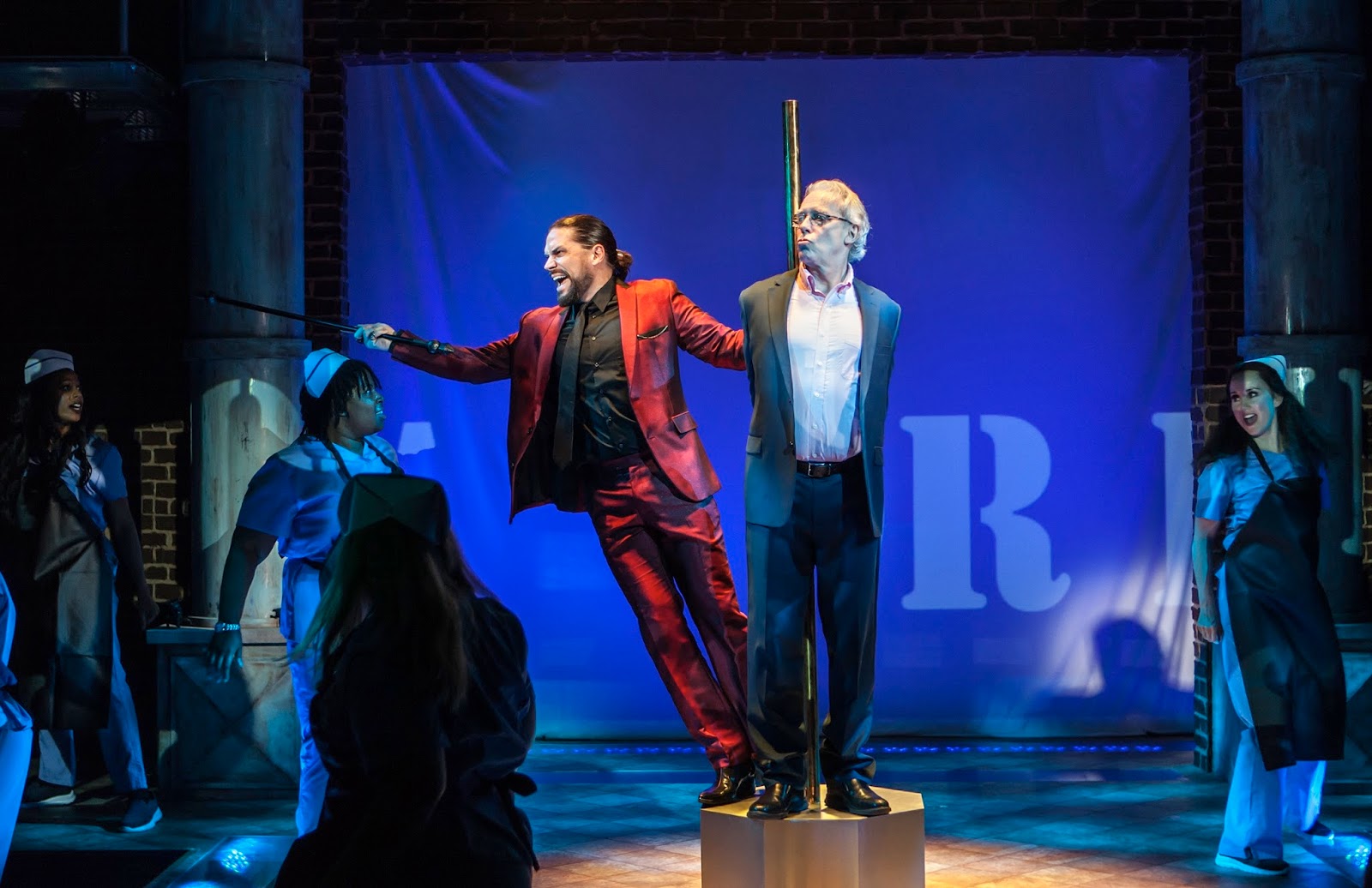
Before Jerry (Terrence Mann) himself enters, his slickly obnoxious warm-up man, Jonathan Wierus (Will Swenson)—who Jerry will soon fire for incompetence—puts the raucous audience in the mood. Meanwhile, Steve (Billy Hepfinger), a tall security guy based on Steve Wilkos, stands ready to handle anything that might get out of hand.
Terrence Mann, Billy Hepfinger, Beth Kirkpatrick, Florrie Bagel, Luke Grooms, Sean Patrick Doyle. Photo: Monique Carboni.
Then Jerry enters, signature cue cards in hand, wearing a blue suit and tieless pink shirt, to interview the first of the show’s guests. This will involve the cheating of a guy named Dwight (Luke Grooms) on Peaches (Florrie Bagel), not only with the trampy Zanda (Beth Kirkpatrick) but with transsexual Tremont (Sean Patrick Doyle). Plenty of action follows, especially when the women go rhino to rhino, forcing Steve to intercede.

Scatological comedy arrives with Andrea (Elizabeth Loyacano) and her boyfriend, Montel (Justin Keyes), who has a thing about being treated like a baby, especially the diaper-wearing part that lets him poop pleasurably in his pants. Montel's involved with Baby Jane (Jill Paice), whose fetish is dressing like a child.
Jill Paice (center). Photo: Monique Carboni.
Finally, we meet the pole-dancing Shawntel (Tiffany Mann), her KKK-member husband, Chucky (Nathaniel Hackmann), and his bizarro mother, Irene (Jennifer Allen). Things go nuts when the tap-dancing KKK itself arrives and the diaper-wearing Montel accidentally shoots Jerry.
Nathaniel Hackmann, Tiffany Mann. Photo: Monique Carboni.
When the audience returns after the intermission, the play, already losing steam, loses more as it shifts to pure fantasy with Jerry in Purgatory, where he meets the warm-up man he fired earlier but who now, dressed in a silken red suit, reveals himself as Satan. To save his soul, Jerry must present a special show in Hell in which Satan can get an apology from God (Luke Grooms) for his expulsion from Heaven.
Brandon Contreras, Terrence Mann, Kim Steele. Photo: Monique Carboni.
Jesus (Keyes), Mary (Allen), and Adam (Hackmann) take part in a weird succession of events during which Jesus is insulted and Jerry must beg for his life over a pit of flames before the action returns to Earth and we watch Jerry’s last moments as he delivers his final words, hoping for people to get along with each other.

The nonstop fountain of X-rated lyrics includes a song sung by Satan that goes on forever as he rattles off one “fu” after the other before climactically spitting out the letters “ck.” In another, the chorus, standing in the aisles, notes its limited lifestyle in “We Eat, Excrete, and Watch TV.”
.
Much of the fun of hearing these naughty numbers derives from their being sung with exhilarating power to Thomas’s often soaring score. I was reminded of listening in the late 1960s to the lyrics of Galt McDermott’s “Sodomy” in Hair, whose shock effect was mollified by its sweet melody.
Will Swenson, Terrence Mann, and company. Photo: Monique Carboni.
Great costumes by Sarah Laux, wigs by David Bova and J. Jared Janas, as well as Jeff Croiter’s awesome lighting (with lots of unusual effects, such as bathing the entire set in TV “snow”), help sell the show. But it’s the exceptional ensemble, led by the white-haired Broadway veteran Mann (Cats, Les Misérables), who barely gets to sing but whose Jerry is one of the few recognizably “human” characters, and the devilishly striking, ponytailed Swenson, that makes the show memorable.
Terrence Mann, Will Swenson. Photo: Monique Carboni.
There are too many top-notch supporting performances to cite so I’ll single out only the hefty Luke Grooms, playing God in a white suit with his face painted gold, and shaking the rafters with his breathtaking tenor when he belts “It Ain’t Easy Being Me."
Terrence Mann, Jill Paice, and company. Photo: Monique Carboni.
Someone recently noted that our current presidency is so outlandish that TV shows like “Our Cartoon President” can’t compete with the reality they’re spoofing. For all its cleverness, the same could be said of Jerry Springer—The Opera and the outlandish behavior its first act parodies. And, with Book of Mormon and other comic shows having broken so many religion-respecting standards, even the second act’s mockery of biblical figures is not as shockingly funny as it may have been when the show was first created.

Jerry Springer once said of his TV show, “I would never watch my show. I'm not interested in it. It's not aimed towards me. This is just a silly show.” Jerry Springer—The Opera has lots of good things, but it, too, is a very silly show.

OTHER VIEWPOINTS:

Pershing Square Signature Center/Linney Courtyard Theatre
480 W. 42nd St., NYC
Through April 1

"Did the Folks Next to Me Like It?"

My plus-one, a veteran Broadway actress, texted: "I'd say 90. Loved the actors, direction, sets and costumes, and the spirit of frolic."