Saturday, September 7, 2019

67 (2019-2020): Review: SINCERITY FOREVER (seen September 5, 2010)

"Heads Up"


If you’re planning to kill two plays with one ticket at the Flea Theater in order to see both Bad Penny and Sincerity Forever on the same evening, be aware—as noted in my review of the former—that you’ll need a separate ticket for each.
Amber Jaunai, Nate DeCook, Vincent Ryne. All photos: Allison Stock.
These works, of course, are part of the Flea’s Mac Wellman: Perfect Catastrophes, A Festival of Plays, celebrating the iconoclastically gnarly work of Flea cofounder Wellman, the prolific writer who heads the distinguished BFA Playwriting Program at Brooklyn College.

And, even if you concur with my less-than-enthusiastic response to Bad Penny, the first half of the bill, if you’re planning to see them in succession you’ll likely to find it worth your while to stick around for Sincerity Forever, even though it means killing an hour between the plays in a not particularly engaging part of Tribeca.

Originally produced at the Berkshire Theater Festival, in 1990, where it won an award, and seen later that year in Brooklyn as part of the 1990 Fringe Series, Sincerity Forever was dedicated to the late Senator Jesse Helms “for the fine job you are doing of destroying civil liberties in These States.” This tongue-in-cheek honor presumably led the National Endowment for the Arts to request that Wellman remove the credit he gave it for an N.E.A. playwriting fellowship, with the writer noting in the published script that he “was wrong, SINCERITY FOREVER was not made possible by the generous assistance of the N.E.A. I don’t know what I was thinking.”

This gives you an idea of Wellman’s feisty political heart, which he pours into Sincerity Forever, a stinging, one-act putdown of American life as seen through the preternaturally ignorant eyes of seven teens living in the fictional, Deep South, small town of Hillsbottom. Moreover, most of these drawling characters dress as if Ku Klux Klan sheets and coneheads were standard cool kids gear.

The thinly plotted play's offbeat characters and structure are accompanied by a heightened, sometimes bizarre, blend of redneck locutions, colorfully distorted grammar, colloquial teenspeak, formal rhetoric, and extreme profanity. At the same time, it’s more linear and thematically accessible than Bad Penny. It’s also better directed (by Dina Vovsi) and performed (by the Bats, the Flea’s resident company of young actors-in-training). It’s still weird, though, as well as over-the-top and WTF?

More than half of its eight scenes are conversations among pairs of teens sitting in cars. These are Judy (Malena Pennycook) and Molly (Charly Dannis), who have two scenes together; Hank (Nate DeCook) and Tom (Vince Ryne); Judy and George (Peter McNally); and Lloyd (Jonathan Ryan) and Tom. Another teen, Melvin (Alex Hazen Floyd), joins in later on.

Stirring things up are a pair of disputatious demons from the tribes of Belial and Abaddon: Furball #1 (Zac Porter), wearing a fur vest, and his Goth partner, Furball #2 (Neysa Lozano). Bringing the wrath of God to town, however, is the suitcase-carrying Jesus H. Christ (Amber Jaunai), played here as an angrily intense African American woman.

Frank J. Oliva’s sceneryless stage, nicely lit by Becky Heisley McCarthy, uses little more than plastic milk boxes, with a narrow beam hanging across the stage about two feet from the ground. As the characters talk while sitting directly behind the beam, we discover American youths practically reveling in their know-nothingness. They think that those who profess knowledge are only faking it, and take pride in being “ignorant forever in absolute sincerity.” Sincerity, you see, is a virtue high enough to forgive any other lapses.

Their comically convoluted conversations are larded with references to God’s secret plans, religious faith, their souls, the search for meaningfulness, heaven and hell, death, romantic crushes (hetero and homo), jealousies, coolness, sex, catastrophic ills, like nuclear pollution, and even the purity of their families’ ancestral, Aryan stock, with invocations to the Norse god Wotan (a.k.a. Odin).

The teens believe their lives are being disrupted by the presence of a mystic Furball that must be destroyed. Those fuzzy aliens—who like jiving to a heavy beat—are demons who thrill to their own monstrosity while hating everything these “empty-headed purveyors of the American dream,” with their “fake cant and bullshit,” hold dear. In fact, one insists it’s all “deeply insincere.” On the other hand, they claim sincerity for themselves, even quarrelling bitterly over which is more sincere. Thus, the arrival of Jesus, bearing an “apparatus” that can detect a Furball’s presence and ready to use her mind to obliterate any she might find.
Malina Pennycook, Amber Jaunai, Alex Hazen Floyd, Vincent Ryne.
Wellman enjoys keeping us off guard by playing games with his language and situations, including having characters, once they're infected by the Furballs, repeat dialogue earlier said by others, or even to have them argue using the Furball’s own particular insults. “Something bad’s gotten into us,” admits someone.

Toward the end, the kids go haywire, with a climactic cacophony of overlapping arguments (as indecipherable as those in Bad Penny) before Jesus delivers a lengthy diatribe. She explains her mission, noting “what a sorry place this world is,” blasts everyone for their vanity, hypocrisy, and distortion of Christian values, casts aspersions on “dumb-ass” sincerity, and wonders why she should  even bother with mankind.
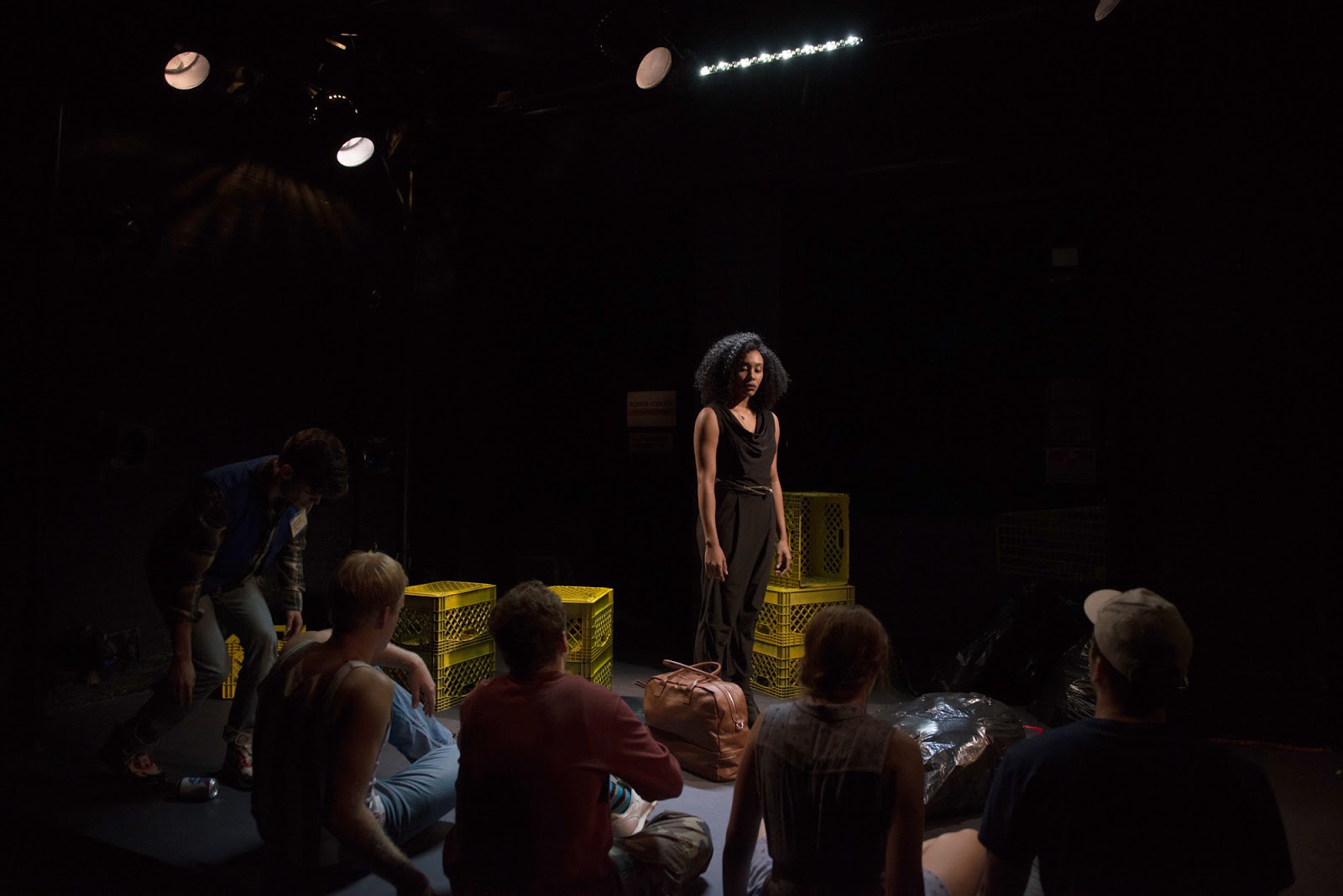
Amber Jaunai.
Not all of this comes across clearly, however, nor am I sure I grasped more than a handful of Wellman’s points, but the writing and staging manage to hold the attention much of the time. The KKK costumes, interestingly, seem intended more to symbolize the kind of ignorance that informs American racism than to reflect actual racist behavior. Apart from a few references, like those to Aryan ancestors, or a quickly passing homophobic/anti-Semitic/racist comment, the usual KKK tropes of cross-burnings, lynching, or slurs are ignored.

As noted in my Bad Penny review, Wellman writes for a niche audience—to which I admit not belonging—that greatly appreciates his quirky, nontraditionalism.  But, given Wellman's esteem as a maven of the avant-garde, I sincerely suggest that, for those interested in an important example of late 20th-century “experimental theatre,” Sincerity Forever, unlike Bad Penny, deserves a heads up. 

Flea Theater/The Siggy
20 Thomas St., NYC
Through September November 1

OTHER VIEWPOINTS

66 (2019-2020): Review: BAD PENNY (seen September 5, 2019)


“Tails Down”


Mac Wellman, the prolific, multi-award-winning playwright, novelist, essayist, and poet heads the Brooklyn College’s MFA Playwriting Program (we were colleagues before my 2007 retirement from the Theatre Department). He's made it one of the most successful in the country: think Annie Baker, Young Jean Lee, Thomas Bradshaw, etc. Wellman's also a cofounder of Tribeca’s Flea Theater, which is presently offering five of his short plays in a festival called Mac Wellman: Perfect Catastrophes.
Joseph Huffman, Emma Orme, Baile de Lacy, Lambert Tamin. All photos: Allison Stock.
Wellman has held high the banner of nontraditional, avant-garde, post-absurdist theatre throughout his abundant career. His nonlinear, linguistically challenging, intellectually slippery, politically charged, and morally determined plays fly in the face of conservative, realistic theatre, with which he has notably taken issue. These idiosyncratic qualities are present in the first two of the festival’s plays, the black comedies Bad Penny and Sincerity Forever (reviewed separately).

Like many of Wellman’s works, these are niche plays, loved by his followers (only a few of whom were there when I went) but caviar to the masses, who would generally prefer the theatrical equivalent of hot dogs and burgers (like me, I guess).
Rear: Baile de Lacy, Dana Placentra, Lambert Tamin; front: Katelyn Sabet, Alex J. Moreno, Caroline Banks; right: Emma Orme.
Be aware that, while they’re presented on the same evening, the tickets are sold separately. If you intend to see them back to back—most who attended when I did chose not to do so (unless Bad Penny convinced them not to return)—be prepared to find something to occupy you nearby between 8:00 and 9:00 pm. Thomas Street is not located in a particularly jumping downtown spot. I was lucky because my plus-one lives a few blocks away.

Bad Penny, originally given a site-specific performance in 1989, near the lake at Central Park’s Bow Bridge, where the action transpires among a group of strangers, is here performed in a small outdoor patio area directly behind the Flea's Pete Theater. To suggest the park setting, the concrete ground is covered with AstroTurf. A single row of metal, plastic, wood (with a picnic table), and canvas chairs (the low, beach-type folding ones) circles the space. Several blankets and yoga mats are spread about for audience members to sit on. The place, designed by Jian Jung, resembles a nursery school play area more than it does Central Park, or any park, for that matter.

Tall, glass windows (one is also a door to the interior) line one side of the space. Although a considerable amount of important action will occur on the inside of the windows, only those opposite the wall can see it, depriving at least a quarter of the audience of the view.
Joseph Huffman, Emma Orme, Dana Placentra, Baile de Lacy.
This is part of the reason director Kristan Seemel’s production only further clouds the  already hard-to-grasp dialogue and behavior. Things are even further dulled by the insistent hum of what seem 100 air conditioners, not to mention, when I attended, repeated helicopter noise.

The confusion created by mingling the actors—the Bats, the Flea’s resident company of young actors-in-training—with the audience, which at first makes it difficult to separate the normally-dressed actors from spectators, requires a few minutes before we can tell who’s who. In short, the production, for all the actors’ enthusiasm, would seem to serve the already problematic play poorly. I say “seem” because this may be precisely what’s being sought.

My wife is one who never leaves a dropped penny behind but insists on rescuing it from abandonment. Bad Penny suggests this might not be such a good idea. The bad penny retrieved by Kat (Bailie de Lacy)—a young woman (designated as Woman One) who’s had mental problems, is obsessed with myth, and ponders whether the sky is real or an illusion—appears to be attracting bad luck.

This is expressed through her exchanges with others she encounters, beginning with Man One (Jason Huffman), calling himself Ray X, “a freelance memory fabulist and metaphysician and card player” from Big Ugly, Montana, who’s left his Ford Fairlane 500 on the East Side because of a flat.  Carrying the tire, which he says he yanked off with brute strength when his jack broke, he’s searching in vain for a gas station.
Caroline Banks, Baile de Lacy, Emma Orme.
Eventually, the others (Alex J. Moreno, Emma Orme, and Lambert Tamin) join in, backed by a chorus of three (Caroline Banks, Dana Placentra, and Katelyn Sabet, reduced from the original’s 12), as we hear (or would if there weren’t so many distractions) frequently nihilistic references to  ugliness, gruesome upbringings, consumerism, toxicity, suspicion, conspiracy theories, trolls, normalcy, a cancer-curing cheese, bulldogs, the meaning of our seemingly senseless existence, and man’s decline into “crummy, little, cheesy, lousy, liars, and con-artists.”  

An important mythical element is the Charon-like Boatman (Ryan Leslie Stinnett) who—although not provided here with anything resembling a boat—is coming for the man with the tire after Kat gives him the penny (which was stolen from the Boatman). Much of what is spoken is incomprehensible, not only because of the ambient noise, the long lists of colorful adjectives, or the densely worded discourse, but because they sometimes shout at and over one another. This too is likely part of the agenda.

Wellman’s script reveals considerable wit mingled with numerous provocative notions. Very little, however, comes through in the Flea’s jumbled production. As it proceeded, I couldn’t help observing a whitehaired, well-known reviewer across from me, someone to whom I’ve been saying hello for years only for him to glance at me as if I were not only a stranger but a pest needing swatting. While he could easily be one of Wellman’s disgruntled characters, his grumpy expression throughout so thoroughly matched my own feelings, I was ready to hand him a newspaper with which to swat away whatever he wanted.

Flea Theater/The Pete
20 Thomas St., NYC
Through October 7

OTHER VIEWPOINTS:


Thursday, September 5, 2019

65 (2019-2020): Review: BETRAYAL (seen August 31, 2019)


"Pauses, Poses, and Pinter" 

In the 1960s, British playwright Harold Pinter (1930-2008), who went on to earn a Nobel Prize, was married to actress Vivien Merchant but having a seven-year fling with BBC-TV personality Joan Bakewell. This personal experience was one of several important influences on his 1978 drama about marital infidelity, Betrayal, now receiving its fourth (and, possibly, best) Broadway production since 1980.
Charlie Cox, Zawe Ashton, Tom Hiddleston. All photos: Mark Brenner.
I recall being unimpressed by that mostly lauded 1980 staging, largely because I considered its three usually outstanding American stars, Roy Scheider as Robert, Blythe Danner as Emma, and Raul Julia as Jerry, to be unconvincing as highly-educated Brits. I missed the 2000 revival, starring Liev Schreiber, Juliette Binoche, and John Slattery, as Robert, Emma, and Jerry. None was English, but, in 2013, when the potentially awesome all-British cast of Daniel Craig, Rachel Weisz, and Rafe Spall played the the same roles, my response (unlike that of most viewers) was only ho-hum.

For the current, limited-run, revival at the Bernard B. Jacobs Theatre, which originated earlier this year during London’s Pinter at the Pinter season, the biggest name among the English leads is Tom Hiddleston (Loki in the Avengers movies), who plays Robert. This is not to say his bright costars, Zawe Ashton (Velvet Buzzsaw) as Emma and Charlie Cox (Philip, Duke of Crowborough on “Downton Abbey”) is Jerry, are in any way diminished by his charismatic presence. They play their roles with the diamond-cutting precision of master jewelers.

But that is still not enough to convince me that Betrayal is more substance than style. In fact, the brilliance of the acting here in Jamie Lloyd’s unconventionally minimalist, finely tuned staging only serves to emphasize the play’s technical glitter over its emotional heartbeat. In the interest of brevity, allow me to adapt the capsule summary of the plot from my review of the 2013 production.

It tells the story of how, in 1968, Jerry, a literary agent (Pinter’s avatar), a married man and father, falls for and begins his affair with Emma. She is the gallery-owning wife of Robert, a publisher who is Jerry’s closest friend (his best man, in fact). The affair lasts seven years and ends in 1975. For much of the time, the lovers conduct their clandestine romance in a rented flat. Meanwhile, Robert begins his own affair, as does Jerry’s wife, Judith. A coda, set in 1977, two years after the affair ends, brings the former lovers together at a pub, and Emma reveals that she is now involved with another writer, one of Jerry’s clients whose publisher is Robert.

What makes this otherwise straightforward tale of adulterous love, male bonding and deception, and scratched memories (à la Proust) intriguing is its backward chronology, with the 1977 post-affair coda actually being the first scene, and with the play then proceeding to eight scenes set, respectively, in 1975, 1974, 1973, 1971, and 1968 (1977 has two scenes and 1973 has 3).

And what makes this production intriguing is its abandonment of realistic scenery in favor of an essentially bare stage, designed by Soutra Gilmour, using only a couple of chairs, and very few other props. Instead of recognizable locales, we see a low, beige, color-textured wall running straight across the upstage area beneath a black ceiling in which multiple, embedded lighting strips run parallel to the wings. Jon Clark’s exceptional lighting paints the background with a mood-enhancing palette, casting the actors’ razor-sharp silhouettes on the wall, as well as varying the spatial feeling with shuttering effects.
Charlie Cox.
In line with this spare, visual restraint are both Pinter’s remarkably polite, reticent, outburst-free script and the actors themselves, each model-slender, wearing the same clothing throughout, their every movement calibrated for effect. Lloyd creates an almost Becketian world in which each gesture, twist of the leg, or crook of the neck--even the way Robert eats a meal--seems choreographed for imagistic impact, almost as if you could take a picture of any moment and get a Vogue-worthy shot. Ashton’s Emma seems especially prone to standing in ways that seem more poses than positions. 
Zawe Ashton, Charlie Cox, Tom Hiddleston. 
Souter’s perfectly-tailored costumes further enhance the physical attractiveness, Robert’s black garb balanced by Jerry’s grayish jacket, with the principal source of color being Emma, the triangle’s pulse, perpetually barefooted in an elegant, high-shouldered, blue, silk blouse and slightly bell-bottomed jeans. 
Charlie Cox, Zawe Ashton, Tom Hiddleston.

Duologues are performed, often with those involved sitting in spindle-backed wooden chairs as the third member of the trio remains upstage, near the wall, present but not present, a constant reminder of his or her significance to the others in the layered strata of betrayal. And while the set may be ultrasimple-looking, it’s actually mechanically complex, using slow-moving concentric turntables that allow the chairs and actors to circle in opposite directions to fascinating effect. 
Tom Hiddleston, Zawe Ashton.
The tall, high-cheekboned Hiddleston, a classically-trained actor who has starred as Hamlet and Coriolanus, is in his element, as are his colleagues, in digging into Pinter’s pregnant pauses, elliptical sentences, and subtextual currents. Lloyd’s direction exploits the playwright’s mannerisms for all they’re worth, and the stage is often electric with unspoken thoughts and repressed feelings. 
Tom Hiddleston, Zawe Ashton, Charlie Cox.
But, over the course of 90 minutes, the plot’s revelations gradually lose power because, after all, the backward trajectory has begun by telling us the result of what has already happened and whose origins the play is seeking to uncover. There are few surprises in store in such a pattern, everything that transpires seeming only to put us on a path of diminishing returns. 

Betrayal is getting a first-class revival here, interestingly directed and designed, and played with just the kind of knowing reserve, cutting psychological insight, and brittle wit great British acting can provide. Every ounce of meaning would seem to have been squeezed from the dramatic tube. Yet,  in this coolly sophisticated, bitingly cerebral environment, the result is more head than heart, or, as I suggested before, more style than substance. All things considered, however, it’s definitely the best of my three Betrayals.

Bernard J. Jacobs Theatre
242 W. 45th St., NYC
Through December 7

OTHER VIEWPOINTS:


64 (2019-2020): Review: EUREKA DAY (seen September 4, 2019)

"A Shot in the Arm"


For my review of Eureka Day please click on THEATER PIZZAZZ.


63 (2019-2020): Review: TECH SUPPORT (seen August 29, 2019)

Good news! The second paperback and Kindle volumes in the Theatre's Leiter Side series (covering 300 reviews for the 2013-2014 season!) are now available on Amazon.com, where you can order them at their ridiculously low prices! 

"All Calls Will Be Monitored"


If you’re that rare individual who never had to call a tech support helpline to fix some problem—my own calls usually have been about computer, purchasing, or financial issues—then you probably won’t appreciate the mildly satirical, SNL-like opening scene of Tech Support, a mediocre time-traveling comedy written and directed by Debra Whitfield in the intimate Theater C at 59E59. 
Margot White. All photos: Russ Rowland.
In the scene, set in the spring of 2020, Pamela Stark (Margot White), an attractive, 40-year-old, New York City dealer in antique books, is on her landline struggling to resolve a wireless printer problem. At the same time, she's trying to figure out how to operate her new cappuccino machine. Add to that some sassy feedback from Siri, as well as well as a phone message she's leaving being cut short for lack of time at the other end.

A nervous wreck, not only because of her technical difficulties but because her husband has served her with divorce papers, Pamela is on the verge of losing it, especially when she learns she’s number 267 on the list waiting for a live representative. Yes, you’re thinking, been there, done that. But things soon shift and, for the most part, leave the tech satire high and dry.

When, to Pam’s delighted surprise, someone finally gets on the line, he has an East-Indian accent but bears the decidedly non-East Indian name of Chip, a mildly amusing reminder of the location of call centers that want us to feel like we're talking to fellow Americans, not folks in Delhi. This leads to an incipient phone relationship between the desperate Pam and the professionally reserved Chip that soon, for no reason other than the playwright's whim, turns into a nightmare when a female voice instructs Pam to select one of the numbers being recited.

Although she doesn't realize it at first, these are actually specific years, so, presto, Pamela is whisked back in time to the same lower Manhattan apartment in 1919. Again, it’s not a fantasy, electric shock, a spider's bite, or the result of drugs or a knock on the head. It's really happening.
Margot White, Mark Lotito. 
The place Pamela lives in, she discovers, was Mrs. Blackwell’s boarding house 100 years ago. What today is her studio apartment was in 1919 a common room occupied by two young suffragettes, Maisie (Leanne Carrrera) and Grace (Laurel Friedman), a handsome, young man named Chip (Ryan Avalos), and the widowed, middle-aged proprietor, Charlie (Mark Lotito). Bewildered, Pam keeps responding with her 2020 locutions, which meet with gentle bemusement. Even her stylish black pants suit (soon replaced by a properly dignified 1919 ensemble) raises barely a hair on anyone’s eyebrows.

The premise: shifting Pam around in time, from 1919, to 1946, to 1977 (judging from hints like “Stayin’ Alive” and the ERA amendment). Oddly, we never revisit 2020, The goal: to satirize changing fashions, language, mores, and the onslaught of progress in the form of advances in modern appliances. We learn that people before us were also forced to confront new technology in their daily lives. It's not a new idea but it has potential for comic treatment.
Margot White, Leanne Cabrera. 
The devices covered are not only today’s, like wireless printers, coffee machines, and cell phones, but minor ones from back in the day, like the Wireless Vac-u-ette (an actual non-electric vacuum cleaner), electric pop-up toaster (invented in 1919), and Tupperware. The script also seeks laughs by implying that the Coca-Cola of 1919 had a kick in it, although Snopes.com explains that whatever traces Coke had of cocaine by then were too tiny to have any discernible effect.
Margot White, Mark Lotito, Leanne Cabrera, Ryan Avalos, Laurel Friedman.
As suggested by the presence of such things as suffragettes, a pregnant woman who helps introduce the (unnamed) subject of abortion, and ERA activists, we note that a principal concern is the rise of feminism and its demands.

Whitfield’s ambitious attempt has the potential to be a funny, meaningful look at the difficulties of coping with progress. But, unlike Mark Twain’s novel on a roughly similar subject, A Connecticut Yankee in King Arthur’s Court, the playwright is unable to milk the comedy for meaningful laughs. Instead, she gets lost in the weeds of Pam’s relationships with the people she meets along her never-explained time travels, including an unconvincing romance with one of the Chips she befriends—much younger than her—whose name inspires her with the idea for a certain little computer invention. Get it?   
Ryan Avalos, Leanne Cabrera.
Tech Support is clumsily directed and inadequately designed. Natalie Taylor Hart’s unattractive apartment set—its upper border decorated with panels resembling computer circuitry—serves for both exteriors and interiors, although which is which is sometimes hard to discern. The actors themselves shift the furniture, one item being a bed that looks about as big as the bucket seat of a car with its back pulled down. 

Elliott Forrest's video projections of city views, as well as hyperkinetic effects to reflect time shifts, add a touch of visual interest, and Deborah Constantine's lighting is serviceable. Some of Jackie O’Donnell’s costumes are sufficiently period-correct, others--especially the men's--are not. You may also wonder why, when the action shifts to 1946 and Pam is still wearing her floor-length, 1919 outfit, no one seems to notice.
Margot White, Ryan Avalos.
Margot White struggles to make Pamela cutely but smartly appealing. She lacks the kind of comic timing and nuance required and too often resorts to overacting, sometimes emitting a self-conscious chuckle to express the character’s confusion. Admittedly, the role is a challenge that would probably defeat anyone playing it. 

For example, Pamela is highly educated but, even after she realizes her dilemma, fails to use it to her advantage. Thus, instead of knowing better, she keeps using 2020 references that no one understands. And, rather than exploiting her predicament by using her latter-day knowledge (like the hero in Twain's novel)—except when showing someone how to operate a toaster or open a Tupperware container—she just goes with the flow, a victim rather than a conqueror of circumstance.  

Tech Support is in need of tech support, even if it means being number 267 on the list.

59E59 Theaters/Theater C
59 E. 59th St., NYC
Through August 21

OTHER VIEWPOINTS:

Friday, August 30, 2019

62 (2019-2020): Review: FELIX STARRO (seen August 28, 2019)


"He Played His Part in San Francisco"

In the spring of 2013, the Public Theater produced a dynamic Off-Broadway musical called Here Lies Love, set in the Philippines. It dealt with that Pacific nation’s political situation during the days of Fernando and Imelda Marcos, especially the latter. Cast with a nearly all-Filipino company, it was the product of David Byrne, one-time frontman of the Talking Heads, who’s neither Filipino or Filipino American. 

In fact, until now, we’re informed, no Filipino American has ever written an Off-Broadway musical, so the May-Yi Theater Company’s Felix Starro, with book and lyrics by Philippines-born and raised Jessica Hagedorn, and music by Fabian Obispo, is, in this regard at least, a pioneer.  
Alan Ariano. All photos: Richard Termine.
Unlike Here Lies Love, however, whose infectious title song still bangs around in my head, the much darker Felix Starro is far from sparkling, although its subject matter is provocative enough to unsettle your innards. Based on a short story of the same name by Lysley Tenorio, it tells of the title character (Alan Ariano, appealing but a bit young for the part), an aging specialist in the practice of psychic surgery. That, for the unitiated, is a fraudulent, pseudo-scientific form of faith-healing that enjoyed particular popularity in the Philippines, beginning in the 1940s. It also took root in Brazil, and has had celebrity advocates like Shirley MacLaine, who’s mentioned in the script. 

If you’ve never heard of psychic surgery, or seen video of it in action, now is as good a time as any to check it out on YouTube, including a demonstration by James Rand revealing how it’s done. In brief, the practitioner, using only his bare hands, seems to reach into the patient’s body, drawing blood, and withdrawing the sufferer's “negativities” (Starro’s word)—in the form of bloody tissue—responsible for the patient’s ailment. Most debunkers claim that the patients’ benefits are placebo effects.
Nacho Tambunting.
Felix Starro is set in 1985, when Felix, a well-known but fading psychic surgeon in Baguio City, believing he’s nearing his end, comes to San Francisco with his 19-year-old grandson, Felix Starro, Jr. (Nacho Tambuntang, pleasant), called Junior, whom he’s training to succeed him. The senior Felix’s reputation is such—he was once a glittery TV star (as a flashy musical flashback reminds us)—that many in the Bay Area’s Filipino community want to use his pricey services.
Francisca Munoz, Caitlin Cisco, Alan Ariano, Diane Phelan.
Felix hopes to earn enough money to ensure his final days back home, disregarding the danger he’s in there from a local who holds him responsible for a relative’s death. Felix admits his fraudulence to the skeptical Junior but also believes he has a special gift, one Junior knows he himself does not.
Nacho Tambunting, Francisca Munoz, Alan Ariano.
Although he can afford better lodgings, Felix occupies a shabby hotel room he’s stayed at before because of its nostalgic value. Visitors include a young, gay man (Ryan James Ortega), suffering from AIDS, for which Felix is unable to do anything; a wealthy matron, Mrs. Delgado (Francisca Muñoz); and Crystal (Caitlin Cisco), the pregnant, unwed hotel maid. We actually see Mrs. Delgado undergo the gory procedure, after which she claims that (for the moment at least) all her pains have vanished.  
Francisca Munoz, Alan Ariano, Nacho Tambunting.
Felix’s hoaxes gradually catch up with him and he also finds himself in danger of losing his grandson, whose own need to survive requires him to use means no less fraudulent than his grandfather’s. While Felix is devoted to his homeland, Junior strives to leave its heat, poverty, and backwardness behind and stay, illegally, in the USA. He’s spurred on in this goal by his girlfriend back home, Charma (Diane Phelan), who keeps appearing in his imagination. In a major lapse, we never learn what Charma’s own plans for joining him are.
Francisca Munoz.
As instructed, Junior seeks out a florist named Flora Ramirez (the always excellent Ching Valdes-Aran), whose crooked sideline is getting aliens to pay a heavy price for false American identities. The Junior-Flora plotline therefore introduces the currently hot issue of illegal immigration, but in a shallow, passing way, including filling the rear wall with a projected image (design by Nick Graci) of hundreds of license-like photos. 
Ching Valdes-Aran, Nacho Tambunting.
The issue is more a momentary distraction than a meaningful grappling with the problem. Last I heard, ICE was not currently targeting San Francisco's Filipino immigrants. It's something of a stretch, but what happens in the play can only very loosely be extrapolated to the current situation at our borders. Even if you're a strong immigration advocate, you may not support Junior's strategy.
Francisca Munoz, Nacho Tambunting, and company.
Felix Starro is neither an in-depth look at psychic surgery nor of immigration policies (remember, the show is set in 1985). It also sometimes can’t make up its mind if it’s a musical or a drama. Ma-Yi artistic director Ralph B. Peña has created several theatrically interesting moments but does little to alleviate the straightforward, ploddingly dramatic scenes, which crawl along at a snail’s pace. 
Company of Felix Starro.
Many of the acceptably listenable but largely generic 17 numbers have a familiar Sondheim feeling, using the music to offer narrative information. Others are in various conventional styles with ordinary lyrics that won’t win any prizes for first-class rhyming, although a few songs have enough originality to linger a bit. One that might be cited is “Medley of Maladies,” listing various physical ailments, and Mrs. Delgado’s “Tango of Pain,” with its thumping Latin beat. 

Paolo K. Tirol’s orchestrations for keyboards, guitar, and drums sound fine in the Clurman Theatre’s intimate confines under the musical direction of Ian Miller, and the company’s singing and acting is satisfactory, if uneven. Don’t, however, expect a Lea Salonga to emerge from the ensemble.
Company of Felix Starro.
Brandon Bieber’s choreography, mostly in the form of heightened movement patterns than traditional dance, is well-executed by the small, seven-member ensemble, all of whom—apart from Ariano and Tambunting-- play more than one role. Costume designer Becky Bodurtha thus provides numerous costumes (and wigs) for her busy troupers. 

Felix Starro’s weakest contribution is Marsha Ginsburg’s determinedly dull, sickly green set, intended to suggest the dreary interior of a cheap room but also serving for multiple other locales, inside and out. Even Oliver Wasson's imaginative lighting can do little to alleviate the glumness. An upstage cubicle (functioning as a closet, bathroom, and room entrance) that the actors slide from side to side helps to slightly vary the space but, if any set could be said to be a distracting eyesore when something more abstract and imaginative was called for, this is it. 

If a viable form of psychic surgery for theatre existed where someone could slip their hand into a show’s entrails and pluck out its negativities, Felix Starro would clearly quality as a patient.

Clurman Theatre/Theatre Row
410 W. 42nd St., NYC
Through September 21

OTHER VIEWPOINTS:


Wednesday, August 28, 2019

61 (2019-2020): Review: SEA WALL/A LIFE (seen August 27, 2019)


“Fathers, Daughters, Sons”


Note:

I was out of the country when this show opened in early August and only caught up with it last night. It originally played at Off Broadway’s Public Theater in the spring, where I reviewed it on March 3, and is now on Broadway at the Hudson Theatre. Since this is, to all intents and purposes, the same production, I’ve reprinted that review below, with one or two minor emendations and bracketed interpolations.  

The programs two one-acts, each for a solo performer—Tom Sturridge and Jake Gyllenhaal—standing on a rather bleak, mostly empty stage, seem even weaker than I remembered. Whatever emotional and literary values they had in the Public’s far more intimate Newman Theater lose much of their impact at the Hudson, dissipating each play’s already slim, narrative.

The biggest difference from the Off-Broadway version appears to be the increase in both the level of intensity and the amount of comedy Gyllenhaal brings his performance. I don’t deny, though, that the latter registered more with the audience at large than with me or my companion. It almost seemed as if, following the tragic circumstances recounted in Sturridge’s opening play, the audience was willing itself to laugh at every hint of lightness in Gyllenhaal’s amiable presence, even greeting his first appearance with fandom’s familiar whoops of appreciative recognition.

I won’t say more here other than to acknowledge (and I’m aware I’m a bit of an outlier) that the plays made an even milder impression on me than in March and that the reason to see them remains the excellent work of the stars. 
Jake Gyllenhaal, Tom Sturridge. All photos: Richard Hubert Smith.
Tom Sturridge (Orphans, 1984) and Jake Gyllenhaal (Constellations), both exciting leading men of stage and screen, bring audiences at the Public Theater to their feet at the end of Sea Wall/A Life, a bill of back-to-back monologues.

I, however, remained seated. This wasn’t because the excellent actors give anything less than what their previous work would have led one to expect. Instead, it was because—with due respect to these stars’ vibrant presences—I could as easily have listened to their material on an audiobook as seen it on a stage.

Simon Stephens’s (The Curious Incident of the Dog in the Night-Time) “Sea Wall” (written in 2008) and Nick Payne’s (If There Is, I Haven't Found It Yet) “A Life,” each around 45-minutes long (they’re separated by a 15-minute intermission), are performed on the same bare, brick-walled set, designed by Laura Jellinek and lit by Peter Kaczorowski [Guy Hoare on Broadway]. A scarcely used upper level runs across the stage proper, to which it’s connected by a set of stairs, also underused. A piano at right center is used (for a mournful rendition of “Imagine”) only at the end of “A Life.”

The British Sturridge and the American Gyllenhaal, directed by Carrie Cracknell, play ordinary, happily married men, dressed by Kaye Voyce [joined on Broadway, for some reason, by Christopher Peterson] in basic everyday wear. They tell their stories to no one in particular as they try to make sense of events both recent and in the past. Only a small number of other characters figure in their narratives.
Tom Sturridge.
Both plays examine fatherhood, marriage, childbirth, and the care of daughters, both move back and forth in time, both include traumatic events, and both ask existential questions about the meaning of life. They capture moods and incidents in natural-sounding, yet poetically suggestive prose, but, while they explore strong feelings, they possess little dramatic tension.

The “f-word” gets plenty of mileage, especially in “A Life,” which also—despite the concern it and its partner share with death—manages to squeeze a few laughs out of its generally serious substance. About the only chuckle raised by “Sea Wall” comes from Alex’s pride in pronouncing Carquerraine, the name of a French town.
Tom Sturridge.
In “Sea Wall,” Sturridge plays Alex, a British photographer trying to maintain his composure in the wake of a recent tragedy that he gradually reveals. Much of it concerns his father-in-law, an ex-military man and retired math teacher who lives in a village in the south of France. There, Alex, his wife, Helen, and their little girl, Lucy, the apple of her grandpa’s eye, vacation annually, swimming in the Mediterranean.

As he builds toward the climax of his tale, Alex describes his conversations with his father-in-law about the existence of God, a subject about which they politely disagree and that remains a persistent thread to which Alex keeps returning. But, regardless of the grief that would seem the trigger for his story, he continues weaving into it trivia on various subjects, from scuba diving to photography to detective fiction.
Tom Sturridge.
He pays considerable attention to the circumstances of Lucy’s birth, but also describes moments incidental to her getting older and the love she generates. All this is a buildup to the heart-rending event that concludes Alex’s sometimes elegiac rambling and the expression of his hope that we’ll one day understand why such things happen. Nonetheless, for all its assumed depth, “Sea Wall” really doesn’t dive very deeply at all.

In “A Life,” Gyllenhaal is Abe, and his story also devotes much time to the physical circumstances of his child’s birth, as well as to its aftermath. But it also keeps shifting to his own beloved father and the fatal heart disease that struck him when Abe was a teen.
Jake Gyllenhaal.
Whereas Sturridge’s Alex has a modicum of physical freedom, the stage is darkened for Abe’s narrative, isolating him in a spotlight, like a stand-up comic. Perhaps because the director grew bored of him standing in one spot for so long, she has him rush through the audience at one point, with his cell phone flashlight on, before returning to the stage.

Payne’s script is technically more complex than Stephens’s since it is essentially two stories running on parallel tracks. One is the preparation for Abe’s baby’s birth, the birth itself, and its postnatal care. The second concerns Abe’s father’s ailment, death, and—with a message about how much we prepare for birth and how little for death—what came after. Tying the tracks together is Abe’s preoccupation with his lack of confidence in his own fatherhood, and the experience that shows him otherwise.
Jake Gyllenhaal.
The play could as easily have been called, “A Life; A Death”; it once was called “The Art of Dying.” Gyllenhaal is required to make rapid shifts in dialogue to suggest different speakers as well as overlapping chronicles. The nature of the material, however, prevents him from showboating and, all things considered, he renders a rather restrained, yet always truthful, almost conversational performance.

Fans of Sturridge and Gyllenhaal will appreciate the chance to see these stars in the flesh, with eyes trained on only them. But I would have preferred to have had the distraction of, at the least, dramatic action and other actors for these fine actors to play off.

Hudson Theatre
141 W. 44th St., NYC
Through September 29

OTHER VIEWPOINTS: