Saturday, April 4, 2020

6. ABSURD PERSON SINGULAR: from my (unpublished) ENCYCLOPEDIA OF THE NEW YORK STAGE, 1970-1975


The following precedes each entry,

"In Lieu of Reviews"
  
Around 40 years ago, I began a major project that eventuated in the publication of my multi-volume series, The Encyclopedia of the New York Stage, each volume covering a decade. For some reason now lost to the sands of time, I chose to start with the 1970s. After writing all the entries through 1975 and producing a typed manuscript of 1,038 pages my publisher (Greenwood) and I decided it would be best to commence with the 1920s. So the 1970-1975 material was put aside as I produced volumes for 1920-1930, 1930-1940, and 1940-1950. With those concluded, Greenwood decided it was all too expensive and not sufficiently profitable, so the remaining volumes were cancelled, leaving my 1970s entries in limbo.


To compensate, I used the research I’d done on the 1970s to write a book for Greenwood called Ten Seasons: New York Theatre in the Seventies, which described all aspects of that era’s theatre, onstage and off. Many years later, in 2012, I began a postretirement “career” as a theatre reviewer, which led to my creating this blog as an outlet for my reviews. Over the past eight years or so I’ve posted nearly 1,600 reviews, a substantial number having first appeared on other websites: Theater Pizzazz, The Broadway Blog, and Theater Life.

 
Now, however, with the New York theatre in suspension, and my reviewing completely halted, is probably the perfect time to post as many as possible of the entries I prepared for the never-published 1970-1975 book. The entries that follow are in alphabetical order. Each entry has a heading listing the subject categories of the work described: the author (A), the director (D), additional staging (ADD ST), when credited; the producer (P), the set designer (S), the costume designer (C), the lighting designer (L), the source (SC), the theatre (T), the dates of the run, and, in parentheses, the length of the run. The original entries also contained the names of all the actors but I’ve omitted those here.

I will try to post at least one entry daily. When time allows, I’ll provide more. The manuscript exists on fading, fragile paper and, because no digital files exist, must be retyped. Hopefully, the tragic health situation we’re all enduring will abate before I get too far into posting these entries but, for the time being, devoted theatre lovers may find reading these materials informative.

[By mischance, the following entry is slightly out of alphabetical order.]
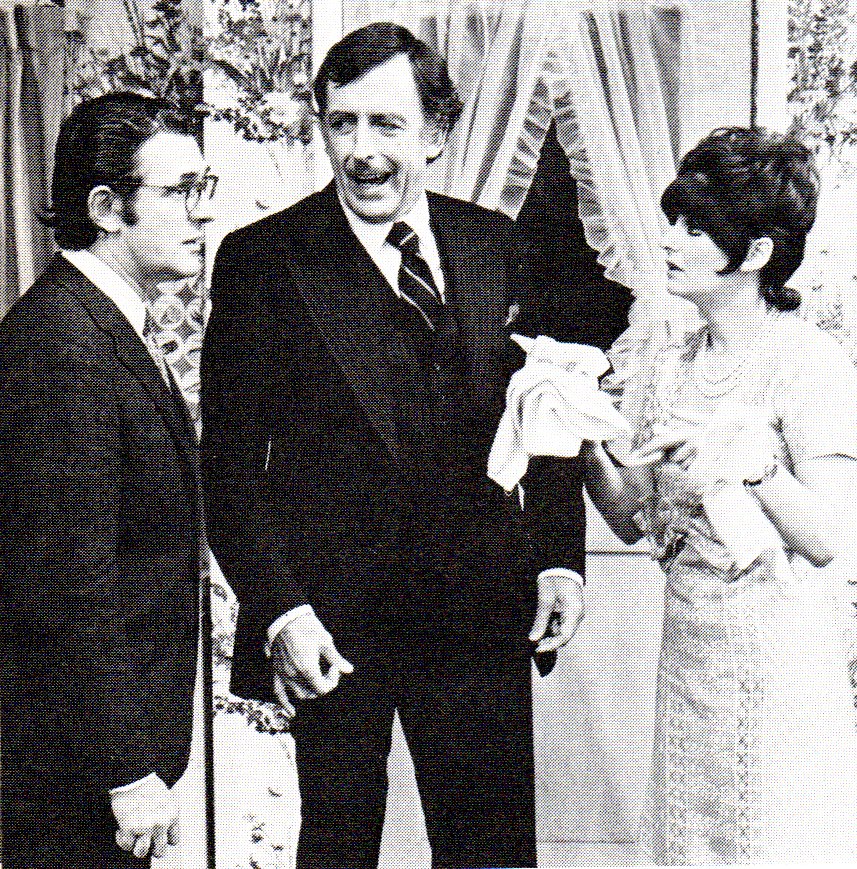
 
Larry Blyden, Fritz Weaver, Carole Shelley.
ABSURD PERSON SINGULAR [Comedy/Marriage/British] A: Alan Aycbourn; D: Eric Thompson; S: Edward Burbridge; C: Levino Verna; L: Thomas Skelton; P: The Theatre Guild and the John F. Kennedy Center for the Performing Arts i/a/w Michael Codron; T: Music Box; 10/8/74-3/6/76 (592)

A star-studded hit from the “British Neil Simon,” this three-act situation comedy takes place at three successive Christmas Eve parties (Christmas Past, Christmas Present, and Christmas to Come). Each act is set in the kitchen of one of the three mismatched couples who make up its cast. The same sextet appears in each act.

Jack Kroll suggested that the play “parodies Dickens, as if to announce the final expiration of jolly Old England, in which class tensions can no longer be sloshed over with plum pudding.”
Tony Roberts, Fritz Weaver, Sandy Dennis.
The action first shows the spiffy, yellow, vinyl kitchen of upward striving shopkeeper Sidney (Larry Blyden, succeeded by Paul Shyre) and his overly fastidious, constantly housecleaning wife Jane (Carole Shelley). Next, we’re in the untidy but not architecturally smart kitchen of downward moving, adulterous architect Geoffrey (Tony Roberts, succeeded by Curt Dawson, Scott McKay) and his neurotic, would-be suicide of a wife, Eva (Sandy Dennis, succeeded by Carol Lynley). The third is in the shabby-genteel, unheated country kitchen of big banker Ronald (Richard Kiley, succeeded by Fritz Weaver) and his bibulous wife Marion (Geraldine Page, temporarily replaced by Sheila MacRae).
Richard Kiley, Larry Blyden, Geraldine Page.
Each act is replete with farcical situations, from Jane’s being locked out of her house in a rain storm after a mad, furtive dash to the store for tonic water, to Eva’s blundering attempts to kill herself, to Marion’s antics while swimming in an ever more alcoholic haze. As the evening proceeds, the changes in social and financial station of the couples are marked, as are their varying stages of psychological and spiritual health. This is most noticeable in the financial superiority Sidney has achieved by act three. He is now being toadied up to by the banker, whose loan first got him started several years ago.

Staged by the same director who did the English production, Absurd Person Singular got mostly favorable notices, and became Ayckbourn’s first American success. He was hailed for his ability to write hilarious comedy while maintaining a steady interest in the development of his characters. Beneath the play’s wild behavior, the playwright suggested “a sense of desperation and even hysteria—the comic and pathetic faces of absurdity” (John Beaufort).
Richard Kiley, Larry Blyden, Carole Shelley, Geraldine Page, Sandy Dennis, TonyRoberts.
Most saw the work as concerned chiefly with the relationships among the British classes but Brendan Gill viewed it as a cynical examination of “the institution of marriage,” especially in the way Ayckbourn reveals the mistreatment of their wives by the three husbands. The play’s severest criticism came from those, like Edwin Wilson, who claimed it was too mechanically predictable.
Paul Shyre, Curt Dawson, Geraldine Page, Fritz Weaver, Carol Lynley, Carole Shelley.
The split-second timing required by this type of comedy seemed intact to some but others felt the cast of stars lacked a true ensemble technique and, apart from British actress Shelley, could not handle the accents. Miss Shelley and Larry Blyden were generally given the largest share of the acting plaudits. Each, along with Geraldine Page, received a Tony nomination in the supporting categories, Page also snaring an Outer Critics Circle Award for her Distinguished Performance.

Previous entries:

Abelard and Heloise
AC/DC
"Acrobats" and "Line"
The Advertisement
Aesop’s Fables


Friday, April 3, 2020

5. AESOP'S FABLES: from my (unpublished) ENCYCLOPEDIA OF THE NEW YORK STATE, 1970-1975


The following precedes each entry,

"In Lieu of Reviews"


Around 40 years ago, I began a major project that eventuated in the publication of my multivolume series, The Encyclopedia of the New York Stage, each volume covering a decade. For some reason now lost to the sands of time, I chose to start with the 1970s. After writing all the entries through 1975 and producing a typed manuscript of 1,038 pages my publisher (Greenwood) and I decided it would be best to commence with the 1920s. So the 1970-1975 material was put aside as I produced volumes for 1920-1930, 1930-1940, and 1940-1950. With those concluded, Greenwood decided it was all too expensive and not sufficiently profitable, so the remaining volumes were cancelled, leaving my 1970s entries in limbo.

To compensate, I used the research I’d done on the 1970s to write a book for Greenwood called Ten Seasons: New York Theatre in the Seventies, which described all aspects of that era’s theatre, onstage and off. Many years later, in 2012, I began a postretirement “career” as a theatre reviewer, which led to my creating this blog as an outlet for my reviews. Over the past eight years or so I’ve posted nearly 1,600 reviews, a substantial number having first appeared on other websites: Theater Pizzazz, The Broadway Blog, and Theater Life.
Now, however, with the New York theatre in suspension, and my reviewing completely halted, is probably the perfect time to post as many as possible of the entries I prepared for the never-published 1970-1975 book. The entries that follow are in alphabetical order. Each entry has a heading listing the subject categories of the work described: the author (A), the director (D), additional staging (ADD ST), when credited; the producer (P), the set designer (S), the costume designer (C), the lighting designer (L), the source (SC), the theatre (T), the dates of the run, and, in parentheses, the length of the run. The original entries also contained the names of all the actors but I’ve omitted those here.

I will try to post at least one entry daily. When time allows, I’ll provide more. The manuscript exists on fading, fragile paper and, because no digital files exist, must be retyped. Hopefully, the tragic health situation we’re all enduring will abate before I get too far into posting these entries but, for the time being, devoted theatre lovers may find reading these materials informative.

Bill Williams and company.
                                                                         
AESOP’S FABLES [Musical/Youth/Fantasy/Animals] B/LY: Jon Swan: M: William Russo; SC: Aesop’s Fables; D: William Russo (“staged by Don Sanders); DS: Vanessa James; P: William Russo; T: Mercer Arts Center (OB); 8/17/72-9/19/72 (58)
mals] B: Jon Swan; M: William Russo; SC:

The Performing Ensemble of the Free Theatre was the group responsible for bringing this rock musical to New York, where Howard Thompson enjoyed it—although he could barely hear the words over the band’s heavy pounding—and John Simon hated it.

The show was based on 11 animal fables of Aesop, and included “The Lion and the Mouse,” “The Mice in Council,” “The Donkey and the Grasshopper,” and “The Crow and the Fox” among its scenes. The players wore animal costumes, and many lighting effects accompanied the action.

Thompson thought the music “imaginative . . . , thoughtful, melodic, often striking.” Simon thought it “highly pretentious” and leading to “crashing boredom.” The directorial credits confusingly listed one person for directing and another (Don Sanders, sometimes credited as Donald L. Sanders) for staging. “How a show that has been both staged and directed can still seem sloppily improvised,” wrote Simon, “I leave to others to puzzle out.”

Previous entries:

Abelard and Heloise
AC/DC
"Acrobats" and "Line"
The Advertisement


4. THE ADVERTISEMENT: From my (unpublished) ENCYCLOPEDIA OF THE NEW YORK STAGE, 1970-1975


The following precedes each entry,

"In Lieu of Reviews"


Around 40 years ago, I began a major project that eventuated in the publication of my multivolume series, The Encyclopedia of the New York Stage, each volume covering a decade. For some reason now lost to the sands of time, I chose to start with the 1970s. After writing all the entries through 1975 and producing a typed manuscript of 1,038 pages my publisher (Greenwood) and I decided it would be best to commence with the 1920s. So the 1970-1975 material was put aside as I produced volumes for 1920-1930, 1930-1940, and 1940-1950. With those concluded, Greenwood decided it was all too expensive and not sufficiently profitable, so the remaining volumes were cancelled, leaving my 1970s entries in limbo.

To compensate, I used the research I’d done on the 1970s to write a book for Greenwood called Ten Seasons: New York Theatre in the Seventies, which described all aspects of that era’s theatre, onstage and off. Many years later, in 2012, I began a postretirement “career” as a theatre reviewer, which led to my creating this blog as an outlet for my reviews. Over the past eight years or so I’ve posted nearly 1,600 reviews, a substantial number having first appeared on other websites: Theater Pizzazz, The Broadway Blog, and Theater Life.

Now, however, with the New York theatre in suspension, and my reviewing completely halted, is probably the perfect time to post as many as possible of the entries I prepared for the never-published 1970-1975 book. The entries that follow are in alphabetical order. Each entry has a heading listing the subject categories of the work described: the author (A), the director (D), additional staging (ADD ST), when credited; the producer (P), the set designer (S), the costume designer (C), the lighting designer (L), the source (SC), the theatre (T), the dates of the run, and, in parentheses, the length of the run. The original entries also contained the names of all the actors but I’ve omitted those here.

I will try to post at least one entry daily. When time allows, I’ll provide more. The manuscript exists on fading, fragile paper and, because no digital files exist, must be retyped. Hopefully, the tragic health situation we’re all enduring will abate before I get too far into posting these entries but, for the time being, devoted theatre lovers may find reading these materials informative.

Julia Curry.

THE ADVERTISEMENT [Drama/Marriage/Italian] A: Natalia Ginzburg; TR: Henry Reed; D: David Black; S: Donald L. Brooks; P: Nicholas John Stathis in the Classic Theatre Production; T: Provincetown Playhouse (OB); 10/3/74-10/20/74 (12)

The first English-language production of this Italian play had been given at England’s National Theatre, with Joan Plowright in the leading role Its New York premiere was Off Broadway, and it failed to generate interest. It represented a misguided attempt to incorporate somber Pinteresque shadings into a tale about a Roman matron (Julia Curry), still married, but living apart from her wealthy spouse, who advertises for a female student willing to serve as a domestic in return for her board.

When a young applicant (Maria Ruberto) arrives for the job, the woman delivers a long monologue about her relationship with her estranged husband, whom she still loves, but who does not care to return to her. The girl takes the job, grows friendly with the woman, and one day meets the husband (Harvey Solin), with whom a romance begins. Soon, a new aspirant (Ali Jones) for the job originally filled by the girl arrives, ad in hand.

Julius Novick, pointing to the author’s self-declared Pinter influence, noted that the style of Tennessee Williams and Jean Cocteau seemed more noticeable. He was not unduly taken with the play but was ecstatic over the performance of Julia Curry, and said her acting kept the evening “this side of boredom.” Clive Barnes, however, faulted the play’s structure, lack of meaningful character motivation, and the overly melodramatic ending. He also criticized the direction and acting for excessive stylization.

Director Donald L. Sanders and his designer wife, Vanessa James, have been active on the New York stage over the past decade (2010-2020) through their work for a company called Ensemble for the Romantic Century.

Previous entries:

Abelard and Heloise
AC/DC
"Acrobats" and "Line"


JOHN LEE BEATTY: PORTRAIT OF THE DESIGNER AS A YOUNG MAN, PART 3

This is Part 3 of a 15-part series based on a recently rediscovered, previously unpublished, 1980 interview I did with the great set designer John Lee Beatty, when he was 32 but already a leader in his field. It can be found by clicking on THEATER PIZZAZZ.
,

Thursday, April 2, 2020

3. "ACROBATS" and "LINE" (1971): From my (unpublished) ENCYCLOPEDIA OF THE NEW YORK STAGE, 1970-1975


The following precedes each entry,

"In Lieu of Reviews"

Around 40 years ago, I began a major project that eventuated in the publication of my multivolume series, The Encyclopedia of the New York Stage, each volume covering a decade. For some reason now lost to the sands of time, I chose to start with the 1970s. After writing all the entries through 1975 and producing a typed manuscript of 1,038 pages my publisher (Greenwood) and I decided it would be best to commence with the 1920s. So the 1970-1975 material was put aside as I produced volumes for 1920-1930, 1930-1940, and 1940-1950. With those concluded, Greenwood decided it was all too expensive and not sufficiently profitable, so the remaining volumes were cancelled, leaving my 1970s entries in limbo.

To compensate, I used the research I’d done on the 1970s to write a book for Greenwood called Ten Seasons: New York Theatre in the Seventies, which described all aspects of that era’s theatre, onstage and off. Many years later, in 2012, I began a postretirement “career” as a theatre reviewer, which led to my creating this blog as an outlet for my reviews. Over the past eight years or so I’ve posted nearly 1,600 reviews, a substantial number having first appeared on other websites: Theater Pizzazz, The Broadway Blog, and Theater Life.

Now, however, with the New York theatre in suspension, and my reviewing completely halted, is probably the perfect time to post as many as possible of the entries I prepared for the never-published 1970-1975 book. The entries that follow are in alphabetical order. Each entry has a heading listing the subject categories of the work described: the author (A), the director (D), additional staging (ADD ST), when credited; the producer (P), the set designer (S), the costume designer (C), the lighting designer (L), the source (SC), the theatre (T), the dates of the run, and, in parentheses, the length of the run. The original entries also contained the names of all the actors but I’ve omitted those here.

I will try to post at least one entry daily. When time allows, I’ll provide more. The manuscript exists on fading, fragile paper and, because no digital files exist, must be retyped. Hopefully, the tragic health situation we’re all enduring will abate before I get too far into posting these entries but, for the time being, devoted theatre lovers may find reading these materials informative.

Danny and Trina DuVal, Barnard Hughes, John Randolph, John Cazale, Ann Wedgeworth, Richard Dreyfuss.
"ACROBATS" and "LINE" [Comedies/One Acts] A: Israel Horovitz; D: James Hammerstein; ADD. ST: Grover Dale; DS: Neil Peter Jampolis; P: New Comedy Theatre; T: Theatre de Lys (OB); 2/15/71-3/14/71 (32); “Acrobats” [Marriage/Show Business]; “Line”

It would have been impossible several years later to have engaged for a commercial production so sterling a cast as “Line” boasted: John Randolph, Richard Dreyfuss, Ann Wedgeworth, John Cazale, and Barnard Hughes. All its players were to have fortunate careers in the 70s, although most were relatively unknown at the time. “Line” was the closing play on a bill of two one-acters, the first half of which was a 10-minute curtain raiser about a pair of acrobats who engage in a marital squabble while performing. Professional acrobats Danny and Trina duVal were cast in the roles but their lack of actor training was apparent.

“Line” is a satire about a group of five eccentric people waiting on line for some unspecified event, and the stratagems each uses to get to the head of the line. Its soon-to-be-distinguished company received only modest reviews for its work—they were recognized as able but not unusual.

An earlier version of the program had been done Off-Off Broadway at La Mama, and other versions had been tried elsewhere before a Los Angeles staging clicked. It was this version, restaged by James Hammerstein, that New York saw.

The critics were amused by the plays, especially the second, and most did not dismiss them outright. Clive Barnes was taken by Horovitz’s theatricality and clever dialogue and by his full-bodied characters, but concluded: “The insights are not worth the paraphernalia presenting them.” Walter Kerr approved of “Line” as a “brilliantly imagined conceit executed with wit and an almost inexhaustible inventiveness.”

Previous entries:

Abelard and Heloise
AC/DC

2. AC/DC (1971): From my (unpublished) ENCYCLOPEDIA OF THE NEW YORK STAGE, 1970-1975


(The following prefaces each entry)

"In Lieu of Reviews"

Around 40 years ago, I began a major project that eventuated in the publication of my multivolume series, The Encyclopedia of the New York Stage, each volume covering a decade. For some reason now lost to the sands of time, I chose to start with the 1970s. After writing all the entries through 1975 and producing a typed manuscript of 1,038 pages my publisher (Greenwood) and I decided it would be best to commence with the 1920s. So the 1970-1975 material was put aside as I produced volumes for 1920-1930, 1930-1940, and 1940-1950. With those concluded, Greenwood decided it was all too expensive and not sufficiently profitable, so the remaining volumes were cancelled, leaving my 1970s entries in limbo.

To compensate, I used the research I’d done on the 1970s to write a book for Greenwood called Ten Seasons: New York Theatre in the Seventies, which described all aspects of that era’s theatre, onstage and off. Many years later, in 2012, I began a postretirement “career” as a theatre reviewer, which led to my creating this blog as an outlet for my reviews. Over the past eight years or so I’ve posted nearly 1,600 reviews, a substantial number having first appeared on other websites: Theater Pizzazz, The Broadway Blog, and Theater Life.

Now, however, with the New York theatre in suspension, and my reviewing completely halted, is probably the perfect time to post as many as possible of the entries I prepared for the never-published 1970-1975 book. The entries that follow are in alphabetical order. Each entry has a heading listing the subject categories of the work described, the author (A), the director (D), the producer (P), the set designer (S), the costume designer (C), the lighting designer (L), the source (SC), the theatre (T), the dates of the run, and, in parentheses, the length of the run. The original entries also contained the names of all the actors but I’ve omitted those here.

I will try to post at least one entry daily. When time allows, I’ll provide more. The manuscript exists on fading, fragile paper and, because no digital files exist, must be retyped. Hopefully, the tragic health situation we’re all enduring will abate before I get too far into posting these entries but, for the time being, devoted theatre lovers may find reading these materials informative. 

A list of previous entries will follow each new one.

Edward Zang, Stefan Gierasch.
AC/DC [Comedy-Drama/Youth/British] A: Heathcote Williams; D: John Hirsch; S: John Scheffler; L: Burl Hash; P: Chelsea Theatre Center of Brooklyn; T: Chelsea Theatre, Brooklyn Academy of Music (OB): 2/23/71-3/21/71 (28)

An unusual and demanding play, first staged at London’s Royal Court, the plot of AC/DC conerns an odd trio who first meet and become friends at a penny arcade (designed brilliantly by John Scheffler with flashing pinball machines as a symbol of our technological society). There are the owner of the arcade, Maurice (James Cromwell), an “electricity freak”; Sadie (Susan Batson) a girl who views the future as a realm of TV images; and Perowne (Edward Zang), a TV victim, mathematician, and possibly Maurice’s lover.

The  play, which features a good deal of profanity, occurs in both the arcade and Perowne’s apartment—a “pulsating cell of McCluhanite madness” (Jack Kroll), where numerous TV sets (one critic says 16, another 20, another 25) are going full blast. The broadcast images, timed to the stage action, are diverse and offer pictures of familiar programming as well as scenes being acted and offstage action. The result of this extensive exposure has turned the two me into “bulb-eyed, spastic, argon-spewing humanoids” (Kroll).
James Cromwell, Jillian Lindig, Edward Zang.
This exceptionally well designed and staged production, in which the author was seen to be attacking the current age of electronic communications, was greeted with a mixed reaction. Martin Gottfried criticized it as an uneasy blend of electronics and live theatre, in a confused “underground comic-book” style. Still, he admitted, it “has an energy and a strength well beyond the common level.” John Lahr dubbed it a “visionary” play: “A brilliant schizoid melodrama of the Technological Society’s sensory overload.” Clive Barnes, however, rejected it on stylistic and linguistic grounds. “The work fails,” he asserted, “because the author cannot resist the hollow sound of his own cleverness, and because his automated puppets exist neither in life or the tragic no-man’s land of an artistic vision.”

AC/DC won the Obie for Distinguished Foreign Play, Susan Batson won one for her Distinguished Performance, and John Scheffler for Best Scenery. James Cromwell, who played Gary, later became a major character actor, especially on TV and in films.

Previous Entries:
Abelard and Heloise


1. ABELARD AND HELOISE (1971): From my (unpublished) ENCYCLOPEDIA OF THE NEW YORK STAGE, 1970-1975


"In Lieu of Reviews"


Around 40 years ago, I began a major project that eventuated in the publication of my multi-volume series, The Encyclopedia of the New York Stage, each volume covering a decade and describing every show on and Off Broadway. For some reason now lost to the sands of time, I chose to start with the 1970s. After writing all the entries through 1975 and producing a typed manuscript of 1,038 pages my publisher (Greenwood) and I decided it would be best to commence with the 1920s. So the 1970-1975 material was put aside as I produced doorstopper volumes for 1920-1930, 1930-1940, and 1940-1950. With those concluded, Greenwood decided the thing was simply too expensive and not sufficiently profitable, so the remaining volumes were cancelled, leaving my 1970s entries in limbo.

To compensate, I used the research I’d done on the 1970s to write a book for Greenwood called Ten Seasons: New York Theatre in the Seventies, which described all aspects of that era’s theatre, onstage and off. Many years later, in 2012, I began a post-retirement “career” as a theatre reviewer, which led to my creating this blog as an outlet for my reviews. Over the past eight years or so, I’ve posted nearly 1,600 reviews, a substantial number having also appeared on other websites: Theater Pizzazz, The Broadway Blog, and Theater Life.

Now, however, with the New York theatre in suspension, my reviewing has come to a screeching stop. This, then, is probably the perfect time to post as many as possible of the entries I prepared for the never-published 1970-1975 book. 

The entries that will follow are in alphabetical order. Each entry has a heading listing the subject categories of the work described, the author (A), the director (D), the producer (P), the set designer (S), the costume designer (C), the lighting designer (L), the source (SC), the theatre (T), the dates of the run, and, in parentheses, the length of the run. The original entries also contained the names of all the actors but I’ve omitted those here.

I will try to post at least one entry daily. When time allows, I’ll provide more. The manuscript exists on fading, fragile paper and, because no digital files exist, must be retyped. Hopefully, the tragic health situation we’re all enduring will abate before I get too far into posting these entries but, for the time being, devoted theatre lovers may find reading these materials an informative, if temporary, replacement for the reviews that normally occupy this blog. 

Sam Leiter
 
Keith Michell, Diana Rigg.

ABELARD AND HELOISE [Drama/Romance/Period/British] A: Ronald Miller; D: Robin Phillips; P: Elliot Martin, James Nederlander, George M. Steinbrenner, III b/a/w John Gale; S: Christopher Morley; C: Daphne Dare; L: H.R. Poindexter; SC: Helen Waddell’s novel, Peter Abelard and the letters of Abelard and Heloise; T: Brooks Atkinson Theatre; 3/10/71-4/24/71 (53)

Abelard and Heloise dramatized the famous twelfth-century love story of the 37-year-old theologian and intellectual Peter Abelard (Keith Michell) and the ravishing 17-year-old Heloise (Diana Rigg). After Heloiise bears his baby, Abelard is castrated by thugs hired by the girl’s uncle, a church canon, and the helpless pair determine to become monk and nun.

The play was politely received by the critics, who found it slickly written and produced but completely unexciting from an emotional, intellectual, or poetic point of view. “The play lacks inner emotional dynamics,” carped Harold Clurman. Clive Barnes, who thought it “a solid, serious play,” said it failed because it lacks the incandescence of poetry.” Jack Kroll, however, was one who believed it to be “an engrossing, well-crafted historical romance,” an attitude directly at variance with Martin Gottfried’s, which held that this was “The true garbage of the stage.”

A key factor for most was the nude scene between Michell and Rigg. Barnes said they might be “the first major stars to appear naked on the Broadway stage.” He thought it “the most tasteful, tactful, and apposite nude love scene I have ever encountered.” A few, though, found it either too dimly lit to make out the actors’ bodies, and “unnecessary and silly intrusion” (Gottfried), or simply unerotic.
 
Ronald Radd, Diana Rigg.
The exquisite Ms. Rigg, who received a Tony nomination for Best Actress, got the best acting reviews, despite her lack of “vulnerability” (T.E. Kalem). She possessed “a gritty, voracious sensuousness. . . ,” he remarked. Another Tony nomination went to Ronald Radd, who played Gilles de Vannes.

The show was first done in London with some of the same actors repeating their roles in New York.