Friday, April 10, 2020

17. AN AMERICAN MILLIONAIRE.From my (unpublished) ENCYCLOPEDIA OF THE NEW YORK STAGE, 1970-1975

Paul Sorvino, Joseph Bova, Bob Dishy, Josh Mostel.

The following precedes each entry

"In Lieu of Reviews" 


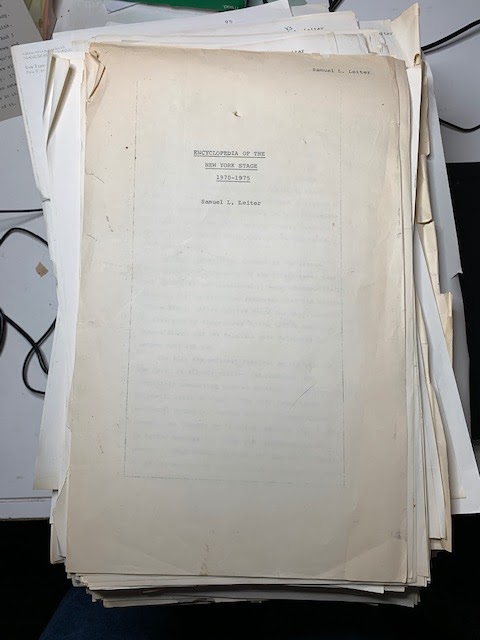
Around 40 years ago, I began a major project that eventuated in the publication of my multivolume series, The Encyclopedia of the New York Stage, each volume covering a decade. For some reason now lost to the sands of time, I chose to start with the 1970s. After writing all the entries through 1975 and producing a typed manuscript of 1,038 pages my publisher (Greenwood) and I decided it would be best to commence with the 1920s. So the 1970-1975 material was put aside as I produced volumes for 1920-1930, 1930-1940, and 1940-1950. With those concluded, Greenwood decided it was all too expensive and not sufficiently profitable, so the remaining volumes were cancelled, leaving my 1970s entries in limbo.

To compensate, I used the research I’d done on the 1970s to write a book for Greenwood called Ten Seasons: New York Theatre in the Seventies, which described all aspects of that era’s theatre, onstage and off. Many years later, in 2012, I began a postretirement “career” as a theatre reviewer, which led to my creating this blog as an outlet for my reviews. Over the past eight years or so I’ve posted nearly 1,600 reviews, a substantial number having first appeared on other websites: Theater Pizzazz, The Broadway Blog, and Theater Life.


Now, however, with the New York theatre in suspension, and my reviewing completely halted, is probably the perfect time to post as many as possible of the entries I prepared for the never-published 1970-1975 book. The entries that follow are in alphabetical order. Each entry has a heading listing the subject categories of the work described: the author (A), the director (D), additional staging (ADD ST), when credited; the producer (P), the set designer (S), the costume designer (C), the lighting designer (L), the source (SC), the theatre (T), the dates of the run, and, in parentheses, the length of the run. The original entries also contained the names of all the actors but I’ve omitted those here.

I will try to post at least one entry daily. When time allows, I’ll provide more. The manuscript exists on fading, fragile paper and, because no digital files exist, must be retyped. Hopefully, the tragic health situation we’re all enduring will abate before I get too far into posting these entries but, for the time being, devoted theatre lovers may find reading these materials informative.

Paul Sorvino, Lee Lawson.

AN AMERICAN MILLIONAIRE [Comedy/Family/Marriage] A: Murray Schisgal; D: Theodore Mann; S: Douglas W. Schmidt; C: Theoni V. Aldridge; L: Martin Aronstein; P: Circle in the Square Joseph E. Levine Theatre; 4/20/74-5/5/74 (17)

A plotless string of farcical characters and incidents on which the critics unanimously turned thumbs down.

Nathanial Schwab (Paul Sorvino) is an overweight millionaire, thrice married, who, though he has everything to live for, must give up eating, drinking, and smoking. He cannot make love without fainting so his wife, Jennifer (Lee Lawson), has left him. His law student daughter, Debbie (Linda Eskenas), is having an affair with her professor (Austin Pendleton). His best friends will have little to do with him. And he keeps receiving death threats, bombs, and poisoned candy from some mysterious enemy.

Created as a sort of Marx Brothers patch-quilt of crazy goings-on, the play offered a top-notch group of comic actors—including Joseph Bova, Bob Dishy, and Josh Mostel—a chance to carry on , with all the clever shtick at their disposal but the production’s indeterminate sense of style and the meager narrative base offended even those reviewers who admitted to laughing at some of the nutty behavior. John Simon was to the point: “there is not an original idea here, a civilized line of dialogue, or a character with enough life for a Hasty Pudding Show.”

Previous entries:

Abelard and Heloise
Absurd Person Singular
AC/DC
“Acrobats” and “Line”
The Advertisement/
All My Sons
All Over
All Over Town
All the Girls Came Out to Play
Alpha Beta
L’Amante Anglais         
Ambassador
American Gothics


Thursday, April 9, 2020

16. AMERICAN GOTHICS. From my (unpublished) ENCYCLOPEDIA OF THE NEW YORK STAGE, 1970-1975

Elizabeth Owens, Donald Kvares, Lorraine Serabian.

The following precedes each entry

"In Lieu of Reviews" 


Around 40 years ago, I began a major project that eventuated in the publication of my multivolume series, The Encyclopedia of the New York Stage, each volume covering a decade. For some reason now lost to the sands of time, I chose to start with the 1970s. After writing all the entries through 1975 and producing a typed manuscript of 1,038 pages my publisher (Greenwood) and I decided it would be best to commence with the 1920s. So the 1970-1975 material was put aside as I produced volumes for 1920-1930, 1930-1940, and 1940-1950. With those concluded, Greenwood decided it was all too expensive and not sufficiently profitable, so the remaining volumes were cancelled, leaving my 1970s entries in limbo.

To compensate, I used the research I’d done on the 1970s to write a book for Greenwood called Ten Seasons: New York Theatre in the Seventies, which described all aspects of that era’s theatre, onstage and off. Many years later, in 2012, I began a postretirement “career” as a theatre reviewer, which led to my creating this blog as an outlet for my reviews. Over the past eight years or so I’ve posted nearly 1,600 reviews, a substantial number having first appeared on other websites: Theater Pizzazz, The Broadway Blog, and Theater Life.

Now, however, with the New York theatre in suspension, and my reviewing completely halted, is probably the perfect time to post as many as possible of the entries I prepared for the never-published 1970-1975 book. The entries that follow are in alphabetical order. Each entry has a heading listing the subject categories of the work described: the author (A), the director (D), additional staging (ADD ST), when credited; the producer (P), the set designer (S), the costume designer (C), the lighting designer (L), the source (SC), the theatre (T), the dates of the run, and, in parentheses, the length of the run. The original entries also contained the names of all the actors but I’ve omitted those here.

I will try to post at least one entry daily. When time allows, I’ll provide more. The manuscript exists on fading, fragile paper and, because no digital files exist, must be retyped. Hopefully, the tragic health situation we’re all enduring will abate before I get too far into posting these entries but, for the time being, devoted theatre lovers may find reading these materials informative.

AMERICAN GOTHICS [Drama/Family/One-Acts] A: Donald Kvares; S: Victor Poleri; C: Evelyn Thompson; L: Robert Murphy; P: Roundabout Theatre Company; T: Roundabout Theatre (OB); 11/10/72-11/26/72 (15)

“A Piece of Fog” D: Frank Errante; “Modern Statuary” D: Nancy Rhodes; “Filling the Hole” D: Nancy Rubin; “Strangulation” D: Frank Errante

A program of four one-acters by Donald Kvares, then one of the most prolific contributors to Off-Off Broadway. This was his first (and last) Off-Broadway production. Each of these symbolic, “gothic” playlets offers another angle on the mistreatment by parents of their offspring. Undertones of horror course through their plots.

Parricide was the subject of “A Piece of Fog”; parental misunderstanding of an obese teenage girl provided the theme of “Modern Statuary”; an earthquake in Central Park affecting a bickering mother-in-law and her children was central to “Filling the Hole”; and the monologue by a distraught, suicidal spinster, psychologically damaged by her late parents, was treated in “Strangulation.”

These pieces had elements of gloom as well as laughter. They were moderately well staged  and Lorraine Serabian did decent work in two roles.

Previous entries:

Abelard and Heloise
Absurd Person Singular
AC/DC
“Acrobats” and “Line”
The Advertisement/
All My Sons
All Over
All Over Town
All the Girls Came Out to Play
Alpha Beta
L’Amante Anglais         
Ambassador

15. AMBASSADOR. From my (unpublished) ENCYCLOPEDIA OF THE NEW YORK STAGE, 1970-1975


Howard Keel, Danielle Darrieux, and the Ambassador company.
The following precedes each entry

"In Lieu of Reviews"


Around 40 years ago, I began a major project that eventuated in the publication of my multivolume series, The Encyclopedia of the New York Stage, each volume covering a decade. For some reason now lost to the sands of time, I chose to start with the 1970s. After writing all the entries through 1975 and producing a typed manuscript of 1,038 pages my publisher (Greenwood) and I decided it would be best to commence with the 1920s. So the 1970-1975 material was put aside as I produced volumes for 1920-1930, 1930-1940, and 1940-1950. With those concluded, Greenwood decided it was all too expensive and not sufficiently profitable, so the remaining volumes were cancelled, leaving my 1970s entries in limbo.

To compensate, I used the research I’d done on the 1970s to write a book for Greenwood called Ten Seasons: New York Theatre in the Seventies, which described all aspects of that era’s theatre, onstage and off. Many years later, in 2012, I began a postretirement “career” as a theatre reviewer, which led to my creating this blog as an outlet for my reviews. Over the past eight years or so I’ve posted nearly 1,600 reviews, a substantial number having first appeared on other websites: Theater Pizzazz, The Broadway Blog, and Theater Life.

Now, however, with the New York theatre in suspension, and my reviewing completely halted, is probably the perfect time to post as many as possible of the entries I prepared for the never-published 1970-1975 book. The entries that follow are in alphabetical order. Each entry has a heading listing the subject categories of the work described: the author (A), the director (D), additional staging (ADD ST), when credited; the producer (P), the set designer (S), the costume designer (C), the lighting designer (L), the source (SC), the theatre (T), the dates of the run, and, in parentheses, the length of the run. The original entries also contained the names of all the actors but I’ve omitted those here.

I will try to post at least one entry daily. When time allows, I’ll provide more. The manuscript exists on fading, fragile paper and, because no digital files exist, must be retyped. Hopefully, the tragic health situation we’re all enduring will abate before I get too far into posting these entries but, for the time being, devoted theatre lovers may find reading these materials informative.

AMBASSADOR [Musical/France/Period/Romance] B: Don Ettlinger and Anna Marie Barlow; M: Dohn Gohmen; LY: Hal Hackady; SC: Henry James’s novel, The Ambassadors; D: Stone Widney; CH: Joyce Trisler; S/C: Peter Rice (costumes “supervised” by Sara Brook); L: Martin Aronstein; P: Gene Dingenary, Miranda D’Ancona, Nancy Levering; T: Lunt-Fontanne Theatre; 11/19/72-11/25/72 (9) 

M'El Dowd, Michael Shannon.
Despite being headed by such starry names as baritone Howard Keel and French stage and film luminary Danielle Darrieux, Ambassador was a failure on almost every count. It was considered a trivialization of a respected Henry James novel about a prudish, middle-aged, New England lawyer, Lewis Lambert Strether (Keel), who, at the request of a client, travels to Paris in 1906 to save the client’s son, Chad (Michael Shannon; not to be confused with the current star of that name), from the wiles of an older woman, Marie de Vionett (Darrieux) with whom he is having an affair. The lawyer is successful in convincing the youth to return home but is himself ensnared by the appealing femme fatale. He decides to throw convention overboard and remain with her.


Carmen Mathews, David Sabin.
The American-written show had premiered in London, where it flopped, and was confronted in New York by unanimously negative reviews. Neither its stars, who were generally considered effective, nor its lyrics book, or music could stir up much interest. Douglas Watt said, “there is nothing very right about it”; Richard Watts remarked that “it never comes to interesting dramatic life”; John Simon was bored by “the plain dullness of it all”: Brendan Gill thought it “mere twaddle”; and Clive Barnes noted that “it was not a disgrace, merely a pity.”

Well-known names in the supporting cast included M’El Dowd, Carmen Mathews, and Andrea Marcovicci.

Previous entries:

Abelard and Heloise
Absurd Person Singular
AC/DC
“Acrobats” and “Line”
The Advertisement
Aesop’s Fables; T
Alice in Wonderland
All God’s Chillun Got Wings
All My Sons
All Over
All Over Town
All the Girls Came Out to Play
Alpha Beta

L’Amante Anglais


Wednesday, April 8, 2020

14. L'AMANTE ANGLAIS. From my (unpublished) ENCYCLOPEDIA OF THE NEW YORK STAGE, 1970-1975


The following precedes each entry,

"In Lieu of Reviews"


Around 40 years ago, I began a major project that eventuated in the publication of my multivolume series, The Encyclopedia of the New York Stage, each volume covering a decade. For some reason now lost to the sands of time, I chose to start with the 1970s. After writing all the entries through 1975 and producing a typed manuscript of 1,038 pages my publisher (Greenwood) and I decided it would be best to commence with the 1920s. So the 1970-1975 material was put aside as I produced volumes for 1920-1930, 1930-1940, and 1940-1950. With those concluded, Greenwood decided it was all too expensive and not sufficiently profitable, so the remaining volumes were cancelled, leaving my 1970s entries in limbo.

To compensate, I used the research I’d done on the 1970s to write a book for Greenwood called Ten Seasons: New York Theatre in the Seventies, which described all aspects of that era’s theatre, onstage and off. Many years later, in 2012, I began a postretirement “career” as a theatre reviewer, which led to my creating this blog as an outlet for my reviews. Over the past eight years or so I’ve posted nearly 1,600 reviews, a substantial number having first appeared on other websites: Theater Pizzazz, The Broadway Blog, and Theater Life.

 
Now, however, with the New York theatre in suspension, and my reviewing completely halted, is probably the perfect time to post as many as possible of the entries I prepared for the never-published 1970-1975 book. The entries that follow are in alphabetical order. Each entry has a heading listing the subject categories of the work described: the author (A), the director (D), additional staging (ADD ST), when credited; the producer (P), the set designer (S), the costume designer (C), the lighting designer (L), the source (SC), the theatre (T), the dates of the run, and, in parentheses, the length of the run. The original entries also contained the names of all the actors but I’ve omitted those here.

I will try to post at least one entry daily. When time allows, I’ll provide more. The manuscript exists on fading, fragile paper and, because no digital files exist, must be retyped. Hopefully, the tragic health situation we’re all enduring will abate before I get too far into posting these entries but, for the time being, devoted theatre lovers may find reading these materials informative. 

Michael Lonsdale, Madeleine Renaud, Claude Dauphin.

AMANTE ANGLAIS, L’ [Drama/Crime/Foreign Language/French/Mystery] A: Marguerite Duras; D: Claude Régy; P: Le Treteau de Paris; T: Barbizon-Plaza Theatre (OB); 4/14/71-4/24/71 (16)

Le Treteau de Paris, a touring French-language company, presented this Duras drama about a bizarre murder during the same season as its English version (A Place without Doors) was done locally. The latter starred Mildred Dunnock—who won a Drama Desk Award for her acting—in the role played here by the great actress Madeleine Renaud, wife of one of France’s foremost actor-directors, Jean-Louis Barrault. The present cast, in fact, included all the actors from the original production, among them another great French star, Claude Dauphin.

The plot of L’Amante Anglais (lit., The English Lover)—inspired by an actual 1966 murder—concerns Claire Lannes (Renaud), a middle-aged, small-town woman, who has confessed without pressure to the horrible murder of her deaf-mute housekeeper-cousin, whose body she chopped into many small pieces. Under the intense questioning of a man (Michael Lonsdale) whose function as a reporter or psychiatrist is never fully explained, the audience comes to understand the explosive rage that boiled up in this woman as a result of her dreary life in her boring town. Her husband of two decades (Dauphin) realizes that only chance has saved him from the fate meted out to his housekeeper.

The play's American version, A Place without Door, which opened earlier in the season, with Mildred Dunnock, Richard A. Dysart (as the husband), and Alvin Epstein (as the Questioner).
The production provided Clive Barnes with “a marvelous evening of theatre.” John Simon, however, remarked that “Mlle. Duras’ play is just as pseudo-philosophic, parapoetic, militantly anti-theatrical and dizzyingly vacuous in French as it was in English.” He appreciated the fine performances, especially Mme. Renaud’s, who made the role the murderess “into a creation all her own,” “so beautiful, touching and human that you feel, as it were, that a reading from the telephone book is turning into Hamlet.” Her role required her to sit throughout while answering questions but, wrote Simon, she managed to give “an imperiling performance, [one that] makes almost every other acting this season look like a halfhearted charade.”

Previous entries:

Abelard and Heloise
Absurd Person Singular
AC/DC
“Acrobats” and “Line”
The Advertisement
Aesop’s Fables; T
Alice in Wonderland
All God’s Chillun Got Wings
All My Sons
All Over
All Over Town
All the Girls Came Out to Play
Alpha Beta


13. ALPHA BETA. From my (unpublished) ENCYCLOPEDIA OF THE NEW YORK STAGE, 1970-1975


The following precedes each entry,

"In Lieu of Reviews"


Around 40 years ago, I began a major project that eventuated in the publication of my multivolume series, The Encyclopedia of the New York Stage, each volume covering a decade. For some reason now lost to the sands of time, I chose to start with the 1970s. After writing all the entries through 1975 and producing a typed manuscript of 1,038 pages my publisher (Greenwood) and I decided it would be best to commence with the 1920s. So the 1970-1975 material was put aside as I produced volumes for 1920-1930, 1930-1940, and 1940-1950. With those concluded, Greenwood decided it was all too expensive and not sufficiently profitable, so the remaining volumes were cancelled, leaving my 1970s entries in limbo.

To compensate, I used the research I’d done on the 1970s to write a book for Greenwood called Ten Seasons: New York Theatre in the Seventies, which described all aspects of that era’s theatre, onstage and off. Many years later, in 2012, I began a postretirement “career” as a theatre reviewer, which led to my creating this blog as an outlet for my reviews. Over the past eight years or so I’ve posted nearly 1,600 reviews, a substantial number having first appeared on other websites: Theater Pizzazz, The Broadway Blog, and Theater Life.


Now, however, with the New York theatre in suspension, and my reviewing completely halted, is probably the perfect time to post as many as possible of the entries I prepared for the never-published 1970-1975 book. The entries that follow are in alphabetical order. Each entry has a heading listing the subject categories of the work described: the author (A), the director (D), additional staging (ADD ST), when credited; the producer (P), the set designer (S), the costume designer (C), the lighting designer (L), the source (SC), the theatre (T), the dates of the run, and, in parentheses, the length of the run. The original entries also contained the names of all the actors but I’ve omitted those here.

I will try to post at least one entry daily. When time allows, I’ll provide more. The manuscript exists on fading, fragile paper and, because no digital files exist, must be retyped. Hopefully, the tragic health situation we’re all enduring will abate before I get too far into posting these entries but, for the time being, devoted theatre lovers may find reading these materials informative.

Kathryn Walker, Laurence Luckinbill.

ALPHA BETA [Drama/British/Marriage/Two Characters] A: E.A. Whitehead; D: John Berry; S: David Chapman; L: David F.Segal; P: Max Brown and Robert Victor b/a/w the Royal Court Theatre; T: Eastside Playhouse (OB): 5/3/73-5/13/73 (14)

A two-character, Strindbergian examination of the hell that marriage can be whena couple is as mismatched as the one depicted here.

Over the course of a nine-year, two-child marriage, Frank (Laurence Luckinbill) and Norma Elliott (Kathryn Walker) of Liverpool move ever more gratingly close to the point where their separaton is inevitable. The thick-witted Norma is pitted against the egotistic, adulterous Frank in a cage-like relationship that his Roman Catholicism prevents from ending in divorce.

Crammed with invective, and with searing and emotionally disturbing dialogue, the drama was successful in its London production starring Rachel Roberts and Albert Finney but could not find critical approval in New York. Clive Barnes blamed its failure on the “slack” direction, “drab” décor, and the charmless acting, with its inauthentic Liverpudlian accents. John Simon also noted the poor accents but still found Luckinbill “very impressive” and Walker “worth watching.”

Both Luckinbill and Walker married famous show business celebrities, his wife being Lucie Arnaz, her husband (from 185-1985) being singer James Taylor.

Previous entries:

Abelard and Heloise
Absurd Person Singular
AC/DC
“Acrobats” and “Line”
The Advertisement
Aesop’s Fables
Ain’t Supposed to Die a Natural Death
Alice in Wonderland
All God’s Chillun Got Wings
All My Sons
All Over
All Over Town
All the Girls Came Out to Play


Tuesday, April 7, 2020

12. ALL THE GIRLS CAME OUT TO PLAY. From my (unpublished) ENCYCLOPEDIA OF THE NEW YORK STAGE, 1970-1975


The following precedes each entry,

"In Lieu of Reviews"


Around 40 years ago, I began a major project that eventuated in the publication of my multivolume series, The Encyclopedia of the New York Stage, each volume covering a decade. For some reason now lost to the sands of time, I chose to start with the 1970s. After writing all the entries through 1975 and producing a typed manuscript of 1,038 pages my publisher (Greenwood) and I decided it would be best to commence with the 1920s. So the 1970-1975 material was put aside as I produced volumes for 1920-1930, 1930-1940, and 1940-1950. With those concluded, Greenwood decided it was all too expensive and not sufficiently profitable, so the remaining volumes were cancelled, leaving my 1970s entries in limbo.

To compensate, I used the research I’d done on the 1970s to write a book for Greenwood called Ten Seasons: New York Theatre in the Seventies, which described all aspects of that era’s theatre, onstage and off. Many years later, in 2012, I began a postretirement “career” as a theatre reviewer, which led to my creating this blog as an outlet for my reviews. Over the past eight years or so I’ve posted nearly 1,600 reviews, a substantial number having first appeared on other websites: Theater Pizzazz, The Broadway Blog, and Theater Life.


Now, however, with the New York theatre in suspension, and my reviewing completely halted, is probably the perfect time to post as many as possible of the entries I prepared for the never-published 1970-1975 book. The entries that follow are in alphabetical order. Each entry has a heading listing the subject categories of the work described: the author (A), the director (D), additional staging (ADD ST), when credited; the producer (P), the set designer (S), the costume designer (C), the lighting designer (L), the source (SC), the theatre (T), the dates of the run, and, in parentheses, the length of the run. The original entries also contained the names of all the actors but I’ve omitted those here.

I will try to post at least one entry daily. When time allows, I’ll provide more. The manuscript exists on fading, fragile paper and, because no digital files exist, must be retyped. Hopefully, the tragic health situation we’re all enduring will abate before I get too far into posting these entries but, for the time being, devoted theatre lovers may find reading these materials informative.
  
Dennis Cole, Michael Murphy.
ALL THE GIRLS CAME OUT TO PLAY [Comedy/Homosexuality/Sex] A: Richard T. Johnson and Daniel Hollywood; D: John Gerstadt; S/L: Leo M. Meyer; C: Joseph G. Aulisi; P: Richard T. Johnson and Daniel Hollywood; T: Cort Theatre; 4/20/72-4/22/72 (4)

A sex comedy with strong affinities to the Restoration classic The Country Wife. At a house in the suburbs a blonde, good-looking, young composer named Ronnie Ames (Dennis Cole) is living with his agent (Jay Barney) and working on a new musical. They have gone into seclusion to avoid distractions from the opposite sex. However, the local women, neglected by their spouses, and thinking the pair gay, are attracted to the composer. They keep intruding on the men’s privacy, eventually ending up in bed with the stud.
Charlotte Fairchild, Bette Marshall, Bill Britten, Susan Bjurman.
“[A] positively awful but very modest little comedy,” was Clive Barnes’s reaction. He said the acting was mediocre, the production ineffective, and “the play . . . cheap, insinuating, nasty and inconsiderable.” Brendan Gill called it “the unpleasant event of the week, Richard Watts tossed it out as “rubbish,” and Douglass Watt disposed of it as “trash.”

Previous entries:

Abelard and Heloise
Absurd Person Singular
AC/DC
“Acrobats” and “Line”
The Advertisement
Aesop’s Fables
Ain’t Supposed to Die a Natural Death
Alice in Wonderland
All God’s Chillun Got Wings
All My Sons
All Over
All Over Town