Wednesday, January 13, 2021

439. ROSEBLOOM. From my (unpublished) ENCYCLOPEDIA OF THE NEW YORK STAGE, 1970-1975

Regina Baff, Sylvia Miles, Ron Rifkin.
ROSEBLOOM [Comedy-Drama/Family/Jews] A: Harvey Perr; D: Jered Barclay; S: Merrill Sindler; C: Ann Roth; L: Thomas Skelton; P: Harlan Keiman and Peter Goldfarb; T: Eastside Playhouse (OB); 1/5/72-1/23/72 (23)

Rosebloom was originally staged at Los Angeles’s Mark Taper Forum, where it won the Los Angeles Drama Critics Circle Award. The New York critics, however, were seriously unimpressed. The nearly plotless play presents a psychologically impaired middle-class Jewish family—a preening, neurotic woman in her mid-40s named Sylvie (Sylvia Miles); her mentally and physically challenged son, Mark (Ron Rifkin), confined to a wheelchair; and the son’s pot-smoking, screwball wife, Enola Gay (Regina Baff), named for the plane that dropped the A-bomb on Hiroshima. They talkatively await and then greet the arrival of Rosebloom (Harold Gary), the family patriarch who is returning home from a 26-year prison term for murder.

Much of the play is written in dense, literary, pause-filled, undramatic, drifting language, combining inner monologues with actual dialogue. The style suggested Edward Albee to most reviewers, but some saw traces of Pinter, Joyce, Pirandello, and Capote. Fantasy and fact, dialogue and asides, flashes of violence, frequent profanity, and bitterness and sarcasm, were principal ingredients in this heavily symbolic work.

Favorable comments were scattered in the coverage of Clive Barnes (“a strangely original play”), Walter Kerr (“much of this is intelligently, persuasively, written”); and Douglas Watt (“a chilling comic tour de force as jumpy as a Schoenberg quartet”). Still, Barnes thought it “too ornate,” Kerr said it was directionless, and Watt felt author Harvey Perr “outsmarted himself.”

Among the more acid-tipped words were those of John Simon, who detected a latent homosexual theme in the writing, which he wished the playwright could have dealt with more honestly. His verdict was that Rosebloom was “the most repulsively pretentious piece of pseudo-art of the year.”

Jered Barclay’s staging and the four player ensemble were generally praised, Jack Kroll, for example, referring to the production as “an evening of sharp, gutsy New York acting.”

Tuesday, January 12, 2021

438. LE ROI SE MEURT (EXIT THE KING). From my (unpublished) ENCYLOPEDIA OF THE NEW YORK STAGE, 1970-1975

LE ROI SE MEURT (Exit the King) [Dramatic Revival/French Language] A: Eugene Ionesco; D: Jacques Mauclair; S/C: Jacques Noel; M: George Delerue; P: The French Institute/Alliance Française under the auspices of L’Association d’Action Artistique of the Government of the French Republic, with the patronage of the Cultural Counselor to the French Embassy, in the Le Tréteau de Paris Production; T: American Place Theatre (OB); 4/15/74-4/20/74 (9)

Note: No photos are available of this production.

Le Tréteau de Paris, a government-subsidized French company of traveling actors, made a brief visit with this revival of Ionesco’s 1962 drama about the death of King Berenger I (Oliver Hussenot), an ageless monarch who must face a death he never believed would come. An English-language version played in New York in 1968.

This symbolic, but not typically absurdist, play was given a reasonably effective mounting in which Oliver Hussenot offered what Anna Kisselgoff deemed a “virtuoso” performance. The rest of the company reportedly fell a bit short, thought Kisselgoff, one of the only reviewers from a major outlet (the Times) to cover the work.

“This is not, however, professionalism marked by homogeneity. As Queen Marie, the King's second and younger wife, Christiane Desbois seemed set apart from the others yesterday by the shrill declamatory style that brought to mind the Théâtre National Populaire. A program note confirmed that she had indeed been part of that famous company. At the other extreme there is Jean Dalmain, as the King's doctor and astrologer, and Mr. Hussenot himself—veteran actors who translate Mr. Ionesco's puns, contemporary mock jargon and deliberate commonplaces from surface clichés into the underlying truths of the playwright's intentions.”

In 2009, Geoffrey Rush starred in a Broadway revival of the play.


LEITER LOOKS BACK: FIVE REVUES OF 1924-1925

Poster for The Garrick Gaieties of 1924.

For this latest installment in my LEITER LOOKS BACK series, please click on THEATER PIZZAZZ.

Monday, January 11, 2021

437. RODGERS & HART. From my (unpublished) ENCYCLOPEDIA OF THE NEW YORK STAGE, 1970-1975

"The Cakewalk" number, with full cast of Rodgers & Hart.

RODGERS & HART [Musical Revue] CN: Richard Lewine and John Fearnley; M: Richard Rodgers; LY: Lorenz Hart; D: Burt Shevelove; CH: Donald Saddler; S: David Jenkins; C: Stanley Simmons; L: Ken Billington; P: Lester Osterman Productions i/a/w WorldVision Enterprises, Inc.; T: Helen Hayes Theatre; 5/13/75-8/16/75 (111)

Jimmy Brennan, Jamie Donnelly, Jim Litten.

A friendly reception greeted this juke box revue’s compilation of 98 songs by Richard Rodgers and Lorenz Hart, called by John Simon “America’s once and still champion songwriting team.” The evening employed a dozen energetic, attractive singer-dancers, six men and six women, all of them put through choreographic and musico-dramatic exercises in acting out the lyrics of each number. The only male performer with enough individuality to emerge from the crowd was Laurence Guittard, while the women fared somewhat better. Accolades accrued for Tovah Feldshuh, Barbara Andres, and Virginia Sandifur. Each of these names made significant contributions to the theatre of the decade. Others in the show were Jamie Donnelly, Jimmy Brennan, Wayne Bryan, David-James Carroll, Mary Sue Finerty, Stephen Lehew, Jim Litten, and Rebecca York

Feldshuh received the Outer Critics Circle Award for Notable Performance by a Young Player (a recognition that also took into account her performances that breakout season in Yentl, the Yeshivah Boy and Dreyfuss in Rehearsal.)

Front: Barbara Andres, Tovah Feldshuh, Virginia Sandifur, Rebecca York, Mary Sue Finerty, Jamie Donnelly; Rear: Jimmy Brennan, Stephen Lehew, Jim Litten, Wayne Bryan, Laurence Guittard. 

The major problem, according to Simon and Brendan Gill, was a superfluity of material, and a relentless cavalcade of songs unrelieved by dialogue. The effect, said Gill, was more like “an oral catalogue” than a show. Simon would have preferred more attention being paid to the less well-known numbers, most of which were given only a few bars, but Martin Gottfried thought that it was the obscure songs that dominated, forcing the revue to fight “an uphill battle.” Clive Barnes and Douglas Watt had few reservations and each recommended the show as a suitable tribute to the great musical duo.

A small sampling of the songs: "Babes in Arms," "Bewitched, Bothered and Bewildered," "Blue Moon," "Dancing on the Ceiling," "Falling in Love with Love," "Give It Back to the Indians," "I Could Write a Book," "Isn't It Romantic?," "Johnny One Note," "My Funny Valentine," "Spring Is Here," "Ten Cents a Dance," "Thou Swell," and "Zip."

Technically, the show inspired some misgivings. Burt Shevelove’s staging and Donald Sadler’s dances pleased some and bored others, but there was a consensus that the David Jenkins set and Stanley Simmons costumes were cheap-looking and unimaginative.


Sunday, January 10, 2021

436. THE ROCKY HORROR SHOW. From my (unpublished) ENCYCLOPEDIA OF THE NEW YORK STAGE, 1970-1975


Tim Curry, Kim Milford, Boni Enten.
THE ROCKY HORROR SHOW [Musical/British/Homosexuality/Science-Fiction/Transvestitism] B/M/LY: Richard O’Brien; D: Jim Sharman; S: Brian Thomson; C: Sue Blane; L: Chipmonck; P: Lou Adler in the Michael While Production; T: Belasco Theatre; 3/10/75-4/6/75 (32)

Abigail Haness, Bill Miller.

This elaborately staged, deliberately trashy, tacky, and campy horror movie spoof, reeking of decadence, was staged in a venerable Broadway theatre where the orchestra seating had been removed so that cabaret chairs and tables could be placed there and drinks served. It came to New York from a sensational run at a London Fringe theatre, followed by a hit reception in Los Angeles. Included in the cast were two of its British stars, Tim Curry and Richard O’Brien (who wrote the show and was billed as Ritz O’Brien). Broadway didn't like it, but the show was soon made into a film that, as The Rocky Horror Picture Show, became one of the greatest cult movie successes of all time, with people (often wearing costumes and makeup) jamming special midnight showings for years.

A painfully loud rock score satirically redolent of the 1950s supported a story (called “simpleminded” by Martin Gottfried, and “mindless” by T.E. Kalem) about a pair of innocent young newlyweds (Bill Miller and Abigale Haness) who seek help at the gothic castle of Dr. Frank N. Furter (Curry) when their car breaks down one stormy night in Transylvania. Soon they are introduced to the bizarre world of this bisexual, transvestite scientist whose most recent breakthrough turns out to be the resurrection of Rocky (Kim Milford), a blandly gorgeous young Adonis who goes around dressed only in brief briefs. Ultimately, young Brad and Janet become the mad doctor’s sexual playthings, while around them loom other weirdos, like the hunchbacked servant Riff Raff (O’Brien), and assorted groupies. Playing two roles, Eddie and Dr Scott, was chunky rock star Meat Loaf, 

Meat Loaf.

The last part of the show is simply a musical floor show with little relation to the plot, but in which everyone appears in the flamboyant costume that posters of Tom Curry (repeating his role in the film version) made iconic in the 70s: black corsets, black fishnet stockings, high heels, garter belts, and a garish makeup using black lipstick.

Songs included "Science Fiction," "Over at the Frankenstein Place," "Sweet Transvestite," "Charles Atlas Song," "Whatever Happened to Saturday Night," "Planet Shmanet Janet," and "It Was Great When It All Began," among others.

The Broadway version of the show was far more extravagant than its British original, which had been done in a crumbling old movie house. The reasons for turning the Belasco into an uncomfortable cabaret were not clear to any of the critics. The seedier trappings and staging of the first version were considered more appropriate, and the glittering sets (with a long runway into the orchestra) and lights of this staging, though extremely well done, were unable to overcome the generally tepid responses of the reviewers. It was felt that the humor was too insistent and heavy, with little evidence of charm or subtlety.

Curry proved a charismatic performer, often being “very funny, flashing his eyes like headlamps, tossing his curls roguishly, and talking in a voice of sugared bile,” as Clive Barnes described it. The only Tony recognition, though, went to Chipmonck, nominated for Best Lighting Designer.


Saturday, January 9, 2021

435. THE RIVER NIGER. From my (unpublished) ENCYCLOPEDIA OF THE NEW YORK STAGE, 1970-1975

Grenna Whitaker, Frances Foster, Les Roberts, Roxie Roker, Les Roberts.


THE RIVER NIGER [Drama/Alcoholism/Illness/Race] A: Joseph A. Walker; D: Douglas Turner Ward; S: Gary James Wheeler; C: Edna Watson; L: Shirley Prendergast; M: Dorothy Dinroe; P: Negro Ensemble Company; T: St. Marks Playhouse (OB); 12/5/72-3/3/73 (120); Brooks Atkinson Theatre; 3/27/73-11/25/73 (400)
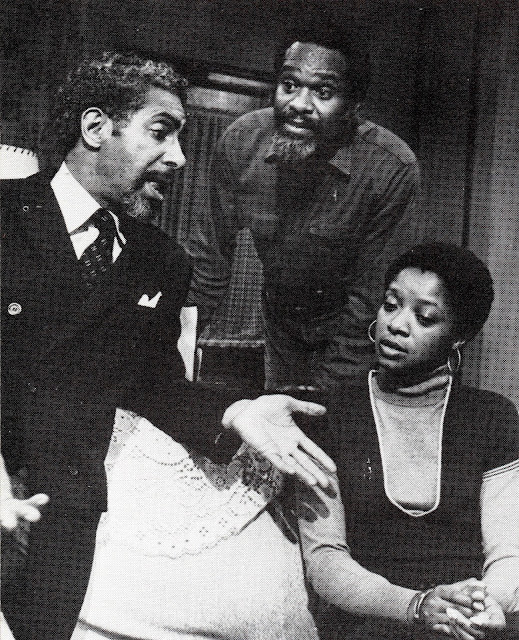
Graham Brown, Douglas Turner Ward, Grenna Whitaker.

Perhaps the most effective Black drama of the decade, The River Niger zoomed to success from its humble beginnings at Off Broadway’s St. Marks Playhouse to the bright lights of Broadway in a magnificently realized ensemble production directed by and starring Douglas Turner Ward. “Broadway has gotten itself a most remarkable black play,” exclaimed Clive Barnes. “Its blackness is beautiful, but its common humanity is everything.” It ran on Broadway after a year, following nearly half a year Off Broadway.

Grenna Whitaker, Les Roberts.

Although somewhat overwritten, long, and melodramatic, The River Niger surged and swelled with the powerful delineation of its dignified, humorous, suffering, violent, and ambitious characters. It received highly complimentary reviews from nearly every critic, both for the potency and pungency of its writing, and the intensely moving and believable quality of its performances.

Douglas Turner Ward, Roxie Roker.

The play is set in the 133rd Street Harlem apartment of Johnny Williams (Ward), a 60ish, would-be poet, boozehound, and house painter, a man who gave up his college studies to help feed his family. It presents an incident-laden plot about Jeff (Les Roberts), Johnny’s son who is returning from the Air Force with hopes of becoming a lawyer, but who is soon enmeshed with an old friend, Mo (Neville Richen), and his pathetic, radical militant cronies. We meet Johnny’s old mother-in-law (Frances Foster); Johnny’s wife (Roxie Roker), a devoted matriarch who is being consumed by cancer; and a cynical, but kindhearted family friend, a doctor of Jamaican background (Graham Brown).

Roxie Roker, Les Roberts, Frances Foster.

The play ends in violence when Johnny is shot by one of Mo’s gang, an act followed by Mo killing the murder in retaliation. Throughout, Johnny seeks completion of his grandiose symbolic poem about the Black man’s struggle and nobility, “The River Niger.” When, at length, it is read, it provides the play with a powerful emotional climax.

Dean Irby, Charles Weldon.

The River Niger displays the need for the Black man to fight to retain, maintain, and attain dignity in a vicious world. In commenting on it, the critics pointed to its depth of feeling, its honest concern with the problems of Black people confronting others within their own midst instead of seeing them purely as imposed by white society, its diverse and finely depicted characters, and its touching, funny, and profane dialogue. “The play’s statement,” declared Harold Clurman, “is humorous, lyric, virile, crude, and oddly inspiring.”

What proved most irksome were the work’s melodramatic excesses, its overuse of subplots, and a tendency toward the propagandistic and didactic. Martin Gottfried accused Walker of writing a “message melodrama” on the level of Clifford Odets, an analogy shared by T.E. Kalem. Gottfried added, “good plays rarely come from social problems. . . . [I]ts style is obsolete, its points are obvious and redundant.” Barnes’s representative comments noted that acting in The River Niger was “as honest and as eloquently rumbustious as the play itself. Despite this unfiltered emotion, there is also very smooth and effective ensemble playing”

The play won both an OBIE and a Tony for Best Play, in addition to the Elizabeth Hull—Kate Warriner 1973 Award. Joseph Walker was honored with a Drama Desk Award for Most Promising Playwright, while Douglas Turner Ward received a Tony nomination for Best Actor, Play, and and OBIE for Distinguished Performance. Finally, Roxie Roker received the corresponding recognition for her performance. 

Note: a reader informed me that Ward's nomination for the Tony as Best Supporting Actor disturbed the actor, who felt he should have been up for the Best Actor slot. Not much about the controversy is available online but I did find this in the New York Times report on the Tony Awards for 1973-1974. It points to the comments of playwright Joseph Walker on receiving his own award: "in his acceptance speech Mr. Walker  mentioned that he supported the protest of Douglas Turner Ward, the play's director and principal actor, who boycotted the ceremonies because he had been nominated as best supporting actor, and not best actor."

Friday, January 8, 2021

434. THE RIVALS. From my (unpublished) ENCYCLOPEDIA OF THE NEW YORK STAGE, 1970-1975

Christopher Hewett, Jane Connell.
THE RIVALS [Dramatic Revival] A: Richard Brinsley Sheridan; D: Michael Bawtree; S: Holmes Easley; C: Susan Benson; L: Clarke Dunham; M: Philip Campanella; P: Roundabout Theatre Company; T: Roundabout Theatre (OB); 12/3/74-2/9/75 (79)

Sheridan’s still funny 18th-century comedy of manners was revived by the then Off-Broadway Roundabout Theatre, precisely 200 years after its London premiere, but the mounting, staged by Australian director Michael Bawtree, was disappointing. The extensive width of the Roundabout’s new theatre on W. Twenty-third Street (previously, and afterward, a cinema) was becoming a hindrance that critics would point to time and again. The clever device used by Bawtree and designer Holmes Easley to somehow distract from the difficulty was a pair of side-by-side revolving units that could bring new scenes quickly into play as needed. However, they did little to alter the stage’s unfortunate dimensions.

Cast of The Rivals.

Bawtree’s rapid pacing and judicious cutting were noted, but the actors were “more decent than magnificent,” wrote Clive Barnes. Walter Kerr grumbled about the excessive volume of the voices and chastised the company for overplaying. He liked only Richard Monette (a mainstay at Canada’s Stratford Festival) as Jack Absolute, “precise and unruffled in his eighteenth-century postures.” Barnes picked out not only Monette, but Christopher Hewett as Sir Anthony, Jane Connell as Lady Malaprop, and George Pentecost as Bob Acres.

The Roundabout was moving slowly toward increasing its presence, and these actors were all a step above those cast in earlier Roundabout shows at their tiny venue in a supermarket basement. Others involved included Elizabeth Owens (a Roundabout stalwart married to Roundabout founder, Gene Feist) as Lucy, Michael Tucker (later of TV’s “L.A. Law”) as Fag, Kathleen O’Meara Noone as Lydia Languish, John Newton a Sir Lucius O’Trigger, and so on.