Sunday, February 7, 2021

464. SEESAW. From my (unpublished) ENCYCLOPEDIA OF THE NEW YORK STAGE, 1970-1975.


Ken Howard, Michelle Lee.
SEESAW [Musical/Romance] B/D/CH: Michael Bennett; C0-CH: Grover Dale; M: Cy Coleman; LY: Dorothy Fields; SC: William Gibson’s play, Two for the Seesaw; S: Robin Wagner; C: Ann Roth; L: Jules Fisher; P: Joseph Kipness and Lawrence Kasha; James Nederlander, George M. Steinbrenner III, and Lorin E. Price; T: Uris Theatre; 3/18/73-12/8/73 (296)

Michelle Lee, Giancarlo Esposito, John Gavin, Cecilia Norfleet, and company.

Seesaw was an enjoyable, far from remarkable, musical based on a popular two-character play of 1962 that had starred Henry Fonda and Anne Bancroft, each of whom was considered ideal for their roles. It concerns a love affair between a Jewish girl from the Bronx, Gittel Mosca (Michelle Lee), and a square, WASP lawyer from Nebraska, Jerry Ryan (Ken Howard; replaced by John Gavin).

Judy Gibson, Michon Peacock, Baayork Lee, Anita Morris.

The musical remake was written, directed, and choreographed by Michael Bennett, a couple of years before he became Broadway’s hottest creative commodity with A Chorus Line. Bennett’s libretto opened up the story considerably to allow for new characters and exterior scenes. The original had shown only Jerry’s apartment on one side of the stage and Gittel’s on the other. A new scene, aimed at bringing the life of New York City into the show more dynamically, was set at a mobile theatre’s Spanish-language street production of Hamlet.

Tommy Tune.

Seesaw was rather faithful to William Gibson’s script in its depiction of the romance between the lovable, ulcerous, pathetic wait Gittel, who wants to be a dancer, but is mired in her life as a seamstress, and Jerry, the married man who desires her, but can’t pull free of his Omaha wife, to whom he eventually returns.

Michelle Lee, John Gavin

Some, like Clive Barnes, liked much of Seesaw, but had strong reservations as well. Barnes appreciated the book (“literate and interesting”), was less well-disposed toward the “tuneful but not especially memorable” music by the distinguished Cy Coleman, and felt likewise about the equally distinguished Dorothy Fields’s lyrics, which he described as “deft enough but [they] seem to have more dexterity than lyricism.” Brendan Gill was irked by the way the book “shuttled” the spectator back and forth between the two principals,” and John Simon felt the broadened scope diluted the impact of Gibson’s cozy world. “Worse: the additional characters and situations are trivially observed and glibly slapped on. . . . [T]he book remains an untimely hodgepodge.” Yet Walter Kerr called Seesaw “a love of a show that knows just when to keep the pressure low and when to open up.” He asserted that "the evening’s end now seems more necessary and more moving than it did in the original play.”

Greater homogeneity of opinion greeted Robin Wagner’s splendid scene designs and Sheppard Kerman’s cityscape projections. Also admired was the effective, abundant, and inventive Bennett choreography (developed with several assistants and co-choreographer Grover Dale); the warmth and charm of Michelle Lee’s Gittel; and the stolid, supportive Jerry of Ken Howard. However, what may have been the show’s principal contribution to Broadway was an attractive, young 6’6” dancer from Texas named Tommy Tune. Tune’s performance as David, a gay choreographer, practically stole the show during his dance routines. “Tommy Tune, as long on talent as on legs, is an exquisitely animated beanpole as well as a gracefully sinuous vine,” gushed Simon.

Cast members of subsequent note included Giancarlo Esposito, Michon Peacock, Anita Morris, Cecilia Norfleet, Baayork Lee,

Giancarlo Esposito, Ken Howard, Michelle Lee.

The consensus was tersely expressed by Martin Gottfried: “The show isn’t great, but it works.” While it didn’t work well enough to turn a profit before closing, it did compile an impressive list of awards and nominations. The show itself was nominated for a Best Musical Tony, and Bennet was Tony-nominated for his book, direction, and choreography. Coleman and Fields were Tony-nominated for their score, while another Tony nomination went to Lee for Best Actress, Musical. Only Tune, though, actually won a Tony, for Best Supporting Actor, Musical. Lee won an award from the Outer Critics Circle, and a Drama Desk Award for Outstanding Performance. And Robin Wagner garnered a Joseph Maharam Foundation Award.

Saturday, February 6, 2021

463. THE SECRET AFFAIRS OF MILDRED WILD. From my (unpublished) ENCYCLOPEDIA OF THE NEW YORK STAGE, 1970-1975.


Doris Roberts, Elizabeth Wilson, Florence Stanley, Maureen Stapleton, Neil Flanagan, Joan Pape, Lee Wallace.
THE SECRET AFFAIRS OF MILDRED WILD [Comedy/Fantasy/Films] A: Paul Zindel; D: Jeff Bleckner; S: Santo Loquasto; C: Carrie F. Robbins; L: Thomas Skelton; P: James B. McKenzie and Spofford J. Beadle; T: Ambassador Theatre; 11/14/72-12/2/72 (23)

Maureen Stapleton, Neil Flanagan.

The critics bulldozed a wide path through this insubstantial comedy about Mildred Wild (Maureen Stapleton), a middle-aged film fanatic, who escapes from the humdrum prosaicness of her life as the wife of a diabetic, Greenwich Village candy store owner (Lee Wallace) by imagining herself the heroine of old Hollywood movies. She watches at least 3,000 movies a year and has collected fan magazines since the 1920s. Mildred’s fantasies allow her to be Shirley Temple, Scarlett O’Hara, King Kong’s main squeeze, Tarzan’s Jane, and Ginger Rogers. The shallow plotline establishes her as the winner of a phony contest that would presumably send her to Hollywood for a screen test.

Lee Wallace, Doris Roberts, Maureen Stapleton.

Stapleton’s talents were capably exhibited in the broadly played, quick-change, Walter Mitty-ish leading role, but her performance lacked a play in which to flourish. As Jack Kroll observed of playwright Paul Zindel, “He has written so far down to the audience that he’s fallen right through it and is at this moment plummeting straight to hell. . . . I have never seen such a symphony of gangrenous venality as this play.”

Elizabeth Wilson, Lee Wallace, Maureen Stapleton.

Clive Barnes wrote that “Miss Stapleton . . . runs the gamut as a crushed cauliflower about to blossom, and her accomplishment as a comedienne is precise and beautiful. She always exaggerates with taste. . . . But Miss Stapleton is not a stand-up comic. Too often the author has supplied her with wisecracks rather than a character, and with situations rather than a play.” Florence Stanley, Elizabeth Wilson, Neil Flanagan, and Doris Roberts, were among the fine actors who were unable to make this turkey edible.

Lee Wallace, Maureen Stapleton.

Friday, February 5, 2021

462. SEASCAPE. From my (unpublished) ENCYCLOPEDIA OF THE NEW YORK STAGE, 1970-1975.


Maureen Anderman, Frank Langella.

SEASCAPE [Comedy/Animals/Fantasy/Marriage/Sex] A/D: Edward Albee; S/L: James Tilton; C: Fred Voelpel; P: Richard Barr, Charles Woodward, Clinton Wilder; T: Sam S. Shubert Theatre; 1/26/75-3/22/75 (65)

Deborah Kerr, Barry Nelson.

Edward Albee won the Pulitzer Prize for this fanciful allegory, but few critics would have supported the decision to grant him the award, even though Clive Barnes’s Times review was headlined: “Seascape Is a Major Event.”

Nancy (Deborah Kerr) and Charlie (Barry Nelson) are attractive, youngish grandparents lounging on a beach and discussing life both in general and in particular. Every now and then a military jet roars overhead. Ennui has settled in. Charlie’s main ambition is to do nothing. Nancy’s is to go from one beach to another around the world. He recalls his secret teenage habit of sinking to the sea’s bottom, stones in his hands, and remaining there as long as possible. Their relationship is passive; sex is in retirement. Their kids have grown up and left the nest. An air of mild acrimony mars their discourse.

Maureen Anderman, Frank Langella, Deborah Kerr, Barry Nelson.

Then, as act one nears its end, a pair of strangers enters: two huge lizards with powerful lashing tails. The husband lizard is Leslie (Frank Langella), the wife Sarah (Maureen Anderman). They speak a highly educated-sounding English. Leslie and Sarah have come up from the sea for a breath of air and soon they and Nancy and Charlie are conversing about the differences between amphibian and human sex organs, married life, and so on.

Charlie almost frightens the reptilian pair back into the ocean with his comments about death, but this hurdle is cleared and Leslie and Sarah are convinced to remain on land and participate in their evolutionary duties. The play closes on Leslie’s tag: “Begin.” (Do I hear an echo of this at the end of Angels in America?)

 Barnes was the play's strongest supporter. Seascape, he wrote, is “a curiously compelling exploration into the basic tenets of life” in which “the tone of the writing is always thoughtful, even careful, even philosophic,” thereby helping to create “a play of great density, with many emotional and intellectual reverberations.” Bleaker opinions prevailed, however, as in Douglas Watt’s belief that there was “nothing especially stimulating about the occasion.” He thought the language was “more literary than dramatic. . . . The dialogue is urbane, occasionally witty, but stiff and artificial-sounding.” This view was shared by many.

“Albee seems drained of almost all vitality—theatrical, intellectual, artistic,” griped Jack Kroll, while John Simon called Seascape a work of “doughy verbiage, feebly quivering inaction, and grandly gesticulating pretentiousness.” 

The play’s meaning was disputed, Simon, for instance, saying that the lizards could represent “underprivileged minorities, upward mobility, élan vital . . . ; the human beings . . . the bourgeoisie, the declining West, the Establishment.”

Whatever its meaning, Seascape went under in two months.

Seascape was Albee’s first stab at directing his plays on Broadway; there was little argument over the acceptable quality of his staging. Movie star Deborah Kerr (returning to Broadway after a long absence) and Barry Nelson (one of Broadway's most reliable leading men) gave their usual high-quality performances, but the actors playing the creatures captured the most attention, especially Langella in his Broadway debut. His reptilian movements and expressive voice, despite his being encased in a costume covering him from head to foot, stole the show, as Watt declared. 

Barnes had this to say of Langella and Anderman:

To my amazement I note from the playbill that this is Frank Langella's Broadway debut—he is among our most distinguished young actors, and Broadway should be ashamed of itself. It would be so easy to play a lizard as sort of Demon King or Godzilla, but Mr. Langella plays him precisely as one of those animals you have always longed to communicate with but never had the language. His partner, Maureen Anderman, is also superbly lizardlike, but as humanly feminine as Mr. Langella is humanly masculine.

In addition to the Pulitzer, Seascape won the Elizabeth Hull-Kate Warriner Award, and was nominated for a Tony. Langella won the Tony for Best Featured Actor, while garnering the Drama Desk Award for Supporting Actor. James Tilton was granted a Tony nomination for Best Lighting Designer.

Thursday, February 4, 2021

461. THE SEAGULL (2 productions). From my (unpublished) ENCYCLOPEDIA OF THE NEW YORK STAGE, 1970-1975.


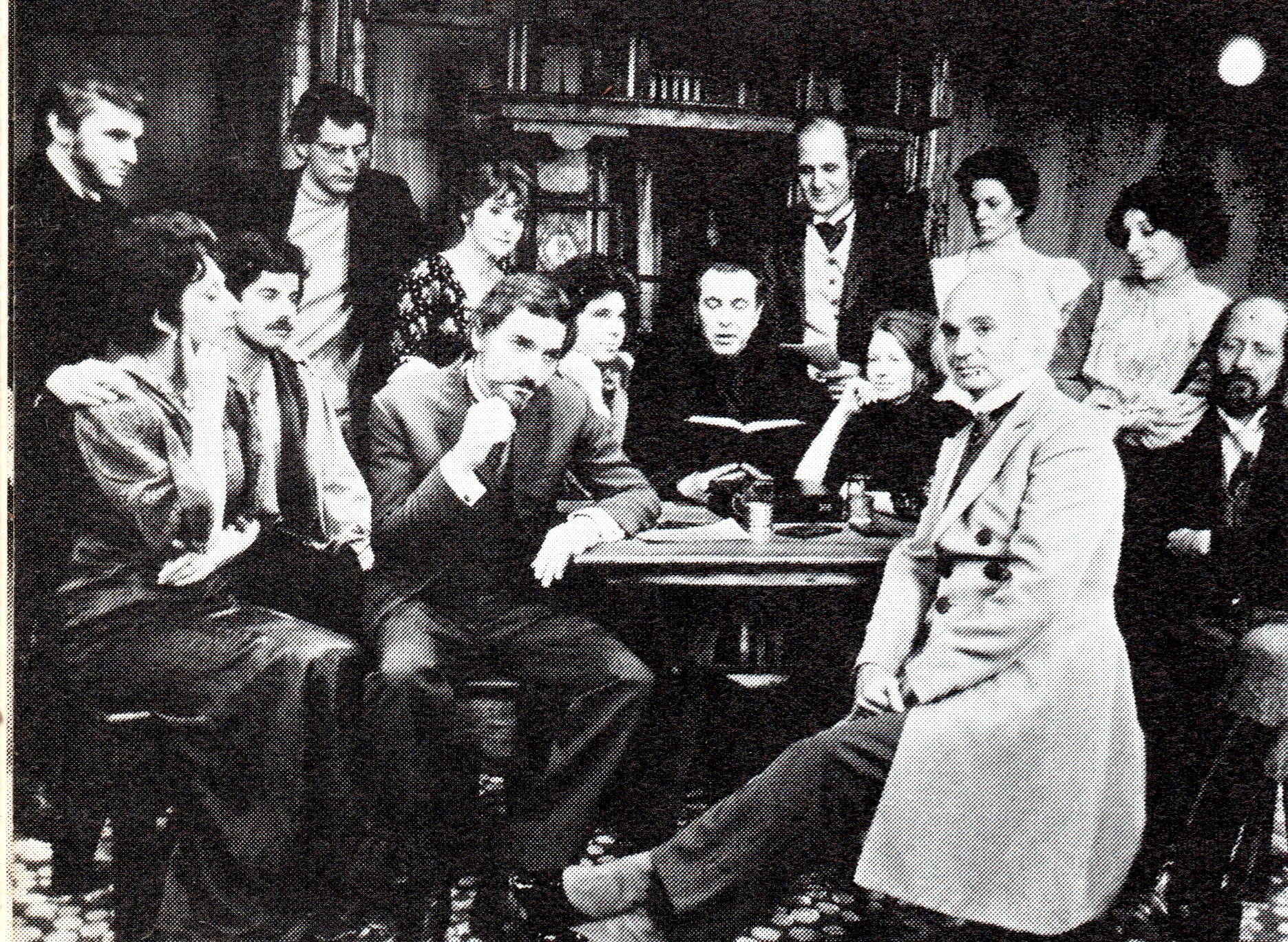
Roundabout Company recreating a famous photo of the Moscow Art Theatre being read the script of The Seagull by Anton Chekhov, with director Gene Feist (up center) as Chekhov.
 1.

THE SEAGULL [Dramatic Revival] A: Anton Chekhov; AD/D: Gene Feist; S: Holmes Easley; C: Mimi Maxmen; L: John McClain; M: Philip Campanella; P: Roundabout Theatre Company; T: Roundabout Theatre (OB); 12/18/73-3/17/74 (105)

Delores Sutton, Tom Klunis.

This revival of Chekhov’s 1898 comedy-drama--one of several in the same time frame--coincided with the 75th anniversary of its original Moscow Art Theatre production. Roundabout Theatre’s founder, Gene Feist, directed it in his intimate arena theatre to an only moderately receptive press. Clive Barnes termed it a demonstration rather than an illumination of the text.

Chekhov’s complex, symbol-laden, atmospheric look at the lives of a frustrated would-be writer, Konstantin (Christopher Lloyd), his exuberantly theatrical mother, Arkadina (Delores Sutton), Arkadina’s novelist lover, Trigorin (Tom Klunis), and the object of both Konstantin and Trigorin’s affections, Nina (Linda De Coff), was staged with little interpretive originality. This led to what Barnes dismissed as a fairly “bland” presentation, despite a “good and exceptionally well-balanced” cast.

Walter Kerr, however, considered this a “generally interesting revival” in which he noticed how deliberately time passed without the clutter of the kind minutia often inserted to provide the play with a patina of naturalism. He and Barnes responded positively to Sutton’s Arkadina, but they had less respect for Klunis’s Trigorin. The Konstantin of Lloyd, gradually coming into his own as an important character actor, was “particularly impressive.”

Others on hand included Paula Laurence as Polina, Laura Esterman as Masha, and Robert Stattel as Medvedenko.

2.

D: Andre Gregory; S: Ming Cho Lee; C: Nanzi Adzima; L: Victor En Yu Tan; P: Lyn Austin i/a/w the New York Shakespeare Festival; T: Public Theater, Martinson Hall (OB); 1/8/75-4/5/75 (42)

Note: no photo is immediately available for this production.

Experimental director Andre Gregory, who called his revival simply Sea Gull, staged it with his Manhattan Project company at the Public, where Joseph Papp supported it along with a company staging of Wallace Shawn’s Our Late Night. (Gregory and Shawn have shared a long history as collaborators.) 

The production moved Chekhov to the 1930s, incorporated such background music as “St. Louis Blues,” and used the device of a semi-environmental design in which the action was spread over three acting areas, to each of which the audience moved en masse when a new act began. 

The approach sought to scoop out the meanings and textures between the author’s lines by means of surprising gestures, behavior, and line readings. All of it was done in a very subdued, practically whispered manner, creating an effect of subtext, rather than the play proper, being performed.

The major weakness, averred Clive Barnes, was the “lack of cultural resonance and an avoidance of theatrical tradition.” He nevertheless found the evening worthwhile as a new approach to a classic. Walter Kerr, however, was dismayed at the inaudibility of the actors, and the monotony of the style. John Simon abandoned ship after one act because of what he deemed the inadequacy of this “troupe . . . most of whom are consummate nonentities in both talent and appearance.” 

Among the "nonentities" were Saskia Noordhoek Hegt as Arkadina, Larry Pine as Constantine, Angela Pietropinto as Nina, and Gerry Bamman as Trigorin.

There were two other, barely noticed, minor productions of The Seagull during the 1974-1975 season, one at the Cubiculo, directed by Philip Meister, which opened on December 11, 1974, for 11 performances. The other was directed by Joseph Chaikin for the Manhattan Theatre Club, opening on January 21, 1975, and compiling 24 performances. Leueen McGrath was Arkadina, Bernard Duffy was Konstantine, and Tina Shepard was Nina. 


Wednesday, February 3, 2021

460. THE SEA HORSE. From my ENCYCLOPEDIA OF THE NEW YORK STAGE, 1970-1975

Edward J. Moore, Conchatta Farrell.

THE SEA HORSE [Comedy-Drama/Barroom/Romance/Two Characters] A: James Irwin [Edward J. Moore]; D: Marshall W. Mason; S: David Potts; C: Jennifer von Mayrhauser; L: Cheryl Thacker; P: Circle Repertory Company; T: Westside Theatre (OB); 4/15/74-8/4/74 (128)

Conchetta Farrell, Edward J. Moore.

This much admired play, produced by the Circle Rep, was the third in little more than a year to be transferred from an Off-Off to an Off-Broadway mounting. Author Edward J. Moore, who played Harry Bales, at first used the penname of James Irwin. He had his authorial billing changed only when, after the play’s successful Off-Broadway opening, the press learned of his contribution.

The Sea Horse was a perfect match for the deft naturalism in which Circle actors and their director, Marshall W. Mason, specialized. It was performed within a thoroughly realistic set of a West Coast waterfront saloon, the Sea Horse, presided over by the fat, feisty, but distrustful Gertrude Blum (Conchatta Ferrell). The only other character an employee named Harry Bales, who loves both fixing things and Gertrude Blum.

The action centers on his attempts to break down the independent-minded Gertrude’s defenses, and get her to acknowledge her affection for him so they can get married. He uses all the ploys at his disposal, especially humor, to expose her vulnerability. By the play’s end, a rapprochement seems entirely possible.

Moore succeeded in making his characters seem alive and interesting, and the acting and direction were perfectly complimentary to the dramatic needs. The major problems were said to include the overuse of naval machinery sound effects imitated by Harry as he describes them, and too artificial a recounting by Gertrude of her unhappy life’s experiences. The remainder, however, was “honest and intelligent in most ways, and the dialogue abounds in comic as well as serious felicities,” wrote John Simon. Walter Kerr, though, argued that the play, “briskly written and cagily acted,” was marred by “a strong sense of arbitrariness, a calculated rise and fall of temperature.”

Ferrell won an OBIE for Distinguished Performance, as well as a Theatre World Award and a Drama Desk Award. Moore was also honored by the Drama Desk, as Outstanding New Playwright.


Tuesday, February 2, 2021

459. THE SCREENS. From my (unpublished) ENCYCLOPEDIA OF THE NEW YORK STAGE, 1970-1975.


Joseph Della Sorte, Osceola Archer, Robert Jackson. (Photos: Alan B. Tepper)
THE SCREENS [Comedy-Drama/French/Military/Politics] A: Jean Genet; TR: Bernard Frechtman; D: Minos Volanakis; S: Robert Mitchell; C: Willa Kim; L: Bennett Averyt; P: Chelsea Theatre Center of Brooklyn; T: Chelsea Theatre, Brooklyn Academy of Music (OB); 11/30/71 (28)

Grayson Hall.

The Chelsea Theatre’s monumental staging of this controversial four-and-a-half hour, 17-scene epic drama about characters embroiled in the Algerian war of independence against France was one of the theatrical landmarks of the early 70s. It was written in 1959, published in 1961, and first staged in Paris by Jean-Louis Barrault in 1966, after five years of being officially barred from production. Barrault’s staging led to riots by those who claimed it to be an anti-French depiction of the strife.

Genet’s nihilistic black farce was more than just anti-French. It was anti “all of modern civilization,” noted Harold Clurman, being an attack on the conventional morality of goodness and decency and a paean to evil, “a celebration of the elegance of vice,” as John Simon phrased it. During its nonlinear, episodic, fragilely constructed plot, Genet shoots scorching satiric fireballs at the decadence and corruption of French imperialism, at the pederasty of the French army troops, and at multiple other targets.

The surrealistic tale is told with dynamic and poetically charged language, often profoundly scatological, with a barrage of theatrical inventiveness carried out by a company of over 40 actors handling more than 80 roles.

The Europeans.

The Screens, called by Clive Barnes “an elongated strip cartoon of a civilization in the process of death,” tells of the oppressed young Algerian farmhand Said (Robert Jackson), a poverty-stricken misfit so poor he must obtain money by wedding Leila (Janet League), an ugly, foul-smelling girl, thus relieving her father of her. He is guided in his actions by his equally repulsive mother (Julie Bovasso). Said treats Leila with sadistic contempt, turns for sex to whores, and sinks ever lower into a life of thievery, which continually sends him to prison. Leila, who responds ecstatically to Said’s sadism, is his willing partner in crime. In his perverted desire to achieve transcendent guilt, Said betrays his nation to the French, and eventually is slain by the Algerians.

The Revolutionaries.

What Simon dubbed an “endless, sticky, mazy, maddening marathon of a play” moved effortlessly through its many scenes via the use of 10-foot high screens that set the locales, disbursing the actors on the floor and on platforms of varying levels situated before a long wall in the rectangular space, with the audience facing the action on tiers of bleachers. Clurman suggested that these titular screens were also “symbols of the false front behind which we hide our villainies.”

Although most critics were intoxicated by the sheer scope of this “tidal wave of total theatre,” in Jack Kroll’s words, there were those, like T.E. Kalem, for whom it more closely resembled “a roiling, debris-clotted river in flood.” Kalem saw “the flaw . . . in the script’s grandiose pretensions, which dwarf interest in any individual.” Barnes noted the difficulty of sustaining concentration on this rambling work: “its picturesque wanderings at first amuse and then rather annoy.” Walter Kerr said, “If there were a thousand ways of expressing any given thought, Genet has here used all of them at once.”

The great majority felt that director Minos Volanakis had created what Kroll called an “amazing” production, one that was helped enormously by Willa Kim’s costumes and Robert Mitchell’s sets. Clurman was awed by the director’s “fidelity and understanding of the script” in which every nuance and intention was made clear and “theatrically visualized.” However, Michael Smith thought the work “earthbound.” The acting was not particularly inspired, but Julie Bovasso as the Mother and Despo as Kadidja were superlative.

The huge company included Grayson Hall, Marilyn Chris, Barry Bostwick (!), Sasha von Scherler, Marilyn Sokol.

Several honors recognized this show’s achievements, among them the New York Drama Critics Circle Award for Best Foreign Play. Willa Kim’s costume designs won the Maharam Foundation award, the Drama Desk Award, and Variety’s Off-Broadway poll for Best Costume Design.

Monday, February 1, 2021

458. SCRATCH. From my (unpublished) ENCYCLOPEDIA OF THE NEW YORK STAGE, 1970-1975.

Will Mackenzie, Will Geer, Patrick Magee.
SCRATCH [Drama/Fantasy/Period/Political/Trial] A: Archibald MacLeish; SC: Steven Vincent Benet’s short story, “The Devil and Daniel Webster”; D: Peter H. Hunt; S: John Conklin; C: Patricia Zipprodt; L: Feder; P: Stuart Ostrow; T: St. James Theatre; 5/6/71-5/8/71 (4)

Will Geer, Patrick Magee.
Archibald MacLeish, distinguished poet, playwright, teacher, and statesman, was 79 when he wrote this, his last Broadway play (he was best known for J.B.). He had intended it as a drama in which the historical character of statesman Daniel Webster would be put on trial, in the playwright’s view, for having sold his soul in 1850 by agreeing to support a policy that would favor Southern slave owners (although he was a professed abolitionist) while managing to prevent dissolution of the Union for at least another decade. Thus, the relation of morality to politics was a chief concern. (Perhaps some present-day playwright might consider updating the tale to our current political situation.)

MacLeish used as his inspiration the famous Benet story (required reading when I was in grade school) in which Webster (Patrick Magee) acts as a defense lawyer for the farmer Jabez Stone (Will Mackenzie) when the devil, called Scratch (Will Geer), comes to claim the man’s soul in return for having made his farm prosperous. The jury, selected by Scratch, is an assortment of the ghosts of notorious villains and rogues. In the MacLeish telling, Webster himself becomes the victim, rather than Stone. (Stone? Hmm. How curious.)

Roy Poole, Patrick Magee.

Cast members included Roy Poole, Rex Robbins, Joanne Nail, and Thomas Barbour.

Martin Gottfried said it was “empty and archaic,” excessively high flown, and “a disaster, boring beyond belief.” Jack Kroll condemned it as “an inflated and disastrously abstract play ,“ while Clive Barnes discarded it as “a ponderous piece . . . pedestrianly written . . . raising pseudo-moral issues that it answers with a kind of chop-logic.” 

On second thought, perhaps it would be better to ponder an updating than to try actually doing one.