For my review of The Music Man please click on THEATER LIFE.

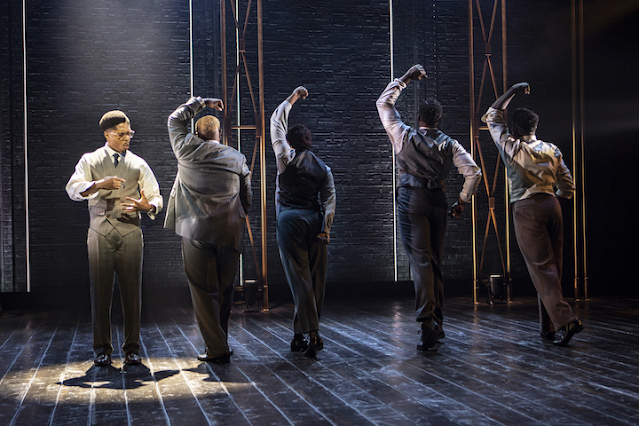 |
| Ephraim Sykes (l) and the ensemble of ‘Black No More.’ (Photo: Monique Carboni) |
For my review of Black No More please click on THE BROADWAY BLOG.


When Alice Childress’s Trouble in Mind was produced at Off Broadway’s Greenwich Mews Theatre in November 1955, it received a brief but positive review in the New York Times. The critic (a stringer signed A.G.) noted that it was “A fresh, lively and cutting satire” about “the foibles and crotches, the humor and pathos of backstage life in the type of Broadway production that utilizes a predominantly Negro cast.”
 |
| LaChanze, Simon Jones, Michael Zegen. (Photos: Joan Marcus.) |
 |
| Danielle Campbell, Michael Zegen. |
 |
| Brandon Micheal Hall, LaChanze, Chuck Cooper. |
The pompously self-involved young director, Al Manners (Michael Zegen, “The Marvelous Mrs. Maisel”), is in a custody fight with his wife (dropped, like a number of other potential plot lines, once introduced). You can see why when you watch his interactions not only with the cast but with his put-upon stage manager, Eddie Fenton (Alex Mickiewicz, appropriately frazzled) and the 78-year-old doorman, Henry (Simon Jones, fine), whose stories of the battles over Ireland’s Home Rule serve as a corollary to the struggles of Black Americans.
 |
| LaChanze. |
Trouble in Mind is a curious curio. It’s a rather uneven play, the dialogue can sometimes be clumsy or clichéd, and Charles Randolph-Wright’s sometimes overwrought direction is not a sine qua non of the art. Nevertheless, it holds a compelling socio-political-historical place as a prescient work reminding us of how many of today’s hot-button issues were just as disturbing then as they are now.
 |
| La Chanze, Simon Jones. |
Childress sends poisoned darts at the theatre’s stereotyping
of Black characters; the lack of plays about Black people (unlike the present
season, it should be noted); the need for people to think about the words they
use (albeit without reference to the yet unborn “political correctness”); the
existence of white privilege, although those words, too, weren’t on people’s
tongues; and even sexual predation by men in power, hinted at in a bit between
Al and Judy.
 |
| Company of Trouble in Mind. |
There’s also a good deal of satire aimed at Method acting (unnamed), then the major focus of actor talk, when Manners is unwilling to accept even the most honest performance, based on instinctive talent, unless it’s been intellectually justified or motivated. These scenes go too far, at times, and then are completely belied by those in which the actors rehearse their script. Here, Manners has them go to such ridiculous lengths to overact—like an SNL sketch or Spike Lee parody—that the contradiction between his theories and what he’s willing to accept make it impossible to believe in anything we’re seeing.
Much of the blame for this, it would seem, belongs to the actual director, Mr. Randolph-Wright, whose goals seems more to get laughs than anything else. O’Wray’s big political speech, timed to a recording of audience reaction, is also rehearsed more for farce than reality, even a somewhat heightened reality.
Larger-than-life theatricality in the interest of making a socio-political
point works only when the fiery Wiletta offers a tour-de-force performance of
the demeaning behavior and accents Black actresses, largely relegated to
mammies and maids, had to provide if they wanted to work. The exaggerated
behavior of the rehearsal scenes not only makes no sense in terms of what any
professional director would accept (especially a movie director), it doesn’t
jibe with what these actors, especially Wiletta, would approve; one can’t help
wondering about what’s going on the minds of the real actors doing this stuff.
This relates to another hard-to-buy feature, one used to
create much of the show’s needed tension. It happens when Wiletta refuses to
say the words the play-within-the-play’s writer provides for her in reaction to
the danger her character’s son is facing. On the one hand, there’s the question
of a little-known, highly ambitious, actress holding up a production because
she disagrees with what her character must say (the playwright isn’t around),
when she could so easily be fired for a clear infraction of Broadway protocol.
(“Artistic differences,” the newspapers would report.) On the other, it’s simply not credible that
she would object to the writing of her role and say not a word when asked to do
the ridiculous things Manners requires of her.
Throughout, we’re constantly reminded of these
contradictions among the relative levels of reality made even more obvious when
a character demands attention. For instance, Mr. Randolph-Wright stages several
scenes by having someone standing downstage center, talking to the cast
upstage, and forced to twist awkwardly to address them when necessary. And in
the biggest example of such a scene, Mr. Cooper’s Sheldon, sitting at center, delivers
a moving speech about a lynching he witnessed as a child; he steps forward, the
lights go down so he’s in a spotlight with the others upstage of him, and then,
just like that, he steps upstage and the lights come on again. It would have
been even more effective if he had just sat there and said the words without all
the smoke and mirrors.
 |
| Company of Trouble in Mind. |
The lighting is the work of Kathy Perkins, some of whose touches, when they don’t interfere so obviously with the onstage reality, are lovely, as when she shifts the colors on an isolated prop door. Arnulfo Maldonado’s set replicates the look of a bare stage with the usual odd tables and chairs, although, as laid out, it doesn’t invite the most interesting arrangements of the ensemble. Emilio Sosa’s costumes look sufficiently mid-1950s to pass muster, including the spectacular fur coat worn by Millie.
Most of the performances similarly pass muster, none more so
than that of LaChanze, who wrings the part for every ounce of comedy and drama
in it, and also gets to show off her Broadway-level singing chops on a
spiritual. Least effective is Mr. Zegen, the ostensible villain, who only now
and then seems authentic—as in his big speech about how hard it is to be white;
most of the time he’s an unappealing caricature of a martinet director.
 |
| Michael Zegen, Alex Mickiewicz. |
The two main reasons to see Trouble in Mind: its path-breaking revelation of still-burning issues rarely addressed so frankly onstage when it was written; its outstanding performance by LaChanze.
 |
| LaChanze. |
American Airlines Theatre
227 W. 42nd Street, NYC
Through January 9



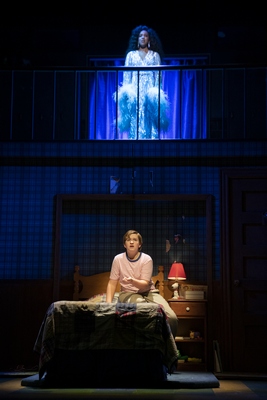 |
| Holden William Hagelberger, Yasmeen Suleiman. (Photos: Joan Marcus.) |
 |
| Company of Trevor: The Musical. |
Trevor, set in 1981, tells the story of how Trevor (Holden William Hagelberger) becomes increasingly aware that his sexual interests don’t jibe with those of his schoolmates. He’s made even more uncomfortable by the attitudes of his well-intentioned, in-denial, theatrically stock-in-trade parents (Sally Wilfert and Jarrod Zimmerman, who also play the other adults). Trevor, unable to share his secrets, keeps a notebook detailing his growing affection for Pinky (Sammy Dell), the school’s star athlete. Pinky’s own sexuality itself can seem ambiguous, but the writers choose not to go down that rabbit hole.
Despite suspicions regarding his orientation, Trevor earns some measure of respect when he employs his talents to stage an all-male number (including Pinky) for the school’s annual talent show. The discovery of his journal, though, leads to cruel bullying, including the hard-to-buy subversion of the number Trevor tried staging with them. (Why do kids in musicals like these always strive to prove William Golding’s point?) Faced with universal ostracism, Trevor sees no option but to open a vial of aspirins. Fortunately, a gay Candy Striper (Aaron Alcaraz) at the hospital offers worthwhile advice from his own experience that helps Trevor face the future. Yes, just like that.
 |
| Holden William Hagelberger, Sammy Dell. |
Trevor, briskly directed by Marc Bruni, and brightly choreographed by Josh Prince, leans more toward musical comedy than musical drama, although the subjects of homophobic bullying, or just plain bullying, and teen suicide are urgently important. The film even inspired the Trevor Project, a now huge 24/7 suicide prevention hotline for LGBTQ young people. But social significance doesn’t automatically make a show successful. This thought seems to have reached the general public, since the show, which I didn’t see until ten days after it opened, was around one-fourth full at the matinee I visited.
Donyale Werle has provided a rather dullish setting of
sliding units that show either Trevor’s bedroom or the school's bi-level
interior, with the ensemble choreographed to bring on or strike furnishings as
needed. Peter Kaczorowski’s lighting and Ms. Blumenfeld’s costumes brighten things
now and then, as in the Saturday Night
Fever-like dream routine in which Pinky and his fellow jocks dance in white
suits, fedoras, and canes, or when Diana Ross appears, usually through shiny
curtain strips. But most of the kids (who look more like adolescents than
typical for such shows), including Trevor, are dressed rather plainly.
The mop-haired, likeable Mr. Hagelberger, only thirteen himself, resembling a member of the audience more than the lead in an expensive musical, displays precocious acting, dancing, and singing talents. He holds the stage with expertise (watch, for example, as he replicates Ms. Ross’s mannerisms) and his acting is perfectly fine. At the moment, though, his still developing voice—for all its strength—is more musically satisfactory than impressive; “pitchy,” as they used to say on “American Idol.”
 |
| Holden William Hagelberger and company. |
The score only fitfully embraces anything like the pop sound of the early 80s, too much of it sounding unoriginally generic. Introducing Diana Ross’s songs (like “Do You Know?” and “Ain’t No Mountain High Enough”)—presented as words of wisdom for the struggling Trevor—only sharpens the contrast between the memorable and the forgettable.
Despite being occasionally reminiscent of other recent popular school-themed musicals, from Spring Awakening to Mean Girls to Dear Evan Hansen to The Prom to Be More Chill to England’s Everybody’s Talking about Jamie, very little about Trevor puts it on their level. While there are some decent laughs, as during a scene when a priest, Father Joe (Mr. Zimmerman), offers Trevor meaningless counsel, the funniest moments come when a schoolgirl reaches into her mouth to remove her rubber band braces.
Stretching the tightly packed movie version of Trevor into an over two-hour show only thins its impact. This makes the songs, no matter how well sung, and dances, no matter how cleverly arranged, into little more than time-filling stuffing. When Act One ended, I felt I’d seen enough. After Act Two, not even a Candy Striper could have changed my mind.
Stage 42
422 W. 42nd St., NYC
Open run