"'No Laughing Matter"


For my review of A Commercial Jingle for Regina Comet, please click on THEATER LIFE.

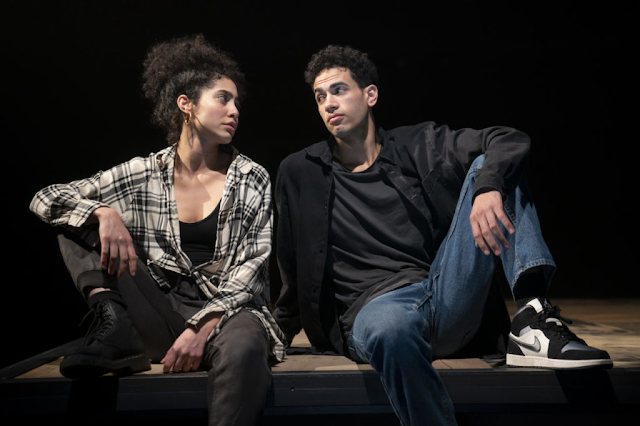 |
| Sharlene Cruz, Jasai Chase-Owens. Photos: Joan Marcus. |

"Black Lives Shattered"


 On Saturday afternoon, September 11, 2021, I saw Pass Over, my first show since March 10,
2020, eighteen months earlier, when I saw The
Girl from the North Country just before the pandemic closed down New York’s
theatres. (I’ll get to Pass Over in a
minute.) I was as nervous at entering a crowded theatre as I was taking the subway
from South Queens. I even wore two masks on the train (where a handful of jerks
were unmasked) and in the theatre.
On Saturday afternoon, September 11, 2021, I saw Pass Over, my first show since March 10,
2020, eighteen months earlier, when I saw The
Girl from the North Country just before the pandemic closed down New York’s
theatres. (I’ll get to Pass Over in a
minute.) I was as nervous at entering a crowded theatre as I was taking the subway
from South Queens. I even wore two masks on the train (where a handful of jerks
were unmasked) and in the theatre. |
| Namir Smallwood, John Michael Hill. |
I was cautiously early, so, with the weather as beautiful as it was twenty years ago on that more fateful 9/11, I exited the subway at 34th Street and walked to the August Wilson Theatre on 52nd. Having visited Manhattan only once during the lockdown, this was my chance to reunite, unmasked, with the midtown I’d missed for so long, and, with traffic considerably lighter than before, breathing what felt like cleaner city air.
The cityscape had changed a bit. Scaffolding, still
ubiquitous, covered different facades, familiar storefronts were shuttered, new
businesses had opened, and excavations, like the one at 34th and 8th, replaced landmark
buildings. But most eye-catching was how slender the 8th Avenue crowds were,
especially after I crossed the nearly deserted 42nd Street.
Those fabulous side-streets in the forties, with their
marquees blaring the names of prior and coming shows, were nearly empty. Back
in the pre-Covid days you needed a bulldozer to clear your way at matinee time
in the theatre district. On Saturday, you could have roller-skated or scootered
between the pedestrians and still kept your social distance.
 |
| Namir Smallwood, John Michael Hill. |
Further, the surprisingly small queue showing its IDs and vaccination
proof outside the Wilson was echoed by the ghost town gloom pervading the theatre's auditorium. The recently reopened
musicals, Hadestown and Waitress, are said to be doing boffo
business (Waitress even broke a single-performance
record), but Broadway audiences seem to be giving Pass Over a pass over of their own, at least at the performance I
attended.
 |
| John Michael Hill. |
Perhaps that’s because Antoinette Chinonye Nwandu’s provocative, but ultimately disappointing,
avant-garde comedy-drama, which opened three weeks ago, itself feels so forlorn
on Broadway. This may have something to do with its being available in a
Spike Lee-directed streaming version on Amazon Prime. Pass Over has a solid pedigree, of course, including a premiere at
Chicago’s Steppenwolf Theatre and a highly praised staging with this very same
cast and director at New York’s LCT3, Off Broadway at Lincoln Center, before
the pandemic descended. I saw neither although I’m aware that there have
been various revisions—especially of the ending—among the several productions
the show has received. Not being qualified to comment on these, I’ll let them pass.
However, even a rave by Jesse Green in the Times hasn’t been able to overcome the box
office lassitude toward what I assume—in spite of the favorable reviews—to be
less than favorable word-of-mouth about a play that would surely work more
potently on an Off-Broadway stage, like the LCT3’s. At the Wilson, at
least most of the time, it looks undernourished.
 |
| Namir Smallwood, John Michael Hill. |
Lots of people obviously favor Pass Over, Broadway’s first new play since it closed up shop. It
has a very decent 78 on the Show-Score review aggregating website. And sixteen individual and institutional
producers are designated at the top of the Playbill
credits. It deploys socially relevant themes, including the urge to
escape from economic oppression, the curse of plagues, and, most
ferociously, American race relations, particularly the
monstrous problem of white on Black police brutality. Nwandu’s distinctive
approach blends gritty realism with dreamlike surrealism in a script with
obvious reflections of Beckett’s absurdist masterpiece, Waiting for Godot.
But, despite its woke goals, its superb three-man,
four-character performance (one actor plays two roles), and Danya Taymor’s inventive
staging, it fails to be more than momentarily engaging, and makes more of a cerebral than an emotional impact.
 |
| Jon Michael Hill, Gabriel Ebert, Namir Smallwood. |
Moses, whose name fits his leader-like aspirations, and
Fitch, his follower, fill their time with petty preoccupations (including Fitch
often working away at a foot problem), role-playing, games (as per the
vaudeville-like shtick in Godot), and
lamenting the sorry state of Black men in a world where fear of the police (the
“po-po”) haunts their every thought. Moses wants to lead Fitch out of this
miasma by leaving the block—a stand-in, it’s implied, for the plantation—to
which conditions have enslaved them. In other words, to “pass over,” as in the
Biblical tale of the Jews fleeing to the Promised Land. Toying endlessly with
their baseball caps, like Didi and Gogo with their bowlers, they speak in artfully
heightened, crude street dialect, riddling their dialogue with countless repetitions
of the n-word.
Perhaps some will argue that this insistent usage has some
higher literary and sociological value that I’m unable to appreciate, but hearing
it so often on the stage (as on the subway) becomes increasingly uncomfortable,
regardless of whatever point it’s intended to make. There is even a scene in
which a third character, a lily-white man named Mister (Gabriel Ebert), who has
entered some time before, confronts Fitch and Moses about it, in the usual
debate about why is it okay for Black people to call one another niggers while
a white person isn’t even allowed to use it in a non-offensive way.
Mister, by the way, is the name in the program, but what I kept
hearing was “Master,” which fell on Moses and Fitch’s ears like the explosive crack
of a slave-driver’s whip. [See my note on the name, below.] One might say that if Fitch and Moses are ultimate archetypes
of smack-talking street guys, Mister/Master (it’s not explained if this is his
last name or his first), nattily dressed by Sarafina Bush in an off-white suit, is
perhaps the ultimate stereotype of the well-meaning, effete, polite, educated,
goofy, gee whiz kind of white man, the kind who would never knowingly say
something inappropriate. In fact, his carefully articulate vocabulary is
peppered with gollies, goshes, and similar vacuities. Benign as he is, it's impossible not to feel an undercurrent of tension in his presence. (Interestingly, Ebert’s
understudy is actress Andrea Syglowski, whose mere appearance would likely open
the play up to gender-related nuances.)
[Note: In the script, which I received after this was posted, the character is listed as "Mister," just as in the program, but he does indeed pronounce it as "Master." When--in the playwright's lowercase style, Moses says, "yo mister," Mister answers that it's "master," repeating, "master, my name is master." Just because I heard correctly doesn't mean I'm not still confused.]
Mister (or whatever) encounters Moses and Fitch when he gets
lost on his way to his ailing mother’s home, carrying an endlessly giving basket
of food, like Red Riding Hood on her way to grandma’s. He is as exaggerated
a symbol as the other character Ebert plays, a cop named Ossifer (a cross,
perhaps between Officer and Lucifer?), who soon betrays his true, blue colors
as the representative of police oppression.
Gradually the play moves ever further into the realm of fantasy,
mingling images of violence (fight direction by J. David Brimmer), religion, and
death (passing over, get it?). Posterior male nudity makes two unnecessarily
distracting intrusions as well.
Hill and Smallwood offer vivid, engaged performances,
shifting deftly from their street personas to affected “white” speech during
several satirical routines. Ebert, a gifted musical theatre actor who gets to
warble ironically intended songs like “Somewhere over the Rainbow,” “Oh, What a Beautiful Morning,”
and “What a Wonderful World” (which latter the others join in on as Mister strums
a ukulele), is delightfully versatile in portraying both the effete visitor and
the ruthless cop. And Taymor (good genes, obviously; Julie Taymor is her aunt) comes through with her
handling of the play’s rhythms and the choreographic way she has with her
actors.
But these are not enough to lift this earnest effort out of
the head-scratching doldrums into which it sinks before its ninety minutes are
concluded. Pass Over is here for only
a limited run and, since there’s presently no competition from any straight
play on Broadway (the one-man Lackawanna
Blues is soon to open), you might want to read some other responses
before deciding whether or not to give it a pass.
August Wilson Theatre
245 W. 52nd Street, NYC
Closes October 10
 |
| Liz O'Neal, Carter Cole, Dean Stolber, Lee Wilson, Stephen Fenning, Grant Cowan. (Photos: Martha Swope.) |
 |
| Stephen Fenning, Liz O'Neal. |
The enormously
successful, 1,597-performance, Off-Broadway production of Charles Schultz’s
widely popular “Peanuts” comic strip closed in February 1971. Several months later it was revived on Broadway. The cast was not up to the original,
wrote Mel Gussow, but Clive Barnes, reviewing it on the radio, said it had
“neither suffered nor been changed.” Other reviews were similarly positive.
Still, it failed to click in its larger quarters and closed in a month.
 |
| Lee Wilson, Grant Cowan. |
The cast members were
Stephen Fenning, Dean Stolber, Lee Wilson, Carter Cole, Grant Cowan, and Liz
O’Neal.
Do you enjoy Theatre’s Leiter Side? As you may know, since New York’s theatres were forced into hibernation by Covid-19, this blog has provided daily posts on the hundreds of shows that opened in the city, Off and on Broadway, between 1970 and 1975. These have been drawn from an unpublished manuscript that would have been part of my multivolume Encyclopedia of the New York Stage series, which covers every show, of every type, from 1920 through 1950. Unfortunately, the publisher, Greenwood Press, decided it was too expensive to continue the project beyond 1950.
Before I began offering these 1970-1975 entries, however, Theatre’s Leiter Side posted over 1,600 of my actual reviews for shows from 2012 through 2020. The first two years of that experience were published in separate volumes for 2012-2013 and 2013-2014 (the latter split into two volumes). The 2012-2013 edition also includes a memoir in which I describe how, when I was 72, I used the opportunity of suddenly being granted free access to every New York show to begin writing reviews of everything I saw. Interested readers can find these collections on Amazon.com by clicking here.
 |
| Jamie Thomas, Dan Held, Lynn Fitzpatrick, Esteban Chalbaud, Grace Theveny, Rod Loomis. (Photo: Kenn Duncan.) |
Cole Porter’s 1938 drawing-room musical is based on a Viennese play, Candle Light, by Siegfried Geyer and Robert Katscher, which had starred Gertrude Lawrence and Leslie Howard on Broadway in 1929, following its London production (as By Candle-Light), starring Yvonne Arnaud. Candle Light was a mild success, running for 129 performances, but Porter's musical was a 78-performance flop. so the reasons for this 1973 Off-Broadway revival are unclear. Porter himself famously disliked his work.
Pared down from the original’s cast of 12, among
which were Libby Holman, Clifton Webb, and Lupe Velez, this six-actor version
made many changes in the script and characters, and there were also adjustments
to the score. These included the insertion of “Ridin’ High” from Red, Hot and Blue. The hit numbers “At
Long Last Love” and “From Alpha to Omega” were intact, but there were too few
graces present to keep the show from repeating the fate of the first
production.
Clive Barnes reported
that “it revolves around—and around and around—a master and servant, and
mistress and maid, exchanging roles. The possibilities for such humor, easily
dampened are quickly extinguished by the quality of the writing.”
The performers, none
of them considered up to the task, were Dan Held, Esteban Chaband, Grace
Theveny, Lynn Fitzpatrick, Rod Loomis, and Jamie Thomas.
Do you enjoy Theatre’s Leiter Side? As you may know, since New York’s theatres were forced into hibernation by Covid-19, this blog has provided daily posts on the hundreds of shows that opened in the city, Off and on Broadway, between 1970 and 1975. These have been drawn from an unpublished manuscript that would have been part of my multivolume Encyclopedia of the New York Stage series, which covers every show, of every type, from 1920 through 1950. Unfortunately, the publisher, Greenwood Press, decided it was too expensive to continue the project beyond 1950.
Before I began offering these 1970-1975 entries, however, Theatre’s Leiter Side posted over 1,600 of my actual reviews for shows from 2012 through 2020. The first two years of that experience were published in separate volumes for 2012-2013 and 2013-2014 (the latter split into two volumes). The 2012-2013 edition also includes a memoir in which I describe how, when I was 72, I used the opportunity of suddenly being granted free access to every New York show to begin writing reviews of everything I saw. Interested readers can find these collections on Amazon.com by clicking here.
Next up: You're a Good Man Charlie Brown.
YERMA [Dramatic
Revival/Spanish Language] A: Federico Garcia Lorca; D: Victor Garcia; S/C:
Victor Garcia, Fabian Puigserver; L: Polo Villasenor; P: Brooklyn Academy of
Music ad Nino T. Karlweis in the Nuria Exert Company Production; T: Brooklyn
Academy of Music (OB); 10/17/72-10/29/72 (16)
Nuria Espert (left), Jose Luis Pellicena.
Victor Garcia, a renowned Spanish director, achieved a universally acclaimed masterpiece of
theatrical innovation in this Spanish-language production of Lorca’s tragedy starring
Nuria Espert of the Madrid company that bore her name. It came to BAM following
its great success with Madrid and London critics. Simultaneous translations
were available with rented headsets.
Lorca’s poetic study
of a barren village woman and her frustration at being unable to bear her
husband children, normally staged in a realistically designed setting, was here
put forth on a giant trampoline that could, by the attachment of ropes to
eyelets by actor-stagehands, be converted at need into a myriad of highly
imaginative locales. It was as much an actor as anyone in the play as it took
shape as a cave, a floor, a wall, a female breast, hills, the sky, a plain, and
so forth. The ritualistically choreographic staging, employing actors both on
the trampoline and on platforms running around and beneath the canvas,
established visual metaphors that brilliantly suggested the internal images
Garcia discerned in Lorca’s people and situations.
Nothing about the
staging was literal or illusionistic—all the techniques were exposed, not
hidden—yet the emotional and intellectual impact of the production had an
overwhelming effect, even on those with no Spanish. Striking sensuality was
evident in several scenes, including those employing nudity and sexual
embraces, to underline the longing of the central figure after whom the play is
named (Yerma means “barren”).
Henry Hewes said the
drama’s story “now emerges not only as the tragedy of a wife doomed to accept
her marriage to a man who cannot and does not wish to make her pregnant, but
also as a poetic and surrealistic metaphor of the needs and frustration of the
female condition.” Clive Barnes saw the conception as on a level with Greek
tragedy in the intensity of its power. Harold Clurman considered this Yerma “one of the outstanding successes
in the effort during the last decade to enlarge the scope of the contemporary
theatre.” A surprising factor was that Garcia, apparently, had accomplished his
goals without “distortion of the text.”
Garcia and Fabian
Puigserver won a Drama Desk Award for their scenic design.
Do you enjoy Theatre’s Leiter Side? As you may know,
since New York’s theatres were forced into hibernation by Covid-19, this blog
has provided daily posts on the hundreds of shows that opened in the city, Off
and on Broadway, between 1970 and 1975. These have been drawn from an
unpublished manuscript that would have been part of my multivolume Encyclopedia of
the New York Stage series,
which covers every show, of every type, from 1920 through 1950. Unfortunately,
the publisher, Greenwood Press, decided it was too expensive to continue the
project beyond 1950.
Before I began offering these 1970-1975 entries, however, Theatre’s
Leiter Side posted over 1,600 of my actual reviews for shows from 2012
through 2020. The first two years of that experience were published in separate
volumes for 2012-2013 and 2013-2014 (the latter split into two volumes). The
2012-2013 edition also includes a memoir in which I describe how, when I was
72, I used the opportunity of suddenly being granted free access to every New
York show to begin writing reviews of everything I saw. Interested readers can
find these collections on Amazon.com by
clicking here.
Next up: You Never Know.
 |
| John V. Shea, Tovah Feldshuh. (Photo: Thomas Victor.) |
 |
| Center: Tovah Feldshuh. (Photo: Laura Pettibone.) |
 |
| Leland Moss, Bernie Passeltiner, Tovah Feldshuh. (Photo: Laura W. Pettibone.) |
Yentl is a Jewish
girl living in a Polish shtetl in 1873 with her widowed father (Bernie
Passeltiner). She greatly hungers for the traditional education that Judaic law
restricts to men (as it still does in ultra-orthodox communities). Her father
secretly teaches her from the Torah and Talmud himself. When he dies she
resolves to attend the forbidden yeshivah by dressing as a boy named Anshel.
She develops a very close friendship with another student, the handsome Avigdor
(John W. Shea), and soon finds herself betrothed to Avigdor’s former fiancée
Hadass (Neva Small, Chelsea; Lynn Ann Leveridge, O’Neill), whom she ends up
marrying. Eventually, Yentl reveals her deception, Avigdor (whom she still
loves) marries Hadass, and the fruit of their union is named Yentl.
The ramblingly
structured play is far from perfect, being highly episodic, containing some
awkwardly phrased dialogue, and an excessively anecdotal, literary style. It also bears the weight of an intriguing folk tale that, for some, simply asked too
much suspension of disbelief. “Not a word of this strikes me as playable on a
stage,” wrote Brendan Gill.
 |
| Lynn Ann Leveridge, John V. Shea. (Photo: Laura Pettibone.) |
Nevertheless, the
gorgeously designed production, making excellent use of a revolve and an
artless, village style using minimal props and sets, was brimful of the period
feeling emanating from the world of 19th-century peasant life. What Gill called
Robert Kalfin’s “immaculate” direction made ample use of orthodox rituals. The
characters were ably etched by the well-cast ensemble, and the thematic
implications were intriguing, albeit anathema to potential audiences from the
contemporary descendants of the community it depicts.
John Simon’s opinion
was fairly typical. “Yentl is all
theatre and no play.” He called the production “a whirring, whizzing marvel,”
and none disputed the assertion. Singer’s views on traditional Jewish attitudes
were provocative in a decade rent by feminist activity. The play’s sexual
ambivalences were likewise much discussed.
The Broadway staging
shaved nearly an hour off the Brooklyn version, tightening the focus on the central
love triangle, but not eradicating the essential problem of the play’s
non-dramatic personality. A major cause for celebration, as noted, was the presence of
Tovah Feldshuh, whose characterization of Yentl caused T.E. Kalem to hail her
as “an actress of imponderable scope and stature. . . . Tovah Feldshuh has the
delicacy of a Tanagra figurine. She is kinetic in presence, graceful in gesture
and capable of igniting, as well as displaying, passion.”
John V. Shea was also
highly approved, Howard Kissel commenting on his “remarkably graceful,
affecting performance.” Others in the large cast included Leland Moss, Hy Anzell, Robin Bartlett (O'Neill Theatre), and Blanche Dee.
Feldshuh won an OBIE,
a Drama Desk Award, and an Outer Critics Circle Award, but the Tonys ignored
her. She would, of course, have been up that season against Ellen Burstyn,
Maggie Smith, Diana Rigg, Elizabeth Ashley, and Liv Ullman, not a one of them small potato
latkes.
Do you enjoy Theatre’s Leiter Side? As you may know,
since New York’s theatres were forced into hibernation by Covid-19, this blog
has provided daily posts on the hundreds of shows that opened in the city, Off
and on Broadway, between 1970 and 1975. These have been drawn from an
unpublished manuscript that would have been part of my multivolume Encyclopedia of
the New York Stage series,
which covers every show, of every type, from 1920 through 1950. Unfortunately,
the publisher, Greenwood Press, decided it was too expensive to continue the
project beyond 1950.
Before I began offering these 1970-1975 entries, however, Theatre’s
Leiter Side posted over 1,600 of my actual reviews for shows from 2012
through 2020. The first two years of that experience were published in separate
volumes for 2012-2013 and 2013-2014 (the latter split into two volumes). The
2012-2013 edition also includes a memoir in which I describe how, when I was
72, I used the opportunity of suddenly being granted free access to every New
York show to begin writing reviews of everything I saw. Interested readers can
find these collections on Amazon.com by
clicking here.
Next up: Yerma.