Showing posts sorted by date for query bad penny. Sort by relevance Show all posts

Saturday, September 7, 2019

67 (2019-2020): Review: SINCERITY FOREVER (seen September 5, 2010)

"Heads Up"


If you’re planning to kill two plays with one ticket at the Flea Theater in order to see both Bad Penny and Sincerity Forever on the same evening, be aware—as noted in my review of the former—that you’ll need a separate ticket for each.
Amber Jaunai, Nate DeCook, Vincent Ryne. All photos: Allison Stock.
These works, of course, are part of the Flea’s Mac Wellman: Perfect Catastrophes, A Festival of Plays, celebrating the iconoclastically gnarly work of Flea cofounder Wellman, the prolific writer who heads the distinguished BFA Playwriting Program at Brooklyn College.

And, even if you concur with my less-than-enthusiastic response to Bad Penny, the first half of the bill, if you’re planning to see them in succession you’ll likely to find it worth your while to stick around for Sincerity Forever, even though it means killing an hour between the plays in a not particularly engaging part of Tribeca.

Originally produced at the Berkshire Theater Festival, in 1990, where it won an award, and seen later that year in Brooklyn as part of the 1990 Fringe Series, Sincerity Forever was dedicated to the late Senator Jesse Helms “for the fine job you are doing of destroying civil liberties in These States.” This tongue-in-cheek honor presumably led the National Endowment for the Arts to request that Wellman remove the credit he gave it for an N.E.A. playwriting fellowship, with the writer noting in the published script that he “was wrong, SINCERITY FOREVER was not made possible by the generous assistance of the N.E.A. I don’t know what I was thinking.”

This gives you an idea of Wellman’s feisty political heart, which he pours into Sincerity Forever, a stinging, one-act putdown of American life as seen through the preternaturally ignorant eyes of seven teens living in the fictional, Deep South, small town of Hillsbottom. Moreover, most of these drawling characters dress as if Ku Klux Klan sheets and coneheads were standard cool kids gear.

The thinly plotted play's offbeat characters and structure are accompanied by a heightened, sometimes bizarre, blend of redneck locutions, colorfully distorted grammar, colloquial teenspeak, formal rhetoric, and extreme profanity. At the same time, it’s more linear and thematically accessible than Bad Penny. It’s also better directed (by Dina Vovsi) and performed (by the Bats, the Flea’s resident company of young actors-in-training). It’s still weird, though, as well as over-the-top and WTF?

More than half of its eight scenes are conversations among pairs of teens sitting in cars. These are Judy (Malena Pennycook) and Molly (Charly Dannis), who have two scenes together; Hank (Nate DeCook) and Tom (Vince Ryne); Judy and George (Peter McNally); and Lloyd (Jonathan Ryan) and Tom. Another teen, Melvin (Alex Hazen Floyd), joins in later on.

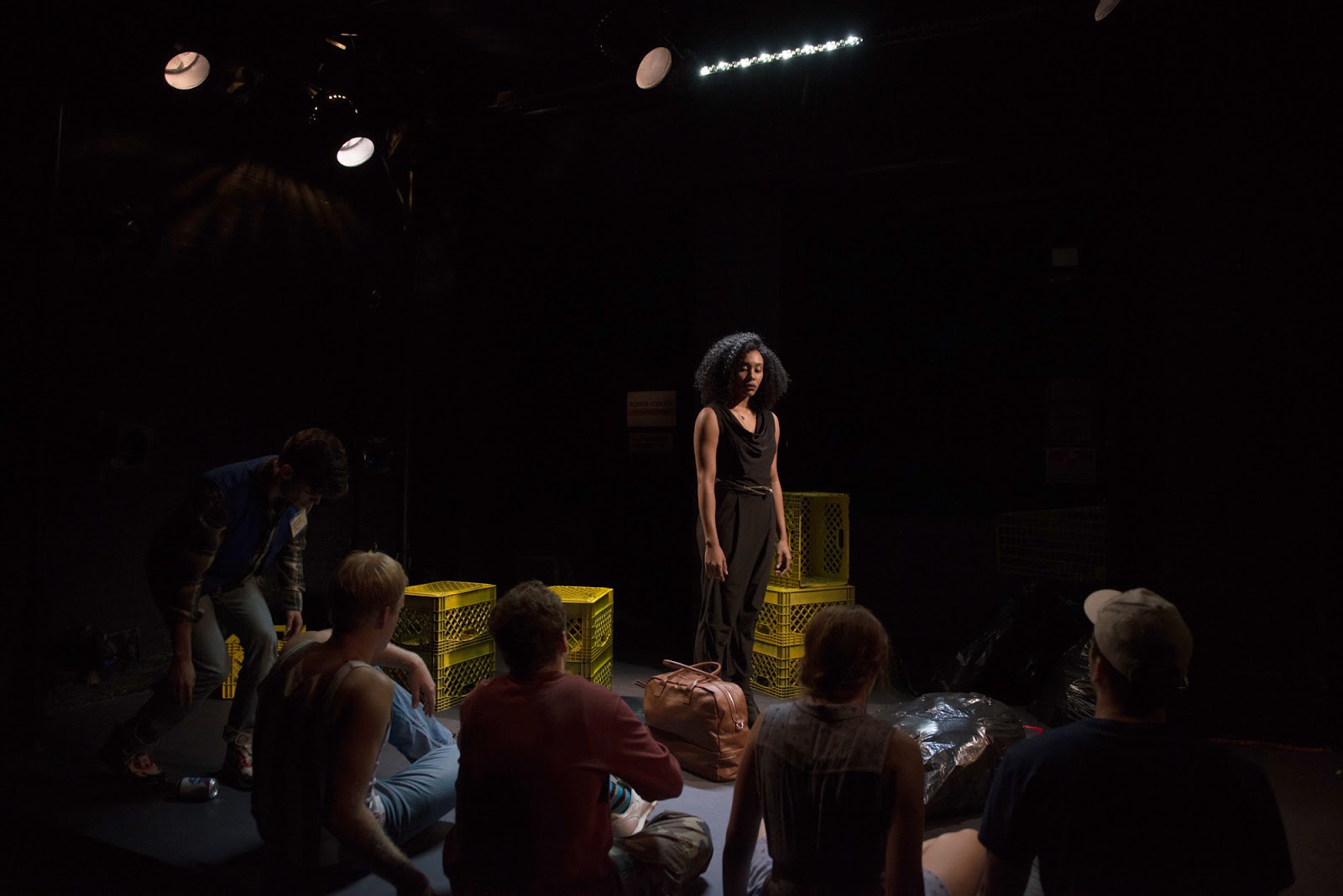
Stirring things up are a pair of disputatious demons from the tribes of Belial and Abaddon: Furball #1 (Zac Porter), wearing a fur vest, and his Goth partner, Furball #2 (Neysa Lozano). Bringing the wrath of God to town, however, is the suitcase-carrying Jesus H. Christ (Amber Jaunai), played here as an angrily intense African American woman.

Frank J. Oliva’s sceneryless stage, nicely lit by Becky Heisley McCarthy, uses little more than plastic milk boxes, with a narrow beam hanging across the stage about two feet from the ground. As the characters talk while sitting directly behind the beam, we discover American youths practically reveling in their know-nothingness. They think that those who profess knowledge are only faking it, and take pride in being “ignorant forever in absolute sincerity.” Sincerity, you see, is a virtue high enough to forgive any other lapses.

Their comically convoluted conversations are larded with references to God’s secret plans, religious faith, their souls, the search for meaningfulness, heaven and hell, death, romantic crushes (hetero and homo), jealousies, coolness, sex, catastrophic ills, like nuclear pollution, and even the purity of their families’ ancestral, Aryan stock, with invocations to the Norse god Wotan (a.k.a. Odin).

The teens believe their lives are being disrupted by the presence of a mystic Furball that must be destroyed. Those fuzzy aliens—who like jiving to a heavy beat—are demons who thrill to their own monstrosity while hating everything these “empty-headed purveyors of the American dream,” with their “fake cant and bullshit,” hold dear. In fact, one insists it’s all “deeply insincere.” On the other hand, they claim sincerity for themselves, even quarrelling bitterly over which is more sincere. Thus, the arrival of Jesus, bearing an “apparatus” that can detect a Furball’s presence and ready to use her mind to obliterate any she might find.
Malina Pennycook, Amber Jaunai, Alex Hazen Floyd, Vincent Ryne.
Wellman enjoys keeping us off guard by playing games with his language and situations, including having characters, once they're infected by the Furballs, repeat dialogue earlier said by others, or even to have them argue using the Furball’s own particular insults. “Something bad’s gotten into us,” admits someone.

Toward the end, the kids go haywire, with a climactic cacophony of overlapping arguments (as indecipherable as those in Bad Penny) before Jesus delivers a lengthy diatribe. She explains her mission, noting “what a sorry place this world is,” blasts everyone for their vanity, hypocrisy, and distortion of Christian values, casts aspersions on “dumb-ass” sincerity, and wonders why she should  even bother with mankind.
Amber Jaunai.
Not all of this comes across clearly, however, nor am I sure I grasped more than a handful of Wellman’s points, but the writing and staging manage to hold the attention much of the time. The KKK costumes, interestingly, seem intended more to symbolize the kind of ignorance that informs American racism than to reflect actual racist behavior. Apart from a few references, like those to Aryan ancestors, or a quickly passing homophobic/anti-Semitic/racist comment, the usual KKK tropes of cross-burnings, lynching, or slurs are ignored.

As noted in my Bad Penny review, Wellman writes for a niche audience—to which I admit not belonging—that greatly appreciates his quirky, nontraditionalism.  But, given Wellman's esteem as a maven of the avant-garde, I sincerely suggest that, for those interested in an important example of late 20th-century “experimental theatre,” Sincerity Forever, unlike Bad Penny, deserves a heads up. 

Flea Theater/The Siggy
20 Thomas St., NYC
Through September November 1

OTHER VIEWPOINTS

66 (2019-2020): Review: BAD PENNY (seen September 5, 2019)


“Tails Down”


Mac Wellman, the prolific, multi-award-winning playwright, novelist, essayist, and poet heads the Brooklyn College’s MFA Playwriting Program (we were colleagues before my 2007 retirement from the Theatre Department). He's made it one of the most successful in the country: think Annie Baker, Young Jean Lee, Thomas Bradshaw, etc. Wellman's also a cofounder of Tribeca’s Flea Theater, which is presently offering five of his short plays in a festival called Mac Wellman: Perfect Catastrophes.
Joseph Huffman, Emma Orme, Baile de Lacy, Lambert Tamin. All photos: Allison Stock.
Wellman has held high the banner of nontraditional, avant-garde, post-absurdist theatre throughout his abundant career. His nonlinear, linguistically challenging, intellectually slippery, politically charged, and morally determined plays fly in the face of conservative, realistic theatre, with which he has notably taken issue. These idiosyncratic qualities are present in the first two of the festival’s plays, the black comedies Bad Penny and Sincerity Forever (reviewed separately).

Like many of Wellman’s works, these are niche plays, loved by his followers (only a few of whom were there when I went) but caviar to the masses, who would generally prefer the theatrical equivalent of hot dogs and burgers (like me, I guess).
Rear: Baile de Lacy, Dana Placentra, Lambert Tamin; front: Katelyn Sabet, Alex J. Moreno, Caroline Banks; right: Emma Orme.
Be aware that, while they’re presented on the same evening, the tickets are sold separately. If you intend to see them back to back—most who attended when I did chose not to do so (unless Bad Penny convinced them not to return)—be prepared to find something to occupy you nearby between 8:00 and 9:00 pm. Thomas Street is not located in a particularly jumping downtown spot. I was lucky because my plus-one lives a few blocks away.

Bad Penny, originally given a site-specific performance in 1989, near the lake at Central Park’s Bow Bridge, where the action transpires among a group of strangers, is here performed in a small outdoor patio area directly behind the Flea's Pete Theater. To suggest the park setting, the concrete ground is covered with AstroTurf. A single row of metal, plastic, wood (with a picnic table), and canvas chairs (the low, beach-type folding ones) circles the space. Several blankets and yoga mats are spread about for audience members to sit on. The place, designed by Jian Jung, resembles a nursery school play area more than it does Central Park, or any park, for that matter.

Tall, glass windows (one is also a door to the interior) line one side of the space. Although a considerable amount of important action will occur on the inside of the windows, only those opposite the wall can see it, depriving at least a quarter of the audience of the view.
Joseph Huffman, Emma Orme, Dana Placentra, Baile de Lacy.
This is part of the reason director Kristan Seemel’s production only further clouds the  already hard-to-grasp dialogue and behavior. Things are even further dulled by the insistent hum of what seem 100 air conditioners, not to mention, when I attended, repeated helicopter noise.

The confusion created by mingling the actors—the Bats, the Flea’s resident company of young actors-in-training—with the audience, which at first makes it difficult to separate the normally-dressed actors from spectators, requires a few minutes before we can tell who’s who. In short, the production, for all the actors’ enthusiasm, would seem to serve the already problematic play poorly. I say “seem” because this may be precisely what’s being sought.

My wife is one who never leaves a dropped penny behind but insists on rescuing it from abandonment. Bad Penny suggests this might not be such a good idea. The bad penny retrieved by Kat (Bailie de Lacy)—a young woman (designated as Woman One) who’s had mental problems, is obsessed with myth, and ponders whether the sky is real or an illusion—appears to be attracting bad luck.

This is expressed through her exchanges with others she encounters, beginning with Man One (Jason Huffman), calling himself Ray X, “a freelance memory fabulist and metaphysician and card player” from Big Ugly, Montana, who’s left his Ford Fairlane 500 on the East Side because of a flat.  Carrying the tire, which he says he yanked off with brute strength when his jack broke, he’s searching in vain for a gas station.
Caroline Banks, Baile de Lacy, Emma Orme.
Eventually, the others (Alex J. Moreno, Emma Orme, and Lambert Tamin) join in, backed by a chorus of three (Caroline Banks, Dana Placentra, and Katelyn Sabet, reduced from the original’s 12), as we hear (or would if there weren’t so many distractions) frequently nihilistic references to  ugliness, gruesome upbringings, consumerism, toxicity, suspicion, conspiracy theories, trolls, normalcy, a cancer-curing cheese, bulldogs, the meaning of our seemingly senseless existence, and man’s decline into “crummy, little, cheesy, lousy, liars, and con-artists.”  

An important mythical element is the Charon-like Boatman (Ryan Leslie Stinnett) who—although not provided here with anything resembling a boat—is coming for the man with the tire after Kat gives him the penny (which was stolen from the Boatman). Much of what is spoken is incomprehensible, not only because of the ambient noise, the long lists of colorful adjectives, or the densely worded discourse, but because they sometimes shout at and over one another. This too is likely part of the agenda.

Wellman’s script reveals considerable wit mingled with numerous provocative notions. Very little, however, comes through in the Flea’s jumbled production. As it proceeded, I couldn’t help observing a whitehaired, well-known reviewer across from me, someone to whom I’ve been saying hello for years only for him to glance at me as if I were not only a stranger but a pest needing swatting. While he could easily be one of Wellman’s disgruntled characters, his grumpy expression throughout so thoroughly matched my own feelings, I was ready to hand him a newspaper with which to swat away whatever he wanted.

Flea Theater/The Pete
20 Thomas St., NYC
Through October 7

OTHER VIEWPOINTS:


Thursday, August 15, 2019

54 (2019-2020): Review: MOULIN ROUGE: THE MUSICAL (seen August 14, 2019)

You've read the reviews. Now read the book. THEATRE'S LEITER SIDE, 2012-2013 A Brief Memoir and Reviews

"Whenever We Kiss, I Worry and Wonder"


Opulent, extravagant, lavish, fabulous . . . the list of superlatives could go on endlessly to describe the eye-boggling visuals of Broadway’s newest theatrical spectacle, Moulin Rouge: The Musical. This, of course, is an adaptation of Baz Luhrmann’s equally profligate 2001 film, starring Nicole Kidman and Ewan McGregor. 
Moulin Rouge set. Photo: Matthew Murphy.
Every penny of its reported $30 million budget flashes in your face from the moment you enter the dazzlingly decorated, red-hued, Al Hirschfeld Theatre auditorium, over whose stage hangs a huge electric sign shouting the show’s name. Hovering above the glowingly gilded balcony to your left is a huge red mill (moulin rouge=red mill), while staring down from the one on your right is a giant, blue elephant. 
Tam Mutu. Photo: Matthew Murphy.
As you wait for the show to start, louche men, top-hatted and cigar-smoking, in turn-of-the-20th-century, white-gloved formalwear, and loose women (two of them doing a sword-swallowing bit), in flesh-baring scanties, slither sensually about in slow-mo to a low-key, rhythmic beat. 
Compay of Moulin Rouge. Photo: Matthew Murphy.
Derek McLane’s remarkably spectacular sets, representing the decadent splendor of Belle Epoque Paris, often using huge, Valentine-like heart inserts, continue to outdo themselves throughout the show’s somewhat overlong two hours and 45 minutes.
Danny Burstein. Photo: Matthew Murphy.
So do Catherine Zuber’s exuberantly imaginative, gorgeous, and often stunningly sexy costumes, supplemented by David Brian Brown’s hair designs. (Wait for the outdoor scene that reveals Parisienne boulevardiers dressed in pastel garments whose elegance rivals Cecil Beaton’s famous Ascot races costumes in My Fair Lady.) 

Thanks to Justin Townsend’s remarkably complex, absolutely brilliant (in multiple senses) lighting, everything looks that much more gorgeous. Thinking back over eight decades of Broadway theatergoing, I can’t recall any show quite as visually over-the-top. 
Sahr Ngaujah, Aaron Tveit, Ricky Rojas. Photo: Matthew Murphy.
As per the film, of course, the stage production, smashingly staged by Alex Timbers (Beetlejuice), tells its hokey romantic tale (book by John Logan) of a doomed love affair mainly by relying on familiar pop songs, some in full versions, some only in snippets, the lyrics cleverly integrated into the narrative to express the characters’ thoughts and feelings. 

It opens with a raucously extended version of “Lady Marmalade” (with its naughty lyric, “Voulez-Vous Couchez avec Moi”), introduced by the irrepressible Moulin Rouge proprietor and MC Harold Zidler (Danny Burstein). This gets the show off to a jubilantly enthusiastic start, revealing the impressive choreographic skills of Sonya Tayeh, none of whose routines is anything less than exceptional. 
Aaron Tveit, Karen Olivo. Photo: Matthew Murphy.
The rather simplistic story, which has a central thread perhaps inspired by La Dame aux Camelias (a.k.a. Camille), tells of Christian (Aaron Tveit), a handsome, young, singer-songwriter from Lima, Ohio, who arrives in Paris to make his way among the bohemian artists of Montmartre, and gets involved with a couple of struggling theatre artists. They, Toulouse-Lautrec (Sahr Ngaujah) and the Argentinian gigolo Santiago (Ricky Rojas), who consider themselves bohemian revolutionaries, spout the slogan “Truth, Beauty, Freedom, Love.” Not quite “Liberté, Egalité, Fraternité,” of course, but just fine for these circumstances.
Karen Olivo, Aaron Tveit. Photo: Matthew Murphy.
The melodramatic developments have Christian fall in love with the exquisite Moulin Rouge star, Satine (Karen Olivo), in Zidler’s employ. She, though, is suffering from (what else?) a fatal case of TB: cue the bloody hankies. A love rivalry with the wicked Duke of Monroth (Tam Mutu) emerges, the Duke’s money and its ability to save the Moulin Rouge from financial ruin being a sufficient lever to wrench Satine from Christian’s embrace and place her in the duke's. In the tradition of the show must go on, Satine opens the new one concocted by Christian, Toulouse-Lautrec, and Santiago, until fate catches up with her. 

But don’t be sad. A substantial curtain call number will get you standing and clapping before Montmartre's lights finally fade.
Company of Moulin Rouge. Photo: Matthew Murphy.
True, it’s not Hamilton. The plot is merely a convenient means for this jukebox musical to tie numerous familiar songs together, many so well known—the Playbill doesn’t even offer a playlist—the audience oohs and ahs at their very first bars. Satine being the Moulin Rouge’s “diamond,” you get a medley of diamond songs, like “Diamonds Are Forever” and “Diamonds Are a Girl’s Best Friend,” and excuses are found for dozens of other tunes. 

Those include both numbers from before the movie was made, as well as many recorded since, with contributions from the likes of Rihanna, Beyoncé, Adele, Katy Perry, and Lady Gaga.
Company of Moulin Rouge. Photo: Matthew Murphy.
Among the ones I forced myself to turn away from the stage to jot down are “Shut Up and Dance with Me,” “Pleased to Meet You, Hope You Guessed My Name,” “Firework,” “You Can’t Always Get What You Want,” “What’s Love Got to Do with It?,” “Bad Romance,” “Sweet Dreams (Are Made of This),” “Only Girl in the World,” “Roxanne,” “We Could Have Had it All,” “Your Song,” “Come What May,” “Nature Boy,” “Chandelier,” “Sympathy for the Devil,” and even “The Sound of Music.” “I Love You Till the End of Time” and “How Wonderful Life Is” serve, more or less, as the show’s emotional anthems. Justin Levine’s orchestrations satisfactorily replace those of the originals with full-bodied, Broadway-style renderings.
Karen Olivo, Tam Mutu. Photo: Matthew Murphy.
One song you won’t hear, though, among the 75 or so that filter through the show is “Tell Me Where Is Your Heart,” the theme song from the 1952 film, Moulin Rouge, its first lyric quoted in the title of this review. Unlike the Broadway film or its cinematic original, that movie attempted a realistic depiction of the same world. In it, Jose Ferrer made a splash playing Toulouse-Lautrec, a dwarf, by acting on his knees.

In Moulin Rouge: the Musical, inspired by the fact-free, phantasmagoric style of Luhrmann’s film, Toulouse-Lautrec is played by a black actor, Sahr Ngaujah, who maintains his natural size and differs from everyone else only by his skin color and his use of an accent that sometimes sounds French, sometimes African. (John Leguizamo covered the role on screen.)
Karen Olivo, Aaron Tveit. Photo: Matthew Murphy.
As Satine, who makes her first entrance by flying in on a trapeze, Karen Olivo’s tawny beauty combines magnetically with her dancing, singing, and acting talent to raise her to the A-list of Broadway musical stars. Aaron Tveit’s Christian evidences his soaring tenor and terpsichorean skills, if not always his thespian ones. Danny Burstein, as always, gives you your money’s worth as the gay, likably comedic, Moulin Rouge owner and Cabaret-like MC. Tam Mutu is a suitably slimy aristocratic villain, Robyn Hurder sizzles as showgirl hottie Nini, and both Sahr Ngaulah and Ricky Rojas shine as Christian’s partners.
Ricky Rojas, Robyn Hurder. Photo: Matthew Murphy.
But the main attraction at Moulin Rouge: The Musical, regardless of its stars and music, is its sumptuousness. If you want to know why Broadway tickets can cost so much—according to one site, top seats here go for as much as $400—take a gander at this one, if you can afford it! Or watch the movie. 

Al Hirschfeld Theatre
302 W. 45th St., NYC
Open run

OTHER VIEWPOINTS:


Sunday, February 21, 2016

146. Review: TENNESSEE WILLIAMS 1982 (seen February 19, 2016)

“Let Sleeping Plays Lie”
Stars range from 5-1.
Here's a question: if a great playwright also wrote lousy plays, should those plays be produced or should they be allowed to rest in peace?

Between 1944 and 1961 Tennessee Williams had an unparalleled number of critical and commercial successes that led many to consider him America’s greatest playwright, placing him, in some pundits' eyes, above even Eugene O’Neill and Arthur Miller. These were the years of The Glass Menagerie, A Streetcar Named Desire, Summer and Smoke, The Rose Tattoo, Cat on a Hot Tin Roof, Orpheus Descending, Suddenly Last Summer, Sweet Bird of Youth, and The Night of the Iguana, to name only the most successful.
Kate Skinner, Jade Ziane, Anne Wechsler. Photo: Antonin Acheillios.
But the theatre’s times they were a-changing, and Williams found it difficult to change with them. The new guys changing the rules included Pinter, Ionesco, Albee, Beckett, and Orton. Writing was Williams’s oxygen, though; despite numerous critical failures, he kept producing both full-length and short plays, almost to his tragic end in 1983. He mostly abandoned the lyrical realism of his classics in search of a wide variety of experimental modes, such as his masterful rivals often employed. The critical disdain with which many of these later plays were greeted, however, has meant they rarely, if ever, get produced, at least not in New York.
Ford Austin, Kate Skinner. Photo: Antonin Achiellios.
Over the past three years a few Off-Broadway revivals of Williams’s lesser works have been presented, one being a disastrous IN THE BAR OF A TOKYO HOTEL and another an only marginally more watchable THE TWO-CHARACTER PLAY. More interest was generated, however, by Romanian-born director Cimo Chivu’s 2013 staging of 1966’s THE MUTILATED (one of two one-acts originally produced on Broadway as SLAPSTICK TRAGEDY); while the play proved interesting on its own terms, much of the attention it received derived from the casting of Mink Stole, veteran of John Waters’s films, and downtown artist Penny Arcade.
Ford Austin, Kate Skinner. Photo: Antonin Achiellios.
With TENNESSEE WILLIAMS 1982, a two-play program, presented by the Playhouse Creatures Theatre Company, offering the world premiere of “A Recluse and His Guest” and the New York premiere of “The Remarkable Rooming House of Mme. Le Monde,” Mr. Chivu again is advocating for the viability of Williams’s neglected oeuvre. He’s strongly defended the current program’s works, saying: “Both plays have the recurring theme of life in imposed exile and fear of accepting love. And at the bottom of both is a familiar theme from Williams’ work: how a woman survives. Each of the two plays complements the other. They are like windows into Tennessee Williams’ soul.” Which is fine with me, but does it translate into effective theatre?
Ford Austin. Photo: Antonin Achiellios.
The acting area for both plays, which faces bleachers on one side and a couple of rows of seats on another, resembles a collection of artfully arranged rubbish, much of it consisting of discarded old TV sets, some practical, allowing grainy images to play across their screens. This generalized concoction of castaway objects—well designed by Justin West and creatively lit by John Eckert—serves as a neutral space in which anything can happen, although it seems more literally appropriate for the attic environment in “The Remarkable Rooming-House of Mme. Le Monde.” Seen in a corner of the set throughout is cellist Paul Brantley, whose original music helps make both plays seem more intriguing than they are.

If you picked up “A Recluse and His Guest,” the opening play, from a stack of anonymous scripts, and began to read it, chances are you’d never guess it was a Williams play, even if you were a Willams maven. It has all the earmarks of a fable, set as it is in an imaginary “far northern” country "in a remote time," where people pay with renzigs, characters say words like “akh,” “kraak,” and “flebst,” favorite foods are chokstrass and trapler, and much ado is made about an animal called a noxwit. The simple plot is about a mysterious, leather-clad, middle-aged woman named Nevrika (Kate Skinner), able to speak to animals and birds, who arrives in the town of Staad after emerging from the woods. She moves in with Ott (Ford Austin), the misanthropic town recluse, serves his every need with patience and love, and even gets him to join the town’s spring revels. The central crisis arises when a letter from another man arrives demanding Nevrika back and Ott must decide what to do.

The storybook-style dialogue has a definite charm and sex plays a role, especially when a drunken town councilor (Beau Allen) insists Nevrika is a whore and forces her to behave accordingly. Still, the only real surprise is that Williams wrote it. Its acting is energetic in a broad, fairytale kind of way, and Ms. Skinner makes a sturdy Nevrika, but the overall impression is of a children’s story with an adult ambience. Take away Williams's name and not much else is left. 

Even less impressive, despite flashes of flashy writing, is the grotesquerie called “The Remarkable Rooming-House of Mme. Le Monde.” Whereas “A Recluse and His Guest” avoids any hint of Williams’s famed Southern influence by moving the action to an imaginary European country, this one is set in London, and all the characters are English. It transpires in the attic residence of a weird young gay man named Mint (Jade Ziane), a former public school student whose legs are useless and who moves about by swinging from hooks on the wall.
Patrick Darwin Williams, Jade Ziane. Photo: Antonin Achiellios.
Mr. Chivu has said he had to overcome various technical obstacles in staging the play. The biggest was clearly that of requiring Mint to propel himself from hook to hook; what the director and his team have done is to hang a series of ropes along a beam so the actor can swing from one to the other and attach himself with a body rigging to whichever he happens to arrive at. It’s probably as suitable an answer as any, short of casting a monkey in the role.
Kate Skinner, Patrick Darwin Williams. Photo: Antonin Achiellios.

If only Mr. Chivu had been able to solve the problem of making it easier to sit through this odd piece of self-conscious decadence. In addition to Mint, there's Mme. Le Monde’s feral Son (Declan Eells), who uses Mint for brutal anal sex as casually as you might use a pin cushion; Hall (Patrick Darwin Willams), a loudmouthed, garishly dressed, onetime classmate of Mint’s, who expounds about his sexual encounter with a hooker and reads at from a newspaper article about certain disgusting acts of violence involving chickens; and Mme. Le Monde (Ms. Skinner) herself, the garish, cunningly evil landlady and whorehouse proprietor with a red hairdo "like a nuclear explosion" to whom Hall believes he’s made a fortune by selling her shares in a company he represents.
Patrick Darwin Williams, Kate Skinner, Declan Eells, Jade Ziane. Photo: Antonin Achiellios.
The writing is filled with childish puerilities, as if Williams felt free to finally say things the 1950s would have banned, the characters seem like discarded junk from bad absurdist plays, and the actors are unable to bring the slightest bit of humanity to a fever dream suggesting that Williams was guilty of WUI (writing under the influence).
Kate Skinner. Photo: Antonin Achiellios.
Tennessee Williams addicts will appreciate the opportunity to see these plays by their beloved idol, and Mr. Chivu is to be commended for making them available in a reasonably effective form. But now that they’ve been exposed, it may be better in the future to put them back in the box and let them R.I.P.

 Other Viewpoints:

Walkerspace
46 Walker Street, NYC
Through March 13

Saturday, April 26, 2014

291-300: Reviews of YOUR MOTHER’S COPY OF THE KAMA SUTRA; VIOLET; THE VELOCITY OF AUTUMN; THE MYSTERY OF IRMA VEP; CABARET; THE CRIPPLE OF INISHMAAN; THE COMPLETE AND CONDENSED STAGE DIRECTIONS OF EUGENE O'NEILL VOL. 2; HEDWIG AND THE ANGRY INCH; CASA VALENTINA; INVENTING MARY MARTIN


291-300. YOUR MOTHER’S COPY OF THE KAMA SUTRA (Friday, April 11)

 VIOLET (Saturday, April 12: matinee)

THE VELOCITY OF AUTUMN (Saturday, April 12: evening) 

THE MYSTERY OF IRMA VEP (Tuesday, April 15)

 CABARET (Wednesday, April 16: matinee)

THE CRIPPLE OF INISHMAAN (Wednesday, April 16: evening)

THE COMPLETE AND CONDENSED STAGE DIRECTIONS OF EUGENE O’NEILL VOL. 2. (Thursday, April 17)

HEDWIG AND THE ANGRY INCH (Thursday, April 17)

CASA VALENTINA (Friday, April 18)

INVENTING MARY MARTIN (Saturday, April 19) 

As the official theatre awards season comes to an end, I note that I’ve seen approximately 300 shows of every type: musical, drama, revue, revivals of modern and classic plays, one-man/woman shows, magic shows, circuses, shows clean as a whistle and dirty as porn. Being human, I missed half a dozen shows I might otherwise have attended, but for those I’ve seen I wrote a review of almost every one. My time this week having been consumed by awards deliberations, I can offer only brief reviews of the final 10 shows for those who may be interested in my general response.

291. YOUR MOTHER’S COPY OF THE KAMA SUTRA


Zoë Sophia Garcia, Rebecca Henderson, Chris Stack. Photo: Jeremy Daniel.

This weirdly named new play by Kirk Lynn, directed by Anne Kauffman at Playwrights Horizon’s Peter Jay Sharp Theatre, has nothing to do with the Kama Sutra, although sex plays a significant role. In the first act, Carla (Zoë Sophia Garcia) insists that she and her fiancé, Reggie (Chris Stack), replicate all their previous good and bad sexual experiences over the course of a year to see if they’re compatible, and without secrets, before marrying. Before doing so, Reggie seeks the advice of his ex-gal pal, a mediator named Tony (a mannered Rebecca Henderson), who has her doubts; still, Reggie goes ahead with the plan. Meanwhile, the action keeps shifting to scenes involving the relationship between a teenage couple, Sean (Max Brawer) and Bernie (Ismenia Mendes), which is interfered with by another teenager, the devilish Cole (Will Pullen), who creates a crisis when he slips the girl a “date rape” drug. We only learn later that act one has been running on two different timelines, and that Bernie, who now needs healing from her own sexual misadventure, is the daughter of Carla and Reggie. Act two connects the dots, but is principally about the push and pull territory between an angry Reggie and his depressed daughter; despite its familiarity and excessive yelling, it has some sizzling writing. The first act is erratic and the second unfulfilling. At the very least, the Kama Sutra would have been sexier.
 
 Ismenia Mendes, Max Brawer. Photo: Jeremy Daniel.

292. VIOLET


Sutton Foster. Photo: Joan Marcus.
 
Sutton Foster shows why her acting and singing chops make her one of today’s top Broadway stars, although she doesn’t get to dance in Leigh Silverman’s excellently directed revival of VIOLET. This is a “road” musical, like LITTLE MISS SUNSHINE earlier in the season, about a journey with a very special goal; it’s based on a book by Doris Betts, The Ugliest Pilgrim. The show, by Jeanine Tesori (music) and Brian Crawley (book and lyrics), originally seen Off Broadway in 1997, had a one-night City Center Encores showing in 2013, and is now being given a Roundabout-produced Broadway version at the American Airlines Theatre. Ms. Foster plays the title role, a resourceful but touchy and defensive 1964 farmwoman from North Carolina’s Blue Ridge Mountains whose face was seriously scarred by an ax accident caused by her father (Alexander Gemignani) when she was 13 (the young Violet is well played by Emerson Steele); after years of being ridiculed and stared at, she seeks to regain her prettiness by traveling through the South on a bus to Oklahoma where she believes a TV faith healer (Ben Davis) can make the scar disappear. She meets a couple of uniformed soldiers on the way, the white Monty (Colin Donnell, wonderful) and the black Flick (Joshua Henry, outstanding, especially when singing “Let It Sing”). Despite her assumed unattractiveness (the scar is not shown), Violet becomes romantically involved with each, a bit of magic realism perhaps. This being 1964, the show’s temperature rises because of the contemporary Civil Rights fever in the background. VIOLET lacks the pizzazz of a big Broadway musical, but its tuneful country, bluegrass, and gospel score, creatively modest production, colorful supporting cast—some in multiple roles—and the sensitive, complex, yet nonetheless big bang-for-your-bucks performance of Ms. Foster make it one of the best musicals now on the Great White Way.
 
 
From left: Joshua Henry, Colin Donnell, Sutton Foster. Photo: Joan Marcus.

293. THE VELOCITY OF AUTUMN
 

Estelle Parsons, at 86, dominates Eric Coble’s flimsy two-character dramedy, at the Booth Theatre, with the remarkably unflagging energy of a woman half her age. She plays Alexandra, a grumpy, feisty, resilient 79-year-old buzzard, who refuses to let her children move her into a nursing home and out of the Brooklyn brownstone she’s lived in for decades; she’s filled her living room with Molotov cocktails, prepared to blow not only the house but half the block to kingdom come if she doesn’t get her way. This prompts her older children (unseen) to summon Chris (Stephen Spinella), her youngest, a ponytailed, gay, middle-aged artist who raised his mother’s ire when he moved away to New Mexico many years ago. As expected, Chris and Alexandra work out their issues over the course of the action, but the piece is riddled with implausible moments and behavior. Despite the exaggerations, many will respond sympathetically to the play’s question of how children should deal with an aging parent, but the fun is in seeing the octogenarian star adding another eccentric character to her trademark gallery of them, going full steam (and shouting much of the time) for 90 minutes, doing all she can to blow air into this flat tire of a play. Mr. Spinella is an only moderately effective counterforce to the velocity of Ms. Parson’s performance.
 
 Stephen Spinella, Estelle Parsons. Photo: Joan Marcus.  

294. THE MYSTERY OF IRMA VEP: A PENNY DREADFUL


This is the 30th-anniversary revival, at the Lucille Lortel Theatre, of Charles Ludlam’s 1984 parody of Gothic stage and film melodramas (like Hitchcock’s REBECCA). Written for Ludlam's Ridiculous Theatrical Company, it's directed by Ludlam's former associate, Everett Quinton, and stars two versatile actors, Robert Sella and Arnie Burton, who make multiple quick changes to play eight roles, male and female. Here’s the Wikipedia plot summary: “Mandacrest Estate is the home of Lord Edgar, an Egyptologist, and Lady Enid. Lady Enid is Lord Edgar's second wife, though he has yet to recover entirely from the passing of his first wife, Irma Vep. The house staff, a maid named Jane Twisden and a swineherd named Nicodemus Underwood, have their own opinions of Lady Enid. Enid is attacked by a vampire, and Edgar seeks answers in an Egyptian tomb, briefly resurrecting the mummy of an Egyptian princess. Returning home with the sarcophagus, Edgar prepares to hunt down the werewolf he blames for the death of his son and first wife. Meanwhile, Enid discovers Irma locked away, supposedly to coax out the location of precious jewels from her. Wresting the keys to Irma's cell from Jane, Enid frees Irma only to discover the prisoner is, in fact, Jane herself, actually a vampire, and the killer of Irma as well as her and Edgar's son. Nicodemus, now a werewolf, kills Jane, only to be shot dead by Edgar. In the end, Enid prevents Edgar from writing about his experiences in Egypt, revealing she was the princess herself, the whole thing an elaborate sham by her father to discredit Edgar. The two reconcile.”  I saw the show at an early preview so I won’t review it here, but there’s nothing wrong with noting that my guest loved it.

295. CABARET


 Michelle Williams. Photo: Joan Marcus.
 
Yes, Kander and Ebb’s CABARET is back at Studio 54 again; it’s essentially the same Roundabout revival, directed by Sam Mendes and Rob Marshall, that opened in 1998 starring Alan Cumming as the Emcee and Natasha Richardson as Sally Bowles, even to having Mr. Cumming return to fill his Tony-winning role. Once again, the orchestra seats have been removed, with the Kit Kat Klub’s seedy ambience created by tiny cabaret tables. (Be warned, the snacks and drinks will require the equivalent of billions of Weimar Marks.) That production, which closed 10 years ago, ran for 2,377 performances, with multiple cast replacements (I saw Mollie Ringwald as Sally) and became Broadway’s third longest-running revival. Sally, the second-rate British performer mired in the trashy night life of pre-Nazi Berlin, is now in the hands of blonde-bobbed Broadway newcomer, Michelle Williams, of Hollywood fame. Despite the glow of her yellow hair, however, the Kit Kat Klub’s lights seem to be burning a bit dimmer than usual. Ms. Williams is a very good screen actress, but, while she has an interesting vibrato, she doesn’t quite generate the theatrical charisma associated with the part; her facial and bodily expressiveness is often more enigmatic than sexually dynamic. Mr. Cumming, of course, brings his heralded blend of mystery, charm, and decadence to the Emcee, the roles of Frau Schneider and Herr Schultz are excellently handled by Broadway vets Linda Emond and Danny Burstein, and Bill Heck is appealing as the bisexual Cliff. There’s no doubt that CABARET’s score is far superior to that of any new musical in the 2013-2014 season, and that “Wilkommen” alone blows everything else out of the park. So CABARET is certainly worth a visit by those not familiar with it (if any such creatures still exist); Alan Cumming alone is worth the price of admission. The show just seems a tad tired and could probably have used a longer rest before so quickly returning to its old haunts.

 
Allan Cumming. Photo: Joan Marcus.

296. THE CRIPPLE OF INISHMAAN
 
 
 Pat Shortt, Daniel Radcliffe. Photo: Johan Persson. 

This is a superb revival at the Cort Theatre of Martin McDonagh’s engrossing, touching, and often hilarious 1996 play, starring Harry Potter, er, I mean Daniel Radcliffe, as Cripple Billy (Mr. Radcliffe), a seriously handicapped 17-year-old on the isolated Irish island of Inishmaan. When, in 1934, Robert Flaherty arrives to film MAN OF ARAN, Billy, despite (or because of) his deformed body and stumbling gait, is chosen from among all the islanders to try out for a Hollywood film, and is flown to Los Angeles for a screen test; this alters not only his life but those of the colorful townspeople who always belittled him. The script turns a number of surprising corners before coming to its satisfactory conclusion. A brilliant ensemble, wonderfully directed by Martin Grandage, brings all the sharply etched, richly accented characters to ruddy-faced life. I could write encomiums to, among others, the veteran actresses Gillian Hanna and Ingrid Craigie as Billy’s aunties, Sarah Greene as the flame-tressed (with temperament to match) Helen McCormick, and the remarkable Pat Shortt as the Dickensian Johnnypateenmike. Mr. Radcliffe, who sounds as authentically Irish as any of his costars, has become something of a regular Broadway visitor in recent years and demonstrates why he’s increasingly recognized as one of England’s best young stage actors.
 
From left: Daniel Radcliffe, Ingrid Craigie, Gillian Hanna, Pat Shortt. Photo: Johan Persson.

297. THE COMPLETE AND CONDENSED STAGE DIRECTIONS OF EUGENE O’NEILL VOL. 2
 
 
I missed the first “volume” (2011) of this ongoing project, which is downtown at the Theatre for a New City. Since what I viewed was an invited dress rehearsal all I’ll say is that this is a clever, one hour and 25-minute piece of devised theatre by a group called the Neo-Futurists in which four versatile actors, two men and two women, using a spare space with carefully chosen props, enact—in mime, apart from a few vocalizations—O’Neill’s extensive stage directions in five early one-acts from 1913-1915 (“RECKLESSNESS,” “WARNINGS,” “FOG,” “ABORTION,” and “THE SNIPER”), as they’re read into a microphone by a seated actor at a desk. The directions are so detailed one can figure out the plots even without dialogue; the results, as adapted and directed by Christopher Loar, are far more comic (intentionally) than the usually dour playwright intended.

298. HEDWIG AND THE ANGRY INCH
 

 Neil Patrick Harris. Photo: Joan Marcus.
 
This is essentially the Neil Patrick Harris (Nell Patricia Harris?) show, in which the uber-talented TV star gives a rock-em, sock-em, knock-em in the aisles tour de force performance at the Belasco Theatre. He plays the flamboyant title character, a transvestite rock singer—born in East Berlin and raised there and in Kansas—giving a concert in New York; his “angry inch” (also the name of his six-member  band) is the result of a genital rearrangement gone wrong. Hedwig wears a number of seriously fabuloso wigs and costumes while fronting a punk/glam rock/R&B band that includes the terrific Lena Hall as Yitzhak, his indeterminately gendered partner, who transforms from cropped-hair butch drag into leggy showgirl regalia at the rousing climax. First seen Off Broadway in 1998, starring John Cameron Mitchell (who co-created it with Stephen Trask and also starred in the 2001 film), HEDWIG has been energetically revived under Michael Mayer’s direction, with a satirically fresh beginning suggesting that the show took over the Belasco only at the last minute, when the previous tenant, a six-hours plus musical version of the war movie, THE HURT LOCKER, closed in mid-performance. (Look for one of the faux HURT LOCKER programs littering the floor; they’re hilarious.) Joining a transvestite-heavy season, it may not be your typical Broadway fare, reveling as it does in gay raunchiness, risqué spectator wrangling, and blaring music (to the detriment of some lyrics), but Mr. Harris and company will keep most audience batteries charged for all 95 minutes of its funny, sad, and, as the title hints, angry presentation.
 
 Neil Patrick Harris. Photo: Joan Marcus.

299. CASA VALENTINA


From left: Nick Westrate, John Cullum, Gabriel Ebert, Tom McGowan. Photo: Matthew Murphy.

 
In spotlight: Nick Westrate, Patrick Page, Tom McGowan. Photo: Matthew Murphy.

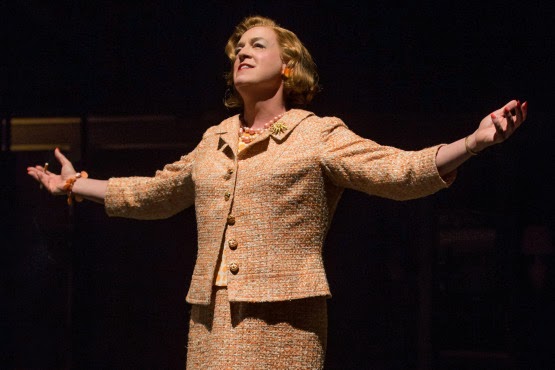
Harvey Fierstein’s new play, directed by Joe Mantello at the Samuel Friedman Theatre, ventures into unusual and potentially fascinating territory with its truth-based depiction, set in 1962, of a group of presumably heterosexual men who used to gather every summer at a Catskills bungalow colony (the play’s title is the place’s nickname) where they could indulge their secret passion for dressing and making up as women, albeit without being campily effeminate. The production, which has received mostly warm reviews, and which my usually hypercritical wife enjoyed, failed to reach me, though. Toward the end of the first act Mr. Fierstein steps into George Bernard Shaw’s shoes to offer a serious discussion drama about the issues of transvestitism and homosexuality, as seen from an early 1960s perspective; its arguments are educationally interesting but dramatically inert. Moreover, the dialogue is stilted, the characters artificial, and the dramatic structure old-fashioned and unconvincing, especially the plot device regarding a character's personal transgression. Perhaps if these cross-dressing men were described as the well-educated members of a classical acting company I might have been able to find them credible; instead, their perfect diction, grammatically correct sentences, and theatrical voices only serve to distance them from reality. The company includes some of New York’s leading actors, among them John Cullum, Reed Birney, Patrick Page, Larry Pine, Gabriel Ebert, and Nick Westrate. Mare Winningham as the woman who runs the bungalow colony with her husband (Mr. Page) is one of the play’s two actual females. Apart from Reed Birney, who brings something special to every role he plays, including his Bette Davis-like role in CASA VALENTINA,  it’s the real women who bring believable femininity to the stage here, not those who playact at being female and, as performed in this play, seem little more than bizarre.
 
Reed Birney. Photo: Matthew Murphy.

300. INVENTING MARY MARTIN: THE REVUE OF A LIFETIME


From left: Lynne Halliday, Jason Graae, Emily Skinner, Cameron Adams. Photo: Carol Rosegg.

This being a preview rather than a review of INVENTING MARY MARTIN, which opens April 27, and which I saw at an early preview showing, I must begin with my personal Mary Martin story, or my “almost” Mary Martin story. In 1951, when I was still10, Mary Martin was a household name because of all the publicity generated by her performance in SOUTH PACIFIC. The show’s hit songs were played on the radio all the time, and TV appearances by Ms. Martin and her costar Ezio Pinza were common. When a theatergoing neighbor and family friend told my parents she had a ticket for SOUTH PACIFIC, then in its second year, that she couldn’t use, it was decided I’d take it, even though it meant I’d have to take the IRT subway from Saratoga Avenue in the nearby Brownsville section of Brooklyn all alone, get off at Times Square, and ask directions to the theatre. No one seemed to be concerned about the potential dangers of putting a 10-year-old kid on the subway and sending him to Manhattan unaccompanied, which shows how much has changed over the past 64 years. When I got out of the subway station a cop instructed me on where to find the Majestic Theatre, and I got to see the first Broadway production of SOUTH PACIFIC, some of which I still remember. Unfortunately, Mary Martin had just left the show and the star replacing her was the then only 21-years-old Martha Wright, so I didn’t see the original star, thus my “almost” Mary Martin story. When the show was over, my parents were waiting outside for me, having driven in by car; they took me to the original Lindy’s, where we actually saw the great comedian Milton Berle saunter in for a late-night snack. (Ten years later, by the way, I played the “Professor” in a summer stock production of SOUTH PACIFIC, which has always had a warm place in my heart.)

Mary Martin and Ethel Merman were the two great musical comedy actresses of the day, of course, and no pair of stars since has ever gained the same acclaim as rivals for the throne of Broadway’s musical queen. Merman, because of her brassy belting voice and personal mannerisms, is the one whose style most often tempted impersonators, and there have been Merman-based one-woman shows centered on her career. Martin’s qualities were less idiosyncratic and less immediately recognizable when imitated, which may have been behind the decision to create a revue around her that uses three singers to sing her songs, none of them attempting to sound anything like her. A similar revue about Merman would probably be a travesty, since the most distinctive thing about her was her idiosyncratic voice, not the shows she starred in. With Martin, as the show’s title suggests, it was the nature of her career that counted, as she went from one type of show to another before finally retiring. The concept is rather thin, as most theatre stars, Merman included, have succeeded because of their ability to reinvent themselves.
 
From left: Emily Skinner, Lynne Halliday, Cameron Adams, Jason Graae. Photo: Carol Rosegg.

All this is by way of introducing INVENTING MARY MARTIN: THE REVUE OF A LIFETIME, an intimate show at the York Theatre, conceived and written by Stephen Cole, and starring the brunette Cameron Adams, the redheaded Lynne Halliday, and the blonde Emily Skinner, with the sole male performer being Jason Graae, who serves as the M.C. while singing and dancing with the ladies. Mr. Graae also does an extended comic number borrowed directly from a 1953 TV sketch in which Ms. Martin, wearing a long, sack-like dress, converted it into a number of historically different styles to show the evolution of women’s clothing during the 20th century. Mr. Graae offers biographical information on Ms. Martin’s career, and, this being a musical revue, the company performs the best-known songs associated with Mary Martin’s Broadway career, such as “I Got Lost In His Arms,” “A Cockeyed Optimist,” “Peter Pan,” and, of course, the grand finale, Cole Porter’s “My Heart Belongs to Daddy,” which she introduced on Broadway in 1938’s LEAVE IT TO ME! and sang in two films,1940’s  LOVE THY NEIGHBOR (https://www.youtube.com/watch?v=ww743OGLgZk) and 1946’s NIGHT AND DAY (https://www.youtube.com/watch?v=r404pTC_qGI). But there’s also a robust sampling of less familiar songs from the singer’s career, such as “Il Bacio,” “Most Gentlemen Don’t Like Love,” and “Swattin’ the Fly.”

And now, ladies and gentlemen, a new season begins.