Showing posts sorted by date for query ordinary days. Sort by relevance Show all posts

Friday, August 30, 2019

62 (2019-2020): Review: FELIX STARRO (seen August 28, 2019)


"He Played His Part in San Francisco"

In the spring of 2013, the Public Theater produced a dynamic Off-Broadway musical called Here Lies Love, set in the Philippines. It dealt with that Pacific nation’s political situation during the days of Fernando and Imelda Marcos, especially the latter. Cast with a nearly all-Filipino company, it was the product of David Byrne, one-time frontman of the Talking Heads, who’s neither Filipino or Filipino American. 

In fact, until now, we’re informed, no Filipino American has ever written an Off-Broadway musical, so the May-Yi Theater Company’s Felix Starro, with book and lyrics by Philippines-born and raised Jessica Hagedorn, and music by Fabian Obispo, is, in this regard at least, a pioneer.  
Alan Ariano. All photos: Richard Termine.
Unlike Here Lies Love, however, whose infectious title song still bangs around in my head, the much darker Felix Starro is far from sparkling, although its subject matter is provocative enough to unsettle your innards. Based on a short story of the same name by Lysley Tenorio, it tells of the title character (Alan Ariano, appealing but a bit young for the part), an aging specialist in the practice of psychic surgery. That, for the unitiated, is a fraudulent, pseudo-scientific form of faith-healing that enjoyed particular popularity in the Philippines, beginning in the 1940s. It also took root in Brazil, and has had celebrity advocates like Shirley MacLaine, who’s mentioned in the script. 

If you’ve never heard of psychic surgery, or seen video of it in action, now is as good a time as any to check it out on YouTube, including a demonstration by James Rand revealing how it’s done. In brief, the practitioner, using only his bare hands, seems to reach into the patient’s body, drawing blood, and withdrawing the sufferer's “negativities” (Starro’s word)—in the form of bloody tissue—responsible for the patient’s ailment. Most debunkers claim that the patients’ benefits are placebo effects.
Nacho Tambunting.
Felix Starro is set in 1985, when Felix, a well-known but fading psychic surgeon in Baguio City, believing he’s nearing his end, comes to San Francisco with his 19-year-old grandson, Felix Starro, Jr. (Nacho Tambuntang, pleasant), called Junior, whom he’s training to succeed him. The senior Felix’s reputation is such—he was once a glittery TV star (as a flashy musical flashback reminds us)—that many in the Bay Area’s Filipino community want to use his pricey services.
Francisca Munoz, Caitlin Cisco, Alan Ariano, Diane Phelan.
Felix hopes to earn enough money to ensure his final days back home, disregarding the danger he’s in there from a local who holds him responsible for a relative’s death. Felix admits his fraudulence to the skeptical Junior but also believes he has a special gift, one Junior knows he himself does not.
Nacho Tambunting, Francisca Munoz, Alan Ariano.
Although he can afford better lodgings, Felix occupies a shabby hotel room he’s stayed at before because of its nostalgic value. Visitors include a young, gay man (Ryan James Ortega), suffering from AIDS, for which Felix is unable to do anything; a wealthy matron, Mrs. Delgado (Francisca Muñoz); and Crystal (Caitlin Cisco), the pregnant, unwed hotel maid. We actually see Mrs. Delgado undergo the gory procedure, after which she claims that (for the moment at least) all her pains have vanished.  
Francisca Munoz, Alan Ariano, Nacho Tambunting.
Felix’s hoaxes gradually catch up with him and he also finds himself in danger of losing his grandson, whose own need to survive requires him to use means no less fraudulent than his grandfather’s. While Felix is devoted to his homeland, Junior strives to leave its heat, poverty, and backwardness behind and stay, illegally, in the USA. He’s spurred on in this goal by his girlfriend back home, Charma (Diane Phelan), who keeps appearing in his imagination. In a major lapse, we never learn what Charma’s own plans for joining him are.
Francisca Munoz.
As instructed, Junior seeks out a florist named Flora Ramirez (the always excellent Ching Valdes-Aran), whose crooked sideline is getting aliens to pay a heavy price for false American identities. The Junior-Flora plotline therefore introduces the currently hot issue of illegal immigration, but in a shallow, passing way, including filling the rear wall with a projected image (design by Nick Graci) of hundreds of license-like photos. 
Ching Valdes-Aran, Nacho Tambunting.
The issue is more a momentary distraction than a meaningful grappling with the problem. Last I heard, ICE was not currently targeting San Francisco's Filipino immigrants. It's something of a stretch, but what happens in the play can only very loosely be extrapolated to the current situation at our borders. Even if you're a strong immigration advocate, you may not support Junior's strategy.
Francisca Munoz, Nacho Tambunting, and company.
Felix Starro is neither an in-depth look at psychic surgery nor of immigration policies (remember, the show is set in 1985). It also sometimes can’t make up its mind if it’s a musical or a drama. Ma-Yi artistic director Ralph B. Peña has created several theatrically interesting moments but does little to alleviate the straightforward, ploddingly dramatic scenes, which crawl along at a snail’s pace. 
Company of Felix Starro.
Many of the acceptably listenable but largely generic 17 numbers have a familiar Sondheim feeling, using the music to offer narrative information. Others are in various conventional styles with ordinary lyrics that won’t win any prizes for first-class rhyming, although a few songs have enough originality to linger a bit. One that might be cited is “Medley of Maladies,” listing various physical ailments, and Mrs. Delgado’s “Tango of Pain,” with its thumping Latin beat. 

Paolo K. Tirol’s orchestrations for keyboards, guitar, and drums sound fine in the Clurman Theatre’s intimate confines under the musical direction of Ian Miller, and the company’s singing and acting is satisfactory, if uneven. Don’t, however, expect a Lea Salonga to emerge from the ensemble.
Company of Felix Starro.
Brandon Bieber’s choreography, mostly in the form of heightened movement patterns than traditional dance, is well-executed by the small, seven-member ensemble, all of whom—apart from Ariano and Tambunting-- play more than one role. Costume designer Becky Bodurtha thus provides numerous costumes (and wigs) for her busy troupers. 

Felix Starro’s weakest contribution is Marsha Ginsburg’s determinedly dull, sickly green set, intended to suggest the dreary interior of a cheap room but also serving for multiple other locales, inside and out. Even Oliver Wasson's imaginative lighting can do little to alleviate the glumness. An upstage cubicle (functioning as a closet, bathroom, and room entrance) that the actors slide from side to side helps to slightly vary the space but, if any set could be said to be a distracting eyesore when something more abstract and imaginative was called for, this is it. 

If a viable form of psychic surgery for theatre existed where someone could slip their hand into a show’s entrails and pluck out its negativities, Felix Starro would clearly quality as a patient.

Clurman Theatre/Theatre Row
410 W. 42nd St., NYC
Through September 21

OTHER VIEWPOINTS:


Thursday, October 18, 2018

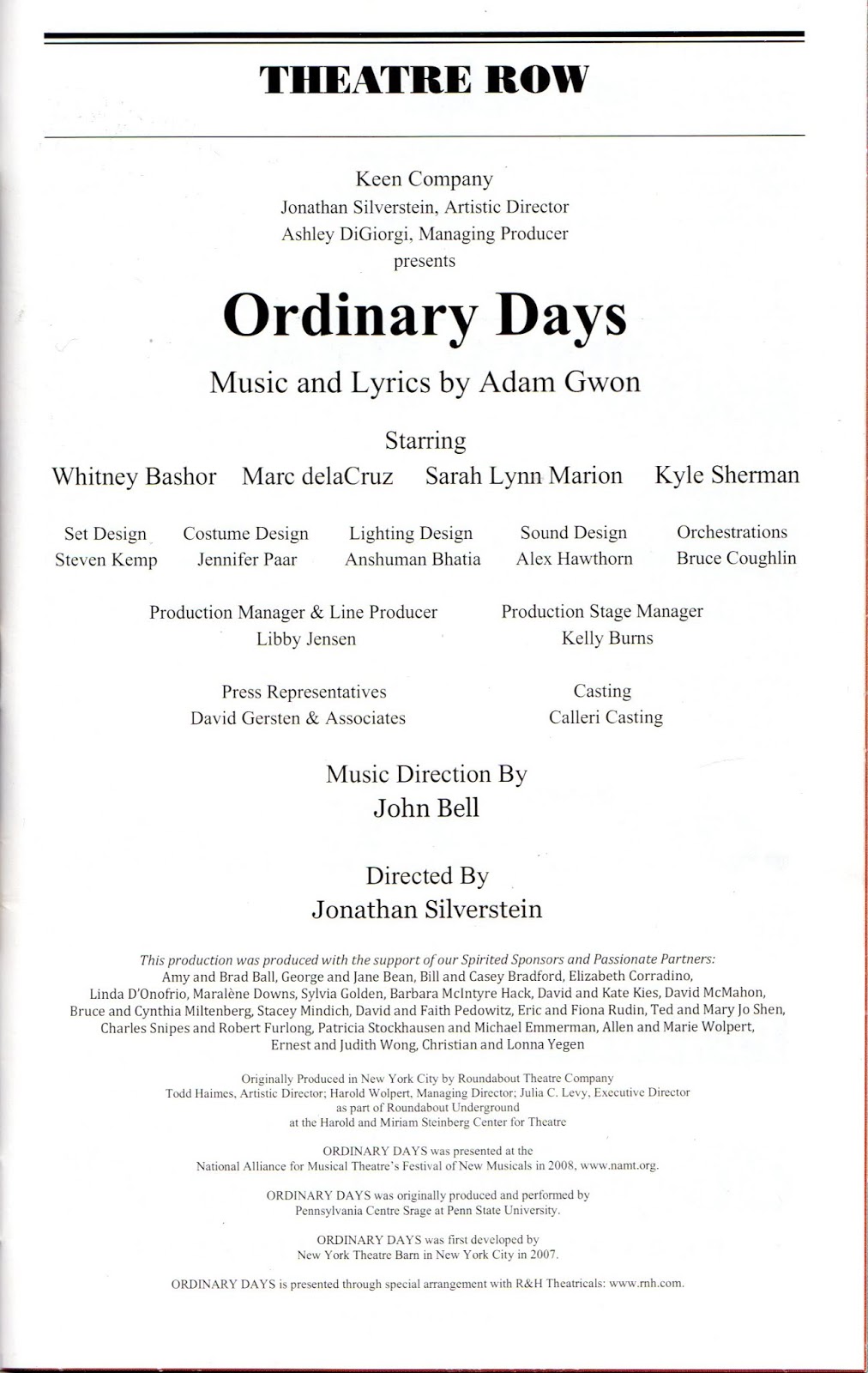
103 (2018-2019): Review: ORDINARY DAYS (seen October 18, 2018)


"Four Bites of the Big Apple"

Ordinary Days, Adam Gwon’s bookless, sung-through, chamber musical, is one of those intimate little shows that has gained something of a cult following with its depiction of young strivers seeking love and fulfillment within the bustle of New York City. Following its 2008 premiere in London’s Off West End, it was given an admired Off-Broadway production by Roundabout in 2009 and has had multiple international stagings since then. Its first New York revival, kicking off the Keen Company’s 19th season, is enjoyably well done but nothing notably out of the ordinary. 

Whitney Bashor, Kyle Sherman. Photo: Carol Rosegg.
Performed on a utilitarian set of black platforming and translucent cube-like enclosures (one of them hiding its piano, reed, and bass orchestra, led by John Bell), it’s about two couples. One is Deb (Sarah Lynn Marion) and Warren (Kyle Sherman), the other is Jason (Marc delaCruz) and Claire (Whitney Bashor). A flip phone reminds us that it’s 2007. 

Warren’s a gay, sweet-natured, somewhat nerdy, aspiring artist who does odd jobs (like cat-sitting and handing out flyers) for a trust fund-wealthy artist. Deb’s a sassy-mouthed grad student who’s at her wit’s end because she’s lost her loosely bound book of research notes for a thesis on Virginia Woolf. Warren finds the notes, notices Deb’s email address, and arranges to meet her at the Metropolitan Museum to return them.

Their bumpy friendship begins when the distressed Deb has a rude (and rather unconvincing) way of showing her appreciation, calling Warren a “fucking weirdo.” Of course, as they discuss art and aspirations, they eventually resolve their mutual issues as they discover “the big picture” of their mutual ambitions.
Kyle Sherman, Sarah Lynn Marion. Photo: Carol Rosegg.
Jason and Claire are seriously in love. He lives 14 blocks away and wants to be closer, so they agree on his moving in with her. This, though, causes their relationship to stumble. Because of tensions Claire’s feeling but that we can’t at first fathom, his proposal that they marry causes their break up. Only later, when Claire sings about it, do we learn the sad reason boy has lost girl. Of course, there’s still time before the final curtain for boy to win girl again.
Sarah Lynn Marion, Kyle Sherman. Photo: Carol Rosegg.
Each couple’s story is enacted separately from the other in alternating scenes. While the couples never actually meet, they now and then pass each other as people occupying the same urban space. The thinness of Gwon’s plotting is not substantially enhanced by these unsurprising characters, nor are the experiences they encounter notably illuminating. It’s all pleasant enough but there’s a been-there, heard-and-seen-that feeling that simply fails to ignite.
Whitney Bashor, Marc delaCruz. Photo: Carol Rosegg.
The burden of maintaining our interest lies in the sequence of Gwon’s narratively-oriented songs, whose clever lyrics define who’s singing them and provide the expository background. A couple of numbers stand out from the 14 heard in this revival, one of those that most delighted me being “Calm,” a rapid patter song Deb performs while standing in a crowded subway car as she fights to find calm amidst all the pressures she’s feeling.

The excellence of Sarah Lynn Marion’s lightly comic rendition is matched by Whitney Bashor’s moving expression of Claire’s “I’ll Be Here,” the 11 o'clock number in which we learn what’s behind Claire’s commitment issues. Admittedly, despite the reason being a contrivance that expects the knee jerk response it receives, it’s still hard not to feel a lump in your throat when you hear it.

Too many of the other numbers, though, are in the generic, faux-Sondheim mode of narrating rhyming exposition to a steady beat. Their witty lyrics are often a delight but the melodies tend to bleed into one another.
Sarah Lynn Marion, Kyle Sherman. Photo: Carol Rosegg.
Jonathan Silverstein’s direction elicits all the right emotional notes from his appealing cast, whom he moves about with spirited élan. The performers have charm, fine voices, and the acting skills to bring their songs to life. Visually, though, Steven C. Kemp’s neutral set is too bland, and Anshuman Batia’s lighting, despite his use of marquee light strips, could do more to kick up the effect. Jennifer Paar provides amusingly kooky clothes for Deb and Warren; Claire and Jason, not so much.
Marc delaCruz, Kyle Sherman, Sarah Lynn Marion, Whitney Bashor. Photo: Carol Rosegg.
What most catches your eye comes when, near the end of this 80-minute show, Deb and Warren toss dozens of colored pages (his art and her notes) into the air, creating a vivid paper rainstorm. At that moment, the too frequently ordinary Ordinary Days becomes extraordinary.
Kyle Sherman, Sarah Lynn Marion. Photo: Carol Rosegg.

OTHER VIEWPOINTS:

Clurman Theatre/Theatre Row
410 W. 42nd St., NYC
Through November 17


Wednesday, May 30, 2018

21 (2018-2019): Review: PEACE FOR MARY FRANCES (seen May 29, 2018)


"A Slice of Life and Death"

Plays with related subject matter often come in waves, creating what could be called playwriting subgenres. Recent seasons, for example, have seen what might—cheekily, of course—be called dementia porn, boxing porn, and disaster porn. Two current plays, one I reviewed last week and one I saw last night, have revived another subgenre, deathbed porn, plays whose stage time is consumed principally by characters who are dying when the curtain opens and who die (or are just about to) when it closes. Older examples would be Whose Life Is it Anyway? and Wit, while very recent ones are Woman and Scarecrow and Peace for Mary Frances.
Natalie Gold, Lois Smith, Heather Burns. Photo: Monique Carboni.
In Woman and Scarecrow, at the Irish Rep, the eponymous Woman, in her 40s, dies before our eyes over a two hour period, although she does so with such vigor it’s amazing she lasts so long. Mary Frances, the soon-to-be-deceased, 90-year-old heroine of Peace for Mary Frances—the professional playwriting debut of Lily Thorne, a student in Brooklyn College’s MFA playwriting program—takes at least 40 minutes longer to depart this mortal coil. Which is not all for the good, even with the still hearty, eternally luminous, 87-year-old Lois Smith playing Mary Frances. 

Natalie Gold, Lois Smith. Photo: Monique Carboni.
Peace for Mary Frances, produced by the New Group at the Signature’s Alice Griffin Jewel Box Theatre, is a slice-of-life and death in which a dysfunctional family with the usual love/hate issues faces the imminent passing of their matriarch. Nonny, as she is called, is suffering—not from anything as conventional as cancer or Alzheimer’s—but from a breathing problem that is also causing terrible pains. It’s a situation that—regardless of the specific idiosyncrasies provided here—is one many audience members will definitely recognize from their own experience. 
Paul Lazar, Natalie Gold, J. Smith Cameron. Photo: Monique Carboni.
The action takes place in Mary Frances’s West Hartford ranch house, where we see the living room/kitchen at our left and, on a raised platform at our right, the upstairs bedroom where she spends long stretches in bed, visited by other characters. The usually reliable Dane Laffrey has failed to find a solution to the problem of placing two rooms on different levels on the Griffin’s relatively narrow stage, creating what are probably the worst sightlines of any mainstream show I’ve seen in a long time. 

Chief of Mary Frances’s visitors are her middle-aged daughters, Fanny (Johanna Day, Sweat) and Alice (J. Cameron-Smith, “the Apple plays”), and a son, Eddie (Paul Lazar, Samara). Other family members are Alice’s grown daughters, Rosie (Natalie Gold, TV’s “Succession”), and Helen (Heather Burns, Dawn in the original production of Lobby Hero). There’s also Rosie’s infant, whose frequent squalling adds one more ingredient to sound designer Daniel Kluger’s cues for music, TV shows, rumbling effects, and so on. 
Lois Smith, J. Smith-Cameron, Paul Lazar. Photo: Monique Carboni.
Fanny, a childless, recovering drug addict, with emotional issues, works as a security guard at the YMCA. She shares caretaking duties with Alice, a divorcée who has given up her job as an astrologer to look after Mary Frances (who pays her, thus planting seeds for a dispute). The sisters are also volatile rivals for mom’s affections. The feckless Eddie, a lawyer, looks after Mary Frances’s legal and monetary affairs. These three, with Alice’s daughters—housewife and mother Rosie, unattached, successful TV actress Helen—must cope with how best to navigate the physical, emotional, and medical needs of the ailing Nonny.
Melle Powers, Johanna Day. Photo: Monique Carboni.
As is so often the case in real life, Mary Frances, a widow whose husband—often referred to—died 18 years earlier, is not the most pliable of human beings. Still with her wits about her, she’s quite capable of lashing out at family members who don’t accede to her demands or live up to her requirements, while simultaneously realizing just how much she needs them. As written, directed, and acted, however, her energy level sometimes makes her seem more likely to be on the road to recovery than the one to eternal rest. 
Natalie Gold, J. Smith-Cameron, Mia Katigbak, Brian Miskell. Photo: Monique Carboni.
Thus the conventional setup: a dying, suffering matriarch needs attentive care to make her last days as comfortable as possible, which will require regular doses of morphine. "When in doubt: medicate," goes the mantra. The bickering family is forced to consider placing mom in an institution or opting for hospice care. We learn about the details of hospice care from Bonnie (Mia Katigbak), the nurse assigned to look after Mary Frances, and Michael (Brian Miskell), the psychological social worker who offers his advice. All this material plays like an infomercial on how to provide homecare for a loved one.

Angry flare-ups and dull discussions occupy the self-involved family members, including one fed-up character’s physical attack on another; Mary France fluctuates in her responses to her children and the money she plans to leave them; Clara (Melle Powers), a round-the-clock nurse from Ghana, offers Mary Frances much-needed solace; and time takes its inevitable course.

Directed by the ubiquitous Lila Neugebauer at a ploddingly naturalistic pace, the episodic play’s many scenes slog along, shifting back and forth from the bedroom to the living room, as the conversations hit one expected topic after the other. Even the scene breaks drag: the lights fade slightly, the actors amble off or make prop adjustments, music plays, the lights rise. When a bit of local color is needed, we get a joke (perhaps too strong a word for it) regarding a Jewish neighbor, or, more egregiously, the identification of Mary Frances’s family with the Armenian genocide of 1915.

(That subject, by the way, drives Daybreak, which I reviewed two weeks ago. It belongs to the disaster porn subgenre but also seems to be part of a growing Armenian genocide sub-subgenre; or maybe I feel that way because, by chance, I watched an epic movie last week about that massacre called The Cut.)

Thorne succeeds in condensing the typical quarrels, questions, and confusion surrounding a family’s waiting for a sick, elderly person to die that most people encounter, but that doesn’t mean it all adds up to a compelling play. Since Mary Frances’s fate is sealed, all Thorne can do is to gin up tension by stirring family resentments, particularly those related to the sibling rivalry between the unstable Fanny and the resentful Alice.

Peace for Mary Frances, despite being far too long for its subject, would have been much more painful to sit through with a lesser cast. While its situation is universal, its dramatization is so ordinary it borders on cliché. When peace comes for Mary Frances it does the same for the audience.*

Pershing Square Signature Center/Alice Griffin Jewel Box Theatre
480 W. 42nd St., NYC
Through June 17

*I sat in front of the gracious Jeremy Irons at Peace for Mary Frances and had a nice little chat with him about his excellent recent documentary, Trashed, concerning the huge, worldwide problems of garbage disposal. It proved a more useful icebreaker than gushing over his many acting accomplishments, although he appreciated my mentioning his Masterpiece Theatre performances on "Love for Lydia" very early in his career.

Accompanying him, in addition to his human companions, was his bichon frise/Jack Russell mix, Smudge, who, apparently, follows his master wherever he goes.

Smudge remained silent throughout, pondering the play's ruminations on mortality, but at, at one point in Act II, let out a sharp bark before settling back into his more peaceful mode. His ruff comment came at a not particularly important moment in the proceedings, so it wasn't possible to detect in it a canny canine's critical bow wow directed at the actors. More likely, it was the result of a careless foot coming in contact with one of Smudge's Pinteresque paws.

The Signature should be commended for being so open to audiences of species diversity, although I'd like to be there when Cameron Diaz visits with her Great Dane. I understand, by the way, that the fire hydrant outside the theatre on 42nd St. is designated as gender neutral.


Monday, May 21, 2018

13 (2018-2019: Review: TIME'S JOURNEY THROUGH A ROOM (seen May 17, 2018)


"Fukushima, Mon Amour"

As I watched Dan Rothenberg’s fine-tuned staging for the Play Company of Time’s Journey through a Room (Heya ni Nagareru Jikan no Tabi / 部屋に流れる時間の旅)--Japanese playwright Toshiki Okada’s evocative, well-crafted, but externally undramatic play—it was difficult not to think of notable examples of Japan’s nō theatre: numbingly slow, emotionally controlled, narratively slight, and emphasizing a state of mind more than a dramatic action. Even its length—12 pages of script requiring 50 minutes to enact (75 minutes in its Japanese version)—and the existence of a ghost echo nō practice. 
 Kensaku Shinohara, Yuki Kawahisa. Photo: Julietta Cervantes.
This somber, three-character drama by director/playwright Okada (b. 1973), founder of the internationally respected avant-garde company cheltfitsch, also shares with nō not only certain structural similarities but a poetic preoccupation with the lingering effects of a past occurrence. In nō this is usually something that happened centuries ago but, in Time’s Journey through a Room, only a few years have passed since its inciting event, the Fukushima earthquake, tsunami, and nuclear meltdown of 2011. And, as with nō, many spectators are likely to find its tortoise-like pacing, lack of action, and inner-directed expressivity stultifying. Others will be moved by the throbbing trauma present beneath the surface's seeming placidity. 

The production opens with a striking, abstract image (not mentioned in the script) when, with the house darkened, a square, tunnel-like opening, whose shape is indicated only by thin bands of neon lighting, shimmers as sound designer Mikaal Sulaiman creates powerful rumbling effects, surely symbolizing the 2011 disaster.

When the play proper begins, a tall, slim woman, Arisa (Maho Honda), enters, dressed in dark blue jeans and sweater (the costumes are by Maiko Matsushima). Arisa, who speaks both in the first person to us and in dialogue with someone else, asks us to close our eyes in preparation for “the journey.” Her presence, and even the account she'll soon tell of being in transit, stuck on a bus, is reminiscent of the supporting character (called the waki) in nō, who often describes the journey he's currently undertaking before the main action begins.

When told to open our eyes, we see a sleekly modernist room (designed by Anna Kiraly and sensitively lit by Amith Chandrashaker). Its stage right wall is pierced by a small, deep window space, and its upstage wall is dominated by a large, hallway-like opening, part of it occupied by a translucent glass panel. Standing alone within the wall-less stage left area is a simple door frame.

Situated at our left on the bright, shiny, yellow floor, which the characters traverse in socks or bare feet, are a small, round table and two chairs, all white, while up center is the kind of stylish gray sofa you might see at Roche Bobois. The nō-like minimalist feeling is heightened by the absence, apart from a flower in glass of water (symbol of a new life?), of all decorative accessories.
Kensaku Shinohara, Maho Honda. Photo: Julieta Cervantes.
We soon see Honoka (Yuki Kawahisa), the late wife of Kazuki (Kensaku Shinohara), her long, black hair in a braid and bangs, wearing a below-the-knees, knitted, beige dress as she moves about in choreographed patterns (movement credited to Lily Kind), while talking to Kazuki, who sits in a chair much of the time, his back to us. 

Honoka's ghost speaks of things she remembers, often asking the mostly silent Kazuki to confirm her memories, and expressing her happiness at seeing and hearing the life around her, even things she once disliked (like a baby’s crying). Lingering in a limbo-like existence that ties her to the past she can't forget, she reflects on events immediately after the earthquake and on how the event transformed her, bringing happiness to both herself and Kazuki, as if the catastrophe was going to change the world for the better. Although this enlightened feeling arrived before her death, it bears the mark of the search for transcendence or salvation that occupies many nō play ghosts.

Arisa begins to weave herself into the narrative, telling us of being on a bus stuck in traffic as she makes her way to Kazuki in this special room, where, we’re informed, outside sounds can’t be heard. Meanwhile, we learn from Honoka of the nostalgia she feels when recalling various trivialities involving her and Kazuki, like quarrelling over something “stupid,” before the earthquake struck.
Yuki Kawahisa, Kensaku Shinohara, Maho Honda. Photo: Julieta Cervantes.
Arisa arrives, apologizes for her lateness, and engages in small talk with Kazuki during which we discover that Honoka died a year earlier, not because of the earthquake but, a few days later, from asthma. Honoka, for her part, continues her trip down memory lane, mentioning things like how such ordinary signs of life, like someone refilling a vending machine, after the earthquake filled her heart with love, not unlike how Emily in Our Town longingly mentions clocks ticking and other mundane things the living take for granted.

Arisa and Kazuki, beginning a new chapter in their lives, chat about happiness, their mutual attraction and their trepidation in facing the future, making it necessary to take things slowly. Kazuki reveals his gratitude for how the earthquake had made Honoka so optimistic about the better world that will follow in its wake, and talks of his plan to rewallpaper the room (which is actually wallpaper-less) because, for all his inability to forget the past, the living must keep changing. 

Honoka continues to recollect the past, expressing not only her post-disaster positivity but her belief, which Kazuki’s new relationship with Arisa puts in doubt, that the happiness she shared with him will never fade away. Time’s Journey through a Room casts a cynical eye on all of Honoka’s sanguine presumptions.
Yuki Kawahisa, Kensaku Shinohara, Maho Honda. Photo: Julieta Cervantes.
Thus ends the script, although Rothenberg extends the action with three blackouts that, when the lights come on again, allow the actors to assume a series of tableaus suggestive of what follows. At the performance I attended, some audience members began to clap after the first blackout, thinking the play was over (it was but the performance wasn’t). When the lights came up after the third tableau there was a longer than usual hesitation as we waited to be sure it was okay to applaud.

Audiences seeking a play that provides specific information about the horrors of 2011 will have to look elsewhere. Okada, while inspired by what happened in Fukushima, has more universal concerns about dealing with tragedy. The events are only briefly referenced and the play, despite the colloquial realism of its dialogue (perfectly rendered into English by Aya Ogawa, my favorite Japanese theatre translator), is deliberately vague about just where this room is and how, given what we’ve seen in videos of the devastation wrought by the quake and tsunami, it could have escaped being damaged.
Kensaku Shinohara, Yuki Kawahisa, Maho Honda. Photo: Julieta Cervantes.
The company, each member of which is a native-born Japanese, has been directed to perform in a cool, emotionally detached way. While never actually robotic—there’s always a suggestion of conviction behind the words—their cipher-like characters speak at a sedate pace, with abundant pauses, and, aside from Honoka’s relatively active behavior, with minimal movement. This approach also brings to mind the "quiet theatre" of Hirata Oriza.

While there are notable differences between this production and the 2016 Japanese one staged by the author, a rough idea of what’s involved—minus the Japanese version's unique props and droning and other unusual sounds—can be seen in this montage of clips from its international tour. One wonders, in fact, whether what’s lacking in the current staging is a more thoroughly integrated system of movement, sound, and speech.
Kensaku Shinohara, Yuki Kawahisa. Photo: Julieta Cervantes.
The Play Company, led by Kate Loewald, deserves support for its commitment over the years to presenting cutting-edge work by contemporary Japanese playwrights. Time’s Journey through a Room is their third Okada play following Enjoy (2010) and The Sonic Life of a Giant Tortoise (2014). It’s also his third rumination on the 2011 disaster. 

For me, the aloof and measured manner of Okada’s play and its highly selective treatment of character and situation invite a cerebral rather than emotional engagement. That, in fact, is not unlike my response to certain (not all) nō plays, despite their austere physical and aural beauty. Time's Journey through a Room has something to offer but be prepared to go with your eyes wide open (except when you're told to keep them shut).


OTHER VIEWPOINTS:

A.R.T./NYC Theatres
502 W. 53rd St., NYC
Through June 10


Monday, April 23, 2018

208 (2017-2018): Review: MY FAIR LADY (seen April 22, 2018)


“Enchantment Pours Out of Every Door”


If you’re just an ordinary man or woman seeking a show somewhere, far away from the cold night air, then you’ve got dozens of choices throughout the city. But if you’ve got a little bit of luck, a wallet full of cash, and are looking for something lavish, luscious, and abso-bloomin-lutely loverly, my advice is to get to Lincoln Center on time to see Lerner and Loewe’s My Fair Lady.

Lauren Ambrose. Photo: Joan Marcus.
This is the 1955 show’s first Broadway revival since 1993, when Melissa Errico played the flower girl Eliza and Richard Chamberlain the egotistical phonetician. And it’s a must-see.


The production, smashingly staged at the Beaumont by the ever reliable Bartlett Sher (South Pacific, The King and I), is an exquisitely directed, designed, and performed rendition of this classic musical about the possibilities of human transformation, made even more resonant by its reflection of contemporary #MeToo concerns.

You may have often seen My Fair Lady before, and have grown accustomed to her face, but by the time the first of its two acts draws to a close you’ll feel seven stories high as enchantment pours out of every door.

The genius behind My Fair Lady’s place at the apex of mid-20th-century musical theatre lies in its unique combination of a remarkable score—both lyrics and music—combined with a surprisingly faithful adaptation of its source, Pygmalion, perhaps the most consistently appealing and provocative comedy George Bernard Shaw ever wrote. (For more on the plot, see my review of the recent Bedlam production of Pygmalion.)

One can only thank heaven for little miracles (to paraphrase a Lerner and Loewe song from another work) that My Fair Lady was written when book musicals with spoken scripts didn’t have to compete with sung-through shows.

There are many things that make this My Fair Lady a must-see, beginning with Michael Yeargan’s gorgeous sets. These brilliantly use the vast expanses of the Beaumont’s huge thrust stage by employing independent sliding units on a disk to represent the various London exteriors, from Covent Garden to the façade of Higgins’s house. All looks ravishing under the spell of Donald Holder's magnificent lighting.
Jordan Donica. Photo: Joan Marcus.
Then there’s Yeargan’s impressive version of the interior of Higgins's house, which slides forward from upstage, revealing a two-story drawing room cum library, with its richly paneled and book-lined walls, and a spiral staircase. When it revolves on the disk so that the action can flow continuously into other rooms, you appreciate the care (and expense) that went into creating this event.

Similarly breathtaking are Catherine Zuber’s Edwardian costumes, including everything from those worn by the poor cockneys to the flouncy red skirts of the music hall girls to the jaw-dropping accoutrements of the fashionably elegant upper-classes.
Norbert Leo Butz and company. Photo: Joan Marcus.
Of course, the ones we wait for are those for the “Ascot Gavotte,” where Zuber dresses the crowd in dazzling pale-silver, with Liza set off in a gown of white and black, with a large, circular white hat, ringed in black, worn on one side of her adorable head.
Norbert Leo Butz. Photo: Joan Marcus.
There are no weak links in the company, which includes a marvelously volatile Norbert Leo Butz as Alfred P. Doolittle. Butz dances, sings, and acts his butt off as Eliza’s bibulous, dustman father, self-styled representative of the “undeserving poor.” His “Get Me to the Church on Time,” memorably choreographed by Christopher Gattelli, deservedly stops the show.
Lauren Ambrose, Dame Diana Rigg. Photo: Joan Marcus.
As Higgins’s mother, the beloved Dame Diana Rigg, as magnetically regal as ever, makes every deeply-voiced word drip with wisdom and humor; veteran Allan Corduner’s Col. Pickering is a delightful moderating force between Higgins and Eliza; Linda Muggleston’s Mrs. Pearce is a stalwart steward of Higgins’s domain; and Jordan Donica as Eliza’s innocuous swain, Freddy Eynsford-Hill, sings “The Street Where You Live” gloriously.
Harry Hadden-Payton, Lauren Ambrose. Photo: Joan Marcus.
The tall, slender Harry Hadden-Payton is perhaps a bit youthful and insufficiently harsh as Higgins but he’s unquestionably dashing, distinguished, and charismatic. His songs were famously written so they could be spoke-sung for the non-singing Rex Harrison, My Fair Lady’s first Higgins, but Hadden-Payton displays actual musical ability when required.
Harry Hadden-Payton. Photo: Joan Marcus.
Stealing both the show and my heart, however, is the Eliza of redheaded Lauren Ambrose, giving an ambrosiac performance of charm, insight, warmth, defiance, passion, and humor that had me in tears at one moment, bursting with laughter at another. A fan of hers since her days on TV’s “Six Feet Under,” I had no idea she could sing so beautifully (I could have listened all night to her “I Could Have Danced All Night”) or that she had the dimensionality to bring so complex a role to life. But she nails her every requirement, from the guttersnipe to the duchess.

She’ll win your heart (and, I hope, a few awards) as she struggles to pronounce “the rain in Spain”; bust your gut when her accent and vocabulary slip while trying to impress the Ascot crowd; make you melt when, wearing a fabulous red robe, she stands alone, psyching herself up for the ambassador’s ball; thrill you with her grace and beauty when she arrives there; rouse your best instincts when she rallies against the supercilious Higgins; and wet your eyes when she walks out on Higgins at the end.

The old question about whether Eliza Doolittle and Henry Higgins need to fall in love for the show to work still gets people worked up. Shaw was convinced there was no need for a romantic relationship between them and that Freddy would be more up Eliza’s alley than Henry. Having the actors playing Higgins and Eliza as close in age as these are (Hadden-Patton is 37 and Ambrose—who looks much younger—is 40) may make us want them to connect as lovers but Ambrose makes it clear (to me, at least) that all she really wants from Higgins is his respect, not his kisses. When even that proves so difficult to achieve, I have no problem with her leaving this egotist to stew in his own purgatory of self-doubt. As she sang to herself earlier, “Just you wait, ‘enry ‘iggins, just you wait.” Well, the wait is over and her words have come true.

As readers of this blog know, I rarely get this worked up over a show. And I'm aware my opinion isn't universal; a tiny number even disapprove strongly. But when a gusher like this My Fair Lady erupts and splashes all over me, what choice do I have but to gush myself?

OTHER VIEWPOINTS:

Vivian Beaumont Theatre
10 Lincoln Center Plaza, NYC
Open run