Friday, January 17, 2014

204. Review of MACHINAL (January 15, 2014)


204. MACHINAL


 The most sensational and widely reported crime story of 1927 was the murder of a Queens, New York, man named Albert Snyder, by his wife, Ruth, and her lover, Judd Gray. In January, 1928, Gray and Snyder both died in the electric chair at Sing Sing. A photo of the moment Ruth was jolted by electricity was taken surreptitiously and published on the front page of the Daily News. In September 1928, journalist Sophie Treadwell’s MACHINAL was produced on Broadway in a stunning production directed by Arthur Hopkins. It told the story of an ordinary New York woman who, after falling in love with an adventurer, killed her husband, was tried, and executed for the crime. Treadwell denied that the play dramatized the Snyder-Gray murder case, but, despite the major differences between the real story and the play, the actual events certainly influenced the play. According to Burns Mantle in his Best Plays of the Year, 1928-29, Treadwell was “willing to admit” that she’d “been influenced to some extent by the grinding forces of a mechanistic world that had played a part in the lowering of Ruth Synder’s [sic] standards and loyalties, her morals and ambitions, her pathetic and utterly frustrated pursuit of happiness.” (The story also inspired James M. Cain's novels, DOUBLE INDEMNITY and THE POSTMAN ALWAYS RINGS TWICE, both of which became classic films noir, among other influences, including a Guns n Roses album picture.)
 
 
Left. Zita Johann and Clark Gable in Vandamm's photo of the original production. Note the caption's error in identifying Gable as Hal K. Dawson. Right: Rebecca Hall and Morgan Spector. Photo: Joan Marcus.
 
            The hyper-intense, melodramatic MACHINAL takes a highly theatrical approach to its narrative, using the techniques of European expressionism with its many scenes, stylized sound and lighting effects, choreographic staging, and frequent rat-a-tat dialogue that sounds like the rapid tapping of telegraph or typewriter keys. It includes passages of heightened lyrical expression, repetitive, everyday expressions chosen for their clichéd inanity, and (for 1928) sexually provocative situations; it also employs scenes bordering on kitchen sink naturalism to show the seamy underbelly of life in the modern urban jungle, with all the pressures it's capable of exerting on sensitive souls.


              Despite several very positive reviews, and its inclusion in Mantle's Best Plays series, it also had its strong detractors, who found the play "unwholesome, hollow, incomplete, and unconvincing," as I reported in my Encyclopedia of the New York Stage, 1920-1930; the public was not particularly interested and it closed after only 91 performances, but its impact was strong enough to give it something of a cult status among those who recognized its groundbreaking features, not least of which was the fact of its having been written by a woman at a time when female playwrights were still trying to break Broadway's glass ceiling. It also earned a footnote in modern theatre history for introducing Clark Gable to Broadway in the role of the murderess’s lover. Subsequent stagings were usually in regional or nonprofessional venues, but in 1989 Michael Greif’s highly lauded Public Theatre production brought the play back into the spotlight. The current Roundabout Theatre revival at the American Airlines Theatre, however, is its first Broadway revival since 1928.


            British director Lindsey Turner’s production is an elaborate one, mounted on a turntable to enable swift passage between scenes. In order to cover costume changes, she's introduced a number of silent scenes that roll into view as the revolve spins, showing painterly arrangements evoking life in New York during the late 1920s. The very first such interpolated scene sets the tone as we see an essentially black and white image of a packed subway train with hatted straphangers in long coats jammed together and hovering over seated passengers as the light picks up the anxious face of the heroine, Helen, called in the credits the Young Woman (Rebecca Hall). She's so uncomfortable that when the train stops, she rushes out, causing her to be late to work.
 
            Her office is a hive of nonstop, frenetic, yet smoothly functioning mechanical (i.e., "machinal") activity, with brief lines of dialogue spit out in machine gun fashion, showing us the dehumanizing effect of modern life that Treadwell holds responsible for the Young Woman’s mental and moral instability. She is uncomfortable for any number of reasons, including a nagging Mother (a very good Susan Bertish) and insufferable boss, George H. Jones, the Husband (Michael Cumpsty in the kind of role he specializes in), who wants to marry her but who, with his "fat hands," makes her skin crawl. Despite her distaste, she marries him; he, while never actually brutish or cruel, is more a machine than a human being, spouting one pat phrase after the other. In one of the strongest scenes, their marriage night proves horribly uncomfortable for the Woman but they do soon have a child and, after nearly half a dozen years, she seems to have adjusted to married life, although underneath she's falling apart. 

            The Woman and a friend visit a speakeasy, where she meets a macho guy, the Lover (Morgan Spector, in the Gable role), and they start an affair. MACHINAL having been written in the late 1920s, the speakeasy scene is rather daring as one table includes a gay older man (Arnie Burton) seducing a young man, the Boy (Ryan Dinning), while another shows a man (Dion Graham) convincing his girlfriend (Karen Walsh) to have an abortion. Taking her cue from his tale of how he killed two Mexicans with a bottle filled with stones, the Woman decides to kill her spouse as he lies sleeping. Arrested, she's tried in a highly energized courtroom scene during which she's been allowed to take the stand by her vigorous attorney (Arnie Burton), whose verbal duel with the prosecutor (Michael Warner) is another dramatic highlight. Eventually, the Woman, hearing an affidavit signed by the absent lover testifying to her guilt, breaks down. A few moments later, she's in her death row prison cell, just before her execution, where she's being administered to by an coldly uncaring priest (Edward James Hyland), who responds to her fears with stereotypically priestly gibberish. The prison officials prepare her for death and the stage begins to revolve as she marches with the others in single file along the proverbial last mile. This sequence has been added to Treadwell's script, which ends with the Woman still in her cell as the lights change from one color to another before coming on full in an indescribable blaze. Also added is the vision of the Woman, watched through a window by the press and various officials, as she’s seated in the electric chair, the switch is thrown, and the lights flare, an image closely reflecting the photo of Ruth Snyder’s dispatch. 
 
              Despite the  production's several powerful images, the staging doesn’t find a consistent style in which to meld the expressionistic and realistic modes. For example, the bedroom scene with the lover, played naturalistically and well acted in that vein, seems out of tune with the almost ritualistic behavior of other scenes. This is a problem inherent in the play, but I suspect that it might have been somewhat ameliorated by less dependency on the scenic literalism provided by designer Es Devlin.  The speakeasy scene, for instance, could be straight out of any conventional O’Neill production. And is it really necessary to have a huge steel cage for the prison scene? 
 
            Although all the actors are highly polished, the acting also ranges in style, from Mr. Cumpsty’s stiffly robotic behavior to Suzanne Bertish’s haggard naturalism, while the tall, lanky Ms. Hall, vaguely reminiscent of a young Vanessa Redgrave, falls somewhere in between. She handles the long, telegraphic-like monologues with technical aplomb (audience members applauded at one point), and she has some fine moments in the bedroom and courtroom scenes, but it’s not easy to accept her on a moment to moment basis. Her voice seems always raised a bit too high, and can become monotonous and even grating. In a Playbill article, Ms. Hall describes the character as “normal,” but, from the minute we lay eyes on her on that crowded subway, there’s little that’s normal about her. She’s a woman with severe psychological issues, a depressive who keeps mentioning death and dying, and who, despite not being unattractive, is ineffably alone, living in a tense love-hate relationship with her mother. Her decision to kill her husband, while acceptable within the context of Treadwell’s dramaturgy, is anything but normal. Perhaps Ms. Hall means she’s “ordinary,” or unexceptional. One can understand why Richard Dana Skinner, reviewing the 1928 performance, thought her "a psychologically deranged moron."

            Given the emphasis on visual effects it would be hard to fault Michael Krass’s period-perfect costumes, especially the lacy wedding dress worn by Ms. Hall (in the interpolated wedding scene), with its mantilla-like headpiece, reminiscent of those we see in old wedding photos of our matriarchal forebears; Ms. Hall’s height, however, is emphasized by this headpiece, making her tower above everyone else in an unintentionally comic way. Jane Cox’s theatrically exciting lighting complements the scenic effects, but Matt Tierney’s very active soundscape contains too many unidentifiable sounds. There’s also original music by Matthew Herbert in the 1920s jazz style, although, with a show that pays such attention to period detail, I’d be interested to know why authentic tunes were excluded.
 
            After I left the theatre in the company of a couple of very experienced theatergoers, we stood on the corner and chatted about the production, each of us expressing our particular quibbles. As we did so, a couple of other theatre regulars we know came along, expressing great surprise to hear our carping. They were enthralled throughout, just as are, it appears, most of the professional reviewers, who consider this MACHINAL an important revival. For them this is a well-oiled machine, while for me its gears don't always mesh.   


Wednesday, January 15, 2014

203. Review of THE SURRENDER (January 12, 2014)


203. THE SURRENDER


Former New York City Ballet ballerina Toni Bentley’s THE SURRENDER, AN EROTIC MEMOIR, named one of the Best Books of 2004 by Publishers Weekly and one of the 100 Notable Books of the Year by the New York Times, was adapted by Ms. Bentley and Isabelle Stoffel as a one-woman play that premiered in Madrid in 2012 and went on to be produced in various international venues in Europe and South America, including a stint at the Edinburgh Festival Fringe. It was in Edinburgh that philanthropist Carol Tambor was so enthused by it her foundation gave it the Best of Edinburgh Award, thereby subsidizing its New York premiere. Now, under the title THE SURRENDER, it’s at the Clurman Theatre, starring Laura Campbell under the direction of Zishan Ugurlu.

 
Laura Campbell. Photo: Paul Kolnik.
 
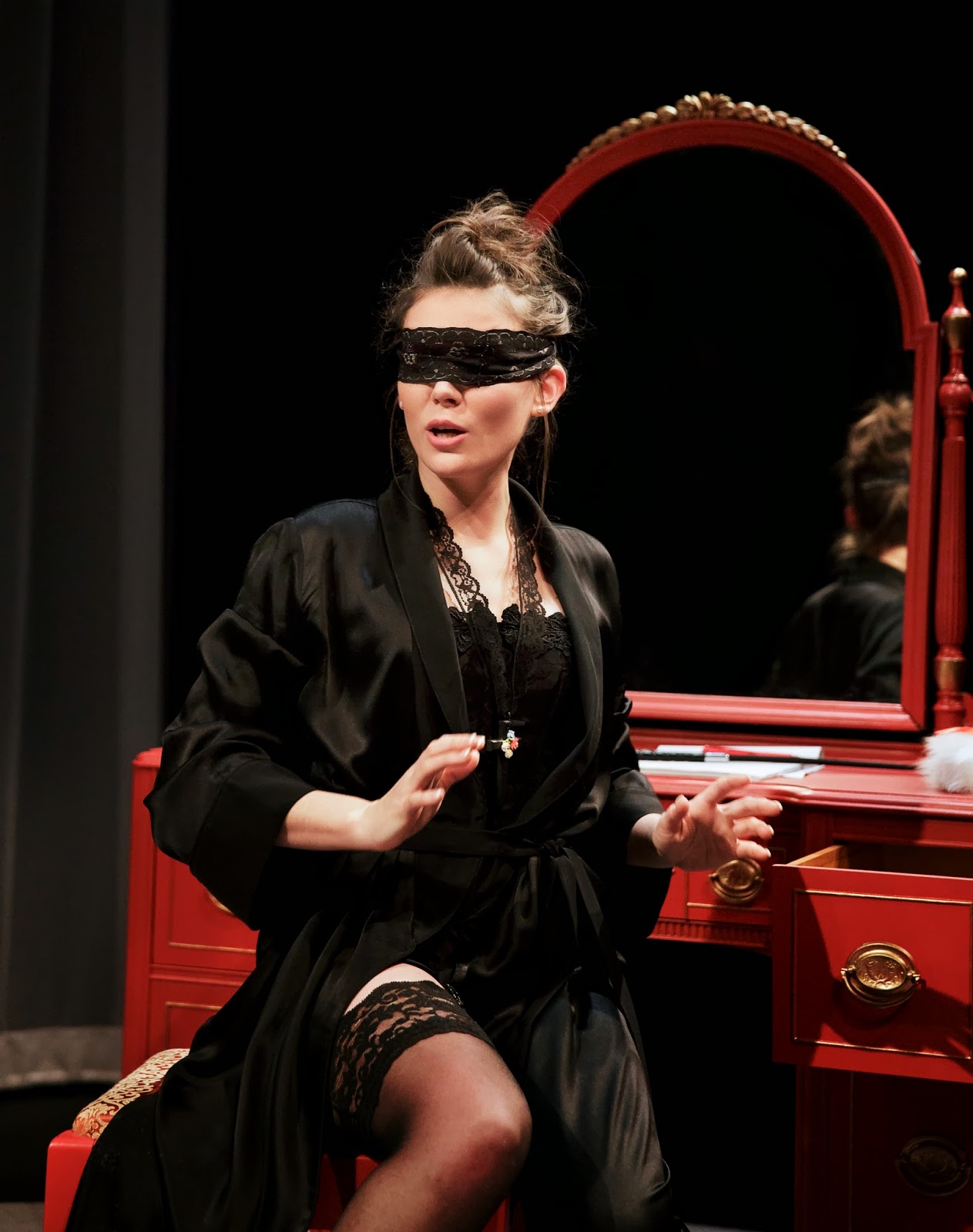
            Given this distinguished pedigree, I think a lot of people who see this 70-minute piece are going to be scratching their heads and wondering, what were these people thinking? Ms. Bentley’s memoir is a very personal account of what she considers the transcendent, almost religious experiences she had after discovering the pleasures of sodomy—anal sex, that is, or, as she usually refers to it, “ass-fucking”—during which she learned the value of submission (as per the play’s title) to her partner’s domination. These experiences are narrated by a character coyly called the Woman (Ms. Campbell), when it's no secret that it’s meant to be the Australian-born Ms. Bentley. Looking like a high-class call girl, she appears in a black lace camisole, gartered black stockings, a black silk dressing gown, and black high heels. She occupies a simple bordello-like bedroom setting, designed by Edward T. Morris and lit by Masha Tsimring, consisting of an off-white oval rug, a chaise longue, and a vanity table, with sheer white curtains at the rear. Using high-flown, pseudo-poetic prose, she tells us, in considerable detail, of her extensive sexual history, beginning with a masturbatory experience she had at 16 after seeing a porn film in a French art cinema. Her language struggles to raise the level of discourse on such private affairs, but she nevertheless is fond of referring to her genitals as her pussy (although avoiding the c-word), while freely sprinkling the air with the usual slang for sex acts and male sex organs.
 
 
 Laura Campbell. Photo: Paul Kolnik.

            Once she has found sexual paradise through her “back door” with a fellow she calls “A-Man” she becomes so obsessed with the act that she keeps a numbered account of each such encounter, the total reaching 298 before her relationship with this perfect lover ends. She concludes by saying. 
 
A-Man was my God. But, I fear, no man can be God again for me—and I mourn the loss of my insistent innocence with all my heart. He burned holes through the parameters of my existing world so that gratitude flows like water.
 
But he no longer lives in my ass. I live there now. What a place.

A similar mingling of the sacred and profane runs throughout the text, often not merely teetering on the edge of but actually falling into the abyss of pretentiousness.

 
Laura Campbell. Photo: Paul Kolnik.

Ms. Bentley, a Guggenheim Fellow who has written other, non-sexual, books, takes pride in having broken boundaries with a best-seller on a presumably taboo subject, although it’s difficult to see what could possibly be verboten in a sex-obsessed culture that allows literary pornography like FIFTY SHADES OF GRAY to make their authors millionaires. But how do you make a personal narrative about a woman’s sexual obsession dramatically interesting when all you have is the woman herself? We only hear about her frequent sexual hookups, so what good does it do to have the actress playing the woman walk about the stage acting as seductively as she can when there’s no one there with whom to interact? For whom is she being so seductive? If this is a story that must be told so as to encourage others to find similar bliss, why not play it straight and have the actress simply tell us her story directly, without all the boudoir baloney? I had no problem viewing the teasing glimpses the lovely Ms. Campbell gives of her shapely legs and derriere, but I couldn’t figure out what the purpose was. Does telling a sexy story require that one tell it sexily? Might it not be even more erotic if the actress, while still being appealingly beautiful, were to deliver it directly? Ms. Ugurlu’s direction, taking its cue from the text’s instructions, fails to bring the woman or her story to life.


Laura Campbell. Photo: Paul Kolnik.
 
Above all, however, the writing, with all its artificiality and overblown sensuality, demands an actress with much deeper theatrical chops than Ms. Campbell, with her high-pitched, unmusical voice, possesses. She seems too young and fresh for the role, which would be much more convincing in the hands of someone who could express the worldliness and knowing humor of a mature, sophisticated woman, not one who seems newly out of the gate. Moreover, the script establishes that the character is a dancer, yet Ms. Campbell’s physicality does nothing to persuade us of this. A dancer-actress might, indeed, have allowed a totally different approach to the material, neither the present one, nor the straightforward one I suggested, but a dance-infused one combining natural behavior with sensually appropriate choreography.

 
Laura Campbell. Photo: Paul Kolnik.
 
THE SURRENDER, by the way, offers some practical advice for those who wonder about the hygienic aspects of anal sex, and it might, perhaps, be best to conclude with it for those thinking about trying this at home. The Woman realizes that, while “infinite love is all well and good,” most people can’t help “seeing shit, shit, shit everywhere!” Not to worry, she informs us. “All you have to do is a nice little finger-in-the-ass cleaning with your middle finger at the end of your bath.” To reassure us, she notes, “Shit is not my thing, either.” And then she adds, “Ass-fucking is about not being afraid of your real shit—to find the shit that really matters.” Let that be a lesson to you.

Tuesday, January 14, 2014

202. Review of YEAR OF THE ROOSTER (January 13, 2014)


203. YEAR OF THE ROOSTER


For nearly half a century, the Ensemble Studio Theatre has had plenty to crow about, including the long roster of future stars it’s nurtured and the many excellent new playwrights it’s produced. Judging by the small number of reviews, most of them positive, that their new production, Eric Dufault’s YEAR OF THE ROOSTER, has received, they’ve added yet a couple of additional feathers to their cap, both for the work of Mr. Dufault and for that of actor Bobby Moreno, who even earned a profile in the New York Times. For this viewer, though, the show—which returns after an earlier presentation last fall—doesn’t actually lay an egg, but tastes more like a Chicken McNugget than chicken cordon bleu.


From left: Delphi Harrington, Thomas Lyons, Bobby Moreno. Photo: Russ Kuhner.

 
             The 25-year-old Mr. Dufault, a member of the exciting playwriting collective called Youngblood, for playwrights younger than 30—which includes such comers as Annie Baker, Amy Herzog, Michael Lew, and Lucy Thurber—has pecked out a two-act play about cockfighting set among the cockers, as they’re called, in Oklahoma redneck country, with the razor-clawed combatants being foulmouthed (fowlmouthed?) roosters (played by actors) specially bred and trained for this illegal blood sport. The central plot concerns a chubby, nerdy McDonald’s burger flipper named Gil Pepper (Thomas Lyons), who lives in a decrepit home designed by Alexis Distler (piles of McDonald’s food boxes are the principal décor), surrounded by low wooden walls to suggest a square cockfight arena; living with him is is his unwashed old mother, Lou (Delphi Harrington delightfully channeling Marjorie Main). Lou carries around a small bundle of wool representing her lap dog, which seems one breath away from death. Gil owns a fearsome rooster named Odysseus Rex (Bobby Moreno), Ody, for short—the play has many such classical allusions—on whom he lavishes all his attention (even though he’s forced to wear a patch over the eye Ody destroyed), hoping to gain success as a cockfight trainer. When, in a physically demanding cockfight, well staged by Qui Nguyen, Ody slaughters the blind but ferocious Bat Dolphin, owned by the hardboiled promoter Dickie Thimble (Denny Dale Bass, who also plays Bat Dolphin), Gil finally has something to squawk about.

 
Bobby Moreno, Thomas Lyons. Photo: Russ Kuhner.
 
            The play, with its many references to “balls” is about how Gil grows a pair of his own. The prize he earns when Ody kills Bat Dolphin is two eggs bearing potentially lethal future roosters, but these are accidentally smashed when Dickie, claiming Gil cheated, beats him up; the eggs appear to be symbols for the balls Gil needs to rule the roost. He’s even bullied by a pretty female coworker, Philipa (Megan Tusing), who ridicules him for, among other things, what she’s heard is his small penis (yes, another play that finds humor in dick size). While unable to assert himself with the aggressive Philipa, Gil seeks a mate for Ody, visiting a McDonald’s farm to buy him a genetically altered hen (Ms. Tusing) that’s so fat she has trouble standing. But Gil fails to recognize that Ody’s fallen in love with this chick and he gets rid of her, bringing great sorrow to the cock, who has no idea of what Gil has done. After other “tragic” events, Gil finds his heroic core, triumphantly planning to strut his stuff during the coming Year of the Rooster.
 
 
Megan Tusing, Bobby Moreno. Photo: Russ Kuhner.

            THE YEAR OF THE ROOSTER is given high-octane comic performances by a talented cast that, under John Giampietro’s direction, is generally effective but sometimes borders on shrillness. Despite often clever dialogue, the overall tone is too cartoonish and one-dimensional to earn more than cheap laughs (like some in this review). The much lauded performance of Bobby Moreno, despite the actor’s physical adeptness at imitating a rooster’s movements, failed to move me, depending as it does on lots of shouted vulgarity and testosterone-fueled activity. He’s playing a raucous, vulgar birdbrain, so there’s little room for nuance here. The costume created for him by Sydney Maresca, consisting of a tail coat, tight jeans, boots, kneepads, and white t-shirt, with feathers at strategic points, is a great idea, just as the fat chicken suit is for the lovelorn hen, but the play needs more than these creative incubators before it can hatch.

            THE YEAR OF THE ROOSTER may not have impressed me as everything it’s cracked up to be, but, as I got ready to fly the coop, there were lots of cockers (alter and otherwise) in attendance clucking happily at the end. I guess the yolk was on me.

Sunday, January 12, 2014

201. Review of BEAUTIFUL--THE CAROLE KING SHOW (January 11, 2013)


201. BEAUTIFUL—THE CAROLE KING SHOW


If you happen to be “On Broadway,” in the vicinity of the Stephen Sondheim Theatre, you’re likely to “Feel the Earth Move under Your Feet,” as the cast of BEAUTIFUL—THE CAROLE KING MUSICAL gives the show “Some Kind of Wonderful” performance. In fact, if “You’ve Lost that Lovin’ Feeling,” you’ll find it again at this thoroughly enjoyable jukebox bio-musical about the eponymous great pop songwriter-singer. I saw it on a very rainy day, but thought, “It Might as Well Rain Until September” because, for all its minor imperfections, I knew when it ended that I’d still love this show and its music tomorrow.   

 
The cast of BEAUTIFUL--THE CAROLE KING SHOW. Photo: Joan Marcus.
 
BEAUTIFUL joins five other current Broadway jukebox musicals. This particular crop honors the familiar music of an era (MOTOWN THE MUSICAL; ROCK OF AGES); a singing group (JERSEY BOYS; MAMMA MIA!); and a singer-songwriter (A NIGHT WITH JANIS JOPLIN). Subject-wise, the Carole King show fits most comfortably next to the one about Janis Joplin. This sextet of shows also represents several ways (there are others) in which jukebox musicals can showcase the music they’ve chosen to perform. Thus, with some overlapping among approaches, we have 1) the bio-musical approach, as epitomized by MOTOWN, which offers the story of music producer Berry Gordy within the history of Motown music, and by JERSEY BOYS, dramatizing the story of Frankie Valli and the Four Seasons; 2) the fictional story that incorporates the big hits of a particular period or artist, as in ROCK OF AGES and MAMMA MIA!; and 3) the straightforward theatrical concert, as in A NIGHT WITH JANIS JOPLIN, which allows actors portraying the group or person being idolized to perform an array of famous numbers, with varying degrees of information (which can mean barely any) provided to explicate them or comment on the artists’ lives. BEAUTIFUL, of course, belongs to the bio-musical school.

 
             Ms. King, still active at 72, has had a long and enormously successful career, but the show, wisely, covers only her early years, from 1958 through 1971, beginning at the end, during a concert performance by Carole (Jessie Mueller) at Carnegie Hall. It then flashes back to 1958, when Carole (née Klein), a Jewish girl from Brooklyn with a solid training in classical music—and only 16 when she entered Queens College (she skipped two grades)—starts selling songs to music publisher Donnie Kirshner (Jeb Brown) at 1650 Broadway, renowned as a songwriting emporium, like the nearby Brill Building. Rejecting the advice of her divorced mother, Genie (Liz Larsen), to give up songwriting and become a teacher, the precocious Carole soon teams up with fellow Queens College student Gerry Goffin (Jake Epstein), a good-looking chem major and budding lyricist, to write one hit song after the other. Goffin and King befriend another young, Jewish songwriting team working for Kirshner, Cynthia Weil (Anika Larsen) and Barry Mann (Jarrod Spector), and the friendly competition between the couples becomes a driving force pushing everyone’s careers forward. The show makes the point that Carole broke the glass ceiling in music publishing at time when women, like Ms. Weil, in fact, were more likely to be lyricists than composers.
 

Jessie Mueller and Jake Epstein. Photo: Joan Marcus.

Personal issues are covered, of course, principally Carole’s romance with, pregnancy by, marriage to, and divorce from the unfaithful Gerry; there also is Cynthia’s romance with and, after years of resisting so as not to threaten their partnership, marriage to Barry. The landmark rock and roll and rhythm and blues songs written by Gerry and Carole, and those by Cynthia and Barry, keep our ears entranced when introduced, usually with some plot element suggesting what inspired them; some are performed, first, by the songwriters themselves, and then by the performers Kirshner arranged to have record them (we see the Shirelles, the Drifters, Little Eva [Ashley Blanchet], and the Righteous Brothers). As the show winds down, Carole, originally too shy to think of herself as a performer, finds success in this role after singing at the Bitter End, following which she moves to California, where she links up with producer Lou Adler (Kevin Duda). At the end we return to Carnegie Hall, in 1971, not long after Ms. King produced her epochal album, “Tapestry,” for which she earned multiple Grammys.    
 

From left: Ashley Blanchet, Rashidra Scott, Alysha Deslorieux, Carly Hughes. Photo: Joan Marcus.

As smartly directed by Marc Bruni, BEAUTIFUL presents us with a trim and tidy theatrical package, Gerry’s betrayal and Carole’s heartbreak being efficiently presented with just enough tragic handwringing to vary the fast-moving, upbeat mood, and with enough gems from the wonderful King and Goffin songbook, supplemented by others, mainly from Weil and Mann, to keep us happily glued to our seats. (There’s nearly enough Weil-Mann material to consider this a joint bio-musical.) Still, the biographical approach covering thirteen years and the presentation of over two dozen songs in 35 scenes can’t help being superficial. Life-changing developments happen at warp speed, and, as in similar shows, it’s difficult to avoid the “and then I wrote . . .” syndrome from overwhelming the proceedings. Moreover, given the plethora of shows in recent years highlighting the changing hair and clothing fashions from the 1950s on, we once again see a wigmaker (Charles G. LaPointe) and costume designer (Alejo Vietti) having a ball recreating those familiar period looks. Book writer Doug McGrath’s necessarily episodic and rather one-dimensional script manages to fulfill its tasks better than most such efforts and to insert just enough humor to balance the occasionally more poignant moments.

But, let’s face it, the scripts in shows like this exist mainly to provide a viable framework on which to hang a string of musical numbers. The scenes come and go so swiftly they have no time to be more than sketches, giving us just enough information to help us appreciate the world in which the songs were created, supplying them with additional resonance; it’s the songs themselves we’re really most interested in, and BEAUTIFUL serves up a robust platter of iconic tunes by the featured songwriters (as well as snippets from other contemporary tunesmiths working at 1650 Broadway—singer-songwriter Neil Sedaka (Kevin Duda) makes a couple of brief appearances, singing his “Oh, Carol” tribute song). Since most such songs were about 3 minutes in length, no single number dominates the show nor are there any true show stoppers, although the several reprises of the still heart-tugging “Will You Love Me Tomorrow” probably make that song stand out most vividly.

We get many songs sung at the piano by the songwriters themselves, as they try them out for others or themselves, but the full production numbers go to the artists playing the Drifters, the Shirelles, the Righteous Brothers, and Little Eva; only the Righteous Brothers (Josh Davis and Kevin Duda), who sing Weil and Mann's “You’ve Lost That Lovin’ Feeling,” are white, by the way, as the songs that rocketed King and company to stardom were sung mainly by black artists. So we watch the Shirelles run through “Will You Love Me Tomorrow,” and the Drifters sell “Some Kind of Wonderful” and “Up on the Roof.” These are choreographed by Josh Prince to resemble the slick group performance style of the 1960s, but if you check out the originals on YouTube you can see how Mr. Prince has upgraded and enhanced routines that were much simpler when first presented.

It’s Carole King’s show, so Jessie Mueller, in that role, gets to carry the bulk of the singing and acting, and she gives a truly sincere and appealing performance of a talented woman not known for her glamour, who, in fact, speaks with comical deprecation about her own physical shortcomings. Her Carole, whose speech carries definite echoes of her Brooklyn upbringing (“saung” for “song,” for example) comes off as a decent, ambitious, middle-class girl with a great talent but no particular emotional or self-abusive habits; her modesty even makes her decline to take part in a game of strip poker and, despite the inclinations of the period, she doesn’t indulge in inappropriate substances. For Carole, the height of contentment is having a home in the suburbs where she can raise a family.
 

Jessie Mueller. Photo: Joan Marcus.

The show, in fact, borders on the squeaky clean, and I don’t recall hearing any profanities, which is not quite the image one has of the entertainment business of that or any other period. Carole is a good mother and a good daughter, with a close relationship to her mom, an unproduced playwright (as, oddly, is Gerry’s father). Ms. Mueller looks enough like the Carole King of the 1960s to get away with the impersonation (although a slight nose bump might have been useful), especially as aided by her basic hairstyles (before all those curls) and moderately frumpy clothing. She sings Ms. King’s songs with every bit of vulnerability, enthusiasm, and insight they require. Carole King, as shown here, is not some kind of star teetering on the brink of a psychological breakdown, although she does have several opportunities to emote with anger and frustration. She’s a grounded, stable person, so playing her requires subtlety and natural warmth. Ms. Mueller, one of Broadway’s brightest rising stars, has all the qualities to make this role her own and, when she sings “(You Make Me Feel Like) a Natural Woman,” it takes no effort to believe her.

As Cynthia Weil, Anika Larsen gives us a stylish, attractive blonde, making an ideal contrast with the more down-to-earth Carole (before her "earth mother" image); she’s a terrific singer, a friendly presence, and a fine comedienne. Jarrod Spector’s Barry Mann is convincing as the handsome Don Juan of a composer who falls for Cynthia after becoming her writing partner. Jake Epstein, as Gerry, is first seen as a kind of Danny Zuko-like student, in black leather jacket and black jeans; however, the character quickly belies this image by his musical talent. He, if anyone, is the show’s villain, because of his marital infidelities. Mr. Epstein is attractive and sings well but is not completely credible in his more emotional scenes. Jeb Brown is serviceable in the non-singing role of Donnie Kirshner, who later became a major concert producer and celebrity in his own right.
 
Derek McLane’s set, a combination of a two-tiered open structure at the rear, and various decorative sliding panels and scenic units, provides a practicable environment for this multi-scened show, allowing  scenes to move on and off rapidly and for multiple spaces to be visible simultaneously. Peter Kaczorowski’s variable lighting effects do everything possible to augment the show’s visual appeal, and Steve Sidwell’s orchestrations do the same for the aural dimension. We get a helpful hint of the value of good orchestrations, in fact, when Carole plays a song for the Shirelles and mentioning as she plays the kind of instruments that will be introduced at certain points, with the pit musicians providing just those sounds as she does so.  

In addition to the songs already mentioned, the show includes Ms. King’s “So Far Away,” “It’s Too Late” (lyrics by Toni Stern), King and Goffin’s “Take Good Care of My Baby,” “Chains,” “Pleasant Valley Sunday,” with other songs from Mann and Goffin (“Who Put the Bomp”), and Weil and Mann (“He’s Sure the Boy I Love,” “Walking in the Rain,” and “Uptown”). If you’re too young or too old to be familiar with these songs, now’s as good a chance as any to give them a listen. The show itself takes its title from the final song heard before the curtain call encore. It ends with:

You’ve got to get up every morning

With a smile on your face

And show the world all the love in your heart

Then people gonna treat you better

You’re gonna find, yes, you will

That you’re beautiful

You’re beautiful

As you feel.

I guarantee many people are going to smile and feel beautiful when they walk out of the Sondheim at the end of BEAUTIFUL--THE CAROLE KING SHOW.  

Friday, January 10, 2014

200. Review of MERCY KILLERS (January 9, 2013)


200. MERCY KILLERS
“Setting: An interrogation room. The recent past.” This is how the program of Michael Milligan’s solo play, MERCY KILLERS, in which he stars, describes the time and place of its action. The key words here are “the recent past” because the play is an excoriation of America’s health care crisis as seen through the personal experience of two fictional characters, but not once in the entire 65-minute performance are the words Affordable Care Act or Obamacare mentioned. Heartfelt as the play is, and important as it might have been a year ago, we will have to wait until the verdict on Obamacare is in before we can determine if the problems depicted in the play will have been ameliorated by a system in which every American has health insurance, regardless of preexisting conditions, and that will cover catastrophic illnesses with no caps on the payments.

            Mr. Milligan, a Juilliard-trained actor, has been performing MERCY KILLERS around the country for a couple of years, both in large and small conventional theatres and in union halls, student unions, doctors’ residences, and even the House of Representatives Hearing Room for members of the Minnesota legislature. The piece received a 2013 Fringe First Award at the Edinburgh Festival, and has gotten a number of warm critical responses outside New York. It’s currently at the Stella Adler Studio of Acting in a black box setting using only a table and chair, and is scheduled to move on to the United Federation of Teachers Bronx Borough Office and the Local 3 IBEW and the Joint Industry Board Electrical Industry Center Auditorium. It’s a good vehicle for instructional purposes but one wonders if its time—at least that part of it related to pre-Obamacare health care issues—hasn’t passed.

            As anybody who hasn’t been living in a gulag for the past few years is aware, America’s health care system can be the nightmare on Elm Street for people who get sick and aren’t able to afford the enormous costs that treatment can require. Michael Moore, of course, made a major documentary, SICKO, that ferociously exposed the system; Mr. Milligan has isolated a typical example of the kind of experience that average Americans without sufficient coverage are (or should that be were?) likely to encounter when they contract a major disease. He has created an everyman from the Midwest named Joe, an inarticulate (except when he suddenly turns poetic), working-class stiff who owns a car repair shop and reveres Rush Limbaugh (and his rants against the “Nanny state”), although he eventually is forced to question Limbaugh’s reactionary ideas. Surprisingly for someone with his profile, his beloved wife Jane holds liberal political attitudes that contrast vividly with Joe’s right-leaning beliefs, just as her healthy lifestyle differs from his junk food-eating habits. The deeply affectionate bond between Joe and Jane gives additional emotional heft to the story, although it doesn’t really alter the trajectory of the play’s main themes. People should be able to afford health care even if they don’t have a spouse who loves them dearly.

            As the flashing red lights that open the play—following a few moments of Woody Guthrie’s “This Land Is Our Land”—indicate, Joe has been arrested and tossed into an interrogation room where, presumably, he’s being questioned, although we neither see nor hear a police officer. Since this is a one-man show, there are no questions, just Joe free associating and rambling on about his life, with occasional comments to remind us that he’s speaking to a cop. His dialogue aims verbal bullets at mortgage brokers, Wall Street, Bernie Madoff, the greedy health care industry, pharmaceutical research studies, and so on, but, essentially, Joe is delivering a confession regarding his response to a health crisis faced by his wife.       

We learn from his monologue that Jane came down with breast cancer, requiring a double mastectomy, and that the costs of her treatments mounted incredibly. Then Joe and Jane’s insurance company cancelled their policy. Joe, a libertarian believer in the American dream, found himself in dire financial straits. He was cheated by a mortgage broker when he sold his house, and his credit quickly dried up; with no way out, he was forced to defraud his customers to earn more money and to divorce his wife so she could qualify for Medicaid. While driving with Jane one day he hit a squirrel, stopped the car, picked up the suffering animal, and put it out of its misery by snapping its neck. We’ve already learned that, because of his judo training, Joe knows just how to do this to kill or disable a person. Jane then asked Joe that, should she ever be in similar physical distress, he do what he could to put her out of her misery.

            The play climaxes when Joe reveals that Jane, no longer able to bear her agony, tried to seek eternal rest by taking every pill in the house. The effect, though, was anything but the peaceful end she sought, especially because certain pills set off an allergic reaction she hadn’t anticipated. Joe, seeing her horrific torment, was faced with the dilemma of what to do, since they lived so far out in the sticks it needed a half hour before the EMS could arrive. The scene, as Joe describes it, however, is irrelevant to the play’s attack on the rapaciousness of the health care system and the other ills in America’s greed-based society. Jane might have done what she did even if she had the best health care in the world but lived too far from medical technicians to get immediate assistance. It seems a mere melodramatic contrivance, especially since the play never actually explores the issue of euthanasia except in passing.

            Mr. Milligan’s Joe is a shambling, stammering, uneducated redneck in shabby clothes and a red baseball cap (the only vivid color on the stage) with a passive-aggressive quality that makes him move back and forth in frequently alternating fits of anger and restraint as he blows off steam and then pulls back to blame himself for whatever he’s chosen to criticize. Joe’s tics and mannerisms, designed to make him as naturalistically authentic as possible, eventually grow wearisome, especially since he’s in a perpetual state of anxiety and the role gives him little opportunity to show a lighter, more humorous side. It’s a decent, well-crafted performance but a limited one.

            Still, there's plenty to appreciate here and many will find it moving and true to their own experiences or to those of people they know. Writing a one-man play that takes on health care as well as many other social issues, and doing so within the context of a man’s tragic love for a woman whose catastrophic illness causes her unbearable pain, is an ambitious project; there are flaws here, but they are overshadowed by the importance of the message. While nothing will cure mankind of greed, we can at least hope that the Affordable Care Act will relieve some of the issues poignantly expressed in MERCY KILLERS.

Friday, January 3, 2014

199. Review of THE FINAL VERSION (January 2, 2014)


199. THE FINAL VERSION

 
I’m almost tempted to ignore this play and pretend it never happened; that way no one’s feelings get hurt and everyone can simply go on with their business. But, since getting to and from the Nuyorican Poets’ Café, located on E. 3rd Street between Avenues B and C, on the night of this winter’s first snowstorm, was such an effort, I feel obligated to say at least a few words about it for the record, especially since the playwright, Ishmael Reed, and the director-leading actor, Rome Neal, both have had distinguished careers, Mr. Reed as a prolific writer of fiction, nonfiction, and poetry, and Mr. Neal as both an actor and director. Unfortunately, this was one of those cases where the extensive achievements listed in these artists’ program bios seemed totally out of whack with the astonishing inadequacy of the work currently on view.
 
 
From left: Dawn Murphy, Rome Neal, Temesgen Tocruray. Photo: David A. Powell.

            THE FINAL VERSION, set largely in 1965, deals with the life and work of a fictional black writer, Lee Ransom, played by Mr. Neal, and provides an overview of the place of black writers in American literature from the 1930s through the mid-1960s; the emphasis is on the activities of black writers within the world of American communism, and the play is little more than a barely dramatized series of political diatribes that attempt to explore the plight of black artists in a society dominated by white capitalists. The ongoing stream of disputation muddied the plot for me to the point that my original report erred in certain plot-related facts, but much of that plot revolves around Lee’s moral dilemma after having chosen financial success by eliminating two communist characters and modifying a third character in a book he wrote in 1939; in 1965 he is offered the chance to publish the full text of the original work. Apart from that the play is really little more than a series of political arguments in which characters—including the characters in the novel—stand and deliver speeches directly to the audience, even when speaking to other characters. Famous names are dropped, kicked, tossed about, stepped on, and otherwise disposed of in dialogue and rhetorical addresses that succeed in showing off Mr. Reed’s considerable erudition about the history of mid-century communism and its place in black American society, but fail to do more than express lots of provocative anecdotes, sexual, political, and otherwise, about the famous people mentioned.

            For over two hours, in two acts with an intermission, the audience is barraged with references to Richard Wright, Carl Van Vechten, James Baldwin, the Kennedys, Martin Luther King, Jr., Marxism, Trotskyism, Leninism, Joe McCarthy, Langston Hughes, Zora Neale Thurston, W.E.B. Du Bois, Vietnam, Lyndon Johnson, Paul Robeson, the Soviet Union, Stalin, William Styron, and numerous other contemporary names and political topics, all of it wrapped in a production sadly lacking in professional polish.

            I can understand that a lack of funds requires a production using no set other than black curtains, a couple of small platforms, a formal chair for Lee Ransom to sit in, and a few bar stools. I don’t mind that June Terry’s costume designs do the best they can on a tiny budget to suggest the periods shown, even if they aren’t the most authentic or high quality in execution. I can detect in several of the performers acting abilities that, under other circumstances, might not appear so wooden and unconvincing. But I cannot understand how Mr. Neal, with all his experience, could have forgotten that a play requires shaping, blocking, pacing, movement, face to face interaction, and the picking up of cues. He himself constantly seemed to be struggling to remember his lines, and I was hoping that the flask his character keeps nipping at throughout the play (Lee is referred to as a drunk) contained nothing stronger than water.

            Perhaps a more resourceful director could have made something of this rambling rehearsal of once polarizing political positions. The final moments, in which a character called the WASP (Stephen Powell) delivers a scathingly satirical denunciation of contemporary capitalism, is certainly viable in this era of the one per centers, THE WOLF OF WALL STREET, and OWS. But if Mr. Reed believes politics on the stage can only be expressed through rhetorical speeches, and not through the give and take of believable characters in compelling circumstances, then I certainly hope that this is the final version of THE FINAL VERSION.

[Incorrect facts about the plot mentioned in the original version of this review were corrected by Mr. Reed, whose corrections have led me to revise accordingly. I offer my apologies for the original mistakes.]

Thursday, January 2, 2014

197. Review of A CHRISTMAS CAROL (January 1, 2014)


197. A CHRISTMAS CAROL


Ebenezer Scrooge and Jordan Belfort, the wolf of Wall Street (as per the recent movie of that name), share one big thing in common: both are rapacious businessmen totally dedicated to the amassing of as much money as they can, regardless of who has to be crushed in the process. Where they differ, however, is what they do with the money. Scrooge wants it purely for the sake of having it, as a mark of his success, something to which he can—by looking at it glowing (via a lighting effect) in its chest—devote the love he seems incapable of sharing with other human beings. The idea of spending it, even in the tiniest amount, is absolutely foreign to him; if asked by a truly destitute person for the smallest of loans, he thinks nothing of asking for 200% interest in return, with the money due in a week. For Belfort, on the other hand, and for many of the Wall Street brokers he stands for, money is meant to be spent in as flamboyantly outrageous a manner as possible. Scrooge would have a heart attack if he could see Martin Scorcese’s movie. Regardless of what they do with their money, though, both Scrooge and Belfort have no qualms about how they obtain it, or who gets hurt in the process.


Peter Bradbury and Mark Price. Photo: Joan Marcus.

Scrooge, the central character in Charles Dickens’s 1843 novella A CHRISTMAS CAROL, continues to epitomize unchecked greed and selfishness; he’s a man who believes the poor should die and do us all a favor. The sentimental story of his redemption when confronted by the Ghosts of Christmases Past, Present, and Future only grows more popular every year, with new plays and movie adaptations; perhaps readers and audiences cannot stop hoping that the Scrooges of this world will also come to the same conclusion. The newest version of the story, now playing at St. Clement’s Theatre, is by Patrick Barlow, who brilliantly adapted Hitchcock’s movie, THE 39 STEPS, into a hit play several years ago with a small cast playing multiple roles. A Christmas Carol uses only five actors, four of them playing more than one part, with Peter Bradbury acting only Scrooge, who’s on stage for the entire 90 minutes of the intermissionless show.

The clever adaptation is performed within a false proscenium suggestive of a Victorian theatre, but thrusting through the arch is a revolving stage fronted by scalloped footlights. The music-hall look makes sense because of the overt theatricality of Joe Calarco’s staging; the supporting cast sings familiar Christmas carols while accompanying themselves on musical instruments, and the play, toward the end, is revealed as just that, a play, thereby serving as a stimulus to Scrooge to open his heart (and pocketbook) before everything fades into memory.

Mr. Calarco takes full advantage of Brian Prather’s scenically spare environment of wrought-iron elements, including a window and rotating spiral staircase, with old-fashioned gas lamps, to summon up the various 19th-century locales required. Chris Lee’s exceptional lighting, made more potent by the fog effect apparent as soon as you enter the theatre, is enormously helpful in creating the appropriate atmospherics to place us in Dickensian London, as are Anne Kennedy’s tasteful Victorian costumes and Victoria DeIorio’s essential sound design. Combined with the use of the frequently revolving stage, these ingredients serve up a tasty Christmas pudding of visual and auditory pleasure.
 
 
From left: Franca Vercelloni, Jessie Shelton, Peter Bradbury, Mark Price, Mark Light-Orr. Photo: Joan Marcus.

There are a number of telling touches for the supernatural beings, the ghost of Jacob Marley, Scrooge’s late partner, for example, being represented by a tall actor (Mark Light-Orr) placing a white mask on the top of his head, supplemented by a shawl to represent hair, and bending forward so that the mask’s placement makes his neck look that much longer. The Ghost of Christmas Past (Franca Vercelloni) is a heavyset woman in a bowler hat, while the Ghost of Christmas Present is a brash young woman (could she be a prostitute?), with a cockney accent, in a white, ruffled blouse, and a black skirt over a red one, and with a Christmas ornament in her hair. The Ghost of Christmas Future is a giant, Nosferatu-like shadow on a billowy white curtain. As a change from traditional renditions of these scenes, in which Scrooge is bombarded with reasons to stop being such a scrooge, this time around he forcibly resists almost every device employed; it is only his awareness that Crachit’s ailing son, Tiny Tim (played by a diminutive puppet), now dead, loved the same stories (like “Ali Baba and the 40 Thieves”) he himself did as a child (before being forbidden to read them by a nasty schoolmaster [Mark Price]) that cracks his shell.

Mr. Bradbury, a bit younger than conventional Scrooges, has the difficult job of keeping us interested in a character whose bitterness and bile give him little opportunity for variety before he achieves enlightenment, and his performance eventually comes to seem one-dimensional. But this is A CHRISTMAS CAROL and it’s simply in our DNA to react with tears and joy to Dickens’s heartwarming story of a miserable old coot who calls everything warm and affectionate “humbug” but whose own attitudes become humbug as love finds its way back into his breast. In fact, with Scrooge suddenly giving away all his riches so that everyone can benefit from them, he becomes at the end another kind of Jordan Belfort, spending not on the excess but on the goodness his money can buy. “Profits and greed?” we want to shout. “Humbug!”