Thursday, September 14, 2017

Wednesday, September 13, 2017

65 (2017-2018): Review: THE RAPE OF THE SABINE WOMEN, BY GRACE B. MATTHIAS (seen September 12, 2017)

“When in Rome . . . “

In essence, Michael Yates Crowley’s The Rape of the Sabine Women, by Grace B. Matthias, the Playwrights Realm’s new production at the Duke on 42nd Street, is a simple, familiar story. A small-town, none-too-bright, 15-year-old high school girl, Grace B. Matthias (Susannah Perkins), goes to a secluded spot with her crush, the football-star classmate Jeff (Doug Harris), gets drunk, passes out, is nonviolently raped, continues to seek the boy’s affection, and testifies at his ensuing trial.

Susannah Perkins, Jeena Yi. Photo: Daniel J. Vasquez.
But Crowley has bigger fish to fry, being concerned not so much with this particular case but with the larger issue of our “rape culture.” The program devotes significant space to the subject, including sources to consult. The story’s broad outlines are familiar from incidents like 2012’s Steubenville case (whose influence Crowley acknowledges), where the accused seemed to gain more sympathy than the victims.
Eva Kaminsky, Susannah Perkins. Photo: Daniel J. Vasquez.
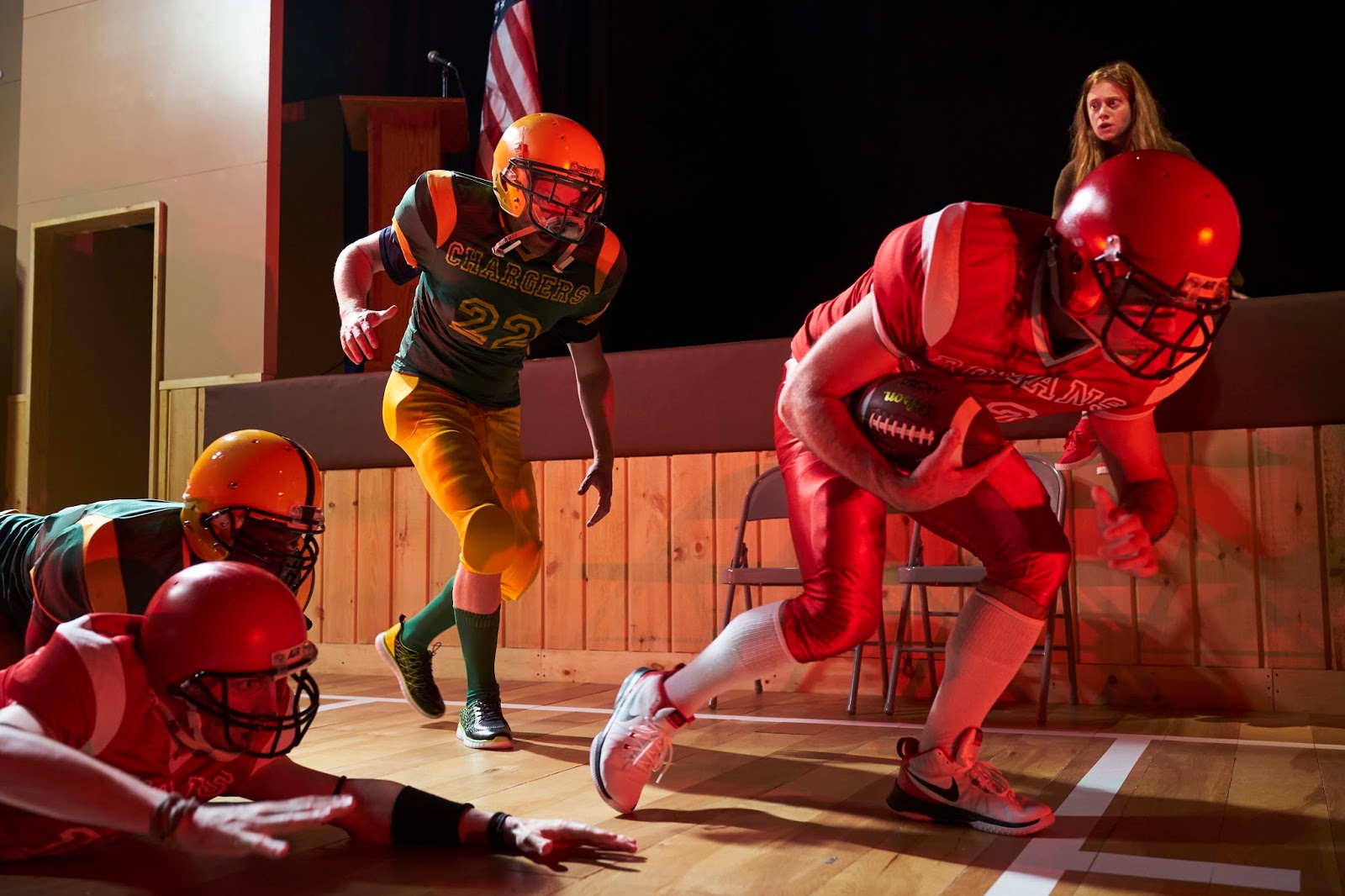
Crowley, however, gussies it up with numerous distractions, like exposing the circumstances of Grace’s experience through constant flashbacks and flash forwards; everything occurs in the symbolic arena of a generic high school auditorium/cum gymnasium, in front of and on a raised, curtained stage, well-recreated by designer Arnulfo Maldonado and excellently lit by Barbara Samuels. 
Andy Lucien, Susannah Perkins, Jeff Biehl, Jeena Yi, Eva Kaminsky. Photo: Daniel J. Vasquez.
This allows a versatile supporting cast to play multiple stereotypes representing those elements in the community who contribute to the circumstances that lead to rape and subsequently misunderstand or even dismiss it when it happens. These include the media, for example, represented by the News (Chris Carey), an announcer who consistently interrupts the action with innocuous headlines and commentary; Wikipedia, the not necessarily accurate source of all necessary information, personified by most of the cast; the educational system, in the persons of a history teacher (Andy Lucien) and an impatient, otherwise preoccupied guidance counselor (Eva Kaminsky); the church, embodied by an everyone’s-a-sinner preacher (Lucien), played in fiery, revivalist style; and the law, represented by an attorney (Jeff Biehl) more interested in winning than eliciting the truth.
Susannah Perkins, Doug Harris. Photo: Daniel J. Vasquez.
There are also an airheaded cheerleader, Monica (Jeena Yi), Grace’s BFF, and two high school football stars in the football-crazy school; one is Jeff, the other his jealous, bullying buddy, Bobby (Alex Breaux), calling everything gay (art, poetry, etc.) as a mask for his own uncertain sexuality (Crowley himself is gay); and the macho fire chief (Biehl), Jeff’s dad. And then there are the Romans.
Doug Harris, Alex Breaux. Photo: Daniel J. Vasquez.
Crowley, you see, expands the rape issue by tying the events to the story of the rape of the Sabine women, which figured in the origins of Rome. The introduction by Grace’s teacher of Jacques-Louis David’s 1799 painting, “The Intervention of the Sabine Women,” sparks discussion of the historical situation, which has been interpreted as not being rape at all because the women forgave the men and married them, The relationship of Grace’s assault to Rome is further heightened by the football team’s being called the Romans, while everyone wears tunics and togas to the school’s costume ball. There’s even a visit from Hersilia (Yi), Queen of Rome, singing (very well, be it noted) Springsteen’s “I’m on Fire.”
Jeena Yi, Susannah Perkins. Photo: Daniel J. Vasquez.
The song is well chosen because throughout the play Grace keeps insisting she wants to become a fire fighter, only for her goal to be continually mocked as impossible. It’s all a metaphor, of course, partly because of the fire that Grace wants to quench and partly because it satirizes the macho culture firefighting embodies, while sparking thoughts regarding appropriate roles for women in modern society.
Company of The Rape of the Sabine Women. Photo: Daniel J. Vasquez.
Crowley’s characters are all comically off-kilter but their extreme attitudes and language, while occasionally amusing, tend to blur whatever the play wants to say about the historical persistence of rape. The play’s exaggerations, with everyone playing their roles at full blast, weaken any argument Crowley may be making, and become more about their own theatricality than what they’re saying. While Grace’s rape may represent a certain kind of male on female sexual abuse, I’m not convinced it’s the best example for the case he’s making.
Alex Breaux, Doug Harris, Jeena Yi, Andy Lucien, Jeff Biehl. Photo: Daniel J. Vasquez.
Tyne Rafaeli’s highly creative staging, with its numerous transitions and costume changes (kudos to costumer Àsta Bennie Hostetter), moves with speed and grace, benefitting from Mikaal Sulaiman’s expert soundscape; however, except for a few scenes, she fails to sufficiently orchestrate the tendency of the energetic actors to shout. Which isn’t to deny that they all offer sharp performances of their cartoonish roles.
Andy Lucien, Susannah Perkins, Doug Harris, Alex Breaux, Jeff Biehl. Photo: Daniel J. Vasquez.
Grace is superbly performed by Perkins, who perfectly captures the girl’s naïveté, ignorance, and vulnerability; as written, though, Grace—absent father, always working or sleeping mother—is too simplistic to gain much sympathy. When, at the end, she delivers a potent classroom speech that shows how far she’s grown, it’s difficult to accept it as coming from the seemingly clueless girl we’ve been watching until then.

Also unusually impressive is Jeena Yi who, as Monica, embodies with delicious precision the talky juvenility of a Valley Girl type; later, she makes a remarkable transition to Hersilia in which there’s not a trace of the silly teenager.

The Rape of the Sabine Women . . . deals with an issue of vital importance. Apart from its fine performances, though, this hour and 40-minute play doesn’t really succeed in what it’s attempting to do but it sure deserves credit for trying.

OTHER VIEWPOINTS:

The Duke on 42nd Street
229 W. 42nd St., NYC
Through September 23


Tuesday, September 12, 2017

64 (2017-2018): Review: INANIMATE (seen September 11, 2011)

“The Objects of Her Affection”

Perhaps if more people like Erica in Nick Robideau’s Inanimate come out of the closet it’ll be necessary to add an O to the LGBTQ acronym. It would stand for object sexuality or objectophilia, that is, a person’s attraction, emotionally and sexually, to inanimate objects. There’s even a website called Objectum-Sexuality Internationale where thing-lovers can share their experiences. Objectophiles love, not just small items, but structures like the Eiffel Tower (which led archer Erika LaBrie to marry it and then call herself Erika Eiffel) and the Statue of Liberty. A YouTube video of a woman embracing and petting a toilet bowl shows the extent to which this condition can lead you: it’s not quite what Rodgers and Hammerstein had in mind when writing “These Are a Few of My Favorite Things.”

Lacy Allen, Artem Kreimer. Photo: Hunter Canning.
Bizarre as it may seem to most of us, then, the transgressive love affair in Robideau’s play is not so far-fetched. Only mildly tongue in cheek, Inanimate, which runs 90 minutes, takes place in a small Massachusetts town where, after their mother’s death, Erica Grilli (Lacy Allen), a quirky, pink-haired, 30-year-old loner, has been living with her politically active sister, Trish (Tressa Preston).

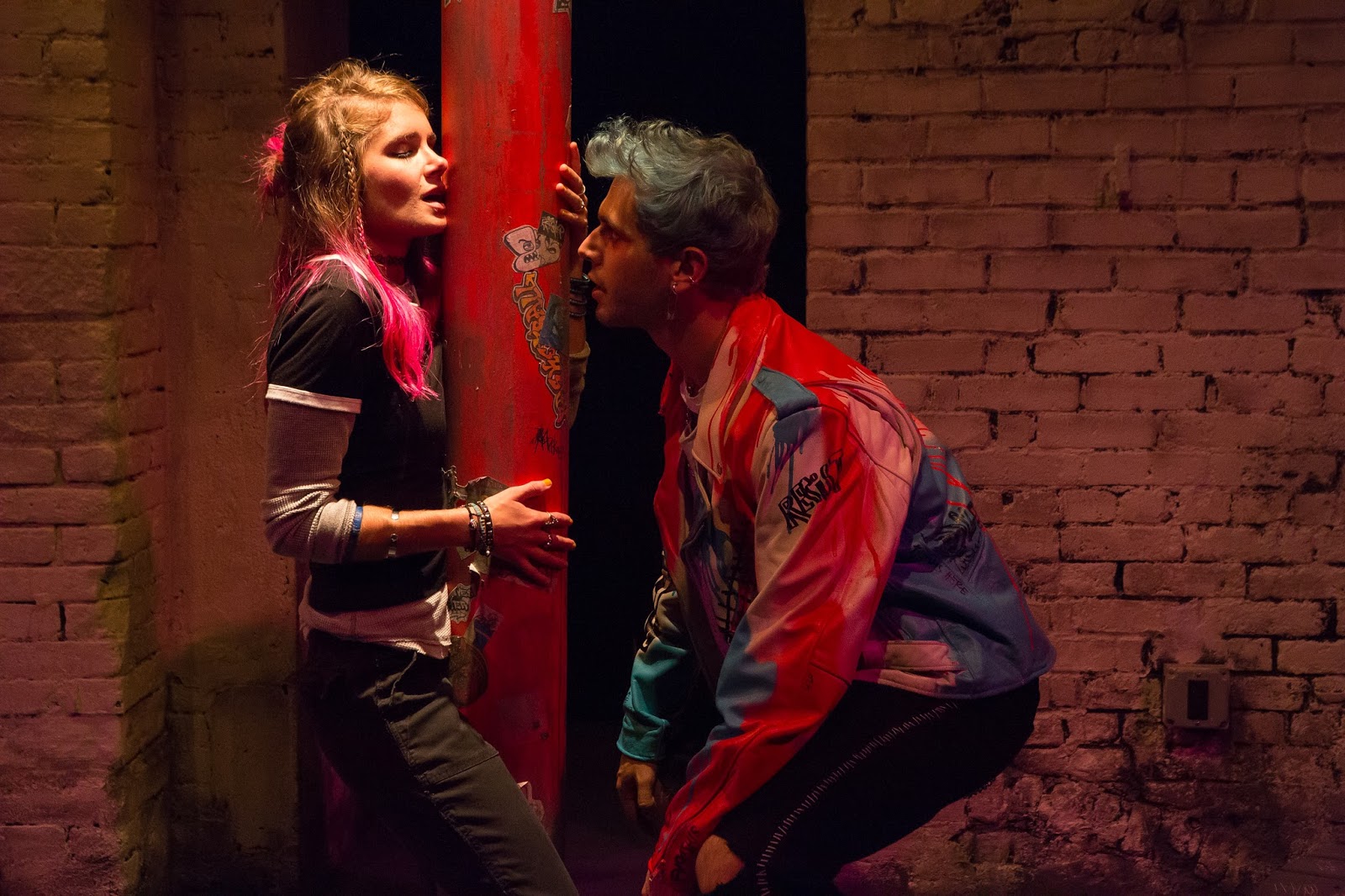
Trish, a selectwoman who’s seeking to redevelop the town’s downtown, sees Erica’s behavior as a threat to her ambitions. That behavior is the outcome of Erica’s affection for a sexy Dairy Queen sign, which she calls Dee (Philip Feldman); we see only the pole holding Dee up while its persona is represented by a punky, Danny Zuko-like dude with blue hair, white face, and red eyeliner, wearing a white motorcycle jacket splashed with blue and red designs.
Lacy Allen, Philip Feldman. Photo: Hunter Canning.
Regardless of her attraction to Dee, whose pole she’s inclined to hump, Erica’s not exclusive: “Monogamy’s kind of impossible in a relationship like this,” she says. Other things she’s got the hots for include a small teddy bear, a standing lamp, and the fancy can opener that got her fired from her supermarket job when a customer complained about her fondling the thing at her checkout counter.

Like Dee, these objects are played both by themselves and by a chorus of three actors in costumes (cleverly designed by Sarah Lawrence) that merely hint at what they represent, like the guy (Michael Oloyede) in rough-trade, black leather playing the can opener. These busy actors also portray a variety of other roles, from a supermarket manager (Artem Kreimer) to the DQ manager (Nancy Tatiana Quintana).
Lacy Allen, Maki Borden. Photo: Hunter Canning.
To underline his goal of inclusiveness and self-acceptance in a sexually biased world Robideau introduces a suitable suitor for Erica’s affections, a lovably scruffy DQ worker named Kevin (Maki Borden), a case of arrested development who had a high school crush on Erica; Kevin takes pride in being nonjudgmental and in his sexual flexibility. Rejecting “bi” as “so 1998,” he insists he’s “not exactly into labels” regarding his gender preferences. Kevin’s the kind of cool nerd (clearly too smart for his DQ job) who collects geeky things like Dungeons and Dragons figures; it’s a shame Robideau doesn’t make more of the incipient objectophilia such collecting implies.
Michael Oloyede, Nancy Tatiana Quintana, Lacy Allen, Artem Kreimer. Photo: Hunter Canning.
The play instead focuses on the way in which Kevin and Erica work out how best to accommodate their peculiar relationship while they struggle to defend Dee from imminent demolition as part of Trish’s project. Robideau’s writing veers between realism and surrealism, mingled with poetic expression and an accent on the comic, but he manages to make Erica’s dilemma sympathetic without turning her into a freak. 
Lacy Allen, Philip Feldman. Photo: Hunter Canning.
Still, it’s never quite clear just how much he’s parodying Erica’s OS and how much he’s taking it seriously. For example, creating dialogue for the objects, allusive as it may be, with Erica suggests that, even if we accept her sexual predilections as different but somehow normal, she may be more in need of psychological help than the play allows. As it is, Robideau offers no explanation for her condition, expecting us to simply accept it and move on. 

Courtney Ulrich’s imaginative direction, helped enormously by Megan Culley’s terrific mood-setting soundscape, keeps the intensity level high throughout. The company, made up of members of the Flea’s young actors-in-training, the Bats, is amusingly animated, although their roles are little more than cartoons. Allen and Borden, in the leads, are fresh presences with a wide variety of histrionic bullets in their performing arsenals. Their roles, too, sometimes incline toward the outlandish, but, they nonetheless retain a grounded believability.  

Inanimate is the inaugural play at the Flea’s attractive new home at 20 Thomas Street, a few blocks away from its place on White Street. It’s in a space called the Siggy, named for Flea co-founder Sigourney Weaver, and, just as at the tiny, downstairs, White Street venue, you get to it via a narrow flight to its basement location. (There are two larger theatres upstairs.)

The space, which replaces the old metal chairs with 44 comfortable new ones, retains a stage whose structural components—in this case, a series of thick pillars—are vaguely reminiscent of the upstage wall in the former theatre. As in the past, they’re incorporated into the simple scenic design, here credited to Yu-Hsuan Chen, with effective lighting by Becky Heisler McCarthy.

Inanimate reveals a promising playwright in Nick Robideau although, unlike raindrops on roses and whiskers on kittens, I have to admit it’s not one of my favorite things.

OTHER VIEWPOINTS:

The Flea Theater
20 Thomas St., NYC
Through October 1

Saturday, September 9, 2017

Thursday, September 7, 2017

62 (2017-2018): Review: THE BARONESS: ISAK DINESEN'S LAST AFFAIR (seen September 5, 2017)

"Out of Denmark"

I’ve said it before and I’ll say it again. Biographical plays about famous writers and their ideas on and problems with writing rarely make great theatre, although they sometimes offer terrific opportunities for actors to portray iconic figures. Of course, there have been exceptions, usually because the subjects have had unusually fascinating lives or the playwright has found an exciting way to incorporate some of their writing into the script.

This is often true of one-person plays, such as those about Emily Dickinson, Truman Capote, and Mark Twain, especially when given life by master actors like Julie Harris, Robert Morse, and Hal Holbrook. The Baroness: Isak Dinesen’s Last Affair has three characters, two of them writers, but the play, lugubriously directed by Henning Hegland, defeats his actors’ attempt to make them live. And Dinesen's best writing is largely absent from the text.
Conrad Ardelius, Dee Pelletier. Photo: Ellinor DiLorenzo. 
The Baroness is Kim Dambæk’s translation of a 2011 Danish play by Thor Bjørn Krebs being given its American premiere under the auspices of the Scandinavian American Theater Company. In Copenhagen it won the equivalent of a Tony Award.

The title character, Karen Blixen (pen name Isak Dinesen), lived from 1885-1962, and was one of Denmark’s most internationally respected writers; her fame was even more widely spread posthumously via Academy Award-winning movie versions of her short story Babette’s Feast and her memoir Out of Africa; the latter was based on her life in Africa, where she ran a coffee plantation in Kenya with her husband, Baron Bror Blixen-Finecke, and had a love affair with a handsome British hunter, Denys Finch Hatton. That part of her life was far more dramatically appealing than the source material for The Baroness.
Conrad Ardelius, Dee Pellietier. Photo: Ellinor DiLorenzo.
Selected biographical details, including Blixen’s African experiences, are scattered throughout The Baroness, set between 1948 and 1955, much of it taking place at Blixen’s estate, Rungstedlund. For stage purposes, Akiko Nishijima Rotch has transformed the lovely place into a spare, mostly black and white environment of Mondrian-like geometric patterns. Here we watch the enactment of the six-year friendship pact between Karen (Dee Pelletier) and the handsome but rather staid young poet, Thorkild Bjørnvig (Conrad Ardelius), which began when she was 62 and he 29, shortly after his first successful book of poetry was published.

Karen is a seductive, elegantly dressed, dominating woman who invites the young writer to live with her so she can be his creative muse. A woman who has had amours with many literary men, she weaves a spider’s web of allure and hopefully stimulating ideas around the innocent Thorkild. She asks him to abandon the literary magazine he edits and even give up the patronage of the wealthy sponsor who covers his expenses, and with whose wife, Benedicte (Vanessa Johansson), Karen’s friend, he eventually begins a romance, to Karen’s dismay.
Dee Pelletier, Conrad Ardelius. Photo: Ellinor DiLorenzo.
The action is a loose amalgam of events in the Blixen- Bjørnvig affair, which Krebs admits is his “free interpretation” based on available documentation; it suggests that, for all of Karen’s preoccupation with sexual forces—she makes as much of the erotic imagery in Thorkild’s poetry as she does of his “athlete’s body,” which she sketches—they never bedded because she was suffering from syphilis, contracted from her loose-living husband, and a significant factor in her behavior; she suffers several painful attacks during the play.
Vanessa Johansson, Dee Pelletier, Conrad Ardelius. Photo: Ellinor DiLorenzo.
Thorkild, who leaves his wife and child to accept Karen’s muse-ship, experiences writer’s block, which allows her to attempt sparking his creative fire; he, in turn, awed by her eminence and magnetic personality, struggles to respond, and the characters go back and forth in working out their mutual needs. But the dialogue is wooden, the situations artificial, and the inspiration commonplace.
Conrad Ardelius, Dee Pelletier. Photo: Ellinor DiLorenzo.
Thorkild comes off more as an earnest cipher bewitched by Karen’s spell than a three-dimensional person. She, touting her witch’s powers, and dressed throughout the overlong first act in a black, high-necked gown with long, tight sleeves, her deep-set eyes encased in dark shadows, is now and then reminiscent of Gloria Swanson’s more egregious moments in Sunset Boulevard; she may not be mad but a hint of madness hovers.
Dee Pelletier. Photo: Ellinor DiLorenzo.
Designer Stine Martensen’s costumes, those actually used in the original production at Denmark’s Folketeatret, are more like low-budget allusions to Blixen’s high-fashion choices than what she would actually have worn. One wonders, though, why she doesn’t wear the baroness’s famous turbans, so ubiquitous in later photos of her, and which Blixen reportedly donned to hide the results of syphilis treatments on her hair.

Karen Blixen in her 60s was an unusual-looking woman, her skin wrinkled and her long face’s bone structure noticeably prominent. It would probably be impossible for any actress to replicate this, but Pelletier, much shorter than the original, has distinctive cheekbones of her own. The actress adopts various strategies to embody the Baroness, such as prowling about with feline grace (Blixen was called “The Lioness” by her Kenyan staff), an unconvincingly smoked cigarette held aloft, but the performance only occasionally goes deeper than its surface masking. Ardelius has the making of a solid leading man but his Thorkild is far too passive to be of much dramatic interest.

The Baroness doesn’t shed additional light on Isak Dinesen’s writing but it may prove of interest for those who wondered what became of her after Out of Africa. As theatre, it’s rather dull stuff and could use an African lion or two.

OTHER VIEWPOINTS:

Clurman Theatre/Theatre Row
410 W. 42nd St, NYC
Through September 24


61 (2017-2018): Review: THE TERMS OF MY SURRENDER (seen September 6, 2017)

“How the F**k Did This Happen?”

Only yesterday was I able to catch up with Michael Moore’s The Terms of My Surrender, which opened nearly a month ago.  In addition to the one you’re reading, it has racked up 46 regular reviews on Show-Score.com, with 135 brief ones from website members. Its aggregate score from the former is 70 and from the latter is 79, with high and low numbers all over the place. So there’s little to add to the discourse other than to briefly note my reactions for the record. And to give it a 70 of my own.

Michael Moore. Photo: Joan Marcus.
As anyone who considers themselves a political junky well knows, Moore is a middle-aged, liberal gadfly from Flint, Michigan, who, for several decades, has cast a jaundiced, regular-Joe, working-class eye on significant social issues, mainly through a series of controversial documentaries dealing with subjects ranging from gun control to health care.


He’s made a number of striking prognostications on political developments that have turned out to be true, like his prediction that Donald J. Trump would win the 2016 presidential election. Moore has regularly expressed on TV talk shows his virulent anti-Trump views and his fervid feelings about the direction the country is taking; whether one agrees with his ideas or not, they’re probably as well known as those of any other liberal pundit’s.
Add caption

In The Terms of My Surrender he has taken his well-researched angst to the Broadway stage, holding forth in what is essentially a one-man show, supplemented by the unnecessary appearance of several other folks. While various sources say the show’s an intermissionless hour and a half, the Wednesday matinee I attended clocked in at nearly two hours and 15 minutes. This, I imagine, is largely because of a guest who appeared late in the show for a needless interview designed to emphasize Moore’s point that each of us can make a difference in fixing the horrible mess into which Trumpian politics have landed us.

The show begins with Moore standing before a wall of 13 horizontal stripes of what looks like wooden siding (set by David Rockwell; lights by Kevin Adams) but that projections (by Andrew Lazarow) can transform into an image of the American flag or use for other video images.
Michael Moore. Photo: Joan Marcus.
With a huge blowup of the president on the backdrop, he gets a nice laugh from his not-so-rhetorical question, “How the fuck did this happen?,” and then presents his familiar, carefully documented, comic jeremiad about how horrible Trump is. The diatribe lasts perhaps 20 minutes and the rest of the evening bounces freely from subject to subject.

There’s a routine about the 59 items, including dynamite and Muslims, that are banned by TSA regulations; stories about how he, a shy high school student, won a speaking contest with a speech about Abe Lincoln that he used to decimate the Elks Club sponsoring the competition, which led to a civil rights outcry against the organization’s whites-only policies; his successful run for membership on his school board as a way to retaliate against the practices of his school’s administrators; his postulating a Michael Moore for 2020 presidential candidacy; and so on.

He wastes too much time with a segment demonstrating the relative lack of knowledge of Americans when compared to Canadians. This involves inviting someone from each country to come on stage to compete in an innocuous quiz show, pitting an American with a high GPA against a Canadian with a lower one; at the performance I saw, the American won, negating the entire point Moore wanted to make.
Michael Moore. Photo: Joan Marcus.
Moore kvetches about the death threats he’s received for his stances, and castigates liberal journalists who have expressed views he rejects, reminds us of how Hitler rose to power in the face of skepticism, and urges the audience to speak out if they don’t want the same thing to happen here.

Of course, the Flint water disaster takes up lots of stage time, as does Moore’s insistence to his audience that each of them, in his or her own small way, do something to get rid of Trump. For all his preaching to the choir, though, the audience, apart from when it’s laughing, never once reacts with the vitriolic glee of Trump’s base at one of his rallies. The contrast is awesomely depressing.

Toward the end of the show I attended, a couple of chairs slid out and Moore interviewed a female singer from L.A. named Milck who wrote a song called “I Can’t Keep Quiet” she and other a capella singers performed at the Women’s March in Washington last year. We heard a snatch but it’s too bad the video, or one of the other versions on YouTube couldn’t be shown during the interminable talk about it.

He’s on Broadway, of course, so Moore and his director, Michael Mayer, choose to end the show with a musical routine imagining him as a contestant on “Dancing with the Starz,” which once actually invited him to be a participant. Replete with cops arriving to arrest him and then stripping down to star spangled jock straps to rock it Magic Mike-style, it brings The Terms of My Surrender to a rollicking but thoroughly irrelevant conclusion.  

Moore is a compelling presence who knows how to play his audience but what he says in The Terms of My Surrender is too familiar to be consistently funny; we chuckle because it’s comforting to share our responses to what we’ve all heard before with an audience of like-minded people; apart, perhaps, from Moore’s personal stories, there’s little here most of us didn’t already know. Yet, even though the show’s a hodgepodge that’s all over the place, it’s still nice to share its pungency with others feeling the same pain. Misery loves company and there's plenty to go around these days.

OTHER VIEWPOINTS:
Belasco Theatre
111 W. 44th St., NYC
Through October 22


Sunday, September 3, 2017

60 (2017-2018): AS YOU LIKE IT (seen September 2, 2017)'

“Here’s a Night Pities Neither Wise Men Nor Fools: 
A Report In Lieu of a Review”


Well, okay. Maybe it wasn’t Lear’s cataracts and hurricanoes, but it certainly was wet at the Delacorte Theater last night.


I love Oskar Eustis, the artistic director of the Public Theater. He’s one of the most creative, socially conscious, provocative (think his recent Trumpian Julius Caesar), award-winning, cultural figures in New York. One award he’ll never win, though, is for his meteorological predictions, at least not if his forecast at last night’s presentation of As You Like It at the Delacorte Theater is any indication.

It was already raining when I left my home in South Queens to take the hour and 15 subway trip to Central Park. For the first time in my seven decades of riding New York’s subways, someone was actually selling plastic ponchos, warning about the inundation the evening held in store. I demurred, thinking I was well enough protected, with my new umbrella (the kind that opens upside down), my baseball cap, a windbreaker, and a small towel. Turns out I was all wet.

When I arrived at the W. 81st Street station, I spotted a sign saying there was no weekend service there for my return trip and I’d have to take the bus downtown to get to the station I needed. This didn’t augur well for getting home easily should the show be delayed.

The rain was coming down steadily when I emerged but that didn’t stop hundreds of people, many holding umbrellas and wearing ponchos but others relatively unprotected, from trekking with me through the park to the Delacorte. Surprisingly, many others were lined up in the dimly lit area outside the theatre, hoping the torrent would cease in time to see the show, scheduled to open at 8:00.
 
Rain had been predicted all day but these impervious theatregoers, hungry for one more jolt of outdoor Shakespeare before the summer ended, weren’t buying it, even as they stood with open umbrellas or sought refuge under the theatre’s eaves. I, going as a reviewer, was required by Public Theater policy to attend regardless of the weather, but I was awestruck by the tenacity of these others, representing as true a cross-section of New York’s population as you could find at any single cultural event, high or low.
 
As 8:00 approached, I filed in, placing the small towel I’d brought over my drenched wooden seat. Like everyone else, I kept my umbrella open but, unlike at baseball games, for example, the audience was told that when the show started the umbrellas would have to close so people behind them could see. When it came time to close our umbrellas, a woman in my row resisted and had to be instructed several times to comply.
 
It’s also the Public’s policy not to cancel a performance if there’s even the slightest possibility of the weather improving. And that’s just what happened in 2014 when I saw Measure for Measure in the park, an experience I described in this report. The current production was under additional pressure to perform. 

Unlike the Public’s regular Shakespeare in the Park performances, which run for several weeks each, this is an annual, five-performance production given under the company’s Public Works rubric. Now in its fifth season, Public Works was founded by the gifted Lear de Bessonet in 2012, and is dedicated to inviting “diverse communities from across New York to join in creating ambitious works of participatory theatre,” much like the pageant productions of the early 20th century created by Percy MacKaye.
 
As Eustis said during one of his soggy pre-show pep talks, 200 professional and amateur performers from a wide variety of community organizations were champing at the bit backstage, waiting for a chance to strut their stuff. It’s easy to understand his dilemma in wanting to get the show off the ground; these dedicated people, ranging from seniors to young children, don’t deserve to lose a minute of what, for many, will be a once-in-a-lifetime experience.

Eustis addressed us twice, first, at 8:10, to say he’d learned there was a chance for “a window” of clear weather to be arriving in about a half hour, and that the composer-lyricist-singer Shaina Taub, who had turned Shakespeare’s play into a musical with director Laurie Woolery, would entertain us in the meanwhile. She did just that, performing several of her terrific, upbeat numbers with the band in a covered, raised pavilion. As this video shows, even the ushers were dancing in the aisles. But the window remained shut.
Later, Eustis, wearing a poncho but with his head uncovered, informed us that, after the stagehands had squeegeed the stage, the show would commence. We learned as well that Rebecca Naomi Jones, playing Rosalind, was having voice problems but insisted on performing; however, her vocals would be sung by Taub, who was also playing Jacques (another woman, the distinguished actress Ellen Burstyn, will essay Jacques in the forthcoming CSC revival). At 8:35, the show began, despite the intensity of a downpour vividly highlighted in the overhead spotlights.

What ensued was perfectly charming, despite the showers; the songs sounded wonderful, the acting was crisp and clear, the modern-dress costumes were delightful, and the enthusiasm was infectious. Still, I couldn’t stop hoping that no one slipped, that the costumes wouldn’t be ruined, and that none of the players (much less yours truly) would get sick.

After 20 minutes of increasing discomfort, in which I was split between personal and professional concerns, I chose to make my departure. At first, barely any others accompanied my lonesome journey back to the bus stop; by the time I reached it I spotted dozens of soaked spectators exiting the park. I can’t be sure but I assume the show was stopped.

From the little I saw this As You Like It promises to deliver both musically and visually; I regret I’m unable to catch it again before it closes. Given the size of its company, it’s unlikely to be revived although there’s always the possibility of a pared-down version getting a shot.

After Houston, this Delacorte deluge was just a drop in the bucket. I commend those waterproof theatergoers who endured it longer than I even if this As You Like It wasn’t just as they might have liked it.

OTHER VIEWPOINTS:

Delacorte Theater
Central Park at 81st St., NYC
Through September 5