Monday, July 22, 2019

46 (2019-2020): Review: JACQUELINE NOVAK: GET ON YOUR KNEES (seen July 18, 2019)


“Thar She Blows!”

No, despite its heading, this review isn’t about a show based on Moby Dick. Then again, much of it is about dicks, both mopey and alert. Its star is a rising, young, standup comic named Jacqueline Novak who doesn’t shy from the title “Blowjob Queen.” Even the name of her one-woman show, Jacqueline Novak: Get on Your Knees, let’s us know where she stands (or kneels).

Jacquelin Novak. All photos: Monique Carboni
Novak’s show is a 90-minute comedy routine performed in classic standup style on the Cherry Lane Theatre’s stage, stripped down to nothing but its de rigueur, comedy-club, bare-brick walls. Her only prop is a hand-held mic, her costume a simple, gray t-shirt and dark jeans, her blondish hair (unlike the color on the program cover portrait) pulled back in a pony tail. 

Novak's personality is sneakily unassuming, her lines delivered in a natural, conversational way, broken now and then by a mild smile at something she’s said that got a notable audience reaction. She’s also very physical, using her body to express much of what she’s talking about, which, since what she’s talking about, mostly, is blowjobs and hand jobs, needs very little for us to catch what it is she’s doing. 

Remember that song, “Sodomy,” in Hair? The one that begins, "Sodomy, Fellatio, Cunnilingus, Pederasty"" It was pretty risqué back in 1968 but Novak’s play doesn’t bother with such formal vocabulary for what she’s talking about, the word “fellatio” not being mentioned once. It’s kind of unusual to see a female comic do an extended riff on her experiences giving blowjobs but, if the orgasmic laughter climaxing at the Cherry Lane is any indication, it’s also kind of refreshing. 
Novak’s routine may be dealing with crass material but she brings a spirited, lighthearted honesty to her work that elevates even her often hilarious discussion of words like “penis” to a higher level. She’s a brilliant raconteur of linguistic niceties, finding fun not only in vocabulary—her bit about why “cock” so nicely encapsulates what it represents is terrific—but in phraseology, the euphemistic idioms (like “laying a pipe,” “baby arm,” or “rock hard”) we use to describe things sexual. Seeking to dignify sexual activity, she prefers atypical ways of describing them, such as calling “doggy style” “the hound’s way.”

Structurally, the piece rambles, loses comic intensity, then picks up with some huge zinger or two, sometimes deliberately thrown away in an offhand manner. Novak’s zany meditations, some of them concerned with concepts like ghosts, are mainly erogenous, as she recalls learning the basics of fellating a fellow high school student, and eventually mastering the art. She similarly deconstructs the nature, aptitudes, and appearances of penises and vulva (her own included), with jocularly erudite disquisitions on the balls. 

Much time is also occupied with the relative toothiness of blowjobs, with its side issue of biting off a member, and the nonexistence of bones in organs capable of being called boners. One of her cleverest bits involves having two mouths while servicing her boyfriend, but I’ll let you discover for yourself why she’d find that helpful. 
Most of the audience packing the Cherry Lane looked like Gen X, Millenials, and Gen Zs, and their laughter was both frequent and loud. My baby boomer plus-one laughed a lot, too, but my own rictus capacity was not quite as active, I’m afraid. I appreciated Novak’s mental, verbal, and physical agility, and was with her all the way, but I was never rocked by the kind of tear-provoking, pee-inducing laughter I've experienced with great sets by comedians like Richard Prior, George Carlin, Joan Rivers, et al.  Humor is in the bladder of the beholder.

Jacqueline Novak is a poetess of the penis, a vindicator of the vulva, a booster of the blowjob. The latter act may require a subject on which to practice but I think most of us would prefer to see this smart and talented comic just as she is, solo. Like what she spends so much time ruminating about, she is, after all, in the standup business.

Cherry Lane Theatre
38 Commerce St., NYC
Through August 18

OTHER VIEWPOINTS:


45 (2019-2020): BROADWAY BOUNTY HUNTER (seen July 20, 2019)


“A Woman of a Certain Age”

Annie Golden, now 67, may have a deep and abiding place in the hearts of veteran theatregoers with offbeat inclinations but it’s probably safe to say, along with Wikipedia, that “she is best known for playing mute Norma Romano” on the Netflix series “Orange Is the New Black.” Readers not familiar with her should really take a look at the aforesaid Wikipedia page, and also Google the images of her changing appearance to get a clear perspective of just how diverse her career has been. As with all of us, she’s changed physically over the years, which is itself part of the self-deprecating humor that infuses her current, name-above-the-title, Off-Broadway show, Broadway Bounty Hunter, at the Greenwich House Theater.
Company of Broadway Bounty Hunter. Photo: Matthew Murphy.
If you don’t know of Golden’s golden years, when she was the lead singer with the punk rock band The Shirts, or when she appeared in various manifestations of Hair, or was in the original production of Sondheim’s Assassins, you’ll be deliciously delighted when she opens that snaggle-toothed mouth and displays her still terrifically listenable voice.
Jared Joseph, Jasmine Forsberg, Annie Golden, Christina Sajous. Photo: Matthew Murphy.
Let’s be clear: Broadway Bounty Hunter is a defiantly silly and campily over-the-top vehicle. It’s also very funny, and, if you go with its flow, performed with such persistent pizzazz by its unbeatably versatile ensemble that you may not believe you’re liking it so much. Broadway Bounty Hunter is probably too limited in appeal to be Broadway bound but it deserves an extended Off-Broadway life when its run at Greenwich House expires.
Omar Garibay, Jasmine Forsberg, Jared Joseph, Badia Farha, Christina Sajous. Photo: Matthew Murphy.
I’m fully aware that, like even the best of Charles Ludlam’s old Theatre of the Ridiculous productions, some audiences won’t tune in to its wavelength. Others, like most of the audience when I attended, will give it their hearts, if not their minds. I’ll put it this way: the show, which originated at the Barrington Stage Company in the Berkshires, has a score by Joe Iconis, whose Be More Chill will soon be closing its Broadway run. That show, too, had an exaggerated book, based on a popular young adult’s novel, but, apart from one or two numbers, it failed to engage me.
Annie Golden. Photo: Matthew Murphy.
Broadway Bounty Hunter’s charmingly preposterous book, by Iconis, Lance Rubin, and Jason Sweettooth Williams, had me from the start, maybe because it’s so filled with inside theatre stuff. Golden plays Annie Golden—a cartoon version of herself—not as the successful star she’s currently become, but as an aging actress who’s lost her popularity. As she laments in a song that becomes almost an anthem of self-assertion, she keeps getting turned down for parts because she’s “A Woman of a Certain Age.” It doesn’t help that she lives in the past, even attending auditions with dated headshots from the time of her cutest glory.
Company of Broadway Bounty Hunter. Photo: Matthew Murphy.
All right. I won’t go into great detail about the plot but here are some basics. Annie, whose beloved producer husband, Charlie, is believed to have drowned ten years earlier, finds herself with her power cut off because she hasn’t paid her bill. At that very moment, she’s confronted in her apartment by Master Shiro Jin (Emily Borromeo), a tall, sleek, Asian beauty who runs a bounty hunting operation with a team of six wickedly dangerous, attractive men and women hunters.
Jared Joseph, Badia Farha, Annie Golden, Jasmine Forsberg, Christina Sajous. Photo: Matthew Murphy.
Shiro recruits the frumpy Annie, who quickly masters the required martial arts techniques, not only because she’s surprisingly physically adept but because she’s able to invest her methods with theatrical knowhow, finding stage-related analogies and characters she’s played to solve each problem that arises.
Annie Golden, Alan H. Greene. Photo: Matthew Murphy.
She’s partnered by Shiro with the superfly hunter, Lazarus (Alan H. Greene), so swaggeringly cool you’d probably stick to him if your skin and his came in contact. Although initially resentful of the pairing, Lazarus leaves with his new partner for the jungles of Ecuador to bring back the villainous Mac Roundtree (Brad Oscar, The Producers), a pimp and drug pusher. Shiro wants him because he caused her actor brother, Hiro, to die from an overdose.
Emily Borromeo, Christina Sajous, Omar Garibay, Annie Golden, Jasmine Forsberg, Alan H. Greene. Photo: Matthew Murphy.
Mac’s goal is to produce shows on Broadway with casts juiced up on a drug he’s created called Fierce, whose potency will increase their talents multifold and give them so much energy they’ll be able to break the union rules of no more than eight shows a week by doing 15! Like a dedicated union deputy, Annie will not stand for such rule-breaking, although she’ll have to reconcile her bounty hunting duties with what she discovers about Mac’s identity.
Badia Farha, Jasmine Forsberg, Christina Sajous, Brad Oscar. Photo; Matthew Murphy.
Sit back and let the players do the work for you as the company—five playing multiple roles with clever wigs and a panoply of Sarafina Bush’s marvelously imagined costumes—takes you along to Ecuador and back on Michael Schweikardt’s adaptable set. Helping it all click are the continuously imaginative video projections of Brad Peterson and the first-class lighting effects by the great Jules Fisher and Peggy Eisenhauer.
Alan H. Greene, Brad Oscar. Photo: Matthew Murphy,
Director Jennifer Weiner’s staging and inventive choreography—much of it based on kung fu moves (watch out for those amazingly well-handled nunchucks!) and some done in hilarious slo mo—never flag as the action barrels along, with one rousing, rock-inspired show-stopper after the other. This is one of the most talented ensembles around, each with dancing, singing, acting, and comic skills so good they practically shout for wider recognition.
Annie Golden, Emily Borromeo. Photo: Matthew Murphy.
I salute Badhia Farha as Sienna and others; Jasmine Forsberg as Indigo and others; Omar Garibay as Spark Plug and others; Jared Joseph as Felipe and others; and Christina Sajous as Claudine Machine and others. They comprise a bodacious, booty-shaking team for the ages, especially when the shaking happens in Mac Roundtree’s “Ho House,” whose sex workers Annie wants to unionize.
Annie Golden, Alan H. Greene. Photo: Matthew Murphy.
Brad Oscar’s Mac Roundtree is as good as you’d expect from this musical comedy veteran. Alan H. Greene may have the name of someone you’d hire to do your taxes but he’s a strappingly striking dude—think an African-American Dwayne Johnson—whose powerhouse presence, physical and vocal, delivers time and again. Emily Borromeo is a dream of exotic mystery and control. Finally, Annie Golden’s comedic and musical glow, as she calls for women to rise up and smash the male patriarchy, shows that all that glisters is indeed golden.
Company of Broadway Bounty Hunter. Photo: Matthew Murphy.
Which leaves us with the burning question: what happens when, at Saturday matinees, Anne L. Nathan takes over for Annie Golden?
Company of Broadway Bounty Hunter. Photo: Matthew Murphy.
Greenwich House Theater
27 Barrow St., NYC
Through September 15

OTHER VIEWPOINTS:


Sunday, July 21, 2019

44 (2019-2020): Review: TWO'S A CROWD (seen July 19, 2020)


“What Happens in Vegas”

Despite its title, Two’s a Crowd, a pleasantly mediocre, nearly two-hour, time-passer of a musical at 59E59, has four actors, two of them the leads, with five additional roles split between two supporting actors. One of the leads is played by the popular, still-adorable, and always welcome comedian, Rita Rudner, who also cowrote the book with her husband, Martin Bergman, the director. 

Robert Yacko, Rita Rudner. Photo: Carol Rosegg.
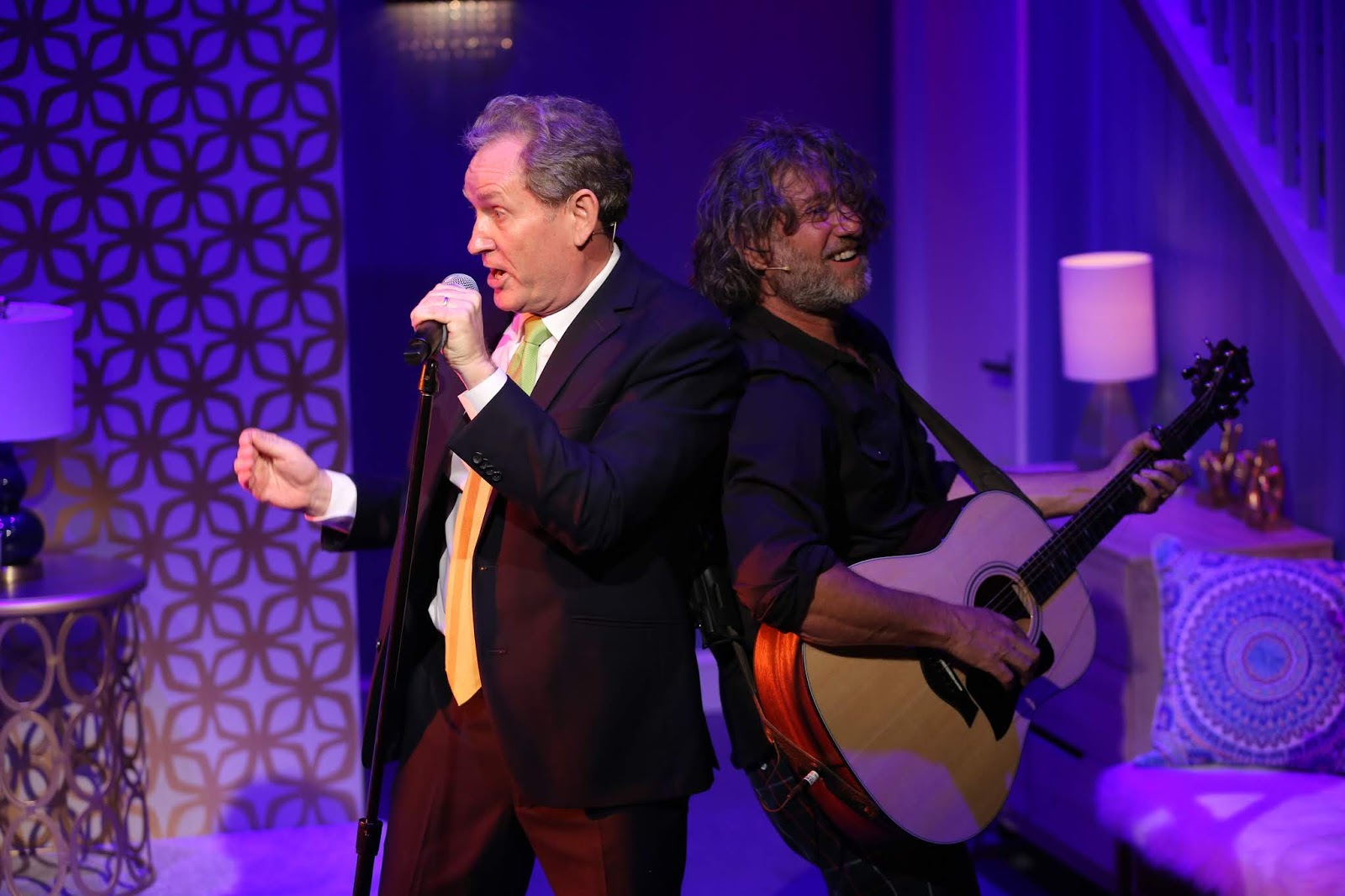
The music and lyrics are the work of Jason Feddy, who, for unexplained reasons, materializes to sing and play the guitar during the show’s interstices when the actors need a moment to change costumes. I guess you could think of him as something of a chorus, although his lyrics—while suitable enough for a stand-alone act—have little to do with the plot or characters. The songs sung by the latter are perhaps a bit more closely related to what’s going on but most could as easily be extracted and performed without any knowledge of the plot.

Then again, the score may easily be the best feature of this sappy, cliched, senior-citizen romcom, set in a Las Vegas hotel room (Rudner is a popular Vegas attraction and even has a theatre there bearing her name). Two’s a Crowd is a perfect vehicle for audiences veering from middle-age into their golden years, and tailor-made for the dinner theatre crowd (wherever that still exists).

It imagines a man and a woman, strangers, meeting cute when they find themselves sharing the same room because of a double booking error. He, Tom McManus (Robert Yacko), is hovering just below his sixth decade, she, Wendy Solomon, just above. As conventional in such situation comedies, you have to let the tired little zingers and fibs about their respective ages wash over you.
Rita Rudner. Photo: Carol Rosegg.
Both are in Vegas for emotional rehab from personal losses, he—a retired electrical contractor—because of his beloved wife’s death, she because she found her husband cheating on her. His goal is to participate in a big poker tournament; she—a wedding planner—seems to have little else on her mind than to shop and play the slots. As per the formula, each has a completely different temperament, setting up the initial friction that makes it seem these two could never get together.

Tom’s nice, laid back, a go-with-the-flow guy, ready to accept life as it comes to him, and, although a college dropout, belatedly into the philosophy of Marcus Aurelius. Wendy’s rude, uptight, and so fearful of taking risks (she relies for information on the Travel Channel) that the first thing she does when she realizes she’ll have to spend the night with Tom—he on a foldup cot—in the same room is to Google him. The actors bring their natural charms to making their growing interest in one another (and their realization that first impressions aren’t always reliable) appear entertainingly inevitable. However, everything seems so carefully laid out that even the surprises are unsurprising.
Robert Yacko. Photo: Carol Rosegg.
Among those would-be surprises are the occasional monologues spoken by Tom and Wendy directly to the audience. This breaking of the fourth wall somehow seems inorganic and unnecessary, as if it’s present only because Rudner and Bergman felt the need to flesh out Tom and Wendy’s roles with additional exposition.

Additional humor is provided by Brian Lohmann and Kelly Holden Bashar, the actors who play the other characters. Lohmann, in addition to a fast turn as “Man at Door," covers Joe, the fey room service waiter, for whom he dons a ridiculous red toupee; and Gus, Wendy’s unfaithful hubby, who shows up with flowers and, in a semifantasy sequence, uses a standing mic to plead for forgiveness in a rockabilly song, accompanied by Feddy.
Brian Lohmann, Jason Feddy. Photo: Carol Rosegg.
Bashar first appears as Louise Zappia, VP of hotel operations, in a Louise Brooks-like helmet cut and black-rimmed glasses that make her resemble Times columnist Michelle Goldberg. She then becomes Lili, the friendly, Slavic-accented, blonde housekeeper, who initiates a promising relationship with Tom. (Question: must every wig be so obviously cheap-looking?)
Kelly Holden Bashar, Rita Rudner. Photo: Carol Rosegg.
Tessa Ann Bookwater’s bright but unexceptional hotel room set (which she’s also lighted, with some awkwardly executed blackouts) is placed on a revolve—shifted by the cast members—on whose other side is a plain green wall fronted by a small table and two chairs. At stage right is a staircase with a white bannister leading to where the three musicians perch. When composer, musical director, and lead guitarist Feddy steps into the spotlight, he does so at the top of the stairs, which, of course, make absolutely no sense being in the room.
Robert Yacko, Rita Rudner. Photo: Carol Rosegg.
Feddy, who happens to be the cantor/soloist at Temple Isaiah, Newport Beach, CA (who knew?), looks like Jerry Garcia and sounds like James Taylor. He’s an engaging presence and his music, almost all of which has a country sound, is actually quite sprightly and effective. On the other hand, Tom and Wendy are both from Cleveland, so why the music sounds like Nashville is a question for the rebbe.

Two’s a Crowd offers very little you haven’t seen before. It gets its occasional laughs, naturally, but one of the biggest comes (with strong applause!) when Tom uses the verb trump and Wendy says “Please don’t say Trump.”  Cheap joke, yes, but many of us need a public opportunity to let off anti-Trump steam, so it's at least excusable.

McManus may not be your ideal leading man but he performs with unassuming believability and, like Wendy, you find yourself appreciating his presence. Lohmann and Bashar are polished comic actors who play their sketch-like characters with the usual sketch-like shtick.
Rita Rudner. Photo: Carol Rosegg.
I’ve always found Rudner’s standup comedy very funny. Her natural humor, however, hasn’t translated well to this standard musical comedy, in which she plays a role that seems part her, part someone else. Rudner, whose open face, delicate features, and wide-open eyes suggest a grown-up Kewpie doll, balances her portrayal of Wendy with equal infusions of the standup playing to the audience and the actress playing to her partners. Very little comes off as spontaneous. When a song is in her register, she sings effectively, if not memorably; when it’s not, it deserves to stay in Vegas.

One of the brightest spots is the finale, when Tom, Lili, Gus, and Wendy, their lives now settled, reunite some time later. They sing one more song that we might presume is meant to sum up the show’s theme. Inspired by the thoughts of Marcus Aurelius, it’s called “Shit Happens.” Who can say no to that?

59E59 Theaters/Theater A
59 E. 59th St., NYC
Through August 25

OTHER VIEWPOINTS:


,


Friday, July 19, 2019

GUEST REVIEW 10 (2019-2020): LEAVING EDEN


“How Does Your Garden Grow?”

by Aron Canter (guest reviewer)

From time to time Theatre's Leiter Side posts reviews of Off-Off Broadway shows my schedule prevents me from seeing. If you are interested in reviewing Off-Off Broadway, please contact me so we can discuss. I hope you find the expanded coverage useful. Sam Leiter

It’s is a blessing that there’s such an abundance of theatre in New York City; the downside, of course, is that a great deal is forgettable. There may be nothing offensive or even off-putting about a production, but if it’s not compelling or dynamic, once I leave the theater, it’s like I was never there. Such a show is Leaving Eden, a new musical offered by the New York Musical Festival, with a book and lyrics by Jenny Waxman, music by Ben page, additional music by Ada Westfall, and direction by Susanna Wolk. Its professionalism and a few charming moments are not enough for it to take root in this summer's theatrical garden.
This is a story of two trios, each at the inception of life. One is biblical, Adam, Eve, and Lilith, the mythical original woman in the Garden of Eden. The other is modern: Adam, Lily, and Eve. The paired stories reflect and comment on each other as each navigates creation, feminism, betrayal, and love.

Taking part on a minimal stage with no more than a single set piece to establish space, and a small band behind the backdrop to accompany the action, the play moves along at a nice clip, but nothing grabs your attention. Lily, played with aplomb by Janet Krupin, cannot have a child after her hysterectomy. She struggles to communicate with her husband, Adam, portrayed by the talented Azudi Onyejekwe. This is reflected in Adam and Lilith’s odd power dynamics, infused with bright tones by Sarah-Anne Martinez and Ian Ward, as they create life in the Garden. Eve, acted with conviction by Gabrielle McClinton, finds her way into both worlds.

The performers are all solid, but, other than some colorful adult humor, the play doesn’t assert itself. Neither its ideas nor dialogue are gripping, while no other particular element stands out. The story just moves along, with one similar-sounding number after another.

That story tells of these couples coming together and falling apart. The modern couple has a ménage à trois. Adam kicks Lilith out of the Garden, following which Lilith feeds the apple to Eve. In theory, this shows promise, but, either because of conservative storytelling or ineffective writing, it makes no impact.         
Perhaps I undersell the performers, who, as in a neoclassical painting, are all firmly set in their characters. Leaving Eden also includes a great deal of physical intimacy, which, impressively, was executed safely and convincingly, thanks to the work of intimacy director Veronica Sofia Burt.

The musical, though, has no tunes worth humming, just a few repeat-worthy dirty jokes. Regardless of its talented cast, there's nothing in it that will stay with me. I couldn't have been happier than to be leaving Leaving Eden.

Leaving Eden
The Pershing Square Signature Center/Alice Griffin Jewel Box Theatre
480 42nd St., NYC
Through July 21

Aron Canter studied theatre theory and alternative performance at The New School and is working toward an Art History masters at Hunter College. He has been a theatre and art critic, a supernumerary at The Metropolitan Opera, and currently works as a medical professional. aron.canter@gmail.com.

42 (2019-2020): Review: I SPY A SPY: A DECLASSIFIED MUSICAL COMEDY (seen July 17, 2019)


“A New York City Melting Plot”

Sometimes a show comes along that perfectly coincides with a major socio-political problem being played out in the daily news cycle. Imagine a play being produced right now that dealt with a presidential impeachment, or one that addressed the exploitation of underage girls by men in powerful positions. Such a play, regardless of its artistic quality, would have a built-in electric charge for potential ticket buyers eager to see how the issue was being handled through a theatrical lens.
Andrew Mayer and company. Photo: Russ Rowland.
To a degree, that’s the case with I Spy a Spy: A Declassified Musical Comedy, a new Off-Broadway musical at Theatre at St. Clement’s. Its theme is the plight of immigrants, legal and illegal, hoping to capitalize on the American dream. Sadly, that issue is used not for a serious, or even serio-comic, examination of the immigrant dilemma. Instead, it provides the spark for a banal exercise that, for all its upbeat treatment of America’s cultural diversity, is little more than an excuse for a mostly witless, farcical farrago about stereotypical, cartoon characters of multiple ethnicities. 
James Donegan, Lawrence E. Street, Emma Degerstedt, Hazel Ann Raymundo, Connor McShane. Photo: Russ Rowland.

It’s a shame because a lot of effort has gone into what, on the surface, is an ambitious enterprise, with a cast of 12 (big for Off Broadway), including the sizzling Emma Degerstedt, so hot in Smokey Joe’s Café and Desperate Measures. But the material is little more than a melting plot of comic book action with an uncomic book, uninspired lyrics, and a generic score of 13 songs.

Andrew Mayer and company. Photo: Russ Rowland.
There’s a lot of activity going on under Bill Castellino’s (Cagney) frenetic direction and choreography, and the cast—a versatile ensemble that gets to make numerous costume changes (Tyler M. Holland is the designer) to play multiple roles—uses its talents gamely. Too bad that none of it adds up to very much. Whatever it may wish to say about the immigrant experience is lost in the show’s mashup of mediocre mayhem.
Bruce Warren, Emma Degerstedt. Photo: Russ Rowland.
Jamie Jackson (who wrote the lyrics and cowrote the book) and SoHee Youn (who cowrote the book and composed the music) are the creators of this juvenile, plotline-cluttered show, which requires nearly two and a half hours to perform. When the intermission arrived around 8:15 following a 7:00 p.m. curtain, it took me by surprise. Just as I was checking my watch to see when it would end, the show was getting ready for another hour or more of unamusing complications.
Connor McShane, James Donegan, John Wascavage, Andrew Mayer. Photo: Russ Rowland.
Those include several subplots. One involves José Rodriguez (Andrew Mayer), an undocumented Mexican and would-be actor, who wears a Statue of Liberty costume in Times Square and works at two stores in Hell’s kitchen. He’s in hot water with a villainous Latina female smuggler, Prisciliana Expinoza (Nicole Paloma Sarro), who threatens his life if he doesn’t pay the $55 K  he owes her for smuggling him across the border.
Emma Degerstedt, Andrew Mayer. Photo: Russ Rowland.
Then there’s his attraction to Alina Orlova (Degerstedt), beautiful daughter of the Russian spymaster Cold Borscht (Bruce Warren), who’s trained her in espionage (she’s constantly citing the rules of spying). Cold Borscht wants her to steal the New York’s mayor’s briefcase as part of a vaguely defined scheme to bring him down.  (Cold Borscht, by the way, is a code name. Alina’s is Cheese Blini and a Russian hacker spy’s is Beef Stroganoff. And that's about the sophomoric level of humor throughout.)
Bruce Warren, John Wascavage. Photo: Russ Rowland.
Cold Borscht, a traditional spy, is rivaled by the newfangled methods of the aforementioned hacker, played with hip-hop attitude by John Wascavage, who wants his job. He threatens to send the older man and his offspring to Siberia if their mission fails. A further subplot concerns a "Spy of the Year" competition.

There's also another competition, one that involves Alina, in the process of pursuing her mission, trying to get José chosen as the Face of New York. Against her will, however, she gets picked herself and becomes a celebrity, even appearing on SNL and the Tonight Show with Jimmy Fallon.
Company of I Spy a Spy Photo: Russ Rowland.
Meanwhile, back in Hell’s Kitchen, Abdul Makhdoon (Sorab Wadja), who runs a Pakistani pizza joint, for which José delivers pies, is in a business rivalry with Ms. Sunny Park (Hazel Ann Raymundo). She's the nearby Korean grocery owner, for whom José also works. But the Pakistani and the Korean, for all their friction (including mutual spying), are attracted to one another (although unwilling to admit it). Eventually, both become targets of Homeland Security agents as suspected terrorists because—oh, the wit of it—they’re guilty of such things as Abdul’s notes on culinary fusion (he makes gefilte fish kebabs) being mistaken for nuclear fusion.
Taylor Fields, Andrew Mayer, Connor McShane. Photo: Russ Rowland.
It all comes together in a big scene set among Russian revelers at the Karamazov Club in Brighton Beach, where an extended Russian folk-dance sequence, “Only a Russian,” concludes the nonsensical proceedings in a choreographically-familiar but, I admit, entertainingly enthusiastic finale.
Lawrence E. Street, Andrew Mayer, James Donegan. Photo: Russ Rowland.
James Morgan, artistic director of the York Theatre Company, where director-choreographer Castellino is also active, has designed a lighthearted, cartoony set that helps moves things from place to place by revolving a row of periaktoi-like towers, each of their sides depicting another place. Michael Gottlieb’s lighting bathes the stage in musical comedy colors. Youn’s mostly upbeat music, well-enough—if unmemorably—sung by the ensemble, is played under Dan Pardo’s musical direction by four musicians placed, largely out of sight, to the right of the auditorium bleachers.
Grace Choi, Taylor Fields, Nicole Paloma Sarro. Photo: Russ Rowland.
Barely any of the songs stand out, and the title of the so-so opening number, “The American Dream,” too readily brings to mind the brilliant, show-stopping song of the same name in Miss Saigon. Of the leading performers, only the striking Degerstedt (an eye-opener when she dons a skimpy, sequined, green sheath) and the bearded, stocky Warren make a lasting impression, but their material prevents them from offering anything you haven’t seen before. Some actors, like Sarro, Warren and Wadja, deploy heavy ethnic accents. Raymundo's lines only occasionally betray her Korean immigrant’s origins, and Mayer, despite playing a Mexican immigrant, speaks perfect American English. 
Grace Choi, Sorab Wadja, Hazel Ann Raymundo, Lawrence E. Street. Photo: Russ Rowland.
Overall, I Spy a Spy is similar to what you’d expect from a children’s musical: energetic, corny, exaggerated, and, for the most part (rare these days), clean. Apart from its message of ethnic inclusivity, however, if one could even call it a message, I spied very little about which to report to Moscow.
Company of I Spy a Spy. Photo: Russ Rowland.

Theatre at St. Clement’s
423 W. 46th St., NYC
Through September 21

OTHER VIEWPOINTS: