Sunday, August 25, 2019

60 (2019-2020): Review: BAT OUT OF HELL: THE MUSICAL (seen August 24, 2019)


You've read the reviews. Now read the book. 
THEATRE'S LEITER SIDE, 2012-2013 A Brief Memoir and Reviews

“Sex, Thugs, and Rock and Roll”

I come late to this show, formally called Jim Steinman’s Bat Out of Hell: The Musical, which opened a couple of weeks ago at New York City Center, while I was away. Here for a limited run through September 8, it's already been widely reviewed. Bat Out of Hell, of course, is a buzz-heavy, rock musical founded on the eponymous 1977 album, one of the best-selling of all time (it had two sequels), with Meat Loaf performing the music and lyrics of Jim Steinman.


Its New York version has undergone frequent revisions, personnel changes, and internal production conflicts since the original had its 2017 premiere in Manchester, England, with later stagings in London’s West End, Toronto, and Oberhausen, Germany. A North American tour is said to have been canceled but the show’s journey has had enough twists and turns to suggest it may yet get back on the road.
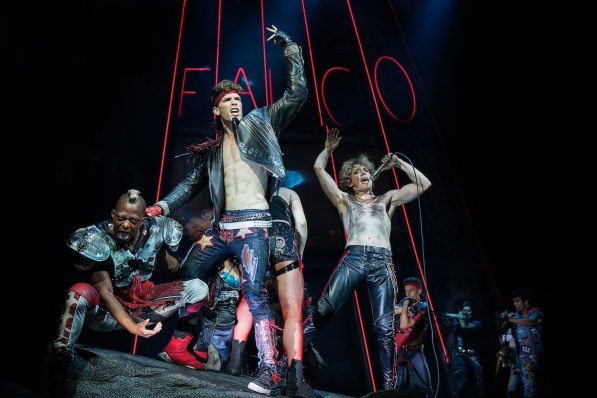
Tyler Wiltex Jones, William Branner, Andrew Polec. All photos: Little Fang.
Steinman, who’s responsible for the book, has conceived it in the vein of juke-box musicals like Moulin Rouge, where stand-alone songs are squeezed into a narrative, giving them a dramatic context that seeks to move their lyrics out of your head and into concrete situations. Seven of these songs may have been on the same album but their relation to one another, not to mention another dozen (some made famous by singers like Celine Dion), is uncomfortably suggested by being linked in a story very loosely inspired by J.M. Barrie’s Peter Pan. In fact, Steinman initially considered turning the album into a rock opera called Neverland.
Christine Bennington. 
This approach let’s us hear the indelible sounds of not only "Bat Out of Hell," but “All Revved Up with No Place to Go,” “Dead Ringer for Love,” “For Crying Out Loud,” “Heaven Can Wait,” “I’d Do Anything for Love (But I Won’t Do That,” “It’s All Coming Back to Me Now,” “Love and Death and the American Guitar,” “Making Love Out of Nothing at All,” “Objects in the Rear View Mirror May Appear Closer Than They Are,” “Out of the Frying Pan (And into the Fire),” “Paradise by the Dashboard Light,” “Two Out of Three Ain’t Bad,” “Wasted Youth,” “What Part of My Body Hurts the Most?,” and, “You Took the Words Right Out of My Mouth (Hot Summer Night).” A vivid lyric (regardless of whatever it may mean) in the last, “Would you offer your throat to the wolf with red roses,” becomes the hero’s running query to potential lovers.

Core elements of Barrie’s classic tale have been moved from Victorian London to a dystopian Manhattan, now called Obsidian, where the father of what we remember as the Darling family is transformed into Falco (Bradley Dean), a studly tyrant who looks more like a pop singer in the Tom Jones tradition than the billionaire CEO he depicts. His wife is the glamorous, alcoholic Sloane (Lena Hall), in conflict with her oppressive husband and concerned for the future of their only child.

That would be Raven (Christina Bennington), a rebellious, 17-going on-18 hottie. She resents her father’s restrictions against her leaving their home in a towering skyscraper, suggested by Jon Bousor’s perspective, multifloored setting, with the word Falco emblazoned across its façade. (Not quite Trump and Ivanka, but one can imagine the possibilities.)
Lena Hall, Bradley Dean. 
Peter Pan is envisioned in the person of Strat (the sensational Andrew Polec, who played it in London and Toronto), an 18-year-old in the rock star fashion of a young Roger Daltrey, with wild, blonde hair and eyeliner topping a tall, androgynously slender frame in black leather pants. He’s the leader of an orphaned gang of young scavengers, the Lost (think Barrie’s Lost Boys), living in the post-apocalyptic city’s abandoned tunnels and subways, and decked out in designer Bousor’s punk rock-meets-Mad Max duds, hairdos, and makeup. All are forever young because of something about their DNA having been frozen as a result of chemical warfare.

Among their singing and dancing members are Strat’s gay, child-like friend, Tink (Avionce Hoyle), jealous of Raven for stealing Strat’s affections, and the voluptuous Zahara (Danielle Steers), who also serves as Falco’s maid. Her romance with another gang member, Jagwire (Tyrick Wiltez Jones), his head shaved except for a blonde forelock, forms one of the subplots.

The muddy plot is further muddied by forcing the songs (when Gareth Owens’s sound design lets you catch the lyrics) to somehow fit the narrative, or vice versa. The action mainly concerns the conflict between Falco (supported by his thuggish militia) and the Lost, whom he believes represent a threat to the wellbeing of his daughter. Tink fares less well than Tinker Bell in the violent proceedings, but, after Strat returns from the dead (don't ask), peace comes to Obsidian.
Andrew Polec, Christine Bennington.
Bat Out of Hell clicks only when its famous songs take over from the pulpy book. To get to them, you have to endure the phony, bland, and unconvincing nonmusical material. With the songs so artificially made to serve the story, this way-overlong, two-hour and 40-minute rock opera-striving tale of teenage rebellion, romantic suffering, and marital discord grows more convoluted, clichéd, confusing, and contrived.

At the end, when the company sings—terrifically, but at notable length—the infectious “I’d Do Anything For Love (But I Won’t Do That),” it sounds great but, contextually, you may wonder what it is that everybody keeps declaring they won't do for love. Reading the lyrics won't necessarily clear it up.

The heavily rhythmic score gets its full complement of stage fog, dazzling (often strobe-driven) lighting (by Patrick Woodroole), confetti blasts, and athletic, music video-style choreography (“adapted by” Kena Gusthart), much of it using robotic, martial arts-type movements. Some numbers make colorful use of a fancy motorcycle and a retro convertible.
Andrew Polec, Christine Bennington.
Jay Scheib’s breathless direction keeps things hopping but his insistence on puerile sexual naughtiness, where line after line is accompanied by humping, licking, and otherwise genitally-directed behavior is irritatingly juvenile. Equally distracting is his backing so much of the action with televised projections of exactly what we’re already seeing live, with a camera operator following the actors around à la the manner of Ivo van Hove.

The cast, though, is first rate. Polec moves, acts, and sings with starbright magnetism and should have a bright future. Tony-winner Hall uses her great voice, good looks, and sense of humor to bring her cartoonish character to vivacious life (not least of which when she strips down to sexy skivvies). The macho Dean (who gets to perform in tight, pink scanties--oh, what actors have to do!) invests enormous passion and a huge voice into his every note and lyric. And Steers has an earthy, Cher-like sound and extraordinary charisma that deserve bigger billing. Bennington, from the West End company, matches gorgeous (although too-mature-for-the-role) looks and vocal talent with not quite so gorgeous acting chops.  

If you’re of a certain generation, the score will be familiar and probably beloved. Like some of the ecstatic, arm-waving fans swarming to the show like bats out of hell, you’ll dig the show's sex, thugs, and rock and roll. If so, three out of three ain’t bad.

New York City Center
131 W. 55th St., NYC
Through September 8

OTHER VIEWPOINTS:


Thursday, August 22, 2019

59 (2019-2020): Review: MAKE BELIEVE (seen August 21, 2019)

“Yesterday, When They Were Young”

Nowadays, it’s a little unusual to see a show with challenging roles for kids actually played by children, or at least by ones closely approximating the ages of their characters. This helps make Bess Wohl’s conceptually intriguing Make Believe, at Second Stage’s Tony Kiser Theater, quite compelling, especially since—under Michael Greif’s meticulous direction—the four child actors (despite a muffled word or two) are all so darned good.
Casey Hilton, Ryan Foust, Harrison Fox, Maren Heary. All photos: Joan Marcus.
Wohl, who has a thing for unique, theatrically clever setups (see Small Mouth Sounds, American Hero), places the four Conlee siblings—Chris (Ryan Foust), 12; Kate (Maren Heary), 10; Addie (Casey Hilton), seven; and Carl (Harrison Fox), five—in the house’s huge attic, excellently designed by David Zinn and exquisitely lit by Ben Stanton. This is their hangout, filled with dolls, a child-size table and chairs, and other playthings, including a substantial playhouse and a “fort” made of cartons and stuff.
Maren Heary, Ryan Foust.
It’s soon apparent that this is a place of refuge from their squabbling, often nasty parents, but it’s also where they create their own make-believe reality by replicating in childlike ways the troubled dynamics of their family life. Chris, who worries that his being "bad" may be why their mom left, and Kate, who fantasizes about being Grace Kelly’s child, are the insult-tossing, alcohol-guzzling parents; Addie is the put-upon baby, who treats her Cabbage Patch doll with the passive-aggressiveness she herself receives; and little Carl, who seems unable to speak, is their affectionate, barking dog.
Ryan Foust, Maren Heary, Casey Hilton.
This routine, already established when the play begins, becomes intensified when it slowly begins to appear—as per phone messages from a hair salon and a neighbor—that their mother has run off, leaving them unattended. Their father is off on one of his business trips and the kids must fend for themselves.

For all their childish innocence and tendency to live more in their imaginations than reality, these kids have a self-sufficient edge, never seeming too worried by their dilemma, and manage to fend for themselves (Chris even somehow managing to lug in sustenance from some outside source).

A series of brief episodes shows how they pass their unsupervised time together, engaging in the usual childhood cruelties and power jockeying, until, in a memorable moment, Kate, dressed in black (spot-on costumes by Emilio Sosa), lights a cigarette and coughs. Instantly, the scene shifts to the same spot 32 years later and young Kate morphs into her older self (Samantha Mathis, just right), also dressed in black and also coughing from a cigarette.
Kim Fischer, Susannah Flood, Samantha Mathis.
As in the childhood scenes, Wohl here expertly teases out her exposition until we learn why—a funeral—Kate, Carl (Brad Heberlee, effective), and Addie (Susannah Flood, richly expressive) are back in their attic playground. We discover something of the reason for their still living mother’s abandonment, what has happened to each of them, and how troubled they've become. Wohl, filling only 80, intermissionless minutes, is sparing with how much information she doles out. There are things we really would like to know more about but that she refuses to divulge.

A new character, a young man with the same name, Chris (Kim Fischer, nicely done), as his close friend, the oldest sibling, adds both dramatic tang and important information to the ensemble. Meanwhile, everyone (us included) ponders not only the ways in which the ghosts of childhood (the kids, wearing sheets, actually play at being ghosts) continue to haunt their grownup selves but just how much of those memories remain embedded in our consciousness, and how many have been submerged.
Kim Fishcher, Susannah Flood, Samantha Mathis, Brad Heberlee. 
The generally engrossing Make Believe is more concerned with its gimmicky premise, the creation of atmosphere, the revelation of character, and the sussing out of offstage events than it is about actual plotting. Essentially, the plot is little more than a group of well-off siblings being left alone to play make believe for a few days when their mom abandons them. Three decades later, having separated and become relatively successful, they reunite for a funeral and rehash their unhappy lives. Wohl’s writing is, thankfully, crisp and witty, and the beautifully realized performances make it all seem believable enough.

Perhaps the falsest note comes from Carl, no longer verbally constrained, but somewhat rude and otherwise engaged. This is conveyed when he talks to the others while conducting a Bluetooth business conversation on his phone, sometimes making it uncertain who’s being talked to. He then shifts gears, unconvincingly, to try out a speech he’s prepared for the occasion, getting so emotionally carried away that the scene resembles the eleven o’clock number in a Broadway musical. Heberlee is fine but the speech is weakly integrated into what precedes it, depriving it of organic necessity.
Samantha Mathis, Susannah Flood.
The issue of child abuse—a mother running away without insuring her children’s wellbeing—is dealt with only superficially. We may learn that the mother is still around three decades later, unforgiven, but her fate is otherwise left unresolved. Not all children will be as resourceful as the Conlees are in such situations, although the father’s return (heard, but not seen) ameliorates the situation somewhat.

Make Believe is, for the most part, thoughtful, touching, and even funny. Its premise is theatrically interesting, and it will have sentimental value for those in whom it sparks thoughts of the difference between who they were as kids and who they've become. Beyond that, its significance as drama begins to fade, suggesting it, too, will soon begin to lodge in the subconscious recesses of our brains.

Second Stage Theater/Tony Kiser Theater
305 W. 43rd St., NYC
Through September 15

OTHER VIEWPOINTS:


Wednesday, August 21, 2019

Sunday, August 18, 2019

57 (2019-2020): Review: SUMMER SHORTS: SERIES B (seen August 17, 2019)

"Coming up Shorts"


Series B, the 95-minute program of one-acts that alternates with Series A in the 13th annual Summer Shorts Festival of New American Plays at 59E59 Theaters, is an improvement over its series partner, reviewed here yesterday. Just a small improvement, but one takes one’s pleasures where one finds them. And, like Series A, it's a single gem, coming at the end, that makes the trip to 59th Street worthwhile. (See Series A for design credits.)
Blake DeLong, Christine Spang. All photos: Carol Rosegg.
It kicks off with “Lucky,” by the highly reputed Sharr White (The True, The Other Place), a two-hander that reads much better than it plays in this production, tediously directed by J.J. Kandel, artistic director of the festival's producer, Throughline Artists. Set in a motel on the outskirts of a small American town in 1949, it dramatizes the reunion of a long absent, depressed, World War II veteran, Phil (Blake DeLong), and his wife, Meredith (Christtine Spang).
Blake DeLong, Christine Spang.
Phil has been missing for six years, ever since going off to war. Although he and Meredith shared letters while he was in combat, his whereabouts and doings since then, aside from his being alive and unwounded, have been a mystery. Meredith has made a life for herself, unhappy as it is, boarding at the home of a woman whose son also has not returned. Still young and pretty, she’s not taken up with another man but has nonetheless become a topic of gossip among the catty townspeople.

Aware of Phil’s presence after his arrival to attend the funeral of his father (for some reason, another target of local gossipers)—his mother is still around—Meredith gets drenched rushing to him during a storm. However, his laconic, distant attitude does little to dry her off. The play, more a situation than a drama, chronicles Meredith’s desperate attempt to get her emotionally scarred spouse—he admits to being “broken”—to reconnect with her.

The piece, which opens to a montage of late 40s radio music and commercials (sound by Nick Moore), seeks to capture that moment in postwar America when the country was moving forward at a rapid pace—the boom in television sales symbolizes the national spirit—but some traumatized veterans, like Phil, found themselves adrift amid all the progress.

Very little of that spirit is embodied here, to a great extent because Phil’s taciturn, uncommunicative behavior suggests overweening self-pity, forcing us to wait for something to crack his shell. He doesn’t even bother to wipe the notably distracting shaving cream from his cheeks, nor does his stage partner, although such would have been a tiny symbol of her longing for intimacy.
Blake DeLong, Christine Spang.
Played at a snail’s pace, the lethargic production, for all its hints of Phil’s subdued ardor for Meredith, fails to express the electricity that must be coursing between a still youthful husband and wife who haven’t seen each other for six years. Much of the problem lies with DeLong, who, despite Phil finally having an emotional breakthrough, lacks the theatrical charisma to overcome what, as performed, comes off as little more than boringly solipsistic behavior.
Add caption
More appealing is Nancy Bleemer’s “Providence,” a light comedy set in that Rhode Island city (or the part designated as Northern Providence). There, Michael (Jake Robinson) and Renee (Blair Lewin), a young couple married for three and a half years, are attempting to sleep in his boyhood bedroom the night before his sister’s wedding. For whatever minor comic values it may have, Michael’s family is Italian and Catholic, while Renee is Jewish. A few moments—including their different views of the afterlife—point to potential marital discord but the play never goes there. For all intents and purposes, Michael and Renee seem like any other married couple, down to the personalized games they play with each other.
Blair Lewin, Jake Robinson.
Bleemer squeezes a few laughs out of Renee’s unfamiliarity with Michael’s typically colorful family members, her reactions to Providence’s relative provincialism (what? No allnight drugstores?), and, mostly, her need for Tampax when she feels her period coming on. The chief comic instigator, however, is a third character, Pauly (Nathan Wallace), the clueless, nervous groom who, hearing Renee and Michael’s voices, barges in to their bedroom at 3:00 a.m. to inquire about what he could possibly talk about with his bride.
Nathan Wallace, Jake Robinso, Blair Lewin.
The contrast between the goofy, overacted Pauly, and the cooler, better-educated couple (despite Michael's inability to tell a capon from a cornish hen) detonates a few, well-placed laughs, and the performances are satisfactory (Lewin’s carries the greatest sense of authenticity). However, director Ivey Lowe’s production favors a lowkey, naturalistic approach which, while it helps make the situation more believable and the humor more natural, also has a plodding rhythm that deflates the sprightliness necessary for material like this. 
Jack Mikesell, Ro Boddie. 
Neither of the first two plays, either in their writing or performance, succeeds in making you feel that what’s happening really matters much. The stakes never really seem that high, and we rarely feel invested in the characters or their plights. That, though, is the opposite of my response to Neil LaBute’s “Appomattox,” ironically titled after the location of one of the final battles of the Civil War, when Gen. Robert E. Lee, commanding the Confederate Army of Northern Virginia, surrendered to the Union forces. The word isn’t used but its relation to slavery, which is, is palpable.
Jack Mikesell, Ro Boddie.
Although I can’t say I’ve appreciated every LaBute one-act I've seen (a lot), he is, perhaps, the form’s foremost advocate and representative, and “Appomattox,” perfectly directed by Duane Boutté, shows him at the top of his game. It’s also given stingingly excellent performances by its two, well-cast actors. 
Ro Boddie, Jack Mikesell.
Frank (Ro Boddie), who is black, and Joe (Jack Mikesell), white, are bros picknicking and tossing a football around in a large, urban park. Joe finds something on Ancestry.com about a Georgetown University college guidance counselor having discovered that one of his own antecedents was a slave whose labors helped finance the very institution at which the counselor is now working.

Joe tells Frank about the students’ plans to raise funds to pay a modest sum as restitution to the descendants of all 272 slaves the place once sold in order to prevent its own financial demise. Joe thinks the idea admirable but Frank isn’t so sure, Aware of the sensitivities involved, he prefers not to get into the weeds about it. He'd rather leave the past in the past and move on into the future.
Ro Boddie, Jack Mikesell.
But Joe’s white, liberal guilt can’t shut the subject down. Frank is sucked into discussing it, even while knowing too well its immense complexities. His knowledge, to Joe’s surprise, gradually emerges as he begins to question just what price tag reparations might require, what form they might take, or, among other issues, just who would be deserving of them.

Frank's wokeness to the issues and deep sensitivity to them, begins to threaten his and Joe’s friendship. It temporarily shuts Joe down, until it doesn’t, moving the men’s relationship to a dangerously higher level when Frank tells Joe just what he personally would desire as reparations from his friend.

LaBute manages in the space of this brief play to condense the issue of slavery reparations into a dynamically tense, thoroughly dramatic, politically charged, and rhetorically informative experience. You may not agree with Frank’s arguments, during which he clearly strains to remain balanced and composed, but you'll be gripped by them and by the actors' emotional honesty as they wrestle with the problem.

Mikesell, as the guilt-ridden, painfully naive Joe, makes a wonderful foil for the remarkably controlled, simmering passions of Boddie.  His Frank, actually, is one of the most expertly realized performances of the season.

Sitting through the first two plays on this bill is small enough reparations to pay for the emotional and intellectual benefits of attending Neil LaBute’s expertly produced, masterful dramatization of a high-stakes issue presented in immediate human terms. It saves Series B from the heap and raises the bar for future one-act playwrights.

59E59 Theaters
59 E. 59th St., NYC
Through August 31

OTHER VIEWPOINTS:


Saturday, August 17, 2019

56 (2019-2020):Review: SUMMER SHORTS: SERIES A (seen August 16, 2019)


You've read the reviews. Now read the book. THEATRE'S LEITER SIDE, 2012-2013 A Brief Memoir and Reviews

"Short Shrift"


Returning for its 13th consecutive year at 59E59 Theaters is the Summer Shorts Festival of New American Short Plays, produced, as usual, by Throughline Artists, in two evenings of three one-act plays each: Series A and Series B. Also, as usual, this being my eighth encounter with the festival, the results are a decidedly jumbled bag, both in writing and performance.
Jordan Bellow, Bill Buell. Photo: Carol Rosegg.
Series A, which runs an intermissionless 90 minutes, includes three plays, Nick Payne’s “Interior,” Danielle Trzcinski’s “The Bridge Play,” and Courtney Baron’s “Here I Lie,” presented in that order. Each deals in some way with suicide (possible, potential, and planned), but little else connects them apart from Rebecca Lord-Surrat’s flexibly neutral setting.

Its main feature is herringbone-patterned panels, including a gate-like, upstage backing that opens and closes laterally as needed. Greg MacPherson provides some lovely lighting and the distinctive projection designs of Joshua Langman create a number of potent images. Amy Sutton designed the mostly everyday costumes.

“Interior” is an adaptation of Belgian playwright MauriceMaeterlinck’s (1862-1949) 1894 play of the same name. A leading figure in the late 19th-century Symbolist movement (he received a Nobel Prize in 1911), his plays (which included Pelléas and Mélisande and The Bluebird) were notable for the dreamlike, mystical staging opportunities they offered those seeking to break away from the growing influence of naturalism. “Interior” belongs to a series of one-acts Maeterlinck wrote in the early 1890s, the others being “The Blind” and “The Intruder,” pervaded by a tone of subconscious dread, punctuated by silences and moody lighting.
Jordan Bellow, Bill Buell. All photos: Carol Rosegg.
What plot there is in “Interior” concerns an Old Man (Bill Buell) and a Stranger (Jordan Bellow), standing outside the home of a family to which they’ve come to report the possibly self-inflicted death by drowning of their daughter. Standing in the cold, watching the soon-to-be-distraught family inside their warmly lit home (seen as a projection), the men hesitatingly discuss how best to deliver the tragic news, which will shatter the happiness of those inside.

Finally, as the mourning townspeople approach, the Old Man ventures forth, his emotions wordlessly presented as he stands, spotlighted amid falling snowflakes. No words are necessary to express either his feelings or those of the family, which, in this version, we don’t see.
Mariah Lee, Jordan Bellow, Bill Buell.
Director Rory McGregor’s production, apart from several effective lighting and projection effects (using paintings by Sharon Houner), fails to bring much emotional or dramatic interest to Maeterlinck’s intentionally static drama. The acting throughout (which includes appearances by Joanna Whicker and Maria Lee as young women) is bland. It’s easy, in fact, to see why Maeterlinck himself intended that it be acted by marionettes. Only the veteran Buell’s sad, hangdog expression offers a glimpse into the play’s interior world.
Mariah Lee, Joanna Whicker, Bill Buell.
Although a more creative staging might inject “Interior” with greater interest, one wonders, given the festival’s focus on “new American short plays,” why, apart from its place in theatre history, this 125-year-old Belgian drama (written in French) was deemed worthy as a Summer Short.
Christopher Dylan White, James P. Rees.
“The Bridge Play,” a dark comedy with a somewhat lighter attitude, shows John (James P. Rees), a forlorn, ordinary, middle-aged guy, preparing to jump off the George Washington Bridge. Before he can leap, he’s accosted by a late-teens driver, Alex (Christopher Dylan White), who gets out of his car (as if you can just park on the GWB) to intervene (or make a viral video). Naturally, John soon finds himself bonding with his innocuous, mildly depressed, young savior.
James P. Rees, Christopher Dylan White.
The barely humorous humor comes from such things as Alex’s juvenile views of middle-aged sex and a phone call from a friend with a clogged toilet that requires plumbing instructions from John. An odd twist at the end involving the New York Yankees makes no sense but that’s the least of this mediocre play’s problems.
James P. Rees, Christopher Dylan White.
A somewhat similar situation informs Luv, Murray Schisgal’s 1964 hit Broadway comedy (later made into a movie). Here, however, playwright Trzcinski is unable to wring sufficient comedy or pathos out of the setup, nor is director Sarah Cronk able to light enough of a fire under her actors to overcome the play’s inadequacies. Rees, heavily mustached, shows sparks of histrionic and comic life, but White is dull, sometimes mumbling his words inaudibly.
Robbie Tann, Libe Barer.
Far more memorable, both as a play and production, is Baron’s two-hander, “Here I Lie,” a title that might imply words on a gravestone or the fabrications that inform the lives of its protagonists. Maris (Libe Barker) is an attractive young editor at a major publishing house. Joseph (Robbie Tann) is a bearded, wool-capped nurse who switched his specialty from geriatric care to the better-paying neo-natal, making him, as a male, a rarity among baby nurses.
Libe Barer, Robbie Tann. 
Written in a manner reminiscent of the intertwined monologues in the currently running Little Gem at the Irish Rep, “Here I Lie” allows each character to tell their story both to us, the audience, and to the other party, with each reacting to the other’s narrative but only actually connecting toward the end.
Libe Barer, Robbie Tann.
Maris is able to gain sympathy and professional advancement by deliberately passing herself off as dying from cancer. This is something she realizes when the only way she can get her boss to accept a second-rate memoir by a cancer survivor is to suggest she herself is a victim of the disease. Her deceptions can only lead in one direction.

Like Maris, Joseph also fakes being ill, until we're not sure where the faking ends and the truth begins. He works diligently to make his medical problems palpably evident by various self-destructive means, baffling his doctors by how cleverly he manages to seem really sick.

Both characters describe their symptoms in detail, including the citing of technically specific conditions and medication. Maris’s narrative is preoccupied with her deceiving her employer, friends, and family, while Joseph’s focuses on his obsessive affection for a tiny, premature baby he cares for, names after himself, and hopes to adopt, even if it means marrying the child’s skanky, unwed mother.
Libe Barer, Robbie Tann.
Some of this fails the plausibility test, and it contains digressions (as in Joseph’s tale of a relationship with a sexy woman of disparate leg length). However, the writing is always absorbing, the actors thoroughly invested and believable, and Maria Mileaf’s direction perfectly in tune with Baron’s narrative style. Even the implausible comes to seem plausible and you appreciate the conviction with which such mendacity can hold your interest.

Up next, Series B.

59E59 Theaters/Theater B
59 E. 59th St., NYC
Through August 31

OTHER VIEWPOINTS:

Friday, August 16, 2019