Showing posts sorted by relevance for query hill town. Sort by date Show all posts

Wednesday, September 4, 2013

83-87: Review of THE HILL TOWN PLAYS: SCARCITY, ASHVILLE, WHERE' WERE BORN, KILLERS AND OTHER FAMILY, STAY


  83-87: THE HILL TOWN PLAYS:

SCARCITY; ASHVILLE; WHERE WE’RE BORN; KILLERS AND OTHER FAMILY; STAY


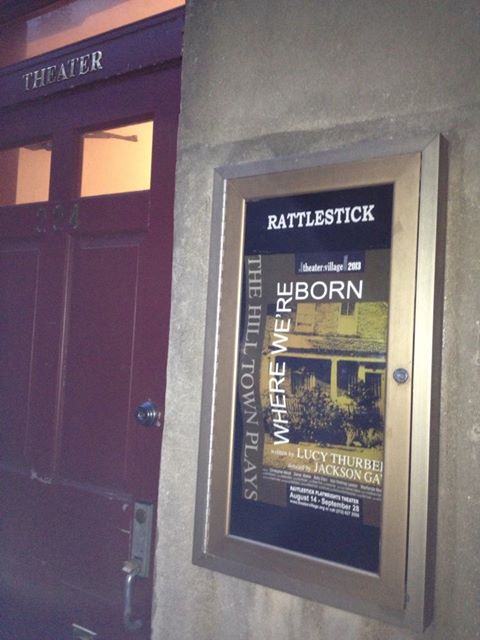
The Rattlestick Playwright’s Theatre production of the five plays in Lucy Thurber’s HILLTOWN PLAYS cycle represents a bold risk for a small Off Broadway company; regardless of my or other commentators' critical response, it is a venture that deserves loud applause for its artistic audacity. The plays are being produced at four important Greenwich Village venues, the Cherry Lane Theatre (SCARCITY and ASHVILLE), the Rattlestick itself (WHERE WE’RE BORN), the Axis at One Sheridan Square (KILLERS AND OTHER PEOPLE), and the New Ohio Theatre (STAY). Aside from the sheer logistical problems of putting on five shows simultaneously at four different theatres, the courageous artistic director, David Van Asselt, must have worried about how the plays, which were not specifically written in tandem but which are all closely related, would work together, provided audiences went to see all five of them. That last point is very important, of course, since someone could, for example, see one, be disappointed, and then skip the rest. This is only one of the multiple marketing problems the company must have faced.


Rattlestick Playwrights Theatre, on Waverley Place, where WHERE WE'RE BORN is playing. 
 

New Ohio Theatre, Christopher Street, where STAY is playing. 

            Four of the five plays have been seen in New York before (three in Rattlestick productions), so the only non-revival is ASHVILLE. The original productions were offered as individual plays, not as part of a cycle. Because of the cycle programming, some spectators will choose to see them in the chronological order with which they chart the story of the central female character. She is the same person in the SCARCITY and STAY, except at different ages, but Ms. Thurber gives her different names, different circumstances, and different surrounding characters in the other three plays; with a small number of exceptions, these differences are not particularly great. Since they were apparently conceived as stand-alone plays, they can be seen and appreciated individually, without seeing the whole cycle; they can be seen out of order; or they can be visited in the chronological sequence of the heroine’s life, which is how I viewed them and why I would recommend that procedure for those not put off by my comments below. The chronological sequence would be SCARCITY (set in 1992), directed by Daniel Talbott; ASHVILLE (set in 1997), directed by Karen Allen; WHERE WE’RE BORN (set in 2003), directed by Jackson Gay; KILLERS AND OTHER FAMILY (set in 2009), directed by Caitriona McLaughlin; and STAY (set in 2013, although taking place in 2007 when first produced), directed by Gaye Taylor Upchurch.


Deirdre O'Connell and Gordon Joseph Weiss in SCARCITY. Photo: Sandra Couldart.


Gordon Joseph Weiss, Natalie Gold, Will Pullen, and Deirdre O'Connell in SCARCITY. Photo: Sandra Couldart.


Izzy Hanson-Johnston and Will Pullen in SCARCITY. Photo: Sandra Couldart.  

All five plays are covered in this overview, so I’ll avoid discussing each in detail and confine myself to more general remarks. The central female figure in SCARCITY and STAY, the bookend plays, is Rachel, first seen as a rather mature 11-year-old (Izzy Hanson-Johnston) and then as a 32-year-old college professor and promising writer (Hani Furstenberg) at a small, elite New England school. In ASHVILLE she’s Celia (Mia Vallett), a 16-year-old high school student; in WHERE WE’RE BORN she’s Lilly (Betty Gilpin), a 19-year-old college student; in KILLERS AND OTHER FAMILY she’s Elizabeth/Lizzie (Samantha Soule), a 28-year-old doctoral candidate, now living in New York. All these characters hail from a rural area among the “hill towns” of western Massachusetts, referred to sarcastically by someone in STAY as Massatucky, a dig at the expense of the region's widespread poverty and the predilection of its white-trash residents for indiscriminate swilling, smoking, screwing, and swearing. At least that’s how many of the characters in the first four plays are depicted.


James McMenamin and Mia Vallet in ASHVILLE. Photo: Sandra Couldart.


Aubrey Dollar and Mia Vallett in ASHVILLE. Photo: Sandra Couldart.


Mia Vallet, Joe Tippett, and Tasha Lawrence in ASHVILLE. Photo: Sandra Couldart. 

In SCARCITY and STAY, Rachel’s closest bond is with her brother, Billy, a 16-year-old high school "brainiac" in the first play (Will Pullen) and a 37-year-old lawyer (McCaleb Burnett) in the second. For the teenaged Celia in ASHVILLE, her principal male friend is her lover, Jake (Joe Tippett), a blue-collar worker who appears to be in his 20s and wants to marry her, while for Lilly in WHERE WE’RE BORN it’s her brother-like cousin Tony (Christopher Abbott); and for Lizzie in KILLERS AND OTHER FAMILY it’s an actual brother again, this one a screw-up fugitive from justice called Jeff (Chris Stack) who hopes to flee to Mexico with his buddy, Danny (Shane McCrae), who has brutally beaten a girl to death. Except for Tommy (Brian Miskell), a wealthy college boy in STAY, all the men would easily match many of the items listed on Jeff Foxworthy’s list of 300 things that define a redneck. They curse incessantly, chain smoke (both cigarettes and weed), pour Jack Daniels down their gullets as if it were Poland Spring, spend their spare time (or all of it) bullshitting and fighting, and wearing their racism and infidelities like badges of honor. Billy, whose academics are good enough to get him into Deerfield and Harvard Law, manages to extricate himself from this backwoods bog, but even he loses control over his instincts and slides back into the primordial ooze; the wonder is that he managed to become a successful lawyer in a high-powered firm before he erupted over a triviality and struck his boss’s daughter.

 
From left: Christopher Abbott, MacKenzie Meehan, Betty Gilpin, and Daniel Abeles in WHERE WE'RE BORN. Photo: Sandra Couldart.


Betty Gilpin and MacKenzie Meehan in WHERE WE'RE BORN. Photo: Sandra Couldart. 

The only other family member who appears in multiple plays is the heroine's loose-mouthed, loose-living, but, in her own perverse way, loving mother, called Martha in SCARCITY and Shelly (Tasha Lawrence) in ASHVILLE. She doesn't show up in person again, although she's referred to, but in STAY she is constantly calling and leaving messages on the answering machine. Her prerecorded voice belongs to Deirdre O'Connell, who plays her in SCARCITY. 


Shane McRae and Samantha Soule in KILLERS AND OTHER FAMILY. Photo: Sandra Couldart.


From left; Samantha Soule, Shane McRae, Aya Cash, and Chris Stack in KILLERS AND OTHER FAMILY. Photo: Sandra Couldart. 

There's a strong core of talented New York actors involved in this super-ambitious project, from young and upcoming men and women to more experienced veterans, such as Ms. O’Connell and Mr. Weiss. While everyone—including, of course, the directors—works hard to make the material live and breathe, the results are often uneven, with emotional transitions bordering on the kind of intense but not wholly convincing mixture of reality and theatricality seen in classroom improvs. The acting occasionally veers into excess, most notably in the case of Pamela Shaw, who plays Gloria, the garishly outlandish wife of Louis (Michael Warner), the cop, in SCARCITY. The older heroines are acted by physically lithe, vocally strong, and emotionally sensitive actresses; sometimes they are excessively sensitive, I might add, given the need to express such a stockpile of insecurities. These insecurities involve the women's growing sexual awareness, which takes most obvious form in their interest in other women: these lesbian lovers are represented by Amanda (Aubrey Dollar), married to Joey (George West Carruth), in ASHVILLE; Franky (MacKenzie Meehan), Tony's lover in WHERE WE'RE BORN; Claire (Aya Cash), Lizzie's girlfriend/roommate in KILLERS AND OTHER FAMILY; and Julia (Mikaela Feely-Lehmann), Rachel's "creepy" student in STAY.


Hani Furstenberg and Brian Miskell in STAY. Photo: Joan Marcus.


Jenny Seastone Stern, Hani Furstenberg, and Mikaela Feely-Lehmann in STAY. Photo: Joan Marcus.

 
McCaleb Burnett and Hani Furstenberg in STAY. Photo: Joan Marcus. 

The almost exclusively unpleasant male characters are well played. Still, too many of the younger men look like they've been spending all their off time when not boozing, cruising, or schmoozing at the gym. As might be imagined, shirtless scenes abound, but several women also get to display their toned physiques. There is also a striking (no pun intended) amount of violence on display, male on male, male on female, and female on male. The fights can be pretty brutal and the actors in some instances should be getting hazard pay. Uncledave's Fight House staged the violence in each of the first four plays, while J. David Brimmer handled the far less arduous fisticuffs in STAY, where the most dramatic slugging occurs offstage.

 Among other physically demanding requirements are the sex scenes, both male-female and female-female; although Rachel in SCARCITY is too young for such hanky-panky, her older manifestations engage in some heavy-duty lovemaking, often in passive-aggressive scenes where she resists and then succumbs to her passion for another female. But her sexual ambivalence is also expressed through several aggressive engagements with men; one vigorously staged scene between Lizzie and Danny, the murderer, borders on rape before she chooses to complete the act. Play after play refers to the physical attractiveness of the women, both in a complimentary way and, when the speaker comments on herself, as an attempt at self-assurance.

Another thread is the alleged smartness of the heroine, referred to frequently as if to underline the tragedy of her being a prisoner of her domestic circumstances while having the potential to smash the chains binding her to her roughneck world. The words “smart” and “stupid” (and their equivalents) bounce through the lines like a rubber ball. Playwright Thurber, however, must do more to convince me that the heroine is smart than to have her or others tell me she is, or to cite the books she’s reading or has read; for all the talk about the intelligence of Rachel-Celia-Lilly-Elizabeth, only Rachel as a child seems wise, and that's partly because the things she says are not what you'd expect to hear from someone so young. The older versions of the character constantly make questionable choices that belie her supposed brilliance. I've read in interviews where Ms. Thurber defends her heroine's continuing to loyally support the folks she grew up with, regardless of their behavior. Perhaps this might be true for her immediate family, but I find it hard to accept that she'd still be so strongly attached to the ragtag bunch of losers represented in the plays by these mostly ambitionless drunks, psychopaths, and even killers. 

I don’t know Lucy Thurber’s personal biography, but there’s a strong impression that the plays are autobiographical accounts of her own struggles to overcome and flee from an environment of alcoholic, crude, and physically violent parents. When mom and pop aren’t behaving like cretins, there are enough other specimens around to serve as sterling replacements. Perhaps I’m going out on a limb here, but the plays suggest that Ms. Thurber has written them to exorcize her personal demons, to somehow escape through dramatic art the horrendous world of her childhood and upbringing. As one watches the plays over the course of a week and sees the same patterns of inappropriate behavior enacted in different forms, with a band of characters who gradually morph from individuals into stereotypes, it becomes difficult to avoid the writing’s therapeutic purpose. As Lizzie in KILLERS AND OTHER FAMILY admits, “There’s something wrong with me.” This is not necessarily a bad thing, as much great theatre stems from personal anguish and suffering. But to be great art it needs to transmute that pain onto a higher, more universal level. Instead, this cycle asks that you spend 8 to 10 hours over the course of a week immersed in the most disturbing moments of the victim’s life; when that life seems little more than a ground hog’s day repetition of similar traumas happening to a not especially interesting person, at different stages of her life, you want to escape from the theatre just as much as she does from the world she’s bound to.

The plays are thinly plotted, most of them lacking sharp central conflicts, and seem more like extended situations that give rise to emotional reactions than conventional dramas with strong narrative arcs. The most decisively dramatic is SCARCITY, whose principal thrust concerns a young female schoolteacher, Ellen (Natalie Gold), who takes a deep interest in promoting Billy’s move from his local high school to Deerfield Academy; her interest seems predicated as much on Billy’s academic promise as on her repressed sexual feelings toward him. (The play contains other pedophiliac hints stemming from the behavior of Rachel’s loutish, unemployed dad, Herb [Gordon Joseph Weiss].) The desperate attempts of Louis the cop to seduce Billy and Rachel’s slatternly mother, Martha (Didi [Deirdre] O’Connell), even provide a subplot. While the play is melodramatically overwrought, it held my interest far longer than the remaining works, a couple of which (ASHVILLE and STAY) proved decidedly soporific. Each has at least one or two potent scenes, but the kind of plotting that creates continual interest in what happens next is sacrificed for more momentary, and not always believable, theatrical effects. Arguments, for example, frequently leap out of nowhere, sparked more by the need to enliven the action than because of organic need. By and large, dialogue--often crisp and colorful, but just as often dull and prosaic--character relationships, and emotional states of mind take precedence over gripping storytelling.

Naturalism is the prevailing mode, but in STAY, Ms. Thurber opts for the surrealistic presence of an alter ego for Rachel called Floating Girl (Jenny Seastone Stern), a sort of psychological Tinker Bell, hanging out on top of bookcases and the like, offering verbal and physical reactions to Rachel’s conflicts (in a manner slightly reminiscent of the invisible friends in FIRST DATE). Floating Girl’s presence also permits the playwright to inject ambiguously “poetic” dialogue into the script. Both Floating Girl and the poetry, which try to raise the stylistic bar in Ms. Thurber’s writing, are dead ends and would be better off floating elsewhere.

The physical elements of the productions are all acceptably realized, but with nothing markedly original about any of them. Raul Abrego designed the set for SCARCITY, and Rachel Hauck designed STAY, but John McDermott created the other sets. SCARCITY takes place in a hardscrabble house interior; ASHVILLE mixes three contiguous row house apartments, no walls separating them, with a center area shared by the two of the apartments;  WHERE WE’RE BORN offers another seedy interior, but it  has a small exterior area outside the front door, and its wall-less bedroom is set off by several trees presumed to be outside; KILLERS AND OTHER FAMILY bumps up the decorative aspect with its realistic, if familiar, depiction of a white New York apartment whose French doors are adorned with multicolored panes; and STAY, which includes polished wooden flooring on two levels, replaces walls and with bookcases, doors, and a decorative window to establish a faculty office at one side that cleverly opens up to create an apartment when a bookcase unit is rolled off to one side.  

Ms. Thurber has said that she sought to trace the evolution of her female lead over time. But, for me, the impression grew I was watching a single play in multiple iterations. As Billy says to Rachel in STAY, where her writer character’s work is based on her own experiences, “Your life’s a sheet of paper that’s been copied too many times.” In aggregate, the cycle expresses the confusion and agony of a young woman described as talented and bright seeking to abandon her harmful, closed-minded, poverty-stricken environment and find a better place in the world where she can free both the social person and the literary artist locked inside; unhappily, much as she tries to escape, that past will always come knocking at her door, or more likely, walk in without knocking.

            Ms. Thurber has said that the plays are "about the culture of poverty in America." Naturally, class differences pursue her heroine as well, and there are frequent clashes between the working-class world she comes from and the bourgeois life she seeks while constantly being reminded of her roots. Ms. Thurber herself encapsulates the essential dilemma of the plays in STAY, when Rachel declares: “Poor boys, poor girls, drinking it up in the country with abusive parents. Violence equals love—love equals violence—lack of connection—lack of hope—no escape—no escape—no escape—no escape.”  Although the conclusion to STAY suggests some sort of redemption and a brighter future, it is via a theatrical convention of magic realism and not as the result of the natural course of events.

            After a week in the company of these cringe-worthy people, I found myself sharing Rachel-Celia-Lilly-Lizzie's longing to flee, even though the playwright has done her best to dramatize not only the characters' flaws but whatever decent qualities they might have, however miniscule. Having watched five plays in which normalcy is to be angry and hostile, to start arguments and fights on the slightest pretexts, to suck tobacco and drown in beer and whisky, and to do the nasty whenever opportunity knocks, I too wanted to run away and never look back. When the cycle ended I was able to find release by stepping into the street and jotting down these comments. Rachel-Celia-Lilly-Lizzie, however, will be forever encased in the emotional amber of Lucy Thurber’s HILL TOWN PLAYS.

           Postscript: I'm aware, of course, that other theatregoers will feel completely the opposite. On leaving one of the shows I ran into a respected acquaintance who writes theatre criticism for a local outlet. He and his companion, who had just finished the cycle, asked me and mine, who still had two plays to go, what we thought. We expressed our middling responses and were greeted with wide-eyed stares of astonishment. His friend kept saying, as she processed our reaction, "How interesting!" as if only people from Mars could have felt as we did. In fact, she walked with me to the subway, detained me on the sidewalk, and held me there as we argued the merits of what we'd seen.  I appreciated her passion for the plays, but, as I descended the subway steps, I continued to feel that, thus far, at any rate, THE HILL TOWN PLAYS were an uphill climb. And the climb, I'm afraid, continued to the end.


Sunday, September 12, 2021

1. (2021-2021). Review: PASS OVER (seen September 11, 2021)

 "Black Lives Shattered"

On Saturday afternoon, September 11, 2021, I saw
Pass Over, my first show since March 10, 2020, eighteen months earlier, when I saw The Girl from the North Country just before the pandemic closed down New York’s theatres. (I’ll get to Pass Over in a minute.) I was as nervous at entering a crowded theatre as I was taking the subway from South Queens. I even wore two masks on the train (where a handful of jerks were unmasked) and in the theatre.

Namir Smallwood, John Michael Hill.

I was cautiously early, so, with the weather as beautiful as it was twenty years ago on that more fateful 9/11, I exited the subway at 34th Street and walked to the August Wilson Theatre on 52nd. Having visited Manhattan only once during the lockdown, this was my chance to reunite, unmasked, with the midtown I’d missed for so long, and, with traffic considerably lighter than before, breathing what felt like cleaner city air.

The cityscape had changed a bit. Scaffolding, still ubiquitous, covered different facades, familiar storefronts were shuttered, new businesses had opened, and excavations, like the one at 34th and 8th, replaced landmark buildings. But most eye-catching was how slender the 8th Avenue crowds were, especially after I crossed the nearly deserted 42nd Street.

Those fabulous side-streets in the forties, with their marquees blaring the names of prior and coming shows, were nearly empty. Back in the pre-Covid days you needed a bulldozer to clear your way at matinee time in the theatre district. On Saturday, you could have roller-skated or scootered between the pedestrians and still kept your social distance.

Namir Smallwood, John Michael Hill.

Further, the surprisingly small queue showing its IDs and vaccination proof outside the Wilson was echoed by the ghost town gloom pervading the theatre's auditorium. The recently reopened musicals, Hadestown and Waitress, are said to be doing boffo business (Waitress even broke a single-performance record), but Broadway audiences seem to be giving Pass Over a pass over of their own, at least at the performance I attended.

John Michael Hill.

Perhaps that’s because Antoinette Chinonye Nwandu’s provocative, but ultimately disappointing, avant-garde comedy-drama, which opened three weeks ago, itself feels so forlorn on Broadway. This may have something to do with its being available in a Spike Lee-directed streaming version on Amazon Prime. Pass Over has a solid pedigree, of course, including a premiere at Chicago’s Steppenwolf Theatre and a highly praised staging with this very same cast and director at New York’s LCT3, Off Broadway at Lincoln Center, before the pandemic descended. I saw neither although I’m aware that there have been various revisions—especially of the ending—among the several productions the show has received. Not being qualified to comment on these, I’ll let them pass.

However, even a rave by Jesse Green in the Times hasn’t been able to overcome the box office lassitude toward what I assume—in spite of the favorable reviews—to be less than favorable word-of-mouth about a play that would surely work more potently on an Off-Broadway stage, like the LCT3’s. At the Wilson, at least most of the time, it looks undernourished.

Namir Smallwood, John Michael Hill.

Lots of people obviously favor Pass Over, Broadway’s first new play since it closed up shop. It has a very decent 78 on the Show-Score review aggregating website. And sixteen individual and institutional producers are designated at the top of the Playbill credits. It deploys socially relevant themes, including the urge to escape from economic oppression, the curse of plagues, and, most ferociously, American race relations, particularly the monstrous problem of white on Black police brutality. Nwandu’s distinctive approach blends gritty realism with dreamlike surrealism in a script with obvious reflections of Beckett’s absurdist masterpiece, Waiting for Godot.

But, despite its woke goals, its superb three-man, four-character performance (one actor plays two roles), and Danya Taymor’s inventive staging, it fails to be more than momentarily engaging, and makes more of a cerebral than an emotional impact.  

Jon  Michael Hill, Gabriel Ebert, Namir Smallwood.
Moses (Jon Michael Hill) and Fitch (Namir Smallwood) are the Didi and Gogo avatars, two Black street dudes on a generic ghetto street corner designated as such by designer Wilson Chin’s placement, against a dead black backdrop, of a milk crate, a tire rim, a tire, and, looming like a gallows, and a street lamp. (Near the end, the background undergoes a mystical transformation.)

Moses, whose name fits his leader-like aspirations, and Fitch, his follower, fill their time with petty preoccupations (including Fitch often working away at a foot problem), role-playing, games (as per the vaudeville-like shtick in Godot), and lamenting the sorry state of Black men in a world where fear of the police (the “po-po”) haunts their every thought. Moses wants to lead Fitch out of this miasma by leaving the block—a stand-in, it’s implied, for the plantation—to which conditions have enslaved them. In other words, to “pass over,” as in the Biblical tale of the Jews fleeing to the Promised Land. Toying endlessly with their baseball caps, like Didi and Gogo with their bowlers, they speak in artfully heightened, crude street dialect, riddling their dialogue with countless repetitions of the n-word.

Perhaps some will argue that this insistent usage has some higher literary and sociological value that I’m unable to appreciate, but hearing it so often on the stage (as on the subway) becomes increasingly uncomfortable, regardless of whatever point it’s intended to make. There is even a scene in which a third character, a lily-white man named Mister (Gabriel Ebert), who has entered some time before, confronts Fitch and Moses about it, in the usual debate about why is it okay for Black people to call one another niggers while a white person isn’t even allowed to use it in a non-offensive way.

Mister, by the way, is the name in the program, but what I kept hearing was “Master,” which fell on Moses and Fitch’s ears like the explosive crack of a slave-driver’s whip. [See my note on the name, below.] One might say that if Fitch and Moses are ultimate archetypes of smack-talking street guys, Mister/Master (it’s not explained if this is his last name or his first), nattily dressed by Sarafina Bush in an off-white suit, is perhaps the ultimate stereotype of the well-meaning, effete, polite, educated, goofy, gee whiz kind of white man, the kind who would never knowingly say something inappropriate. In fact, his carefully articulate vocabulary is peppered with gollies, goshes, and similar vacuities. Benign as he is, it's impossible not to feel an undercurrent of tension in his presence. (Interestingly, Ebert’s understudy is actress Andrea Syglowski, whose mere appearance would likely open the play up to gender-related nuances.)

[Note: In the script, which I received after this was posted, the character is listed as "Mister," just as in the program, but he does indeed pronounce it as "Master." When--in the playwright's lowercase style, Moses says, "yo mister," Mister answers that it's "master," repeating, "master, my name is master." Just because I heard correctly doesn't mean I'm not still confused.]

Mister (or whatever) encounters Moses and Fitch when he gets lost on his way to his ailing mother’s home, carrying an endlessly giving basket of food, like Red Riding Hood on her way to grandma’s. He is as exaggerated a symbol as the other character Ebert plays, a cop named Ossifer (a cross, perhaps between Officer and Lucifer?), who soon betrays his true, blue colors as the representative of police oppression.

Gradually the play moves ever further into the realm of fantasy, mingling images of violence (fight direction by J. David Brimmer), religion, and death (passing over, get it?). Posterior male nudity makes two unnecessarily distracting intrusions as well.

Hill and Smallwood offer vivid, engaged performances, shifting deftly from their street personas to affected “white” speech during several satirical routines. Ebert, a gifted musical theatre actor who gets to warble ironically intended songs like “Somewhere over the Rainbow,” “Oh, What a Beautiful Morning,” and “What a Wonderful World” (which latter the others join in on as Mister strums a ukulele), is delightfully versatile in portraying both the effete visitor and the ruthless cop. And Taymor (good genes, obviously; Julie Taymor is her aunt) comes through with her handling of the play’s rhythms and the choreographic way she has with her actors.

But these are not enough to lift this earnest effort out of the head-scratching doldrums into which it sinks before its ninety minutes are concluded. Pass Over is here for only a limited run and, since there’s presently no competition from any straight play on Broadway (the one-man Lackawanna Blues is soon to open), you might want to read some other responses before deciding whether or not to give it a pass.

Pass Over

August Wilson Theatre

245 W. 52nd Street, NYC

Closes October 10


Friday, May 1, 2015

202 (2014-2015): Review of THE VISIT (seen on April 29, 2015)

“The Unkillable Chita Rivera”


When I was in college in the late 1950s and early 1960s it seemed like barely a season went by without a major New York production of some contemporary European playwright. I still have the paperbacks I bought of plays by that era’s leading Continental dramatists: Anouilh, Giraudoux, Brecht, Durrenmatt, Frisch, Ionesco, and so on, usually in editions published by Hill and Wang or Grove Press. Nowadays, however, important new European plays rarely grace Broadway’s stages, much less Off Broadway’s, and even revivals of the best postwar plays are extremely limited. While technically not a revival, of course, the new tragicomic Broadway musical, THE VISIT, based on Swiss author Friedrich Durrenmatt’s play of that name (Der Besuch der alten Dame in German, meaning The Visit of the Old Lady), provides a Reader’s Digest version of the original that gives a pared-down sense of the playwright’s intentions.
Alfred Lunt and Lynn Fontanne on the Playbill cover for the 1958 production of THE VISIT.
Written in 1956 and produced on Broadway in 1958, THE VISIT was the inaugural production of the Lunt-Fontanne Theatre, with the theatre’s namesakes, Alfred Lunt and Lynn Fontanne, in the leading roles, under Peter Brook’s direction. As can be imagined, the presence of those beloved stars in the theatre named after them was a glorious moment, especially since Durrenmatt’s socio-politically probing play (allegedly inspired by Swiss neutrality during World War II) allowed them to escape the rather limited confines of the drawing room comedies on which they’d been spending too much of their talents in recent years. Chita Rivera, the star of the new musical version of the play, directed by John Doyle, with a score by John Kander and the late Fred Ebb (CABARET, CHICAGO), and a book by Terrence McNally, similarly offers an occasion for celebration, since this glamorous grande dame of musical theatre, the original Anita in WEST SIDE STORY (1957), can still bring it, even at the age of 82.
Foreground: Chita Rivera. Photo: Thom Kaine.
THE VISIT has been kicking around for a decade and a half. Originally, Angela Lansbury was expected to open in it on Broadway in 2001, but that was shelved when her husband died. Ms. Rivera replaced her for a Chicago opening that year, with Frank Galati directing, but 9/11 interfered with its hoped-for move to Broadway. New York’s Public Theatre was set to produce it with Ms. Rivera and Frank Langella in 2003, but withdrew for lack of backing. Ms. Rivera headed a 2008 staging at Arlington, VA’s, Signature Theatre, and there were later concert versions before a production close to the one at the Lyceum opened at the Williamstown Theatre Festival. It was directed by Mr. Doyle, and included Ms. Rivera and several of the same actors now supporting her, including Roger Rees. Ms. Rivera’s long relationship to the material pays off in a performance of depth, nuance, and superlative theatricality.  
From left: Roger Rees, John Riddle, Michelle Veintimilla. Photo: Joan Marcus.
Durrenmatt’s three-act play has been condensed by Mr. McNally into a one-act running an hour and thirty-five minutes, just long enough to make its point without belaboring it. Characters have been excised along with a number of plot incidents. The story has been reduced to its essence: The town of Brachen (Güllen in the original), “somewhere in Europe,” has fallen on hard times, but sees in the unexpected visit of a former resident, Claire Zachanassian (Ms. Rivera), the possibility of recovery, since Claire is now the world’s wealthiest woman, the result of her marriages to a series of wealthy men. The town’s leaders are represented by the mayor, Peter Dummermut, (David Garrison); his wife, Annie (Diana DiMarzio); the schoolteacher, Friedrich Kuhn (Jason Danieley); the police officer, Otto Hahnke (Aaron Ramey); and the priest, Father Josef (Rick Holmes).
From left: Chita Rivera, Chris Newcomer, Tom Nelis, Matthew Deming. Photo: Thom Kaine.
Also anxiously awaiting Claire's arrival is Anton Schell (Roger Rees), a shabby old shopkeeper who, in youth, was Claire’s lover, but who, after impregnating her, lied about his paternity, leading to her banishment as a prostitute and, eventually, to the child’s death. Claire’s heritage as both a Jew and Gypsy has been added to emphasize the townspeople’s ethnic prejudices; it’s not in Durrenmatt’s play. Anton is now married to Matilde (Mary Beth Peil), and his grown children are Ottilie (Elena Shaddow) and Karl (George Abud). He fantasizes about rekindling his youthful affair when he sings “I Know Claire” and “I Must Have Been Something,” but Claire has other things on her mind.
John Riddle, Michelle Veintimilla. Photo: Joan Marcus.
Claire arrives at the station (designer Scott Pask’s huge, crumbling, overgrown framework serves as the background for all the action), accompanied by two white-faced, blind, tuxedoed, sunglass-wearing, falsetto-voiced eunuchs, Louis Perch (Matthew Deming) and Jacob Chicken (Chris Newcomer), and her towering butler, Rudi (Tom Nelis), also in dark glasses. (The eunuchs committed perjury during her trial, and the butler was the judge.) Claire and Anton are seen both in their elderly manifestations and in their youthful beauty (Michelle Veintimilla and John Riddle), shadowing the main action in song and gentle balletic dance. Claire seeks something far from Anton’s fantasies: his death, for which she offers the needy town 10 billion marks (1 billion in the original, but inflation seems to have upped the ante), and each citizen 2 million each. She seeks revenge, but calls it justice. 
John Riddle, Roger Rees. Photo: Joan Marcus.
The townspeople are at first aghast but, as expressed in the song, “Yellow Shoes,” which shows the townspeople on a mad spending spree, the thought of so much money gradually removes their scruples, even those of Anton’s family, leading to the finally repentant man’s trial, conviction, and execution: he's the sacrifice made on behalf of the town’s collective guilt. (In the 1964 movie version, starring Anthony Quinn and Ingrid Bergman, Claire relents at the last minute, forcing Anton to live among his would-be executioners.) Money rules, and anything can be bought. The town will prosper, but the price is spiritual death.
Chita Rivera, Michelle Veintimilla. Photo: Thom Kaine.
Ms. Rivera, gowned for most of the show in exquisitely regal white satin, drenched in jewels and fur, coiffed in a short black wig, and carrying a fancy walking stick, commands the stage like the theatre queen she is. Her songs, and those of Mr. Rees, are in the speak-sing style that requires perfect articulation and just enough musicality to stay in tune, but allowing for the occasional big notes that remind you you’re hearing a song, rather than lyrics accompanied by music. When she hits those notes, it’s with a deep-toned voice seasoned thickly with decades of sophisticated experience and awareness. Mainly known as a dancer, she moves with the expected stature and grace, even though Claire reveals that she has a prosthetic arm and leg. The principal dancing (choreographed nicely by Graciela Danielle) is in the hands of the exquisite Ms. Veintimilla and the statuesque Mr. Riddle, each of whom also provides the melodic singing neither Ms. Rivera nor Mr. Rees (especially, Mr. Rees, who acts his songs well but works hard to keep in tune) aren’t required to provide.
From left: Tom Nelis, Chita Rivera, Chris Newcomer, Matthew Deming. Photo: Joan Marcus.
Doyle’s lightly expressionistic staging is in his familiar stripped down style, with extraneous sets and production elements removed. Here, a black coffin on casters and an assortment of black luggage serve as multiple-use props, while the cast works both as specific characters and as part of a townspeople’s chorus. They wear costumes suggesting Middle-European garments but everything has been distressed to convey how penniless they are, in sharp contrast to the splendor of Claire’s presence (at the end, after Anton’s death, she switches from white gown and black hair to black gown and white hair). Ann Hould-Ward’s costumes hit the right notes separating poverty from wealth, with yellow touches (on props as well) representing money and consumer goods standing out from the general glumness. Japhy Weideman’s stark lighting provides the proper atmospherics.
Company of THE VISIT. Photo: Thom Kaine.
The music is easy to listen to, and some of it, like the beautiful ballad “You, You, You” worth hearing many times. Some of it, however, is derivative; I was distracted during the affecting “Love and Love Alone,” during which Claire dances with her younger self, by trying to recall what it so vividly reminded me of. Eventually I realized it was “The Third Man Theme” from the classic 1949 Orson Welles movie, but the distraction restricted my full appreciation. (A theatre journalist I ran into in the lobby had the same experience.)
Rear left: Matthew Deming, Tom Nelis, Chita Rivera, Chris Newcomer, David Garrison; bench, center, fromleft: Diana DiMarzio, Mary Beth Peil. Photo: Joan Marcus.
THE VISIT’s Brechtian ambiance left me emotionally distanced, but my wife was moved, and I can’t vouch for why a woman I passed as I exited up the aisle was wiping her eyes. Although my own sense is that the show hasn’t long for this world, if you’re going to make a visit of your own you’ll at least have the rare opportunity to see a consistently dark, but well produced and meaningful musical on the Great White Way, and the even rarer one of watching a legend like Chita Rivera (she gets a big laugh saying, “I’m unkillable”) putting a long, long lifetime of theatrical artistry to work in a very engaging way.
Kneeling: Michelle Veintimilla; rear, from left: Diana DiMarzio, Aaron Ramey, David Garrison, Matthew Deming, Roger Rees, Chita Rivera; right: Chris Newcomer. Photo: Thom Kaine.
THE VISIT
Lyceum Theatre
149 West 45th Street
Open run