Showing posts sorted by relevance for query seared. Sort by date Show all posts

Thursday, October 31, 2019

104 (2019-2020): Review: SEARED (seen October 30, 2019)


“In Search of the Wild Salmon”

The only thing searing about Seared, Theresa Rebeck’s edible but not always digestible new comedy, is a seared, wild salmon dish actually cooked on stage. Its preparation is in the hands of Harry (four-time Tony nominee Raul Esparza), a contrarian, anti-capitalist (until he’s not), self-absorbed, self-destructive chef working in a boutique, Park Slope restaurant. The play comes to New York after its premiere at the San Francisco Playhouse and an East Coast premiere at the Williamstown Theatre Festival.

Raul Esparza. All photos: Joan Marcus.
Harry and his three coworkers (a fourth, a dishwasher, never appears) keep the sauces simmering throughout the play’s two and a quarter hours (with one intermission). Most patrons will feel they’ve had a toothsome theatrical meal although, for all of its gourmet pretensions, Rebeck can’t avoid overcooking it.

The production’s use of real onstage cooking is its most novel contribution, although there have been earlier plays, even going back to the late 19th and early 20th-centuries, in which real food was prepared on stage.

[A digression: In Food and Theatre on the World Stage, Dorothy Chansky reminds us that in 1892, James Herne’s Shore Acres, set on a Maine farm, included “the preparation (on a wood stove) and consumption of a complete turkey dinner, with attention given to details right down to a discussion of various ways of making cranberry sauce and mashed potatoes. . . .” In 1912, director-playwright David Belasco presented The Governor’s Lady in which he replicated the interior of a Childs Restaurant in which real food was prepared and eaten. As the New York Times critic wrote, “one could almost scent the ‘browning of the wheat.’” More modern examples would include Arnold Wesker’s The Kitchen, which shows the daily routine in a large restaurant kitchen, where, in one account, “Two expert pastry chefs . . . roll out dough, prepare tarts, baste, and bake bread throughout the entire working day.”]

Seared, set in the restaurant’s small, perfectly naturalistic kitchen (designed by Tim Mackabee), begins as we watch a precisely choreographed sequence of Harry preparing a meal in time to a rhythmic jazz background (excellent sound design by Palmer Heffernan). An even more detailed meal--the seared, wild salmon--is crafted in act two. These are perfect displays of director Moritz von Stuelpnagel’s (Bernhardt/Hamlet) ability to create complex, dynamic activity within a confined, cluttered space, a talent he consistently deploys throughout.

Seared is about how Harry—typifying the obsessive artist who places his genius above commerce, disdaining filthy lucre if it threatens his creative vision—takes his culinary compulsions to such outrageous levels that they threaten to harm not only himself but those who depend on him. These are his partner, Mike (David Mason), the manager whose money built the business; Rodney (W. Tré Davis), the African-American waiter who idolizes the chef to the point of sharing his tips with him; and Emily (Krysta Rodriguez), the beautiful consultant Mike hires to improve the establishment’s business following its listing as a “Best Bet” by New York magazine.
Raul Esparza, W. Tré Davis, Krysta Rodriguez, David Mason. 
The central conflict derives from Harry’s disdainful attitude toward anything that might corrupt the purity of his cooking. When his scallops are publicly praised, for example, he refuses to make them anymore. “I’m not feeling the scallops,” he utters. Later, he devises a delicious wild salmon dish, refusing the practical substitution of the more readily available farmed salmon. With the business failing, Mike, desperate to turn things around, brings in the insistently upbeat Emily, who has her own agenda, to provide new ideas, but Harry nastily dismisses her.
Raul Esparza, Krysta Rodriguez.
The expected rom-com developments do, of course, arrive, but mainly for momentary spice. Ultimately, Harry’s reluctant willingness to change his OCD-like gastronomic routine meets its ultimate test when a major critic comes to review the restaurant and Harry, true to himself, pulls the ultimate hissy fit.
Raul Esparza, Krysta Rodriguez, David Mason.
Given that this is a 16-20-seat restaurant, the menu-less kind that uses a blackboard to note the day’s dishes, it’s hard to swallow the idea that—regardless of Harry’s talent—the place could survive with an uncompromising prima donna who resists doing his part when the place is on the brink of financial success. One also has to wonder how, even if Harry were amenable, the place could operate with a single person preparing the food, especially as he takes so much time to prepare each dish. Further, if this handsome, articulate, middle-aged chef is so gifted, why isn’t he higher up on the food chain by now?
W. Tré Davis. 
If you take these far-fetched premises on faith and don’t mind the triviality of the situations, you’ll enjoy the rat-a-tat-tat dialogue; the colorful, expertly played frustrations embedded in the ongoing arguments; the directorial orchestration of movement, music, and dramatic interplay; the strained but nonetheless touching resolution; and the well-honed performances.

Esparza masterfully navigates the difficulties of enacting minutely detailed kitchen business—including the use of a sharp slicing knife—while somehow managing to make the selfishly arrogant Harry not too annoyingly unlikable. Davis’s Mike bickers heatedly with Harry but never abandons a sense of love and respect for his infuriating partner. Rodriguez—looking awesome in trendy outfits designed by Tilly Grimes—diplomatically handles the chaos in which Emily finds herself with remarkable aplomb. And Davis, despite the implausibility of the transformation Rodney undergoes, is a charmingly pleasant presence.

Seared wasn’t always to my taste but, given what’s available in the barely appetizing marketplace of recently opened new plays, it just might be flavorsome enough to place on my “Best Bets” list, if I had one.

The Robert W. Wilson MCC Theater Space/Susan and Ronald Frankel Theater
511 W. 52nd St., NYC
Through December 15

Other Viewpoints:


Tuesday, February 11, 2020

162 (2019-2020): Review: STEW (seen February 10, 2020)


"Stirring the Pot"

In life, they say, the best way to someone’s heart is through their stomach. Judging from all the plays about food-making (recent examples being Seared and Richard Nelson’s Apple Family series), some writers think it’s also the best way to an audience’s heart.  Even if we don’t get to eat anything (which does sometimes happen!), just watching a meal being prepared can be fulfilling.

Nikkole Salter (rear), Portia. All photos: Jeremy Daniel.
Add to the recipe tasty characters, season it with spicy dialogue, wash it down with a satisfying narrative, and top it off with a superb ensemble and you have Stew, Zora Howard’s zesty dramedy, in what Michelin might rate a three-star production, at Tribeca’s Walkerspace.
Kristin Dodson.
                                                                                               
Even the best meals sometimes have a little gristle, however, and Stew has a bit of its own. Everything else is so appetizing, though, that few theatregoers are going to leave this 90-minute repast with growling stomachs.
Toni Lachelle Pollitt, Portia, Kristin Dodson, Nikkole Salter.
The main dish being prepared is the eponymous one, created as we watch by a lower-middle-class black family, the Tuckers, in Mount Vernon, New York. Ruled by the imperious matriarch, Mama (Portia), the feisty Tuckers include Mama’s two daughters, the mid-30s Lillian (Nikkole Salter) and the not-yet-18-year-old Nelly (Tony Lachelle Pollitt), along with Lillian’s 14-year-old daughter, Lil’ Mama (Kristin Dodson).
Toni Lachelle Pollitt, Nikkole Salter, Kristin Dodson.
Lawrence E. Moten III’s realistically detailed set places us in Mama’s kitchen, which has a small upstage staircase leading to the upstairs bedrooms. It’s early in the morning and Mama, dressed in a turban-like headscarf and a floor-length house dress (costumes by Dominique Fawn Hill), is tending to the stew she’s preparing for the 50 people who’ll be attending an unspecified church event. Suddenly, a loud pop is heard outside, but Mama dismisses as probably from a tire blowout. 
Toni Lachelle Pollitt, Kristin Dodson, Nikkole Salter, Portia.
The noise brings into view Mama’s sleepy family, each wearing a similar headscarf, who soon enough begin to contribute to helping—with different levels of enthusiasm and ability—prepare the meal, while bickering mightily with one another. Personal details seep out slowly, many instigated by conversations on the wall phone, the time being in the pre-cellphone days.
Toni Lachelle Pollitt.
Mama’s having dizziness issues: “It’s nothing. It comes and goes.” Lillian’s in a difficult relationship with her husband, J.R. Her young son, Junior, is hanging out with a neighbor whose mother, claims the disgusted Mama, once opened her bag to offer her a mint only for roaches to come crawling out. Nelly is going hot and heavy with a boy she calls her “man,” not her boyfriend: “A boyfriend is temporary. A man is forever.” Lil’ Mama is auditioning for a school production of Richard III.
Toni Lachelle Pollitt, Nikkole Salter.
This last inspires a memorable scene, since each family member has participated in local theatricals. Mama, in fact, never tires of reminding everyone that she was “the founder and director emeritus of the Mt. Vernon High Dramatic League as well as the lead soprano at the Greater Centennial A.M.E. Zion Church.” Lil’ Mama becomes the reluctant subject of Mama’s coaching her in a speech mistakenly attributed to Queen Elizabeth, when it’s actually Queen Margaret who speaks it. It's surprising no one's caught this.
Portia.
The speech, in which a mother refers to her baby’s death, is used for comic effect but will later reverberate within the play’s thematic stew, like much of what we’re watching. Stew may seem like a conventional family sitcom—even with its outbursts of interfamilial vituperation—but it’s actually much darker, as represented by Avi Amon’s unsettling inter-scene music, and the hints dropped (too) subtly throughout, suggesting that perhaps the drama, for all its external specificity, is more metaphorical than naturalistic.
Portia.
One senses this in the way the characters all seem to be reflections of one another, sometimes expressing themselves with phrases we’ve heard someone else use, the ways their personal stories mirror those of others, or even how their names intersect, as if they’re part of an unending cycle.

Unusually for a play about contemporary black characters, racial issues are not overtly foregrounded, but are embedded in the dialogue’s DNA. Everyone speaks in black dialect, even the self-aware Mama who nevertheless assumes grammar police authority when others misuse the language, such as saying “lay” when it should be “lie.”

On the other hand, her own words can be as colloquially ungrammatical as anyone else’s: “Lil’ Mama, that hair ain’t coming out them pins by itself.” So it’s sure to come as a surprise when, to cap the Shakespearean coaching scene, she delivers the speech in question with the piercing intelligence and sensitivity you’d expect from a seasoned classical actor. 
Most surprising, though, is the play’s ending, which subverts what we’ve been watching into a playwright’s head game. To say more would probably be unfair but this viewer was forced to return to the script to search for the clues that led to Howard’s conclusion.

Putting that stringy morsel aside, Stew offers an exceptional group of actors whose contributions are stirred by the masterful direction of Colette Robert. Taking full advantage of Zora Howard’s deliciously articulated sequences of overlapping speeches and simultaneous conversations, she has cooked up one of the season’s most nourishing thespian concoctions.

Portia, with a voice that could bring any stew to a boil, simmers with maternal power, compassion, sarcasm, and vulnerability as Mama. Pollitt’s salty Nelly, Salter’s bitter Lillian, and Dodson’s sweet Lil’ Mama are scrumptious portraits that, combined, create as close to an authentic family feeling as you’re likely to see on any local stage. You might want to taste this one while it’s still on the stove.

Walkerspace
46 Walker St., NYC
Through February 22


Monday, March 9, 2020

180 (2019-2020): Review: THE HOT WING KING (seen March 8, 2020)


"A Game of Chicken"

Katori Hall’s The Hot Wing King, or as it’s pronounced in the script’s often impenetrable, Southern-accented argot, “The Hot Wang Kang,” is a moderately heartwarming, sometimes amusing, occasionally clichéd dramedy with sitcom overtones. Drifting from its central situation, in which five characters, four of them gay, prepare a hot chicken wings recipe, is the aroma of a black Boys in the Band.
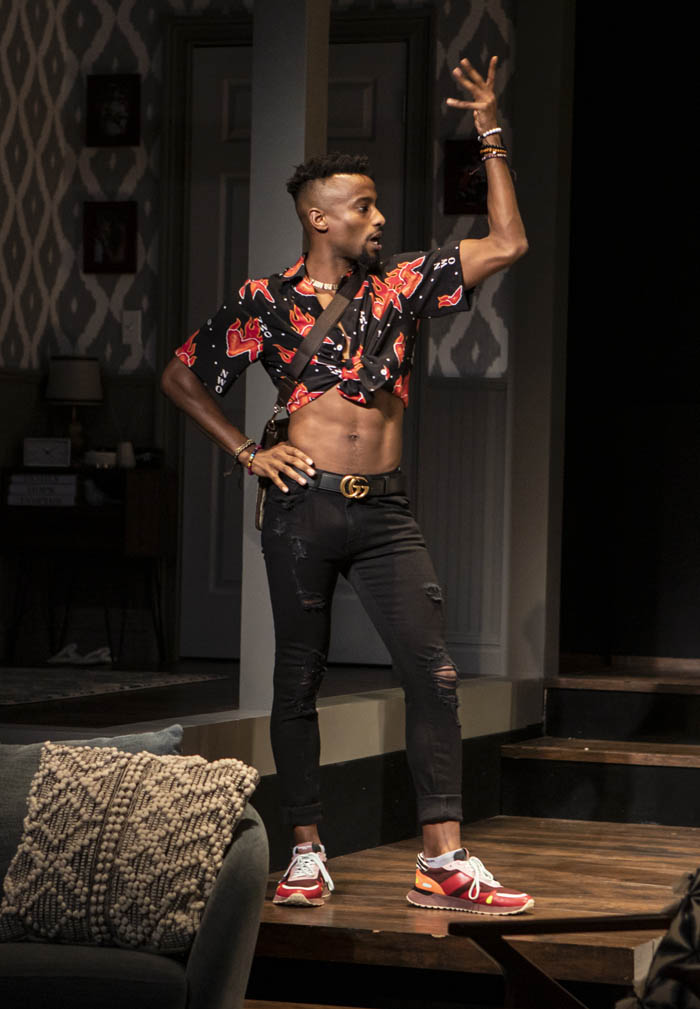
Toussaint Jeanlouis, Korey Jackson. All photos: Monique Carboni.
Set in Memphis—the playwright’s home town—in the house shared by Cordell (Toussaint Jeanlouis) and Dwayne (Korey Jackson), who owns it, the play deals with issues of masculinity, gay love, friendship, teamwork, and single parenting as five of the six characters prepare 280 pounds of Cordell’s “Spicy. Cajun. Alfredo. With Bourbon Infused. Crumbled Bacon” recipe. Their hope is to win the $5,000 first prize in a local hot wings contest. 
Cecil Blutcher, Korey Jackson.
Only the comical irresponsibility of the naughty, zingermeister Isom (Sheldon Best), the conventionally flamboyant member of the team, threatens their success. Isom, who spices up the proceedings—let’s just say there’ll be a hot time in some old mouths tonight—is present with his partner, Big Charles (Nicco Annan). The latter is a barber at whose shop Cordell and Dwayne met five years earlier, and who’s more concerned with a TV football game than what’s being tackled in the kitchen, where the real tension is.
Korey Jackson, Toussaint Jeanlouis.
Like the recent Seared, this is another live cooking show, as Cordell’s team carries out his instructions in a realistic kitchen, using apparently real ingredients. Aside from the crowded kitchen, located upstage left in Michael Carnahan’s detailed set, we also see a raised bedroom, a living room, and an outside patio, replete with an offstage basketball hoop visible only to those seated on the audience’s left.
Sheldon Best.
The patio serves various outdoor purposes, related to both the cooking and playing ball (which is done well), but is also where the characters are forced to share their intimate conversations (when they’re not being eavesdropped on).
Nicco Annan, Korey Jackson, Toussant Jeanlouis.
Performed under Steve H. Broadnax III’s buoyant direction, with raucous energy (three men even do a routine to Luther Vandross’s “Never Too Much”), the play’s first part is preoccupied with introducing everyone during the lively preparations—jokes and bickering included—for making the hot wings marinade. Eventually, more serious personal matters intrude, forcing a tonal shift as we discover the tensions tying these folks together. Balancing sitcom business and darker issues is a precarious endeavor that the play doesn’t always master.
Nicco Annan, Toussaint Jeanlouis, Korey Jackson, Sheldon Best, Cecil Blutcher.
One important issue is the conflict between Cordell, currently unemployed, and Dwayne, a harried hotel manager, over when Cordell—who left his wife and kids in St. Louis—will be ready to inform his family of his sexuality. It’s not unlike the situation between Sol and Robert in the first season of TV’s “Grace and Frankie.”
Cecil Blutcher, Toussaint Jeanlouis.
Another is the concern of Dwayne about his troubled, 16-year-old nephew, Everett a.k.a. EJ (Cecil Blutcher). He’s the son of Dwayne’s sister, a mentally unstable woman killed by the police as her son watched, for which Dwayne somehow blames himself.
Toussaint Jeanlouis, Nicco Annan.
The boy’s father is TJ (Eric B. Robinson, Jr.), a drug hustler who, for all his faults, worries about being a good father to Everett, who prefers staying with Dwayne. When Dwayne offers his home to EJ, it creates a conflict with Cordell, who opposes the idea. The macho TJ, too, wrestles with it, worried that the men’s gayness will rub off on the boy.
Toussaint Jeanlouis, Korey Jackson, Eric B. Robertson, Nicco Annan, Sheldon Best.
Alan C. Edwards’s versatile lighting, nicely isolating the multiple locales; Emilio Sosa’s character-perfect costumes, including the team’s competition shirts; and Lugman Brown and Robert Kaplowitz’s spirited sound design of musical selections go far to making The Hot Wing King tasty, although not quite enough to sustain a two hour and 20 minute meal.
Eric B. Robertson, Jr., Korey Jackson.
Playwright Hall (Tina—The Tina Turner Musical) definitely knows the slang slung by these homies but many listeners—even those present when titles are projected for the hearing impaired—will find themselves depending more on the expressive acting than the words spoken to follow along closely. But those actors definitely make The Hot Wing King a sweet-tasting, if not particularly hot, concoction that many will enjoy.
Cecil Blutcher, Eric B. Robinson, Jr.
I’m not ready to hand The Hot Wing King first prize but that needn’t prevent anyone from taking a bite out of it to try it for themselves.

Pershing Square Signature Center/Alice Griffin Jewel Box Theatre
480 W. 42nd St., NYC
Through March 22


Wednesday, February 27, 2019

171 (2018-2019): Review: RANDOM ACTS (seen February 26, 2018)


“Guardian Angels”


Onstage, Renata Hinrichs, playwright/actress/
dancer, looks about 40 in the simple, plaid, jumper-style dress (designed by Deshon Elem Delta) she wears in Random Acts. Actually, she’s in her mid-50s, since the autobiographical story she tells in her sweet, but not particularly newsworthy, one-woman memory play, is of being in first grade when Martin Luther King, Jr., was assassinated in 1968.

Renata Hinrichs. Photo: Mitch Traphagen,
Random Acts, first performed at the F.A.B. Women@tbg, and seen at the United Solo Theater Festival in 2014, is now at TBG on W. 36th Street, where Renata’s memories are acted out over the course of a brisk hour and 15 minutes. These consist mainly of her being a white girl encountering racial strife as a child in grade-school and later, in high school, and of life lessons learned along the way.
Renata Hinrichs. Photo: Mitch Traphagen.
Hinrichs tells her tale on a bare stage backed only by a vertical flat of multicolored squares (designed by Chika Shimizu), with only a bench on which to now and then sit. In a program note, she declares that New York’s post-9/11 turmoil jogged her memories of Chicago’s civil rights disturbances following Dr. King’s death, leading to other recollections that she subsequently wrote down and performed.
Renata Hinrichs. Photo: Mitch Traphagen.
Speaking to us both in her adult and childhood voices, this talented artist smoothly jumps from character to character, including her parents, her schoolmates, a boy she dated, and so on, altering her speech and body movements to do so. Occasionally, little Renata, an aspiring ballerina, bursts out dancing. In one bit, she performs in her room along with a recording of Julie Andrews, her idol, singing “The Sound of Music,” a choreographically hammy version of a little girl dreaming her heart out to her favorite song.
Renata Hinrichs. Photo: Mitch Traphagen.
As that number suggests, much of the Random Acts provides the nostalgic background for a recreation of Hinrichs’s early life as the daughter of a Lutheran minister and his prim and proper wife. Hinrichs’s account describes the events after the family moved in 1966 from Boston to Chicago, where her father, replacing a racist minister, was assigned to a white church on the South Side, very close to Ashland Avenue, a street dividing white and black neighborhoods, rife with racial tensions.

Her father is an idealistic liberal of great integrity whose resistance to racism and “God loves everybody” philosophy alienates some congregants, as when people walk out when a black baby is baptized. Her mother is a woman tensely aware of the need to keep her family and home under spic and span control, the kind who constantly warns Renata to behave or get “the living daylights” beat out of her.

But, once she’s enrolled in public school, even in kindergarten, little Renata can’t avoid being bullied by resentful black kids. One painful incident is resolved by the intercession of an older black boy whose identity she never learns. When she tells her dad about it, he comforts her, not only by trying to explain why people are biased against people of other colors, but by calling the boy a “guardian angel,” such as we all have in times of need.
Renata Hinrichs. Photo: Mitch Traphagen.
Such theological platitudes may not resolve questions like why Dr. King is later murdered, but, as an explanation for the influence of random acts of kindness, it nonetheless remains important to Renata.

Hinrichs also describes the trauma of the racial violence that erupted in Chicago following Dr. King’s death, which seared her for life. Nonetheless, she remained so colorblind that, in 1978, she appears not to have realized the potential for trouble in her relationship with Willy, the captain of her high school football team and editor of the school paper.

When she went to pick him up at his home for their Homecoming Dance date, his mother’s nasty, “Willy, there’s some white girl here for you,” was never to be forgotten. Nor was Willy’s own rudeness toward her that night; his bad behavior needn’t be interpreted through a racial filter but it does allow for a touching moment later in Renata’s life when Facebook appears on the scene, providing a nice touch of sentiment that displays the actress’s emotional depth.

Director Jessi D. Hill serves the play well, both in her staging, which makes good use of the small space, and by her incorporation of a rather extensive sound design (by Matt Otto), using pop (“Downtown,” “Sitting on the Dock of the Bay,” etc.), and church music, and considerably varied lighting design by Daisy Long.

Perhaps the most interesting slant the material takes is its concern with a white girl being on the receiving end of racist attitudes, and of a child’s loss of innocence but not her faith in human goodness. Random Acts raises valid issues, and nicely captures Hinrichs’s recall of a specific time and place. As drama, though, it’s rather thin, like the threads of a spider web, lovely to look at but so fragile it doesn’t take much effort for it to crumble.

The Barrow Group
312 W. 36th St., NYC
Through March 2

OTHER VIEWPOINTS: