Wednesday, November 11, 2015

99. Review: SHEAR MADNESS (seen November 10, 2015)

“Shave and a Haircut, She's Dead”
Stars range from 5-1.
Talk about out-of-town tryouts! SHEAR MADNESS, the endearingly (and enduringly) silly audience participation murder-mystery farce that just opened at New World Stages, clocks in (according to the Guinness Book of Records) as America’s longest-running comedy, even though that record has been compiled elsewhere than in New York. (A few plays have had even longer runs in Europe.) Created by Bruce Jordan and Marilyn Abrams for a Lake George, NY, dinner theatre in 1978, it proved so successful that it was soon being shown in Boston (where it’s been running for 36 years), with companies springing up around the country in Washington, D.C., Philadelphia, San Francisco, Los Angeles, Chicago, and elsewhere, and as far away as Buenos Aires, Athens, Istanbul, Paris, Kuala Lumpur, Seoul, and God knows where else, grossing a reported $232 million. Mr. Jordan and Ms. Abrams have been involved with what has evolved into a cottage industry ever since; Mr. Jordan, who staged the original, is still its director.

Jordan Ahnquist (standing), Adam Gerber. Photo: Carol Rosegg.
This low-brow, highly funny novelty may have delayed its appearance on a local stage because it feared the snooty disdain it would receive from Manhattan audiences and critics. However, judging from the way the crowd I watched it with warmed up when invited to figure out whodunit, they could as easily have been from Podunk as from Park Avenue. I even spotted the New York Daily News critic raising his hand to pitch in with a comment. (He was ignored.)
Jordan Ahnquist, Patrick Noonan. Photo: Carol Rosegg.
Resembling a fast-paced, high-energy mashup of Agatha Christie murder mysteries (like The Mousetrap, the longest-running play in history), the board game “Clue,” The Mystery of Edwin Drood, and the louder door-slamming TV sitcoms (you can practically hear a laugh track in your head), SHEAR MADNESS is actually a translation of a 1963 German play called Scherenschnitt by Paul Pörtner, who died in 1984.
Kate Middleton, Jeremy Kushinier. Photo: Carol Rosegg.
It’s set in the brightly lit baby blue, pink, and brick unisex hair salon of the title (lighting and set by Will Cotton), where the flamboyant Tony Whitcomb (Jordan Ahnquist, replacing Jonathan Spivey) cuts men’s hair (and flirts with everything in pants) and gum-chewing, bleached blonde, sexpot ditz Barbara DeMarco (Kate Middleton—no, not that one) handles the ladies. Customers include Mike Thomas (Adam Gerber) and Nick O’Brien (Patrick Noonan), who turn out to be detectives staking out the clip joint; a fashionable Park Avenue socialite, Mrs. Shubert (Lynne Wintersteller); and Eddie Lawrence (Jeremy Kushnier), a shady “used antique dealer.” In one way or the other, everyone’s a stereotype, which is part of the fun; then again, amusing as Mr. Ahnquist is when he’s not overdoing it, the gay hairdresser shtick tends to date the piece.
Jordan Ahnquist, Lynne Wintersteller, Jeremy Kushiner, Kate Middleton, Adam Gerber, Patrick Noonan. Photo: Carol Rosegg.
As per the show’s practice elsewhere, local references are to the city where the show is being performed. Thus Shear Madness’s address is at Ninth Avenue and 50th Street, down the street from the theatre. In D.C., however, it’s in Georgetown. Only time will tell whether jokes referencing things like Hell’s Kitchen will go over in touristy New York. If anything, the show could use more and better Big Apple yocks.
Kate Middleton, Lynne Wintersteller. Photo: Carol Rosegg.
The inciting incident is the murder by barber shears of Isabel Czerny, the famed pianist who lives upstairs and whose incessant playing drives Tony nuts. Her killing precipitates an investigation, with Tony, Barbara, Eddie, and Mrs. Shubert all being potential suspects. The fun comes from the way the show breaks the fourth wall to allow the audience to participate. The characters are asked to quickly repeat everything that’s happened since the play began, and the audience responds—often raucously—whenever something doesn’t jibe with what they’ve seen. So make sure you watch closely if you want to join in.
Jordan Ahnquist, Patrick Noonan, Kate Middleton. Photo: Carol Rosegg.
After the intermission (the play runs two hours), the audience asks questions of the participants, until, finally, a vote is taken as to whom everyone thinks is the guilty party. As in Edwin Drood (and Ayn Rand’s The Night of January 16, which had a different onstage jury at each performance), someone else could be singled out nightly, with the actors prepared to respond with a separate scenario. The actors, especially Mr. Noonan, who handles the investigation, must know their material intimately in order to answer the very specific questions and comments made by observant theatregoers. (It helps that Mr. Noonan has been with the show, off and on, since 1998.)
Patrick Noonan, Jordan Ahnquist. Photo: Carol Rosegg.
Many of the laughs are of the wink-wink, self-consciously groan-worthy type, with characters who should know better nuking the language and setting off radioactive puns, double entendres, and malapropisms, which seem to explode in every speech. What do I mean by groan-worthy? How about the close friendship between two women being called a Lebanese relationship? I think I heard a groan. Or someone claiming she knows her constipational rights? Was that another one? Or correcting someone who calls a Steinway a Steinberg by saying they mean Steinbeck? Groan away, but there are so many you’ll eventually have to crack a smile.

There are no cellphones (the play maintains a 1980s ambience), but the wisecracks include a steady stream of up-to-the-minute jibes at pop culture (the Kardashians and Bill Cosby, natch) and presidential candidates such as Clinton, Carson, Trump, and Bush. As in Brendan Behan’s The Hostage, the company has to keep the jokes as fresh as the 6:00 news. The entire cast rises to the challenge of combining improvisation with set-in-stone dialogue and over-the-top characterizations.

Mr. Noonan told a New York Times reporter covering the show that “People aren’t going to walk out of the theater a better person . . . but they will walk out in a better mood.” True. Judging by the response when I attended, SHEAR MADNESS may have found yet another home for its worldwide franchise.

 OTHER VIEWPOINTS:

New World Stages
340 West Fiftieth Street, NYC
Open run


Monday, November 9, 2015

98. Review: LOST GIRLS (seen November 8, 2015)

"All Is Not Lost"

The daughter apples haven’t fallen far from the mother trees in LOST GIRLS, John Pollono’s (Small Engine Repair) engrossing blue-collar family dramedy at the Lucille Lortel, in an MCC Theater production. (It originally was produced at Los Angeles’s Rogue Machine Theatre.) There’s a lot to appreciate here, both in the writing and performances, but there’s also a humongous plot contrivance that requires tiptoeing through the plot to avoid giving away the spoiler.

We’re in the living room-kitchen of a plain little house in Manchester, New Hampshire, as a dangerous snowstorm rages outside and Maggie Lefebvre (Piper Perabo), a harried woman in her mid-30s, is rushing to get to work at her Bloomingdale’s outlet store sales job. Out the door she goes only to come back in a moment later, raging: “Goddamn motherfucking sonofagoddamn cunt!” This is close to the perpetually angry Maggie’s standard level of discourse, raised here to a slightly more profane level because her old Honda Accord (her “caarh” as they say in New England) is gone, apparently stolen. Soon enough, her live-in mom, Linda (Tasha Lawrence), a blowzy, bleached blonde still given to wearing thongs, enters; once she begins cursing—I mean talking—we see where the seed that became Maggie comes from.
Piper Perabo, Tasha Lawrence. Photo: Joan Marcus.

Turns out that Maggie’s high school sweetheart and ex-husband, Lou (Ebon Moss-Bachrach), a recovering alcoholic with whom she maintains a tense relationship, is the state trooper coming over to make out the report, and that the couple’s teenage daughter—a girl half their own ages—didn’t go to school that day. Two plus two equals the daughter’s having run away and taken the Honda. The chip on chain-smoking Maggie’s shoulder grows exponentially larger over the play’s 90 intermissionless minutes: she’s broke and afraid of losing her job, her daughter and car are gone, she bickers with her mother, and Lou arrives accompanied by Penny (Megghan Fahy), his pretty, young, piously Christian wife (whom the dependably sarcastic Maggie unfairly calls “a boring, fuckin’ retard”). As the evening wears on, the reasons for Maggie and Lou’s breakup and why there’s still glue bonding them together come sharply into focus.
Piper Perabo, Tasha Lawrence, Ebon Moss-Bachrach. Photo: Joan Marcus.

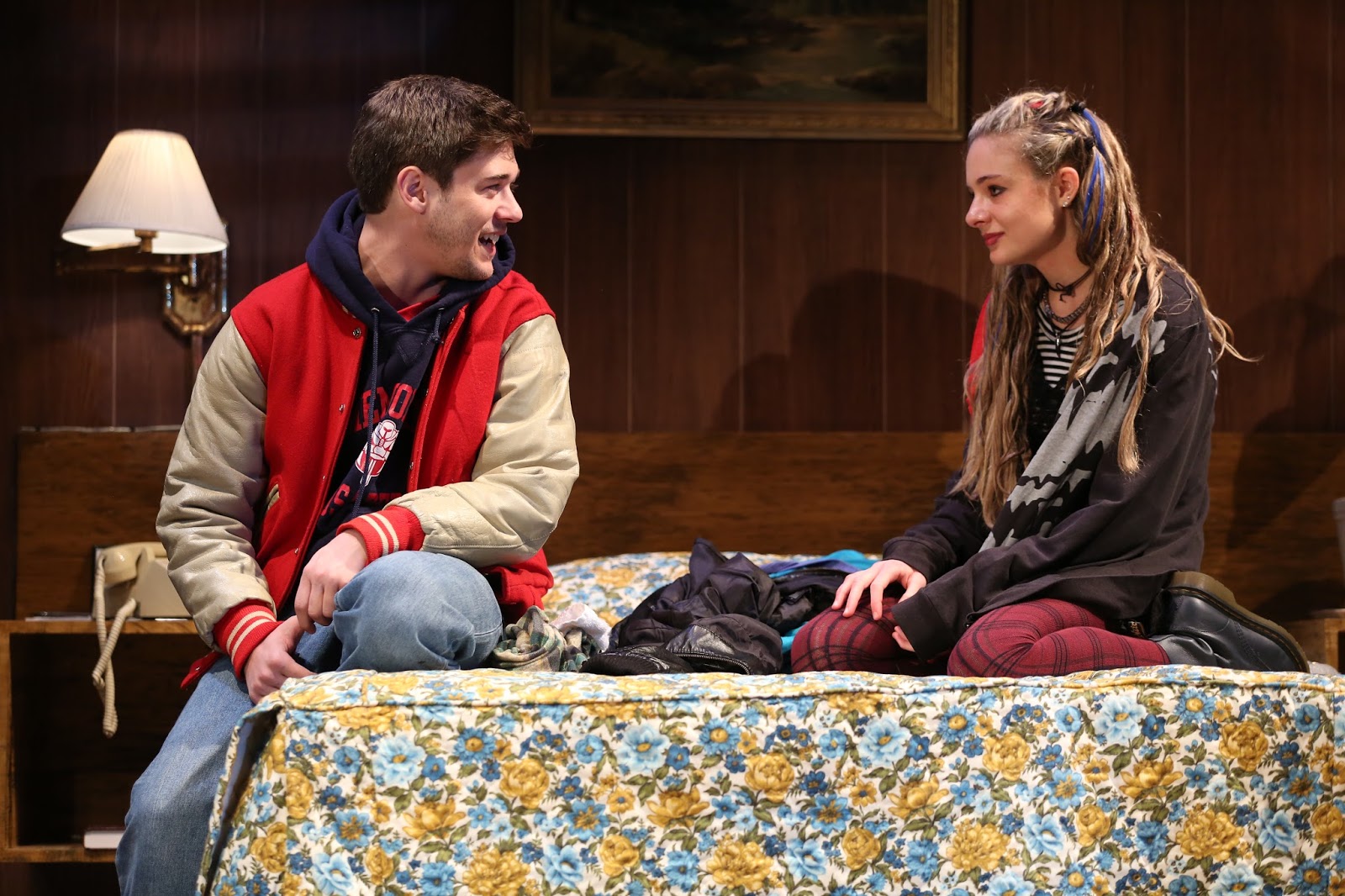
The sniping snottiness of Linda and Maggie, the restrained reactions of Lou, who struggles to maintain his demeanor, and the upbeat sweetness of Penny, who takes the insults aimed at her in stride, make for both dramatic and comic fireworks, although there’s a limit to how much one can take of Maggie’s nonstop nastiness. Once the family dynamic is established the stage right side of the living room flips around to turn the space into a Connecticut motel room, where a teenage girl (Lizzy DeClement) and boy (Josh Green), enter, brushing off the snow.
Josh Green, Lizzy DeClemente. Photo: Joan Marcus.

It doesn’t take long before we discover that she’s a 16-year-old running away to meet a much older man in Florida, and he, the same age, is being paid to drive her there, even though he’s a good, clean-cut kid, who’s taking a big chance in doing something so stupid. She has the same potty-mouthed snarkiness as Maggie, but the boy’s crazy for her anyway. Despite the idiocy and danger of their adventure they share a cautiously optimistic view of what the future holds in store. One thing leads to another and, ultimately, they make a blood vow that if, some day . . . no, I’ve got to stop here before the spoiler police get me. Suffice it to say that the play returns to Maggie’s house, there’s a power outage just as Lou gets a frightening report of a car accident, that the conclusion borders on the overly sentimental, and that not all you see is what you may at first think it is.
Tasha Lawrence, Meghann Fahy, Ebon Moss-Bachrach, Piper Perabo. Photo: Joan Marcus.

The play gains greatly from Jo Bonney’s incisive direction and its potent performances. Ms. Perabo brings fierce defiance and subtle vulnerability to Maggie; Ms. Lawrence is razor sharp as her slash and burn mother; Mr. Moss-Bachrach proves appealingly sympathetic as Maggie’s former spouse, struggling to remain cool in the face of her antagonism; Ms. Fahy is winningly effective in showing Penny’s struggle to do the right thing; Ms. DeClement brings fearsome rebelliousness to the manipulative runaway; and Mr. Green is convincingly innocent and boyishly compliant as her love-addled accomplice.

Richard Hoover’s blue living room interior and seedy hotel room, Theresa Squire’s authentic costumes, Lap Chi Chu’s versatile lighting, and Daniel Kluger’s mood-setting sound design all make effective contributions. Mr. Pollono’s vulgarity-peppered, New England-accented dialogue crackles with sharp ripostes, and his characters—despite some exaggeration—are sharply enough defined to make them both entertaining and plausible. While the setup leading to the big reveal employs the kind of clever trick that seems increasingly contrived the more you think about it, LOST GIRLS would probably be lost without it.

OTHER VIEWPOINTS:
Show-Score

Lucille Lortel Theatre
121 Christopher Street, NYC
Through November 29


Sunday, November 8, 2015

97. Review: MEN ARE FROM MARS, WOMEN ARE FROM VENUS LIVE! (seen November 5, 2015)

"When Worlds Collide"
Stars range from 5-1.

For my review of MEN ARE FROM MARS, WOMEN ARE FROM VENUS LIVE! please click on THEATER PIZZAZZ.

OTHER VIEWPOINTS:
when available

New World Stages
340 West Fiftieth Street, NYC
Through November 29


Peter Story. 
Peter Story. 

Peter Story. 


96. Review: SHANK'S MARE (seen November 6, 2015)

"Shanks for the Memory"
Stars range from 5-1.
For my review of SHANK'S MARE, please click on THEATER PIZZAZZ.

OTHER VIEWPOINTS:
to be added

La Mama Experimental Theatre
66 East Fourth Street, NYC
Through November 15

Please note that there are several differences between the photos below and the production itself.
CB Goodman, Sarah Plotkin, Koryu Nishikawa V. Photo: Ayumi Sakamoto.

Koryu Nishikawa V. Photo: Ayumi Sakamoto.

Josh Rice, CB Goodman, Sarah Plotkin. Photo: Ayumi Sakamoto.

Josh Rice, Sarah Plotkin. Photo: Ayumi Sakamoto.

Hye Young Chyun, Josh Rice, Gabrielle Schutz, Niva Alush, CB Goodman. Photo: Ayumi Sakamoto.

Saturday, November 7, 2015

95. Review: SYLVIA (seen November 4, 2015)

"Love, Doggy Style"
Stars range from 5-1.

  
For my review of SYLVIA, please click on THE BROADWAY BLOG.

OTHER VIEWPOINTS:

Cort Theatre
138 West Forty-Eighth Street, NYC
Through January 24, 2016


Matthew Broderick, Annaleigh Ashford. Photo: Joan Marcus.

Robert Sella, Matthew Broderick. Photo: Joan Marcus.

Annaleigh Ashford, Matthew Broderick. Photo: Joan Marcus.

Julie White, Matthew Broderick. Photo: Joan Marcus.

Robert Sella, Annaleigh Ashford, Matthew Broderick. Photo: Joan Marcus.

Matthew Broderick, Annaleigh Ashford. Photo: Joan Marcus.

Julie White. Photo: Joan Marcus.

Matthew Broderick, Annaleigh Ashford. Photo: Joan Marcus.

Friday, November 6, 2015

94. Review: KING CHARLES III (November 4, 2015)

"Uneasy Lies the Head that Wears a Crown"
Stars range from 5-1.


For my review of KING CHARLES III, please click on THE BROADWAY BLOG.

OTHER VIEWPOINTS:

The Music Box
239 West Forty-Fifth Street, NYC
Through January 31, 2016


Tim Pigott-Smith. Photo: Joan Marcus.

Tim Pigott-Smith. Photo: Joan Marcus.

Tim Pigott-Smith and company. Photo: Joan Marcus.

Tim Pigott-Smith, James Adams. Photo: Joan Marcus.

Margot Leicester, Tim Pigott-Smith. Photo: Joan Marcus.

Oliver Chris, Lydia Wilson. Photo: Joan Marcus.

Oliver Chris, Tim Pigott-Smith. Photo: Joan Marcus.

Tafline Steen, Richard Goulding. Photo: Joan Marcus. 


Sunday, November 1, 2015

93. GHOST LIGHT: THE HAUNTING (seen October 30, 2015)

"Spooky Macbuki"

Elaina Erika Davis. Photo: Michael Blase.
In 1603, the year traditionally given for the birth of Japan’s kabuki theatre, Shakespeare wrote his greatest play, HAMLET. Soon after, Japan closed its doors to the outside world, not reopening them until the mid-19th century. By this time kabuki had developed into a magnificent traditional theatre, and Shakespeare had become the sine qua non of Western classical drama. Before long, Japan, hungry for modern ideas from the West, discovered the cultural and artistic importance of Shakespeare and began trying to adapt his plays for Japanese audiences. Since the only theatre capable of doing so at the time was kabuki, plays like THE MERCHANT OF VENICE and HAMLET, which would probably have been incomprehensible if produced in conventional terms, were rendered into Japanese settings with Japanese characters replacing the originals. By the early 20th century, however, Shakespeare was being done in ways not unlike how it was given in the West. 
Greg Brostrom, Elaina Erika Davis. Photo: Michael Blase.
Eventually, both kabuki actors and actors belonging to Japan’s modern theatre were doing Shakespeare; some of Japan's most exciting modern productions of the Bard—like those staged by Ninagawa Yukio—have gained international acclaim. Moreover, among the many outcomes of the cross-fertilization of Shakespeare and Japan’s traditional theatres (noh, bunraku, and kyĹŤgen, as well as kabuki) have been Western—chiefly American—productions that attempt to fuse Japanese theatrical conventions with Shakespeare’s texts. Such experiments have given us Kabuki Macbeths, Kabuki Othellos, and so on.
Elaina Erika Davis. Photo;  Michael Blase.
Less common are original plays that seek to combine Japanese traditional plays with Shakespeare. A good example of this is Carol Fisher Sorgenfrei’s GHOST LIGHT: THE HAUNTING, which opened at midnight on Halloween, October 31, at the TBG Theatre. Ms. Sorgenfrei, a UCLA professor emerita and specialist in Japanese theatre, is a published and produced playwright who has been at the forefront of creating what many call “fusion” theatre, of which GHOST LIGHT is a good example. Her new play, directed by Penny Bergman, who also has trained in Japanese theatre, is an ambitious attempt to find the correlations in kabuki’s greatest ghost play, TĹŚKAIDĹŚ YOTSUYA KAIDAN (Ghost Stories at Yotsuya on the TĹŤkaidĹŤ), written by Tsuruya Nanboku IV in 1825, and MACBETH, which has some ghostly creds of its own. Although conflict of interest concerns prevent my critiquing GHOST LIGHT, I’d like to offer a few words to introduce its approach.
Elaina Erkia Davis, Greg Brostrom. Photo: Michael Blase.
The Japanese play tells of a masterless samurai named Iemon who betrays his wife, Oiwa, who’s recently given birth, by planning to marry a neighbor’s daughter; Iemon’s machinations lead to Oiwa’s disfigurement and death, after which, in scenes that are still frightening, her ghost returns to seek revenge on those responsible. In GHOST LIGHT, Keiko Tamiya (Elaina Erika Davis) is a present-day Japanese-American actress, married to the actor Bryan Eamon Quinn (Greg Brostrom); their mutual popularity is recognized—as in the Brangelina melding of Brad Pitt and Angelina Jolie—as Breiko. However, after Keiko wins a Best Actress Emmy, Bryan’s envy of Keiko’s achievement and his ambition—fueled by a cunning manager, Jonathan Hecht (Patrick Goss)—leads him to seek the role of Macbeth in a major Broadway revival directed by a famous, controversial director, Hellen Gates Porter (also Mr. Goss). It’s not long before betrayal, murder, adultery, chemical poisoning, Japan’s Fukushima tsunami, a giant spider web, and a vengeful revenant vie for center stage.
Greg Brostrom, Elaina Erika Davis. Photo: Michael Blase.

Ms. Bergman’s minimalist production employs various kabuki conventions, including live accompaniment of traditional Japanese-inflected music (Yukio Tsuji and Sumie Kaneko), black-garbed stage assistants, striking theatrical poses, female impersonation, and so on. GHOST LIGHT: THE HAUNTING, running in an Equity Showcase production, is an unusual contribution to the local theatre scene. 

TBG Theatre
312 West Thirty-Sixth Street, NYC
Through November 8