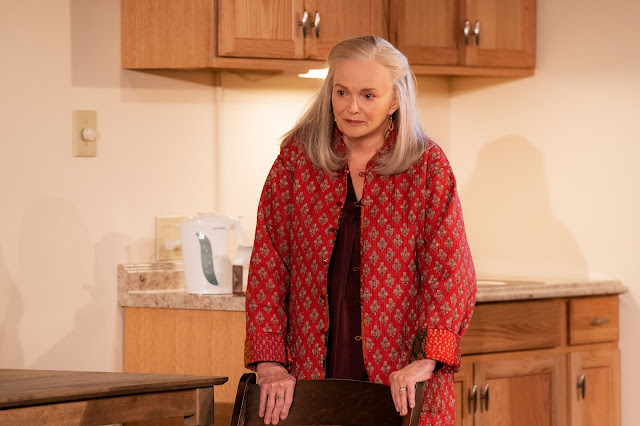
For my review of Morning’s at Seven please click on THE BROADWAY BLOG.
Sunday, November 14:
Theatre has returned to New York, of course, but only under certain restrictions necessitated by the Covid pandemic. Over the past two months it’s been encouraging to see the number of people in the Times Square district increase exponentially, although still not to the level of pre-Covid days, when you could barely walk down Eighth Avenue without being forced into the gutter.
I’ve seen seventeen shows, on and Off Broadway, since
September. For a reviewer, that’s not as many as it might seem. I’ve actually been
more selective this season, given some of the discomforts necessitated by the
theatregoing process and the wish to expose myself to the virus as little as
possible, both in theatres and on public transportation (I subway in from South
Queens).
Since most—not all—shows provide critics with two seats,
many of us have plus-one lists of people we invite to accompany us. Mine
includes over twenty people; however, over half of those have decided not to
accept my invitations until they feel safer about going to the theatre. Mind
you, these are all sophisticated theatregoers who ordinarily would be reluctant
to turn down offers to see theatre for free, and to simultaneously enjoy my iridescent
presence.
And even offers made to my reduced list have rarely gotten
more than one bite; several people who asked to remain on the list still have
not responded to my invitations. Clearly, there’s a great deal of hesitancy
about returning under the present circumstances, not least the need to show
vaccination proof and wear a mask. And while more and more people, tourists and
locals, have been filling theatre seats, notable gaps can be seen in the
auditoriums of shows that aren’t hit musicals.
Many people ask me, and, I’m sure, my fellow reviewers, what’s
it like to go to the theatre these days? Well, speaking only for myself, I can
say it ain’t thrilling. I am, after all, in my early 80s and, though still
spry, am faced by the usual geriatric obstacles. This means one must get to the
theatre early so as to have time for passing through the gauntlet of safety and
personal needs obstacles.
On Broadway (and, in some cases, Off) you must line up
outside and wait for the processing of theatregoers to begin. This means you
must show some proof of your having had two shots (on a card or phone app)
along with a photo ID to prove it’s actually you who’s been jabbed. Oldsters,
of course, especially those unprepared for the experience, may struggle as they
manipulate their phones, purses, and wallets, causing delays for others on the
line. The weather has been mostly mild so far, but when it’s not, doing this
outdoors can make the experience that much more uncomfortable. I foresee this being
something the coming months hold in store.
Next, you must pass through a metal detector or have a
security person poke through your bag with a long flashlight wand. Naturally,
everyone’s wearing a mask, which can muffle spoken instructions from the staff.
If you’re flustered on a muggy day, expect the sweat to flow and your glasses
to fog up.
Once inside, if you’re like me, you may wish to visit the
restroom before taking your seat. Social distancing, I assure you, is paid no
more than lip service at the facilities, with so many people needing to take
care of business. And, since many theatres have insufficient stalls for women, some
men’s rooms are seeing women using them when their own lines are too long. Modesty
be damned. Off Broadway, by the way, has seen a proliferation of gender-neutral
bathrooms over the last few years, so the person washing their hands next to
you will likely not share your particular gender.
Senior citizens, like me, will often want to use the free
assistive listening devices available at many theatres. In the past, most users
simply handed over their driver’s license as surety for the safe return of the
devices. Now, a number of Broadway theatres (not all) have the person providing
the devices enter your contact info on an IPad, making it unnecessary to leave
your license or photo ID. While this makes it easier to depart by simply
dropping off your device, it can seriously clog up the pre-curtain time
available as you wait on line for others to complete the process.
Finally, you take your seat, remove your outer wear, wipe the steam off your glasses, mop the sweat off your brow, and get ready for the show to start. When the show ends you race for the exits (try racing out of a crowded Broadway theatre) so you can get to the street and rip the mask off your face for the few minutes of fresh air before you descend into the subway.
On the other hand, as happened to me at Saturday's matinee, you may
never get this far.
As I said, I’ve seen my fair share of shows since September,
and got through the gauntlet with flying colors each time—until this past
weekend. I was booked to pick up a pair of ducats to a major Broadway show and,
as on multiple recent occasions, brought along a plus-one regular. Naturally, she
had a card proving that she had her second shot. However, while the CVS
pharmacy clearly recorded it as her second shot, they didn’t list her first.
That’s because she’d lost her first card and, when she got the second shot,
they listed only that one. You’d think that since it says “second shot” or
something similar that would be sufficient.
But this theatre’s Covid supervisor, sympathetic but firm,
said his bosses were very strict. So my plus-one searched and searched her
emails for the CVS confirmation of her two-shot status. She didn’t have an
Excelsior pass because she’d had technical problems downloading one and hadn’t
bothered calling their help line for assistance. Besides, none of the other
theatres we’d been to had made a fuss. But now it was beginning to rain,
curtain time was approaching, and we were getting nervous.
Seeing no alternative, I approached the box office, canceled
the seats, and left on the subway with my plus-one for Queens. She kept rifling
through her old emails on the train. Several stops away, there it was: bingo! In
the best of all subway systems, we might have turned around and made it back in
time, but New York isn’t Tokyo.
The lesson, of course, is that, if you're in a situation like my plus-one's, you shouldn't assume your vaccination card will get you in, even if it says you've had both shots.
Later on Sunday she visited CVS and got a proper statement of her vaccination status. For some technical reason, however, the Excelsior pass remains a hill she's still trying to climb.


 |
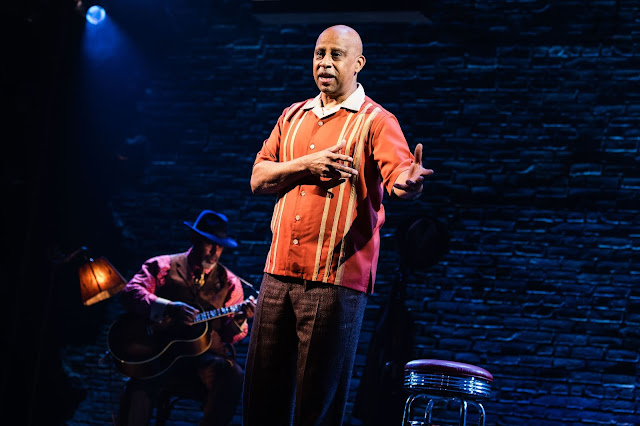
| Ruben Santiago-Hudson. (Photos: Mark J. Franklin.) |
 |
| Ruben Santiago-Hudson. |
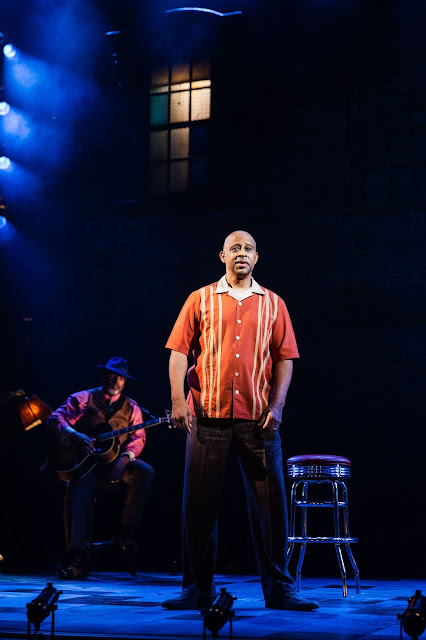
Because there’s only one actor speaking all the lines and
playing all the characters, Lackawanna
Blues belongs to the category of one-person shows. It would, however, lose
a huge chunk of its theatrical punch without the awesome presence of Junior
Mack, the onstage guitarist who accompanies Mr. Santiago-Hudson, playing
low-key, bluesy background music by the late Bill Sims, Jr., during almost
every one the show’s ninety minutes.
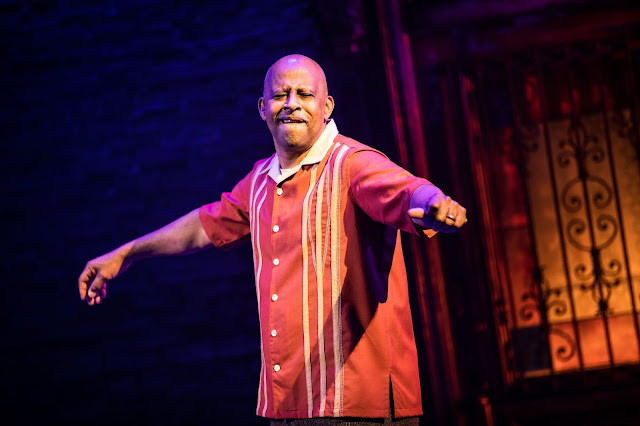 |
| Ruben Santiago-Hudson. |
Mr. Santiago-Hudson, a multitalented New York theatre
powerhouse, who also serves as MTC’s “artistic advisor,” is no stranger to the
solo format, having done just fine eight years ago starring at the Signature in
August Wilson’s How
I Learned What I Learned, a memorable performance strangely missing
from his Playbill bio. (Mr.
Santiago-Hudson, of course, is one of our leading Wilson exponents, both as an
actor and director.)
I didn’t see Lackawanna
Blues, based on Mr. Santiago-Hudson’s childhood experiences, when it was first produced back in 2001
at the Public Theatre, where George C. Wolfe directed its award-winning
production. This was followed in 2005 by a multiple award-winning HBO movie
version, starring S. Epatha Merkeson as Rachel “Nanny” Crosby, and a cornucopia
of first-line actors in support, among them Jimmy Smits (as Ruben’s father),
Terrence Howard, Mos Def, Rosie Perez, Delroy Lindo, Jeffrey Wright, and many
others.
These actors played the many colorful characters Mr.
Santiago-Hudson recalled from his boyhood growing up during the 1950s in Lackawanna,
an upstate New York working-class city, where circumstances saw him being
raised by the remarkable Nanny. She was a saintly Black woman who was both
entrepreneur and nonjudgmental overseer of those who, in one way or the other,
came to fall within her purview as a local boardinghouse proprietor. As lovingly
embodied by her onetime ward, she comes off as a pious woman of enormous
strength, courage, determination, wisdom, and gentleness, anchored by
inordinate depths of kindness.
Lackawanna Blues
is more a series of anecdotes built around the sturdy frame of Nanny than it is
a conventionally structured play. No matter. Mr. Santiago, dressed by Karen
Perry simply in slacks and a casual, rust-colored, cabana-type shirt, with beige stripes, like the
kind bowlers used to wear, ably presents the panoply of characters, men and women, he
recalls. Merely by shifts in voice, accent, body, and facial expression, he makes you see them parading across the stage.
Keep your eyes and ears peeled for Ol’ Po’ Carl, Mr. Lemuel Taylor, Numb Finger Pete, Sweet Tooth Sam, Mr. Luscious, and on and on and on, including the wide-eyed, innocent Mr. Santiago-Hudson once was. We see each with their limps, their coughs, their stuttering and muttering, their smoking, their boasting, their sweetness, their threats, their coolness, their neediness, their pride, and their suffering. And each is incarnated with grace, humor, affection, and sufficient accuracy to provide lifelike thumbnail portraits.
With Mr. Mack seated at right center, in and out of the shadows as lit by Jen Schriever with expressive sensitivity, Mr. Santiago freely roams Michael Carnahan’s set of a dark, crumbling, brick background. Into it is set no more than an an ornate, old-fashioned doorway, with a window of frosted, colored-glass panes high above. Hovering overhead down front is a rotating ceiling fan. In this memory-laden space, Mr, Santiago shows that he can not only act but sing (albeit minimally); even more impressive are those moments when he plays a really mean harmonica.
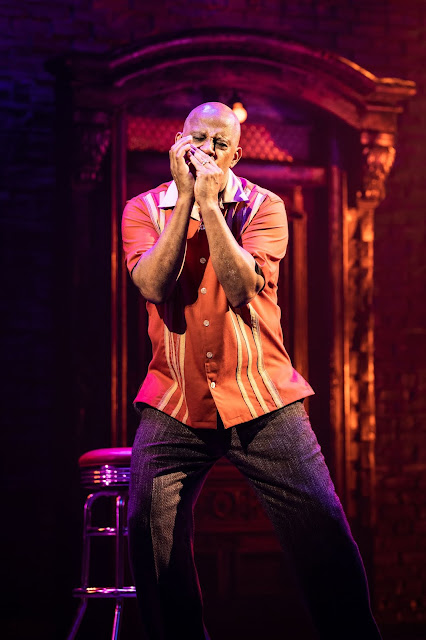 |
| Ruben Santiago-Hudson. |
Each season brings an assortment of solo shows, most of them
revealing the striking talents of their performers. Just the day before seeing Lackawanna Blues I visited another
outstanding, albeit radically different, work in this category, Off Broadway’s Kristina
Wong: Sweatshop Overlord. Both shows are autobiographical, the first an
affectionate memorial to a long-gone slice of postwar African-Americana, the
latter a farcically inclined docudrama with a ripped-from-the headlines
political agenda. And both are among the best things I’ve seen during this
still young season.

 |
| Kristina Wong. (Photo: Joan Marcus.) |
For my review of Kristina Wong: Sweatshop Overlord please click on THEATER PIZZAZZ.
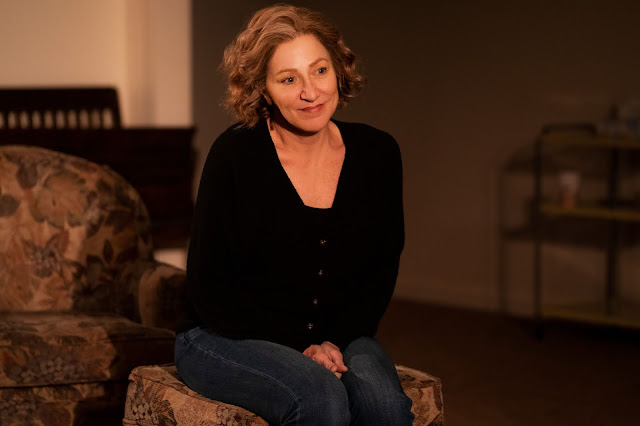 |
| Edie Falco. (Photos: Matthew Murphy) |
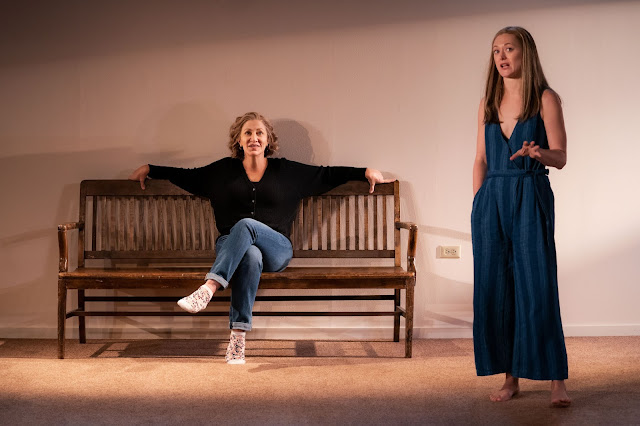 |
| Edie Falco, Marin Ireland. |
 |
| Marin Ireland. |
Those recollections are mostly related to Charlotte (who prefers “Charley”) McBride (designated as “1” in the script), in her mid-fifties. What action there is encapsulates her passage through life, beginning with childhood. Charley’s experiences, of course, are tied to the lives of her mother, Claudette (“2”; Ms. Brown), seen in her seventies, and Charley’s daughter, Tessa (“3”; Ms. Ireland), thirty, as they help Charley navigate issues from her past.
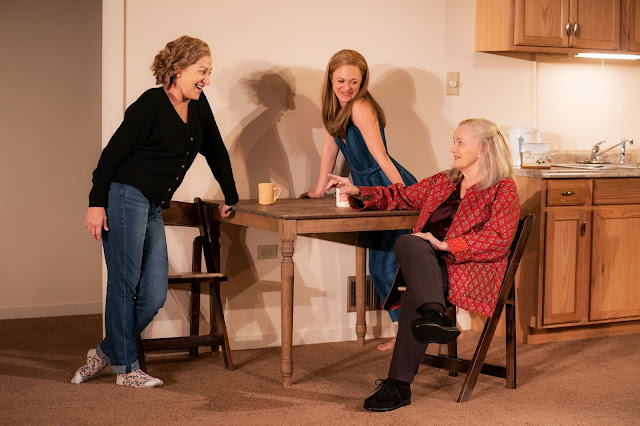 |
| Edie Falco, Marin Ireland, Blair Brown. |
These memories—bitter, recriminatory, happy, or sad, as the case may be—concern mainly romantic relationships (positive and otherwise) and mother-daughter conflicts, mostly negative. Most are set against the landscape of New York as experienced from the perspective of the fifth-floor walkup on 11th Street in Greenwich Village, where the family long resided.
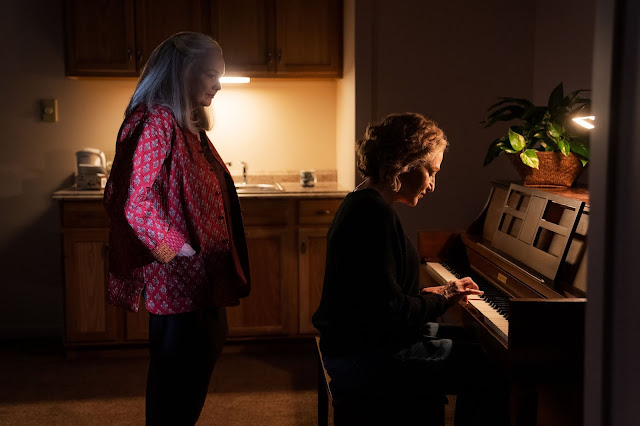 |
| Blair Brown, Edie Falco. |
About that walkup. Stephens’s script calls for “a
liminal space” defined more by light and shadows than objects. Lighting
designer Lap Chi Chu has deftly used his skills to realize this goal,
but the setting itself is more literal than liminal. With small, high windows running
across the top of its walls it reads as a basement, but without relevance to anything mentioned in the script, like the apartment the family once owned. Further, its extreme width in
contrast to its low height (like a kabuki stage) serves only to dissipate the
impact of director Lila Neugebauer’s staging on the spacious, relatively bare
expanse.
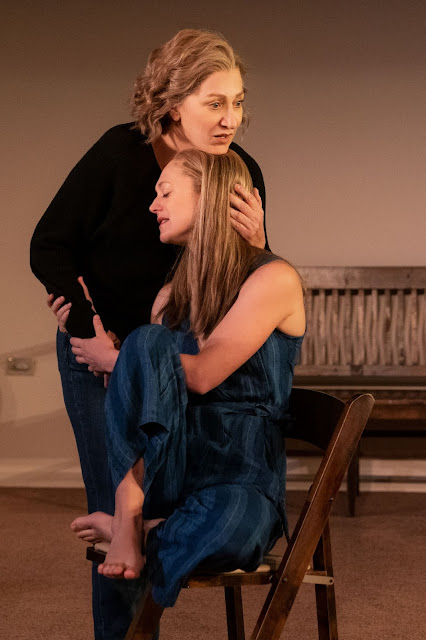 |
| Edie Falco, Marin Ireland. |
In this space, the characters drop shared references to familiar places and events, most New York-related, across the past half-century. We hear of the White Horse Tavern, Peter McManus, Washington Square, and the Cherry Lane Playhouse (for some reason called, inaccurately, the theatre on Cherry Lane). Then there are the Beatles, Joni Mitchell, Bruce Springsteen, and Leonard Bernstein, a couple of great moments in New York baseball, the demolition of Penn Station, the Weathermen explosion, the AIDS crisis, the Dakota and John Lennon, the Circle Line, Brighton Beach, Macy’s, Murray’s Bagels, 9/11, the New School, and so on and so forth. Charley’s longest-held job, as a receptionist at the now vanished St. Vincent’s Hospital, recalls an iconic New York landmark.
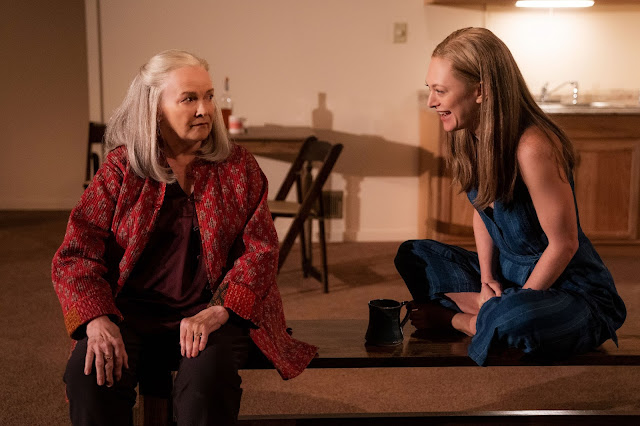 |
| Blair Brown, Marin Ireland. |
Stephens seems intent on evoking the drama of even the most ordinary of lives, although the dialogue is rich enough to provide the stars with many histrionic possibilities. I suspect most people will enjoy the performances more than they do the play, which lasts 100 uninterrupted, but not always interesting, minutes. Although there are emotional disruptions, the principal tension comes from the efforts the audience must make to absorb the stream of memories and their significance; otherwise, since these characters drift along across half-a-dozen or so decades, the few dramatic stakes are fleeting.
Each actor portrays both her own principal character, as well as several others (men included), while also now and then serving as a narrator. We meet friends, husbands, lovers, grandfathers, uncles, and the like, some briefly, some at greater length, like the pilot who knocked up Charley on a one-night stand, producing Tessa as a result.
Maybe I was confused but, in one scene, all three women seemed to be sharing lines meant for two people, Claudette even speaking Charley’s words. Whatever’s going on, it’s indicative of the fuzziness created by the writing’s goal of subtle transitions, requiring nuances of attitude as opposed to appearance to distinguish one person from another. It's far easier to distinguish among the dozens of characters invoked by Ruben Santiago-Hudson's solo performance in Lackawanna Blues than it is to figure out this play's dramatis personae.
Late in the play, Charley, on life support, delivers a touching monologue of things she longs for, bits of which made me think of Emily’s farewell to clocks ticking in Our Town. It comes off as something like the eleven o’clock song in a musical, just in time to retrieve Morning Sun from lapsing into total boredom. Ms. Falco, presently icing TV screens with wifely sangfroid as the betrayed Hillary Clinton in “Impeachment,” delivers the goods, as she always does. And the distinguished reputations of both Ms. Brown (looking, sounding, and acting like Lois Smith's doppelganger) and Ms. Ireland are further enhanced by their sterling work.
Whether Morning
Sun drowses or arouses you, I wouldn't be surprised if, as a play for three actresses of different generations, it doesn't have a significant afterlife. If all it does, however, is remind you of its inspiration, the Edward
Hopper painting of the same name, showing a young woman sitting on a bed
staring vacantly out a window into the morning sun, that too is a takeaway of sorts.
Manhattan Theatre Club
City Center Stage 1
131 W. 55th Street, NYC
Through December 19