Thursday, March 17, 2016

170. Review: THE GABRIELS: ELECTION YEAR IN THE LIFE OF ONE FAMILY: HUNGRY (seen March 16, 2016)

"More Meat, Please"

Stars range from 5-1.
For my review of HUNGRY please click on THEATER PIZZAZZ.

OTHER VIEWPOINTS:

The Public Theater/LuEsther Hall
425 Lafayette Street, NYC
Through April 3


Amy Warren, Lynn Hawley, Jay O. Sanders. Photo: Joan Marcus.

Lynn Hawley, Maryann Plunkett. Photo: Joan Marcus.

Maryann Plunkett, Lynn Hawley, Meg Gibson, Photo: Joan Marcus.

Amy Warren, Meg Gibson, Jay O. Sanders, Lynn Hawley. Photo: Joan Marcus.


169. Review: THE WAY WEST (seen March 15, 2016)

"Westward, No!"
Stars range from 5-1.
Chances are you know the feeling of helpless embarrassment after having a credit card declined when dealing directly with a vendor. If you were lucky, it was a technical glitch you later ironed out; if, though, like Manda (Nadia Bowers) in Mona Mansour’s THE WAY WEST, a bleak, unhappy comedy at the Labyrinth, it meant your credit line was maxed out, your embarrassment was mingled with gut-wrenching fear. And you would know just how Manda feels when she can’t pay the delivery guy for the pizza he’s just delivered to feed her, her mother, and her sister. The possibility of starvation may be staring Ms. Mansour’s people in the eyes, but, her point having been made, the focus shifts—as it already has on earlier occasions—to an unconvincing finale that tries to put a hopeful face on the increasing hopelessness we’ve been watching for 90 minutes.

Anna O'Donoghue, Deirdre O'Connell, Nadia Bowers. Photo: Monique Carboni.
THE WAY WEST is set in the fiscally challenged California city of Stockton, where the financially reckless Mom (Deirdre “Didi” O’Connell), in her 60s, lives with her daughter, Meesh (Anna O’Donoghue), single and more like a feckless teen than a woman in her 30s. Big sister Manda (Nadia Bowers), also single, has flown in from Chicago; she’s staying at the family’s deteriorating home to help Mom fix her screwed-up finances, for which bankruptcy seems the only way out.
Nadia Bowers, Anna O'Donoghue, Deirdre O'Connell. Photo: Monique Carboni.
Ms. Mansour makes several dubious choices, the most awkward of which has Mom—whose ignorance of the most basic principles of household management inclines more toward stupidity than carelessness—serve as a verbally gifted narrator. This happens at selected points as she tells her rapt daughters stories of survival about the westward-bound pioneers who crossed America in wagon trains under terrible hardships. (When the play premiered at Chicago’s Steppenwolf Theatre, under Amy Morton’s direction, these sections were accompanied by projections and songs played by the daughters on guitars. At the Labyrinth, Mom presses a button on an old cassette recorder to introduce background music.) In Mimi O’Donnell’s New York staging, it’s never very clear whether the stories are being told as part of the realistic action or if they’re a magical realism infusion. Or both.
Deirdre O'Connell, Portia. Photo: Monique Carboni.
One might also question the sudden revelation of Manda’s credit card debacle; to discuss it would be too much of a spoiler so I'll say only that the circumstances, demonstrating how much she, like everyone else, is in denial, seem too contrived to be convincing. Manda’s relationship with her ex-boyfriend, Luis (Alfredo Narcisco), who agrees to help clean up Mom’s finances, hints at a possible way out, but this thread simply vanishes. There are also production head scratchers, such as why the same very recognizable actor—burly, bearded, and silver-haired Curran Conner—plays, without a radical change in demeanor, both Meesh’s boyfriend, Robbie, and the pizza guy. All it does is add an unnecessary distraction (is Robbie delivering pizzas?) to the climactic scene.
Alfredo Narcisco, Deirdre O'Connell, Nadia Bowers. Photo: Monique Carboni.
As the play advances, we see how each character—even the seemingly successful Manda, a development officer (a.k.a. fund raiser) at a Chicago university—is responsible for their own problems while remaining in irritating denial about them. Mom, especially as played by the gifted Ms. O’Connell, who originated the role with Steppenwolf, is colorfully ditzy, but not sufficiently so to make us feel she didn’t ask for what was coming. For instance, despite having access to thousands of dollars in a trust fund, she blows it on a foolish investment to help a friend, Tress (Portia), in a questionable business venture that quickly fizzles.

To further underline the decline of the American dream in this family’s particular wasteland, Ms. Mansour not only inflicts Mom with symptoms of physical distress but finds devastating ways to damage her house, inside and out: a fire, car crashes, a power outage. Ms. Mansour may be saying that the American pioneer spirit of survival in the face of every obstacle, on which Mom keeps harping, will somehow prevail, but what she’s shown about this family suggests not that they’ll succeed but that even worse awaits in the future. THE WAY WEST isn’t funny enough to gloss over how depressing it is.

The cast is uniformly polished, but the honors go to Ms. O’Connell for making her insufferable character at least barely sufferable. The play’s uneasy blend of naturalism with theatricalism isn’t instantly visible in David Meyer’s impressively dingy living room set, occupying one long wall of the tiny theatre; a picture window looks out on the wide-open vista of what seems more a Nevada-like desert than the farmland outside Stockton. You can practically hear the sound of symbols crashing. Lighting designer Bradley King gives it pretty sunset colors, and when the rear wall slides open magically at the end, it comes into its own.
Nadia Bowers, Deirdre O'Connell, Anna O'Donoghue. Photo: Monique Carboni.
If you’re heading to the Labyrinth, take the way west on Bank Street. A little further and you’ll reach the Hudson, perhaps a more satisfying destination than THE WAY WEST itself.

OTHER VIEWPOINTS:

Labyrinth Theater
155 Bank Street, NYC
Through April 3


168. Review: IRONBOUND (seen March 12, 2016)

"Bus Stop Blues"

Stars range from 5-1.
For my review of IRONBOUND please click on THEATER PIZZAZZ.


OTHER VIEWPOINTS:

Rattlestick Theater
224 Waverley Place, NYC
Through April 10


Marin Ireland, Josiah Bania. Photo: Sandra Coudert.
Marin Ireland, Morgan Spector. Photo: Sandra Coudert.

Marin Ireland. Photo: Sandra Coudert.
Shiloh Fernandez, Marin Ireland. Photo: Sandra Coudert. 


Tuesday, March 15, 2016

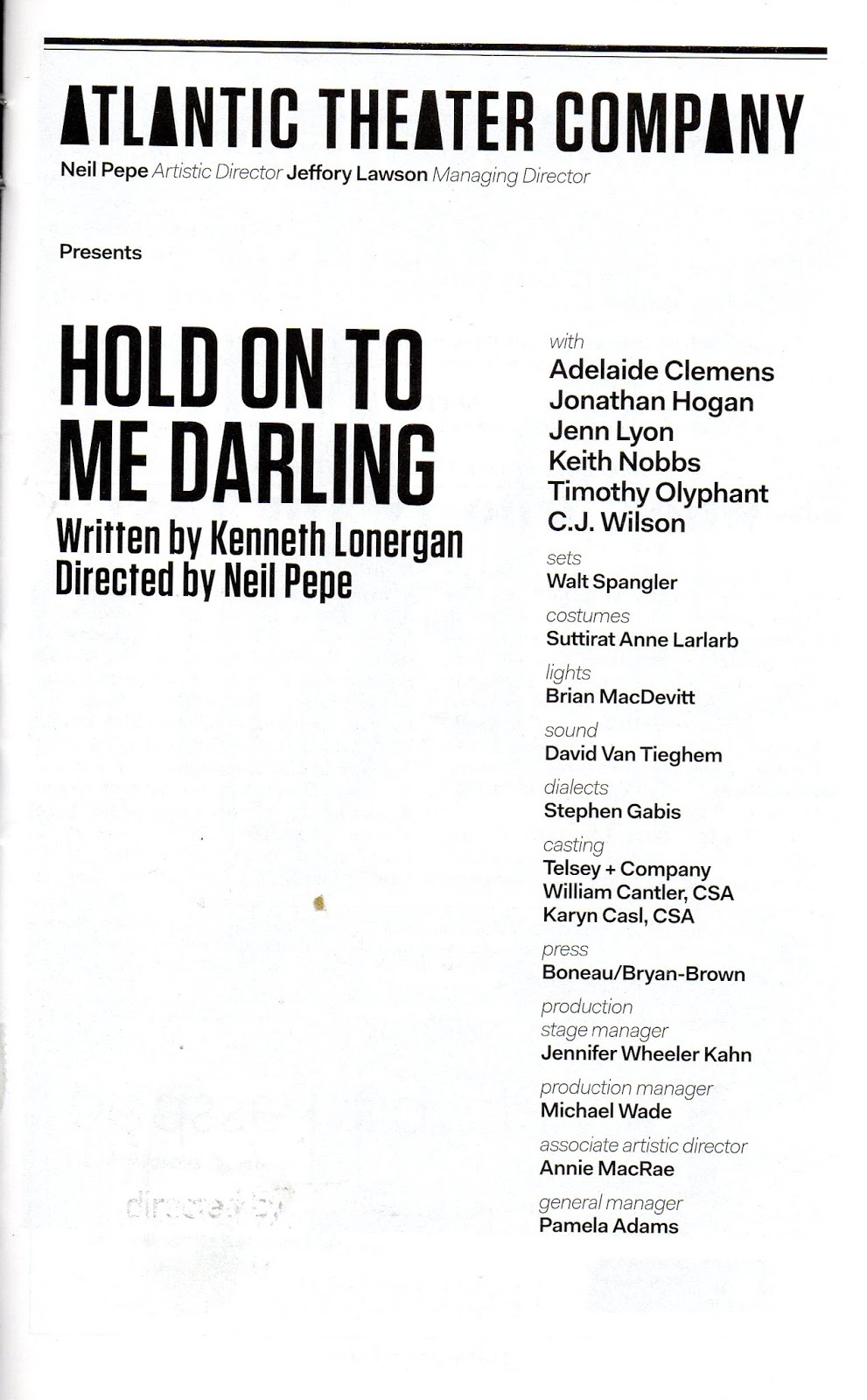
167. Review: HOLD ON TO ME DARLING (seen March 12, 2016)

“Hold On to This One, Darlings”


The premise of Kenneth Lonergan’s (THIS IS OUR YOUTH) hilarious, and occasionally moving, new play, HOLD ON TO ME DARLING, is simple, so let’s dispense with it right away. “Strings” Clarence McCrane (Timothy Olyphant) is a 39-year-old, vaguely Elvis-like, country western idol and movie superstar (“the 3rd biggest crossover star in the history of country music”) involved in a big budget movie set in outer space. His mama has just died and he’s so “tore up inside” he wants to move back home, give up his fame and riches, and become a good ole boy again selling feed in his hometown feed store. This premise, aiming to satirize the excesses of our celebrity culture, is embedded in one of the most raucously funny, perfectly acted, and delightfully staged works currently available on any Off-Broadway stage. It might be even better if Mr. Lonergan could trim it down a bit from its two-hour, 45-minute running time, but, under Neil Pepe’s priceless direction, it’s so rich in dialogue and character I can understand if others think it’s just as long as it has to be. 
Timothy Olyphant, Jenn Lyon. Photo: Doug Hamilton.
Strings believes his success has cost him his humanity and that all that people see in him is the glitzy shell of who he really is. Women, he claims, want only to brag to their friends about having spent the night with him, even texting about it while having sex. As he tells his sycophantic personal assistant, Jimmy (the deliciously obsequious Keith Nobbs), “How can they grab hold of a man who isn’t there? How can you touch somethin’ you can’t feel?,” words in which Jimmy immediately hears “a new song comin’ down the pike.” But Strings declares he’s finished with new songs; his mama’s passing has inspired him to abandon his career and to make it up to her for not having married, settled down, and raised a family like a normal person. He even puts in motion an attempt to find his dad, who ran off when Strings was eight.
Timothy Olyphant, C.J. Wilson. Photo: Doug Hamilton.
Strings hates the publicity and the prying into his private life; it's part of a national celebrity-worshiping sickness for which he holds himself partly responsible. His moralizing, however, doesn’t stop him from his inveterate womanizing as played out here in his relationships with two blond lovelies: Nancy (Jenn Lyon), the self-deprecating (“I was raised with dogs and chickens”) yet smoothly manipulative masseuse he hooks up with after she gives him the Ambassador Grand Classic massage in his Kansas City hotel room; and Essie, his sweetheart of a distant cousin who tries to resist him after they meet at mama’s funeral in the fictional mountain town of Beaumont, Tennessee. It’s here that Strings convinces his older half-brother, Duke (C.J. Wilson) to go into the feed store business with him, a decision that quickly incites a string of lawsuits that threaten to wipe out Strings’s many millions.  
Timothy Olyphant, C.J. Wilson. Photo: Doug Hamilton.
Using a revolving stage, designer Walt Spangler brilliantly brings one realistic set after another into view, from the hotel room, to C.J.’s paneled den (which he calls “an ashtray with furniture in it”) to the funeral parlor where mama lies in rest, to Essie’s chintzy living room, to the quaint feed store. Brian MacDevitt’s versatile lighting provides just the right ambience for each. While the characters we meet are memorably vivid and colorful, so are those we don’t meet, like Verner, the half-Swiss film director whose movie awaits Strings’s return; String’s late mother herself; and Ernie, the feed store owner.
Timothy Olyphant, Jenn Lyon. Photo: Doug Hamilton.
Lonergan’s dialogue has never been more richly humorous; it’s rooted deeply in whoever’s speaking it but constantly makes unexpected shifts that hit your laughter buttons and cause you to explode. Strings lives his life on impulse, making almost everything popping out of his mouth a surprise. He and Duke demonstrate their Southern fried creds with frequent exclamations of the “Jesus Christ in a downtown Memphis hair salon” variety, and Duke recites a litany of feed store products that might almost sound poetic if it didn’t make you laugh so hard. When Strings offers a compliment to Duke about his unseen wife, saying, “Now don’t fool yourself about that Ellie, old buddy. She is worth her weight in gold,” Duke retorts dryly, “Be quite a windfall if that was literally true.” And the bit about the “topless burka” Strings’s actress girlfriend wore in Afghanistan when feeding the hungry? Plenty more where it came from.
Adelaide Clemens, Timothy Olyphant. Photo: Doug Hamilton.
Thoroughly comedic as all this is, the play also has room for moments of feeling (most of them almost immediately blown up by a sidesplitting firecracker). And there’s a truly sentimental, anticlimactic final scene you may not be prepared for but in which veteran Jonathan Hogan, as the long-lost dad, gives such a subdued, heartfelt performance you wouldn’t have it any other way.
C.J. Wilson, Timothy Olyphant. Photo: Doug Hamilton.
Mr. Olyphant (TV’s “Deadwood,” “Justified”), back on Off Broadway after 20 years, couldn’t be better as the twangy, downhome, self-involved Strings (even getting to traipse around in his skivvies, showing off his ripped, slender frame). He has an arsenal of comic skills rarely seen in his serious TV characters. Thank heavens director Neil Pepe hired this charismatic star to play a charismatic star! Both Jenn Lyon and Australian actress Adelaide Clemens make what could be two-dimensional Southern cartoons into three-dimensional women, while C.J. Wilson’s scene-stealing Duke is a comic masterpiece of grumpy Dixie manhood.
C.J. Wilson, Keith Nobbs, Timothy Olyphant, Jenn Lyon. Photo: Doug Hamilton.
HOLD ON TO ME DARLING has a potentially serious theme, but I wouldn’t bother my head about it. I advise you to enter the Atlantic Theatre with only one thing in mind: you’re about to watch nearly three hours of some really funny people saying really funny things in a really funny way. Hold on to this, darlin’, and you’ll have a damn good time.
Jonathan Hogan, Timothy Olyphant. Photo: Doug Hamilton.

OTHER VIEWPOINTS:
https://atlantictheater.org/playevents/holdontomedarling/
Show-Score

HOLD ON TO ME DARLING
http://www.show-score.com/shows/hold-on-to-me-darling
Atlantic Theater Company
336 West Twentieth Street, NYC
Through April 3


166. Review: IDEATION (seen March 10, 2016)

"C.R.F.D.W.S." 

Stars range from 5-1.
According to one definition, “ideation” means “the formation of ideas or concepts.” In Aaron Loeb’s chillingly fascinating, bitingly clever, black comedy of that name, the ideas or concepts being formulated concern the creation of the means for a top-secret project involving—and here’s my sole spoiler alert— “collection,” “containment,” “liquidation,” and “disposal.” 
Carrie Paff, Mark Anderson Phillips, Jason Kapoor, Ben Euphrat, Michael Ray Wisely. Photo: Carol Rosegg.

An American corporate think tank of three top-flight civil and industrial engineers, each with his specialized expertise, has gathered in their company’s white conference room (capably designed by Bill English and lit by Gertjan Houben) with their manager and her new assistant; their mission—to put together, in 90 minutes (the length of the play), a presentation for their C.E.O., J.D., who appears, when necessary, via a vidcon screen we don’t see. 
Michael Ray Wisely, Jason Kapoor, Mark Anderson Phillips, Ben Euphrat. Photo: Carol Rosegg.
The engineers are the wiseacre Brock (Mark Anderson Phillips); the grounded Texan, Ted (Michael Ray Wisely); and the India-born PhD, Sandeep (Jason Kapoor). Their manager is a beautiful married woman, Hannah (Carrie Paff), who’s having a thing with Sandeep; her supercilious young assistant is Scooter (Ben Euphrat), hired because his father’s on the board.
Jason Kapoor, Carrie Paff. Photo: Carol Rosegg. 
The ideation process is to have no digital record, with all notes transcribed only on paper and on the large whiteboard attached to the upstage wall. The whiteboard practically becomes a character as countless diagrams and outlines are rapidly scribbled (and erased) on it. A snarky, self-satisfied, even jokey air surrounds the team as it begins its ideation session on the plan, which—despite what seem its unspeakable implications—is being carried out because everyone’s been told it has the humanitarian purpose of saving the world.
Carrie Paff, Mark Anderson Phillips, Michael Ray Wisely. Photo: Carol Rosegg.
As we watch the team dispassionately argue in technobabble over the logistical problems, the potentially horrific consequences of what they’re planning grip our hearts until, finally, one of them—a bit belatedly, one might think—begins to question the project’s morality. Soon, when the project comes under suspicion, the team members, using every ounce of their considerable ability to rationalize outcomes, always via whiteboard diagrams, begin frantically to suspect not only those masterminding the enterprise but each other as well. Every possible hint at collusion or espionage is examined; as their paranoia spirals out of control, they fret not only over the project’s ethics but whether it even exists.
Carrie Paff, Mark Anderson Phillips. Photo: Carol Rosegg.
Although it’s been called a psychological thriller, Mr. Loeb’s play leans more toward being a frequently funny and decidedly edgy satire of global corporate power, the self-interested rationalization of ethical dilemmas, the paranoia leading to conspiracy theories, and the impossibility of knowing who to trust and how much (from friends to colleagues to lovers to bosses to the government). Director Josh Costello has coached each of his expert actors to portray believable, intelligent, cocky, sarcastic, yet, in the end, highly vulnerable characters; this is the same troupe that introduced the play under Mr. Costello’s direction at the San Francisco Playhouse in 2013, and their timing and byplay couldn’t be better.  
Michael Ray Wisely, Carrie Paff, Mark Anderson Phillips, Ben Euphrat. Photo: Carol Rosegg.
IDEATION creaks a bit here and there, as with the Sandeep-Hannah affair, but, on the whole, is a fast-paced, original, suspenseful, and intellectually satisfying yet consistently accessible contribution. By the way, if you've read this far, the acronym heading this review means: "Crazy Rich Fuckers Do Weird Shit."
Carrie Paff, Michael Ray Wisely, Mark Anderson Phillips. Photo: Carol Rosegg.


OTHER VIEWPOINTS:
Show-Score

IDEATION
59E59 Theaters/Theater A
59 East Fifty-Ninth Street, NYC
Through April 17


Sunday, March 13, 2016

165. Review: WIDOWERS' HOUSES (seen March 12, 2016)

"I'm Not Evil. I'm a Landlord"

Stars range from 5-1.
George Bernard Shaw’s first play, WIDOWERS’ HOUSES (on which William Archer collaborated before dropping out) is being given a rare—and happily welcome—revival by TACT (The Actors Company) under Shaw specialist David Staller’s spirited direction. Written in 1885, published in 1888, and first produced (two performances at a private theatre) in 1892, it was initially derided for favoring polemics over dramaturgy. Shaw, a Socialist, saw the play as a way to advance his political ambitions, saying he had written it “to induce people to vote on the Progressive side at the next County Council election in London.” 


The volume he published it in contained two other plays, all lumped by him under the title of Unpleasant Plays because of the dark social issues they sought to address (he later published a volume of Pleasant Plays). In performance, WIDOWERS’ HOUSES, for all its unpleasant concerns, proves to be a pleasant work of theatre; Shavians should be warned that Mr. Staller (of the Gingold Theatrical Group, which co-produced) has taken considerable liberties in editing the dialogue--cutting, revising, and even adding. This is surely meant to make the play briefer and more accessible although Shaw--notoriously rigid about having his plays toyed with--would have done to Mr. Staller much worse than what the ingenue does to her maid in the play.
Jeremy Beck, Jonathan Hadley. Photo: Marielle Solan.
Jeremy Beck, Talene Monahon. Photo: Marielle Solan.
Jeremy Beck, Jonathan Hadley. Photo: Marielle Solan.
The unpleasant theme is slum landlordism, a problem as topical today as it was when the play was written. Amazingly, the day after I saw it the New York Times published an op-ed by the modern equivalent of a slum landlord under the title “I’m Not Evil. I’m a Landlord,” defending his practice in terms that might have been composed by Sartorius, the fabulously wealthy landlord in WIDOWERS’ HOUSES. Shaw, for all his anger, gives his non-villainous “villain” considerable opportunity to rationalize why he screws whatever money he can out of his indigent tenants. The poor are ruthlessly demonized by the money-rotted parvenu, whose snobbishness (and that of his daughter) holds those beneath him in contempt.
Jeremy Beck, Jonathan Hadley, Terry Layman, Talene Monahon. Photo: Marielle Solan.
WIDOWERS’ HOUSES is in three acts (played as two in this two-hour production). In the first, young Dr. Harry Trench (Jeremy Beck), earnest and straightforward, is vacationing in Germany at a hotel at Remagen on the Rhine with his pompous friend, William De Burgh Cokane (Jonathan Hadley), given to spouting phrases in mutilated French. Harry encounters the pretty young thing, Blanche Sartorius (Talene Monahon), touring Europe with her beloved father, Sartorius (Terry Layman); the couple fall in love and become engaged.
Jeremy Beck, John Plumpis. Photo: Marielle Solan.
In act two, set in the Sartorius family’s London home, the slumlord fires his lowly rent collector, Lickcheese (John Plumpis), despite the latter’s dedicated service, for being too soft on the tenants. This leads the abject Lickcheese to beg Harry to intercede on his behalf; he then reveals to Harry and Cokane the harsh nature of Sartorius’s business practices. Harry, disgusted at what he’s learned of how his future father-in-law earns his wealth, insists to Blanche that they will live on his meager 700 pounds a year and not take anything from her father, who wants them to share his riches. The spoiled, petulant Blanche revolts and the couple split up. Harry is set back even further when Sartorius reveals that Harry’s entire income derives from interest earned on mortgaged property owned by Sartorius. He’s shocked to discover that he, too, is a slum landlord, and could not survive without this dirty money.
Jeremy Beck, Talene Monahon. Photo: Marielle Solan.
The third act resolves all problems when Lickcheese returns, having become a smartly dressed rich man and works out a shady business deal with both Sartorius and the disillusioned Harry, who will now be able to marry Blanche. After we’ve seen her display callousness, selfishness, and even physical cruelty toward her maid, Annie (Hanna Cheek), we may seriously doubt the wisdom of this match.
Hanna Cheek, Talene Monahon. Photo: Marielle Solan.
A dark shadow hovers over WIDOWERS’ HOUSES, and, despite its being classed as one of Shaw’s “romantic comedies,” the laughs are subsumed by Shaw’s anger at the social conditions he attacks. But there are many surprises in the way Shaw subverts traditional 19th-century romantic comedies, such as his emphasis on the buying of social position; Blanche’s forthright, erotically charged behavior; her lack of sympathy for the downtrodden; Harry’s moral ambiguity; and the pervasiveness of hypocrisy.  However, there’s considerable energy and sprightliness in Mr. Staller’s adaptation, enough to maintain the semblance of a comic spirit so that the nefarious aspects of the plot and characters retain their entertaining edge. The director’s choice of opening and closing the play with Harry spotlighted on a dark stage to emphasize his ethical dilemma clearly tells us there’s something troubling about the hero’s loss of innocence.
Terry Layman, Hanna Cheek, John Plumpis. Photo: Marielle Solan.
Brian Prather’s unit set of a white framework of pillars and arches serves equally as well for the hotel terrace of act one as for the interiors of acts two and three. However, the upstage curtained hanging showing what seems an architect’s rendering of a massive residence (or official building) remains unchanged through the play. It not only makes no sense for either scene but suggests that the budget was insufficient for a second curtain to reflect a change of scene. A neutral hanging would have been better.
Jeremy Beck, Talene Monahon, Jonathan Hadley, Terry Layman, John Plumpis, Hanna Cheek. Photo: Marielle Solan.
The slender, girlish Ms. Monahon fully embodies Blanche’s willful, defiant, tempestuous, and snooty personality, while Mr. Beck offers a believable panoply of responses to the circumstances affecting him. Mr. Layman is every inch the arrogant, self-satisfied landlord-father, Mr. Hadley is colorfully flamboyant as the parasitic Cokane, and Mr. Plumpis is truthfully obsequious as the beggarly Lickcheese and craftily reptilian when Lickcheese rises in the world. Everyone looks fine in Barbara A. Bell’s turn-of-the-20th-century costumes (the production is set in 1900), the lighting by Peter West is efficient, and Toby Jaguar Algya’s period sound design for the scene breaks (resembling silent movie piano music) adds to the atmosphere.
Jeremy Beck. Photo: Marielle Solan.
Compared to Shaw’s better-known works, WIDOWERS’ HOUSES receives few significant productions. This one, however, shows it’s not only pleasurable in its own right (with several characters who would appear in more polished versions in later plays) but that, in the 124 years since it premiered, its relevance has never vanished.  

OTHER VIEWPOINTS:

Beckett Theatre at Theatre Row
410 West Forty-Second Street, NYC
Through April 2