Friday, November 15, 2019

115 (2019-2020): Review: TINA: THE TINA TURNER MUSICAL (seen November 14, 2019)


"She Takes Us Higher"

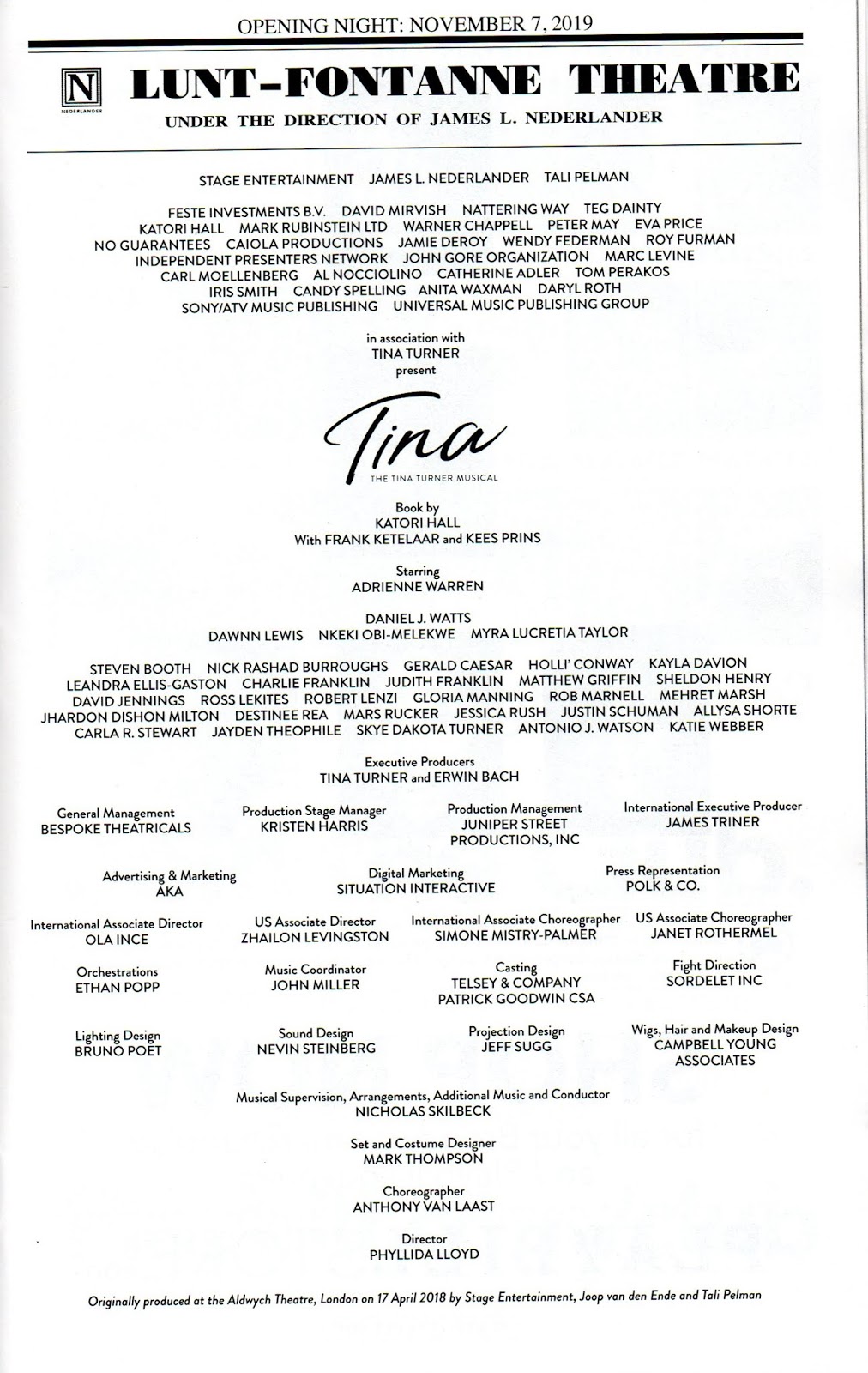

There were two starbursts last night at the Lunt-Fontanne Theatre, where Tina: The Tina Turner Musical recently opened. One was created following something that happened about 15 minutes into this rockingly entertaining jukebox musical, which first wowed audiences last year on London’s West End. 

Adrienne Warren. All photos: Manuel Harlan.
At that point, Mars Rucker, the live-wire playing Alline, Tina’s older sister, was leading Tina through a door to meet Alline’s friends. Suddenly, Rucker fell to the ground in pain, and everything stopped as the stage crew came on, headphones in place, to help out.  

Was this part of the show? Did Rucker have an accident? The audience began buzzing in confusion. Having avoided reading any reviews before seeing the show, I quickly began looking through the digital copy of the script on my phone. Just as I found the spot where the show had stopped, the stage manager’s voice was heard, informing us that the show would be temporarily halted and inviting us to use the time to visit the concession stands or bathrooms. So, it was an accident. I later learned from a friend who’d spoken to an usher that it was caused when Rucker “banged into the door and tripped and fell and hurt her back.”
Adrienne Warren, Daniel J. Watts. 
It was a half hour before the show resumed. That's when the first starburst (as opposed to the black hole of the accident) exploded as one of the show’s “swings”—a remarkable feature of Broadway musical casts—Leandra Ellis-Gaston, stepped in to take over as Alline and other Rucker roles (as an “Ikette” and ensemble member). Within a minute or two, it was as if Ellis-Gaston was the original Alline, playing the role with precisely the same vibrant singing and dancing enthusiasm as the injured performer, and making not a single misstep for the rest of the evening.

Sometimes shows stop because of audience problems (see my review of Carousel), sometimes because of technical glitches, but it’s not uncommon for an actor to be the cause. A Facebook friend, responding to my “real time” description of the incident, tells me that, “On Wednesday, I was at Beetlejuice. During Act 2, the lead actress dropped to her knees, appeared to gag, and then ran offstage in the middle of a song. The curtain came down, with an announcement about a short delay—which ended up being almost 15 minutes.”
Adrienne Warren, Steven Booth. 
Rucker may have seen stars when they fell, and perhaps some audience members saw a star (even a shooting one) being born in Ellis-Gaston’s emergency performance. There’s no question, though, that there was a gigantic starburst when Adrienne Warren appeared in the title role. I'm not given to hyperbole, but Warren gives what can only be described as one the most indelible musical theatre performances I’ve seen in seven decades of theatregoing. Her post-curtain encore set is itself so blazingly bright you may need to watch it through sunglasses.

Tina, for most intents and purposes, is a standard biomusical, its book—by Katori Hall, with Frank Ketelaar and Kees Prins—telling the life story of a famous musical performer in an episodic series of vignettes in which songs from the artist’s repertoire have been inserted where their lyrics and spirit have an appropriate connection. In some cases, songs from the singer’s playbook are sung by others in the story. And, of course, the artist usually gets to sing their biggest hits in fabricated theatrical, concert, or other contexts, outside of their use as situational responses.

Highlights from Tina Turner’s life, already dramatized in the 1993 hit movie, What’s Love Got to Do With It?, starring Angela Bassett (has it really been 26 years?), are presented in broad strokes, telling (while taking the usual factual liberties) the familiar tale of a black girl from rural Nutbush, Tennessee, born Anna May Bullock, who rose from humble beginnings to become the singing partner (and later, wife) of popular singer and guitarist Ike Turner (Daniel J. Watts), leader of the Kings of Rhythm band. This launched her ascent to such enormous success that she was dubbed the Queen of Rock ‘n Roll.

However, as in most such rags to riches stories, there are also riches to rags setbacks. While drugs and alcohol, play a role (by Ike, not Tina), they are minor issues in a career marred by the philandering Ike’s physical and emotional abuse, by Jim Crow restrictions, by friction with a difficult mother (well-played by Dawnn Lewis), and by the usual conflicts with the business people—in this case, those in the record industry—who control artists’ careers.

The uplifting part comes when Tina turns it all around, giving Ike the kick in the balls he deserves, being brutally honest with her dying mother, restarting her stalled career so that the record producers come crawling to her rather than she to them, and, although raised a Baptist, her even finding spiritual peace in Buddhism (chanting Namu Myōho Renge Kyō). When romance, with a German marketing executive, Erwin Bach (David Jennings), blooms, you can’t help admiring Tina Turner not only as a remarkable entertainer but for what she did with her life.

Phyllida Lloyd’s rapid-paced direction is enhanced by the vivid choreography of Anthony Van Laast, much of it inspired by the flashy movements of backup singers. The multiple scenes move swiftly on Mark Thompson’s conventional set via units sent spinning on a turntable, sliding on and off, or rising and falling, as numerous projections—mainly of colorfully abstract images—designed by Jeff Sugg cover the rear wall. Bruno Poet provides the brilliant lighting pizazz required, especially in the big production numbers. And the costumes, by set designer Thompson, capture not only the look of the changing time periods, but perfectly replicate the unique Tina Turner performance look.

But let me cut to the chase: Tina’s book is by-the-numbers show biz melodrama, sometimes clumsily obvious, but consistently entertaining none the less. It’s filled with outstanding performances, with noteworthy contributions by all the supporting players, most memorably Skye Dakota Turner, the hugely gifted, powerfully voiced, sweet-faced 10-year-old who plays Tina as a child.
Adrienne Warren and company.
But the overwhelmingly most persuasive reason to see Tina: The Tina Turner Musical is Adrienne Warren. Her role is so demanding that it’s taken on Wednesday and Saturday matinees by Nkeki Obi-Melekwe, who, I’m sure, gives a terrific performance. Absent my seeing her, I can only comment on the indescribably glowing performance of Warren, who is clearly destined for a Tony nomination. 
Adrienne Warren and company. 
Wikipedia says that “a star shines due to thermonuclear fusion of hydrogen into helium in its core, releasing energy that traverses the star’s interior and then radiates into outer space.” If any those words could be applied to a stage performer, first in line would be Adrienne Warren. She fuses the helium of beauty, physical fitness, dancing talent, acting ability, and personal appeal with the hydrogen of a voice every bit as awesomely powerful and expressive as that of the Queen herself to produce enough energy to light up not only the Lunt-Fontanne but the Great White Way itself, should the power ever go out. 

When she sings such house-rockers as “I Want to Take You Higher,” “Proud Mary,” “Private Dancer,” “River Deep—Mountain High,” “What’s Love Got to Do With It,” and others, especially when dressed in classic, sequined, fringed, Turner minidress, and that iconic Turner mane of golden hair, you can bet that her star power traverses her interior and radiates into outer space.

Lunt-Fontanne Theatre
205 W. 46th St., NYC
Open run


Thursday, November 14, 2019

Wednesday, November 13, 2019

113 (2019-2020): Review: THE BLACK HISTORY MUSEUM . . . ACCORDING TO THE UNITED STATES OF AMERICA (seen November 12, 2019)


"To Be Black in America"


America’s dirty history of enslavement has been a subject of much dramatic interest lately, what with the big-screen dramas of 12 Years a Slave, Django Unchained, and Harriet, as well as such theatrical efforts as Brandon Jacobs-Jenkin’s An Octoroon (updated from a pre-Civil war play), Underground Railroad Game, Behind the Sheet, Amazing Grace, and Slave Play
Kareem M. Lucas. Photo: Paula Court.
None, however, has so thoroughly explored the historical conditions of that horrific institution in its American embodiment (slavery elsewhere has figured in other works) as an unusual new immersive theatre experience called The Black History Museum . . . According to the United States of America, at Soho’s HERE Art Center.
Toni Ann DeNoble and Landon Woodson. Photo: Paula Court.
Part lecture/diatribe, part satirical sketch comedy (in the raw, parodistic vein of George C. Wolfe’s The Colored Museum), part art installation, and part history lesson, this work for the Smoke and Mirrors Collaborative was conceived by Zoey Martinson, co-written by Martinson, Kareem M. Lucas, and Jonathan Braylock, with additional writing by Robert King and Shenovia  Large. King and Lucas also perform in the excellent nine-member ensemble, most of whom play multiple roles.
Telly Fowler. Photo: Maria Baranova.
In keeping with the work’s title, HERE has been transformed, top to bottom, and in almost every nook and cranny, into a museum, not simply of slavery but of the entire history of black struggle, strife, and success in America. In the vein of similar works, the small audience (of 30 or so), stands through much of the experience, moving from site to site within the building. Now and then, a limited number of visitors has a brief opportunity to rest its weary butts on something or other.
Tabatha Gayle, Marcia Berry, and Langston Darby. Photo: Paula Court.
The work begins in the lobby, where you’re invited to check (meaning simply hang on a rack) your coat and anything else you don’t want to lug around, as recorded voices are heard talking about what the speakers understand blackness to mean. The lobby walls are filled with artfully arranged words on racial issues, with frame-like windows in which will be seen the faces of the founding fathers as portrayed by several of the actors, their faces half in whiteface, with half-black, half-white wigs. 
Eury German, Latra Wilson (front), Telly Fowler, Taylor Boyland. Photo: Paula Court.
A Guide (Robert King), introducing himself as Jasper Sasparilla, “a magical mulatto,” appears, dressed in a red, conductor-like cap and jacket, to guide us, over the next two hours, through a maze of rooms, hallways, and spaces, each inch of which is covered with instructional materials and artifacts. We see videos of black history, including artistic performance; typewritten letters (with headphones on which they can be heard being read) documenting 19th and early 20th centuries relationships; a barber shop; and a tiny room memorializing hair braiding, with hair samples lining the walls. 
Love letters. Photo: Maria Baranova.
There also are peepholes, through which we view things like record labels advertising famous musicians; beautiful puppets of famous old-time band leaders, with a spotlight on the sole black one, Cab Calloway; a staircase lined with puffs of cotton, accompanied by information on slave labor and the cotton industry; images celebrating Barack Obama and his family; a closet dedicated to civil rights leader, and closeted homosexual, Bayard Rustin; an array of MAGA hats with a “Made in China” sign; and so on.
Toni Ann DeNoble, Langston Darby, Landon Woodson, Tabatha Gayle, Marcia Berry. Photo: Maria Baranova.
The audience also witnesses provocative, caricaturish sketches, one about the Founding Fathers (Ben Franklin, Thomas Jefferson, John Adams, John Hancock, Richard Henry Lee) discussing the “all men are created equal” phrasing in the Constitution; another in which the audience participates in a TV game show on black history; and one in which cartoonish versions of Presidents Reagan, Clinton, Bush, Sr., Bush, Jr., and Trump reveal their racist leanings. Other moments include placing the entire audience inside and out of a crudely constructed pen, watching the abuse of captives aboard a slave ship.
Mural by Brandan “B-mike” Odums. Photo: Maria Baranova.
There is no intermission, per se, but there is nearly a half hour in the middle when the audience is given the freedom to roam the crowded exhibition area on its own.  
Hair braiding. Photo: Maria Baranova.
Taken as a unified experience, the exhibit and performances, which incorporate call and response segments (Black Lives Matter! Black Lives Matter!, etc.), dancing, music, gospel-like preaching, and soaring, sometimes angry, speechifying (in the gifted hands of Kareem Lucas as someone called the Descendant), are profoundly informative and emotionally disturbing. Although there may simply be too much to absorb in so brief a time, the packaging is theatrically entertaining and well-produced.
Obama and Trump Land. Photo: Maria Baranova.
So cutting is the condemnation of our nation’s racial oppression (gays and immigrants get some attention as well) that it’s impossible to dismiss the aggressively defiant rhetoric spit out toward the end by the fast-talking Descendant, dressed in gold-tinted, leather jacket and flat-brimmed baseball cap:

America is a lie
A fantasy
A wish
A hope
An idea
A thought
A clever story
A dream Built upon the foundation of genocide and enslavement.
Kareem M. Lucas (center), Latra Wilson, Telly Fowler, Taylor Boyland, Eury German. Photo: Paula Court.

HERE Arts Center
145 Sixth Avenue
Through November 24


Monday, November 11, 2019

111 (2019-2020): Review: THE LIGHTNING THIEF: THE PERCY JACKSON MUSICAL (seen November 10, 2019)

"Mashed Monsters"


For my review of The Lightning Thief: The Percy Jackson Musical please click on THEATER PIZZAZZ.


Guest Review 18 (2019-2020): NOW SERVING

“A Dinner Party in Poor Taste” ** 

By Elyse Orecchio (guest reviewer) 

The only thing worse than participating in immersive theatre is watching it (imagine viewing Sleep No More from the bleachers).  At Radiohole’s immersive dinner party Now Serving, at The Collapsable [sic] Hole, audience members who are not eating a four-course meal at the table watch, for half-price, from a seat in the “peanut gallery”—and basically miss everything. 
Photos courtesy of Now Serving.
I say “four-course meal” loosely. If you choose to buy a ticket at the table, you should be prepared to be a good sport about your bread course being a ball of Wonder bread (which, you’re told, is made from vagina yeast), your salad course being lettuce whooshed in front of you with a leaf blower, and your main course being served from a giant papier mâché frog head after the man wearing it has been decapitated.
  
Having sat in the gallery, I’m not equipped to adequately share the true dinner party experience. Without having experienced food hurled at me, the taste of the red soup from the conveyor belt, or being able to identify the meat from afar, the true takeaways (takeouts?) from Now Serving were lost on me. What I saw were avant-garde performers Amanda Bender, Erin Douglass, Eric Dyer, and Maggie Hoffman drinking wine out of IV bags and tossing their food about, leaving the dining room looking like Times Square at 12:05 a.m. on January 1st. 
In the show’s promotional materials, pastry chef Kristin Worrall is touted for providing the dessert, but, sadly, I cannot tell you what it was or how it tasted. Reviewers normally get the full experience at shows of this nature. Now Serving, however, had bare cupboards for this one.

Not that your gallery ticket gets you nothing. For just $25, the drinks are unlimited before the show begins (so get there early, kids!), and there’s beer, popcorn, and even vegan hot dogs available as you watch the dinner party. That actually makes for a pretty cheap night out in New York City, and Now Serving will, if nothing else, make for a conversation piece after you leave.  
But to truly create a novel, satisfying experience for everyone, Radiohole would be wise to cut the gallery seating and perhaps charge more for a ticket at the table. While there are moments of amusement and some lovely violin accompaniment, courtesy of Katherine McRae, substance is not on the menu. 

I suppose the show is supposed to be about taking down the patriarchy (as evidenced by the murder of Pepe The Frog) and the show’s opening and closing with a vagina reference. But there’s not much of a script and it’s difficult to make sense of the sparse dialogue. What’s promised as a guide to etiquette is little more than a guide to spectacle.

The Collapsible Hole
155 Bank St., NYC
Through Nov 16

Elyse Orecchio studied musical theatre at Emerson College, acting at CUNY Brooklyn College, and English Linguistics & Rhetoric at CUNY Hunter College. She has worked in nonprofit communications for more than a decade. She lives in Sunnyside, Queens, with her husband Joe, kids Theo and Melody, and three cats. eorecchio@gmail.com @elyseorecchio


Sunday, November 10, 2019