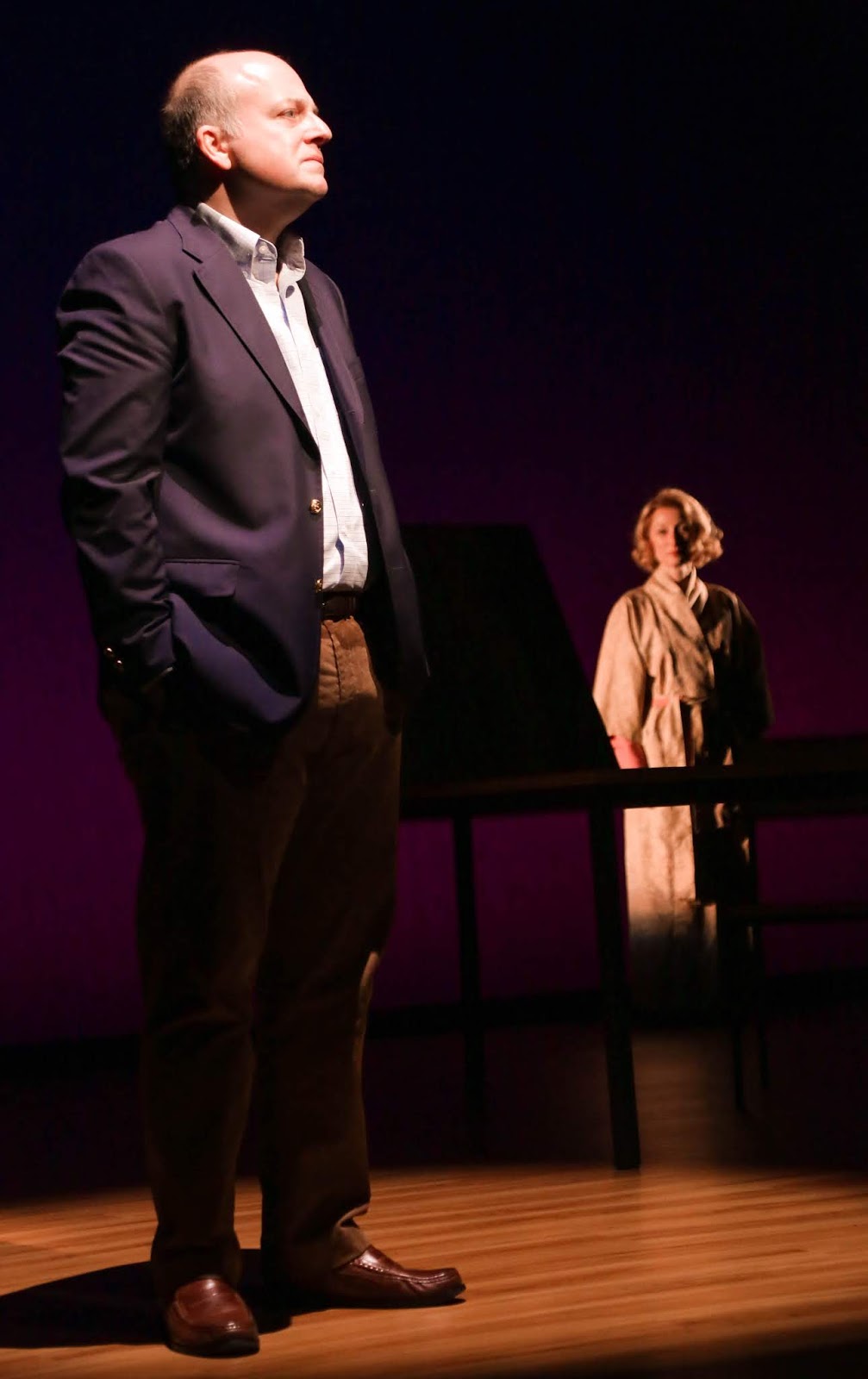
Showing posts sorted by date for query the thanksgiving play. Sort by relevance Show all posts

Sunday, May 2, 2021

548. TWIGS. From my (unpublished) ENCYCLOPEDIA OF THE NEW YORK STAGE, 1970-1975


Sada Thompson. 
TWIGS [Comedy-Drama/One-Acts/Women] A: Paul Furth; D: Michael Bennett; S: Peter Larkin; C: Sara Brook; L: David F. Segal; P: Frederick Brisson i/a/w Plum Productions, Inc.; T: Broadhurst Theatre; 11/14/71-7/23/72 (289)

“Emily” [Romance]; “Celia” [Marriage]; “Dorothy” [Marriage]; “Ma” [Marriage/Old Age]

A. Larry Haines, Sada Thompson.

A program of four one-acts that served well as a vehicle for character actress Sada Thompson, who played each one’s eponymous character, comprising three sisters and their mother. She changed her costume (designed by my talented college classmate, Sara Brook), makeup, and wig for each. The plays take place in different urban kitchens on the day before Thanksgiving. 

Robert Donley, Sada Thompson.

Ranging in style from the semi-serious to the farcical, Twigs begins with “Emily,” about a widow who is attracted to the head of the moving company (Nicholas Coster) that has just moved her into her new home. She makes a date with him for Thanksgiving dinner.

Then comes “Celia,” about her sister, who is unsuccessful at getting into the swing of her selfish husband’s (Simon Oakland) macho conversation with an old army buddy (Conrad Bain).

“Celia” is followed by “Dorothy,” in which the third sister and her spouse (A. Larry Hines) overcome her superstitious fears of celebrating their 25th anniversary.

Sada Thompson, Nicholas Coster.

Finally, there is “Ma,” about the matriarchal virago who wants to marry her common-law husband (Robert Donley) before she dies.

Twigs’s title is based on poet Alexander Pope’s line, “Just as the twig is bent, the tree’s inclined.” By our viewing, in the last scene, the mother of the three daughters, we are—as per Pope’s remark—expected to understand all that came before. The playwright, in fact, does not make it clear in the first three scenes that the women are even related.

Most critics felt the play was thin stuff with an occasional funny remark, more effective as an acting vehicle than a contribution to dramatic literature. The four women were thought neither sufficiently developed nor different enough to consider their characterizations especially noteworthy, but Sada Thompson’s performance was nonetheless a season highlight. Clive Barnes termed the play “rickety,” unoriginal, and worthy of little attention outside of Thompson’s presence. John Simon wrote that the playlets “of such abject triviality, such forced and simplistic humor, such clumsily apparent joining, that I felt I was watching a workshop play.”

Critical support, though, came from Walter Kerr, for whom these were “four, funny and touching and freshly conceived pieces,” and from Brendan Gill, who felt great “admiration” for this “often very funny and no less often touching” comedy.

Simon may have found Thompson’s work “second-rate,” but his colleagues raved. Barnes declared that Twigs revealed her “remarkable” talent. “She is confident and assertive and etches in each of her subtly different characters with bold, deft strokes. She also exhibits that special sympathy for life, that expansiveness, that not only makes stars but also makes audience idols.”

Accordingly, Thompson won the Tony for Best Actress, Play, the Drama Desk Award for Outstanding Performance, and Variety’s Poll for Female Lead.

Readers of this blog who may be interested in my Theatre's Leiter Side review collections (one with a memoir), covering almost every show of 2012-2014, will find them at Amazon.com by clicking here. 

Next up: Two by Two


Wednesday, March 11, 2020

181 (2019-2020): Review: GIRL FROM THE NORTH COUNTRY (seen March 10, 2020)


"May His Songs Always Be Sung"

There’s so much vigorous handshaking, hugging, kissing, and other forms of human contact in Girl from the North Country, the often thrilling Bob Dylan-scored musical now at Broadway’s Belasco Theatre, one can only imagine a backstage area filled with hand sanitizers, soap and water, disinfectants, and other forms of antiviral precautionary items. Sorrowfully, despite the multiple raves the show has garnered—give or take a few nitpicks, like my own, below—it seemed last night that the current health crisis is having an impact. Near me, at the rear of the orchestra, were a number of notably empty seats. 
Caitlin Houlahan, Colton Ryan. All photos: Matt Murphy.
At this point no one knows just how potent an impact the coronavirus epidemic will have on New York theatregoing but I can vouch for the fact that each of the last four shows I’ve seen—all at prime venues—has been far from full, despite good reviews or buzz. I myself, being of advanced age, am going to be cutting back on my theatregoing. As someone who tries to cover as many shows as possible—I’ve reviewed approximately 180 thus far this season—this is a difficult decision, but, unless the health crisis is quickly ameliorated, I suspect more and more like me will be doing the same. Some Broadway shows already have slashed ticket prices in order to make up for the loss in sales.
Colton Ryan, Kimber Elayne Sprawl, Mare Winningham, Jay O. Sanders.
If, however, you intend to keep going to the theatre but want to be especially selective, you won’t go wrong by choosing Girl from the North Country. I reviewed it here in October 2018, when it played at the Public, and have adapted that review below to reflect cast changes, alter a sentence here and there, and add a comment or two to what I previously wrote.
Jay O. Sanders.
The many fans of the wonderful Irish playwright Conor McPherson (The Weir, The Night Alive) will no doubt be excited to see a new play by him but music lovers will be even more excited at its incorporation of many classic songs by Minnesota troubadour Bob Dylan. I wish I could say both of these brilliant talents come off equally as well.
Jeannette Bayardelle and company.
What makes Girl from the North Country—now at the Belasco, following its Off-Broadway stay at the Public, itself coming after a hit premiere at London’s Old Vic and a West End transfer—so special, however, is the showcase it provides for one magnificent cover after another of Dylan’s oeuvre. This is thanks largely to the extraordinary orchestrations and arrangements of Simon Hale (with contributions from McPherson himself) and the singing of an exceptional cast.
Mare Winningham, Kimber Elayne Sprawl.
Even if, like me, you find McPherson’s play—set during the Depression in a boarding house in Dylan’s home town of Duluth, Minnesota, in November and December 1934—less than stellar, you’ll probably agree that it serves aptly as a dramatic context into which Dylan’s songs fit beautifully. And that’s regardless of the fact that he was born seven years after the fictional events depicted. Girl from the North Country, named, of course, after a Dylan classic, is so musically agreeable that I’m forced to put my caveats about its dramaturgy aside and recommend it with a five-star rating, whether you’re a Dylan fan or not.
Luba Mason.
“Blowin’ in the Wind,” one of the troubadour’s best-known songs, is not among the 20 sung or played during the show, but “Idiot Wind” is, and the dialogue makes frequent references to the metaphor of the wind’s blowing during the hardscrabble days faced by all the troubled characters. Everything transpires in the confines of Nick (the outstanding Jay O. Sanders, replacing Stephen Bogardus) and Elizabeth Laine’s (Mare Winningham, better than ever) “guesthouse,” most of it taking place around preparations for and consumption of Thanksgiving dinner.
Mare Winningham, Jay O. Sanders.
Nick is deeply in debt and Elizabeth has early onset dementia, which doesn’t stop the otherwise decent Nick from carrying on with Mrs. Neilsen (Jeannette Bayardelle, in great voice), a widow waiting for the money her railroad employee husband left her to clear probate. The Laines’ 20-year-old son, Gene (Colton Ryan, superior), is a jobless, alcoholic, would-be writer.
Robert Joy.
In one of the plot elements most difficult to swallow, the Laines’ 19-year-old daughter, Marianne (Kimber Elayne Sprawl, wonderful), is black, abandoned by her parents as an infant and raised by the bighearted Laines. Marianne’s problem is she’s five months pregnant by a Lake Superior boatman who’s sailed off into the Minnesota sunset.
Matt McGrath, Mare Winningham, Todd Almond.
Guests at the house are, in addition to Mrs. Neilsen, the down-and-out Mr. and Mrs. Burke (Marc Kudisch and Luba Mason, each terrific), and their tall, mentally challenged, 30-year-old son, Elias (Todd Almond, excellent). The Burkes are later joined in the middle of the night by a good-looking, black boxer, Joe Scott (Austin Scott, replacing Sydney James Harcourt, very good but looking more like a dancer than a pugilist), and a nasty bible salesman called Reverend Marlowe (Matt McGrath, perfectly seedy in the role earlier played by David Pittu). Each trails unpleasant secrets.
Austin Scott, Kimber Elayne Sprawl.
Filling out the cast of principals are three more characters. One is Dr. Walker (Robert Joy, living up to his name), the substance-abusing local doctor, who also occasionally serves as the Our Town-like narrator, speaking into a standing mic to provide expository background and, at the end, a (posthumous) summary of what happened to the people we’ve met. Then there’s the thickly bearded Mr. Perry (Tom Nelis, spot on), an elderly “shoe mender,” who offers money to make the reluctant Marianne his live-in companion (marriage to her being illegal). Finally, we have Kate Draper (Caitlin Houlahan, sweetly satisfying), the pretty girl who leaves Gene to marry someone more stable.
Tom Nelis.
This assemblage is further amplified by a gifted four-member, racially mixed, backup-singing and dancing ensemble (Matthew Frederick Harris, John Schiappa, Rachel Stern, and Chelsea Lee Williams) who represent friends and neighbors. The show’s fluid conventions allow moments when the ensemble members get brief solos, just as the principals often drop their characters to become part of the ensemble’s choral numbers. They may even play musical instruments, as when both Kudisch and Mason demonstrate their drumming skills.
Mare Winningham.
McPherson’s multiple plot strands follow each character, introducing elements of financial loss, substance abuse, abandonment, loneliness, marital stress, sexual longing, adultery, romantic heartbreak, fisticuffs, blackmail, gunfire, and death. McPherson’s skill at creating
colorful characters with tangy dialogue keeps us engaged, even when the situations border on melodramatic contrivance. And some things simply don’t ring true, like having all these 1930s Midwesterners drop so many f-bombs, or an intrusive moment of magic realism when Marianne describes the encounter that led to her pregnancy. 
Marc Kudisch.
Then there’s the racial issue. Given the play’s own emphasis on race-based biases in 1920s and 1930s Duluth (Dr. Walker cites a notorious 1920 lynching), the idea of a black child being raised by white parents while barely raising local eyebrows seems a stretch. Even the entry of the black Joe Scott into the household, and his casual reaction to Marianne’s presence, doesn’t feel right. This air of unreality is further underlined by casting a black actress as Mrs. Nielsen, Nick’s lover, without a single comment about their miscegenation within an otherwise racially charged script.

Elizabeth is as likely to be not only lucid and articulate in one moment as she is in the next to be mentally distracted. Despite Winningham's winning performance, this often makes it confusing as to just how bad her condition is. It’s also a bit much to see Nick, inches from his wife, not only speaking candidly about her to Mrs. Nielsen but openly discussing their affair as if Elizabeth weren’t there. These are just a few of the problems that make McPherson’s script less than it might be.

The playwright’s staging, aided significantly by Lucy Hind’s movement direction, mingles heightened theatricality with Depression-era realism. Sometimes it evokes the feeling of painters like Thomas Hart Benton. However, because of the show’s position between a straight play and a musical, not everyone can avoid overacting to achieve it.

Rae Smith’s open scene design—movable walls, background vistas, and furniture—allows for the omnipresent company to move things about in the semidarkness. Smith’s period costumes are especially on the mark, and little could be done to improve the deftly imaginative lighting of Mark Henderson. Simon Baker’s sound design makes everything easy to listen to.

Some have questioned whether Girl from the North Country is or isn’t a jukebox musical. Of course, it is, given that the script is designed to allow the insertion of multiple, preexisting, songs. There are many kinds of jukebox musicals. This one is the type that fits the songs of a particular performer or writer into a new story, such as Broadway’s Head over Heels, with its Go-Gos’ score used for a plot set in the Middle Ages.
Company of Girl from the North Country.
One of the things that makes Girl from the North Country different is that Dylan’s lyrics often have little to do with the moments they illustrate, or do so only tangentially. Even the title song has nothing to do with the play, at least not directly. When a song is to be sung, the characters don’t do so within a particular dramatic context but, instead, step up to a mic and sing it for the audience. More significant than the songs’ meaning-based specificity is their emotional value, which comes across in the impact made by both their words and music, especially as performed here, where every number sounds freshly minted.
Todd Almond and company.
A CD is available of the London production but I’m looking forward to the Broadway recording, so I can again listen to Jeannette Bayerdelle sing “Went to See the Gypsy,” Kimber Elayne Sprawl perform “Tight Connection to My Heart,” Todd Almond warble “Duquesne Whistle,” and, among so many other gems, Mare Winningham (known mainly as a dramatic actress) do wonders for “Like a Rolling Stone” and, with the company, set your heart racing with “Forever Young.”

To paraphrase a lyric in that last one, may Bob Dylan's songs always be sung. 

Belasco Theatre
111 W. 44th St., NYC
Open run


Sunday, January 20, 2019

151 (2018-2019): Review: ABOUT ALICE (seen January 18, 2019)


“Just Dumb Luck”

Calvin Trillin, the well-known humorist whose writing has been long associated with The New Yorker, was married to a wonderful woman named Alice Stewart Trillin (1938-2001), about whom he often wrote, including a memoir called About Alice. That memoir is the basis for a sweet and touching, if not particularly memorable, two-person play of the same name now at the Polonsky Shakespeare Center, where Leonard Foglia has directed it for Theatre for a New Audience. 
Jeffrey Bean, Carrie Paff. Photo: Gerri Goodstein.
The two characters are Trillin himself, played by Jeffrey Bean (The Thanksgiving Play), and, of course, Alice (Carrie Paff, Ideation). About Alice consists of Trillin recounting his 35 years of marriage to this beautiful—outside and in—woman, described in the program notes as “a remarkable educator, author, film producer, activist and longtime muse of her husband, Calvin Trillin, whom she married in 1965.”
Jeffrey Bean. Photo: Gerri Goodstein.
About Alice memorializes Alice’s too-brief life, which might have been briefer had she (a nonsmoker) succumbed earlier to the lung cancer with which she was stricken in 1976. Trillin projects her as a near perfect person, whose professional talents were accompanied by a wit that made her, in Trillin’s twist on the expected reference, George Burns to his Gracie Allen. He insists that for someone like him to marry someone like her was “just dumb luck.”
Jeffrey Bean, Carrie Paff. Photo: Gerri Goodstein,
His account recalls their meeting at a party, their mutually Jewish origins (her mother, both his parents), their lives together as man and wife, their accomplished, socially aware daughters, Alice’s career achievements, and, most significantly, her 25-year-battle with the on- again, off-again scourge of cancer, about which experiences she wrote extensively. Ironically, when she died, it was not from cancer itself but from the cumulative effects of the radiation she’d received over the years.
Jeffrey Bean, Carrie Paff. Photo: Gerri Goodstein.
It’s a familiar version of the kind of story we’ve practically become inured to after years of movies and TV scripts describing noble, exceptional people fighting fatal illness but never losing hope, being brave even when staring death straight in the eye. And while it’s hard not to keep your own eyes from tearing up at such courageous fortitude, especially if you’ve witnessed a loved one’s suffering (as who hasn’t?), that alone shouldn’t be why we praise the latest dramatization of such a struggle. After all, it’s also likely that your cheeks get wet when you watch a commercial for the Shriners Hospital, with its adorable handicapped children, or an ASPCA ad showing one pitiable canine after the other. 
Carrie Paff, Jeffrey Bean. Photo: Henry Grossman.
About Alice has the form of a one-man play into which Alice—wearing a series of flattering outfits designed by David C. Woolard—continues to intrude, occasionally in dialogue but more often in direct address. Riccardo Hernandez’s thrust set is a simple arrangement of polished wooden platforming, lit effectively by Russell H. Champs, with an upstage screen for Elaine J. McCarthy’s surprisingly limited projections.
Jeffrey Bean, Carrie Paff. Photo: Henry Grossman.
The general tone, though, is more that of a memorized recitation than words spoken spontaneously. For all Bean’s appealing charm, his words have a literary, not a natural cadence. Paff is more successful at sounding in the moment but she too can’t always shake the sense that she’s performing a text meant for reading, not speaking.
Carrie Paff, Jeffrey Bean. Photo: Henry Grossman.
And with that text written by Calvin Trillin, we expect not just conventional hagiography, but a comically illuminating take on the familiar dilemma of caring for a loved one living beneath an ever-threatening sword of Damocles. There are certainly laughs here but they’re neither frequent nor loud enough to ward off the inevitable sorrow that’s bound to govern. 
Carrie Paff, Jeffrey Bean. Photo: Henry Grossman.
At one point, Trillin, explaining that Alice would often critique his work, offers the following tongue-in-cheek exchange:

ALICE Is this meant to be funny?
CALVIN Well, maybe mildly amusing.
ALICE (As if turning over that idea in her head) Mildly amusing . . .
CALVIN (Looking a bit concerned) How about wry? I’m often described as wry. I’ve decided that wry means almost funny. But that’s fine, if you think it might be wry. Wry is fine. I’d settle for wry.
ALICE (Again considering) Wry . . .
CALVIN Well, what did you think?
ALICE (With a straight face) I think this is very funny.
CALVIN You do? ALICE Yes, I do. One of the funniest things you’ve ever written. (Suddenly smiling) Gotcha!

About Alice, though, isn’t one of the funniest things Trillin has ever written. Nor, given its subject matter, should it be. But where its humor is concerned, Alice’s original assessments are pretty close to the mark. 
Carrie Paff, Jeffrey Bean. Photo: Henry Grossman.

OTHER VIEWPOINTS:
Polonsky Shakespeare Center/Theatre for a New Audience
262 Ashland Place, Brooklyn, NY
Through February 3


Monday, December 31, 2018

Best and Worst of New York Theatre: 2018


"It Was the Best of Years"
 "It Was the Worst of Years"

I reviewed around 220 shows this year, distributed among four sites, Theatre’s Leiter Side , The Broadway Blog, edited by Matthew Wexler; Theater Pizzazz, edited by Sandi Durell (with great assistance from J.P. Clarke), and Theater Life, edited by Barry Gordin and Patrick Christiano. My lists of the year's best and worst are given below.

Many of the shows listed here have nothing to do with the 2018-2019 season, which began in May and ended in April. A number already won awards as part of the 2017-2018 season. They represent only shows I covered between January 1 and December 31, 2018.

Each show I review is given at least three grades, some getting as many as four. First there’s the thumbs-up or -down system where Samoji, as we’ll call him, offers two thumbs up for shows in the 85-100 range, one thumb up for the 70-84 range, two thumbs neither up nor down for the 50-69 range, one thumb down for the 30-49 range, and two thumbs down for anything below that. Through the goodness of his heart, Samoji gave only two shows (Molasses in January and A Walk with Mr. Heifetz) a two thumbs-down rating in 2018.

If you look closely at Samoji’s shirt, you’ll see he also rates shows by a star system, ranging from one for the worst and five for the best. Thus, two thumbs up gets ***** while two thumbs down gets *.

With one or two exceptions, all shows are also given a numerical grade when the review appears on Show-Score.com, where most online reviews are excerpted and numerically graded to provide a composite score, similar to what Rotten Tomatoes does for movies.

Finally, Theater Life has its own star system for which I provide another star grade.

The Best of 2018 lists that follows are based on my two thumbs-up reviews. The Worst of 2018 lists are based on all shows getting either one or two thumbs-down. I’ve added the numerical grades I gave the shows on Show-Score.com and used those figures to organize the lists from highest to lowest. The total number of shows graded 90 or above comes to 13. If I were forced to pick the ten best of those, they’d be (based on some after-the-fact reconsideration):

(in alphabetical order)
Hangmen
Hershey Felder as Irving Berlin
Mlima’s Tale
My Fair Lady
Separate and Equal
The Cher Show
The Ferryman
The True
Three Tall Women
Travesties

The lists are organized as follows: New Plays; New Musicals; Revivals of Plays; Revivals of Musicals.

Some of these may surprise by their variance from other reviewers’ choices best or worst of the year choices, but that’s what all this is about.

Best of 2018
New Plays
The Ferryman 95
Mlima’s Tale 90
The Damned 90
Hangmen 90
The True 90
The Emperor 90
Separate and Equal 90
Feeding the Dragon 85
Admissions 85
Babette’s Feast 85
Balls 85
The Low Road 85
The Metromaniacs 85
My Life on a Diet 85
The Originalist 85
Mary Page Marlowe 85
Teenage Dick 85
Mike Birbiglia: The New One 85
What the Constitution Means to Me 85
The Thanksgiving Play 85
The Waverly Gallery 85
New Musicals
Hershey Felder as Irving Berlin 90
The Cher Show 90
Girl from the North Country 85
Inner Voices 85
Revivals of Plays
Travesties 95
Three Tall Women 90
The Seafarer 85
Our Lady of 121st Street 85
Hindle Wakes 85
Lobby Hero 85
On Beckett: Exploring the Works of Samuel Beckett 85
Revivals of Musicals
My Fair Lady 90
Fiddler on the Roof 85
Smokey Joe’s Café 85

Worst of 2018
New Plays
The Amateurs 45
The Stone Witch 45
A Walk with Mr. Heifetz 45
Against the Hillside 45
Cardinal 45
Good for Otto 45
Education 45
Amy and the Orphans 45
The Hollower 45
The Gentleman Caller 45
Days to Come 45
Kurt Vonnegut’s Mother Night 45
Hitler’s Tasters 45
Hurricane Party 45
The Property 40
The Undertaking 40
Molasses in January 20
New Musicals
Escape to Margaritaville 45
This Ain’t No Disco 45
R.R.R.E.D.: A Secret Musical 45
Comfort Women 40


Monday, November 5, 2018

114 (2018-2019): Review: THE THANKSGIVING PLAY (seen October 31, 2018)


"No Turkey, Please, We're Pilgrims”

At this very moment in 2018, there are many schools across the US where children are preparing projects, including plays, depicting the traditional story of Thanksgiving. That story, of course, would feature pilgrims (historically, Separatists) and Indians (now American Indians, Native Americans, First Nations, or simply indigenous peoples) in 1621, feasting together in peace—probably on an historically inaccurate turkey and stuffing—to celebrate a bountiful harvest following a year of devastating hardship. 

In The Thanksgiving Play, an endearingly funny, considerably educational, satirical farce by Larissa FastHorse, who identifies as an indigenous person, we get a drumstick-in-cheek lesson about just how problematic that story is. Originally produced at the Artists Repertory Theatre, Portland, OR, it’s now at Playwrights Horizons. 
Margot Seibert, Jennifer Bareilles, Greg Keller, Jeffrey Bean. Photo: Joan Marcus.
In a program note, FastHorse describes the familiar account of the early interactions of white settlers and indigenous peoples as a lie: “That which was recorded and reproduced was usually an intentional choice to support governmental policies of manifest destiny and genocide to make America larger, wealthier, and great.”
Margot Seibert, Jeffrey Bean. Photo: Joan Marcus.

This is serious stuff, capable of inspiring reams of historical, political, anthropological, and ethnographic discourse. However, FastHorse pulls off the remarkable feat of expressing her dismay at the distortions by ridiculing them mercilessly while simultaneously making hilarious fun of political correctness. Plays by Native Americans are rarities on the New York stage. Hopefully, The Thanksgiving Play will open the door for others.
Margot Seibert, Jennifer Bareilles. Photo: Joan Marcus.
The setting is a conventional classroom (precisely designed by Wilson Chin and lit by Isabella Byrd); in it are four theatre artists—a director and three actors—joined to create a politically correct play about Thanksgiving. The frantically optimistic director, Logan (Jennifer Bareilles), is a high school drama teacher who’s received a grant with which she wants to produce a 45-minute work of “devised theatre,” in other words, one created improvisationally in collaboration with her cast. 
Margot Seibert. Photo: Joan Marcus.
The actors, all white (and all so comically perfect I won’t say anything further about them), are her slacker boyfriend, Jaxton (Greg Keller, Belleville), a second-rate street performer, yoga practitioner, and obsessive PC advocate; Caden (Jeffrey Bean), a middle-aged elementary school teacher and aspiring playwright, who uses picture books to teach the others about Thanksgiving; and Alicia (Margo Seibert, Rocky), a gorgeous actress whose guileless simplicity appealingly combines talent, ego, and ignorance. 

Alicia was hired mainly because Logan, whose grant depends on her hiring a Native American, saw a headshot depicting her in indigenous guise and assumed that was her ethnicity. When Logan, despairing, learns of her mistake, Alicia responds: “Whatever, it's theater.  We don't need actual Native Americans to tell a Native American story.  I mean, none of us are actual Pilgrims are we?”
Jennifer Bareilles, Greg Keller. Photo: Joan Marcus.
Alicia’s heritage and colorblind casting in general thus join the many PC-related topics with which FastHorse stuffs her theatrical bird. Among these are veganism, yoga, feminine hotness, the commodification of sex, gender sensitivity, coded language, historical inaccuracy, public school prayers, meditation, female empowerment, white privilege, racial labels, and post-racialism.

Laughs are also generated at the expense of street theatre, improvisation, acting as a career, and rehearsal practices. Much of the humor stems from the characters’ well-meaning but comedically oversensitive tiptoeing around saying or doing anything inappropriate.
Jennifer Bareilles, Margot Seibert. Photo: Joan Marcus.
At several points, the cast drops character to don Tilly Grimes’s costumes in clever interludes representing variant Thanksgiving scenarios. The prologue, for example, begins with the actors lined up as three pilgrims and a turkey, singing, to the tune of “On the Twelve Days of Christmas” about the nine days of Thanksgiving. Another employs body puppets (also by Grimes) attached to the actors, whose own faces remain exposed, and in yet another the actors assume rebellious hip-hop attitudes.
Greg Keller, Jeffrey Bean. Photo: Joan Marcus.
Logan eventually has a brainstorm about the best way to dramatize Thanksgiving, one I’ll leave for you to discover. However—given how hard it is tell the story without offending someone—it couldn’t be more pointedly elegant.
Jennifer Bareilles, Greg Keller, Jeffrey Bean. Photo: Joan Marcus.
Director Moritz von Stuelpnagel (Bernhardt/Hamlet) pulls these bits off just as effectively as he does the play’s fast-paced comedy, straight-faced cluelessness, and farcical mayhem, including football played—Ugh! (in more ways than one)—with a pair of bloody heads. 
Greg Keller, Jennifer Bareilles. Photo: Joan Marcus.
One comes away from The Thanksgiving Play feeling it’s impossible to dramatize controversial historical events in a way that will satisfy everyone. And why, for example, is the story of Thanksgiving automatically better because told by a Native American, even if it uses facts hitherto unexpressed? How much of a story’s power is lost if equity takes precedence over drama? And is even-handedness actually possible? That’s why Logan’s seemingly outlandish solution—sardonic as it may be—is so thoughtful.
Greg Keller, Jennifer Bareilles, Jeffrey Bean, Margot Seibert. Photo: Joan Marcus.
In the real world, theatregoers will be thankful for Larissa FastHorse’s having exploded and explored the Thanksgiving story through satire both broad and subtle. The Thanksgiving Play deserves some thanksgiving of its own.

OTHER VIEWPOINTS:

Playwrights Horizons/Peter J. Sharp Theatre
416 W. 42nd St., NYC
Through November 25